Welcome to a side of India that history textbooks love, but mainstream holiday brochures often overlook. When most people map out a vacation, they look for predictable leisure hubs. But if you are a traveler who craves deep roots, architectural marvels, and stories that shaped empires, it is time to pivot your compass toward Bihar.
Far from the usual tourist traps, this region holds the blueprint of ancient global civilization. Today, we are diving into a comprehensive Bihar travel guide focusing on one of its crown jewels: Vaishali.
Whether you are mapping out your first Bihar trip planning journey, coordinating a meaningful family outing, traveling solo as a backpacker, or looking for a quiet weekend getaway, this ancient soil has something timeless to offer. Let’s explore how you can experience Vaishali in a practical, friendly, and deeply enriching way.
Why Bihar is a Must-Visit Heritage Destination
For decades, Bihar has quietly guarded some of the most critical turning points in human history. This is the land where prince Siddhartha sat under a Bodhi tree and rose as the Buddha. It is where Mahavira was born, and where the world’s earliest democratic institutions took form.
When you look beyond the surface, a North Bihar travel guide or a journey into South Bihar reveals a landscape layered with peace, profound archaeology, and magnificent rural beauty. From the sprawling ruins of Nalanda to the peaceful shores of Vaishali’s ancient tanks, a vacation here isn’t just about sightseeing—it is about walking through the cradle of spiritual enlightenment and ancient politics.
The Ultimate Vaishali Heritage Guide
Vaishali is not just another dot on the map; it is widely recognized by historians as the home of the world’s very first democratic republic, flourishing under the Vajji and Lichchhavi clans around the 6th century BCE. It is uniquely revered as the birthplace of Lord Mahavira and the sacred ground where Gautam Buddha delivered his final sermon.
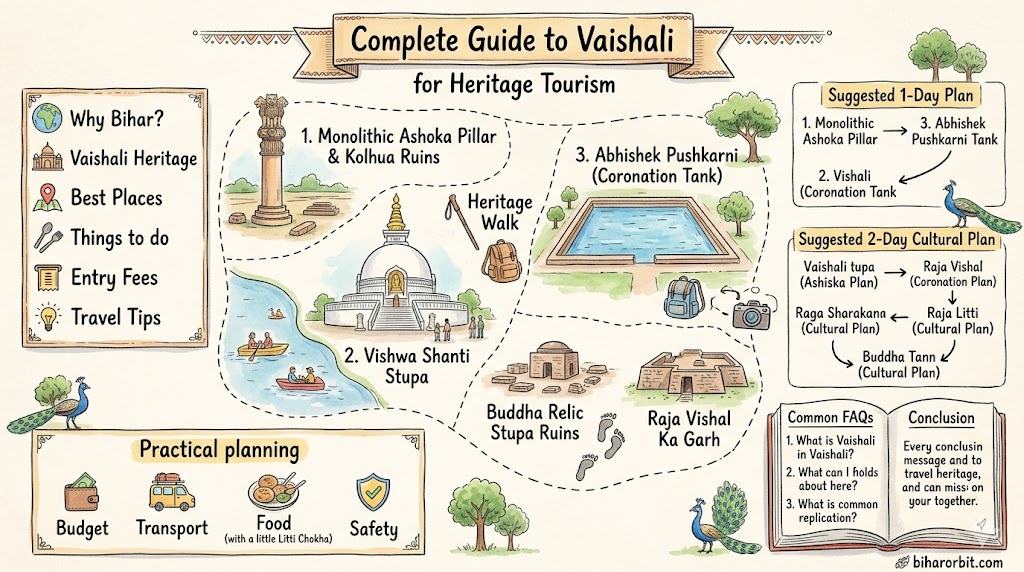
- Best places to visit: The monolithic Ashoka Pillar at Kolhua, the serene Vishwa Shanti Stupa, the Abhishek Pushkarni (Coronation Tank), Raja Vishal ka Garh, and the Buddha Relic Stupa ruins.
- Things to do: Walk through centuries-old brick monastic complexes, enjoy peaceful boating on the lake next to the Peace Pagoda, photograph flawless Mauryan architecture, and explore ancient stone caskets at the local Archaeological Museum.
- Entry fees: Most open-air archaeological sites like the Ashoka Pillar complex charge a nominal fee of ₹15 to ₹25 for Indian citizens and around ₹300 for foreign tourists.
- Travel tips: Wear comfortable, slip-off walking shoes since you will be entering active and historical religious zones. Carry an umbrella or a wide-brimmed hat; the archaeological parks are expansive with minimal tree shade over the ruins.
- Nearby attractions: Patna (the capital city, located roughly 60 km away), the bustling ruins of ancient Nalanda University, and the historic town of Rajgir are easily reachable within a few hours.
- Food options: Enjoy authentic, soul-satisfying Bihari cuisine. Don’t miss Litti Chokha (roasted wheat balls stuffed with spiced gram flour, slathered in ghee, and served with mashed vegetables), hot Malpúas, and refreshing local Sattu drinks.
- Budget planning: Vaishali is incredibly pocket-friendly. A budget traveler can easily manage food, local e-rickshaw transport, and entry tickets for under ₹500 to ₹800 per day. Mid-range hotels are available in nearby Hajipur or Patna.
- Safety tips: Vaishali is a peaceful, small semi-rural heritage town. Standard travel safety applies: stay around well-lit monument areas, avoid wandering deep into isolated rural tracks after dusk, and rely on registered transport.
- Local transport options: E-rickshaws (locally called Tuk-Tuks) and auto-rickshaws are the most efficient, eco-friendly ways to hop between monuments. For total flexibility, hire a private cab from Patna or Hajipur for the day.
- Family-friendly suggestions: The beautifully manicured lawns around the Vishwa Shanti Stupa and the interactive galleries of the Archaeological Museum make it a brilliant, educational, and easy-going trip for children and grandparents alike.
- Couple-friendly suggestions: Take a quiet, late-afternoon boat ride on the peaceful pond adjacent to the World Peace Pagoda while the sun sets behind the white dome.
- Hidden or less-crowded options: Visit the Bawan Pokhar Temple or the ruins of Buddha Stupa II early in the morning to experience the profound silence of these ancient sites before the tour buses arrive.
Best Places & Experiences in Vaishali
To help you get the most out of your Bihar tourist places itinerary, let us break down the absolute highlights of Vaishali that you cannot afford to miss.
1. The Monolithic Ashoka Pillar & Kolhua Ruins
- Location: Kolhua Complex, roughly 5 km from the central Vaishali area.
- Why it is worth visiting: This is one of the few Ashokan pillars left in the world that remains perfectly intact, topped by a magnificent, life-sized seated lion carved out of a single block of highly polished Chunar sandstone. It stands beautifully next to the ancient Ananda Stupa and a brick monastic pond.
- Best things to do: Marvel at the mirror-like polish of the 2,300-year-old Mauryan stone cutting, sit quietly by the ancient Ramkund tank, and explore the brick foundations of the Kutagarshala Vihara where Buddha stayed during his rainy season retreats.
- Best time to visit: Early morning (6:00 AM to 9:00 AM) to catch the soft golden sunlight reflecting off the ancient sandstone.
- Ideal for whom: History buffs, solo backpackers, photographers, and family travelers looking for deep historical insights.
- Travel tip: Hire a local ASI-certified guide at the gate. The structural layout of the brick monasteries makes infinitely more sense when someone points out where the ancient kitchens, cells, and prayer halls used to be.
2. Vishwa Shanti Stupa (World Peace Pagoda)
- Location: Situated near the Coronation Tank and Vaishali Museum.
- Why it is worth visiting: Soaring 38 meters into the sky, this massive, gleaming white dome is one of the several peace pagodas built globally by the Japanese Buddhist sect Nipponzan-Myohoji. It enshrines sacred Buddhist relics and exudes an undeniable aura of absolute stillness.
- Best things to do: Walk the circular path around the dome to view the stunning golden statues depicting the different life stages of the Buddha, sit on the lawns for meditation, and enjoy a paddleboat ride on the surrounding lake.
- Best time to visit: Late afternoon (3:30 PM to 5:30 PM) when the temperature drops and the white marble catches the sunset hues.
- Ideal for whom: Peace seekers, couples looking for a serene walk, and families.
- Travel tip: Maintain quiet inside the core complex out of respect for the monks meditating or chanting nearby.
3. Abhishek Pushkarni (The Coronation Tank)
- Location: Central Vaishali, adjacent to the Buddha Relic Stupa ruins.
- Why it is worth visiting: This is the historic body of water whose waters were considered so sacred that all newly elected representatives of the old Lichchhavi republic had to be anointed here before taking their oath of office.
- Best things to do: Walk along the stone ghats, appreciate the ancient engineering of water conservation, and view the adjacent ruins where the original casket containing the corporeal relics of the Buddha was excavated.
- Best time to visit: Morning or late evening.
- Ideal for whom: Heritage enthusiasts and travelers interested in the origin of democratic governance.
- Travel tip: Combine this visit with the nearby Archeological Museum to see the actual artifacts discovered around this water tank.
Travel Planning Tips for Bihar
A great trip relies on smart preparation. Keep these practical Bihar vacation tips in mind to ensure your journey runs smoothly:
- Book stays early during peak season: The ideal weather window runs from October to March. Heritage spots fill up quickly with global pilgrims during these cooler months, so secure your accommodation well in advance.
- Hire local transport with clear terms: If you are booking local autos, e-rickshaws, or private cabs for the day, agree on a fixed price before sitting inside to avoid any awkward negotiations later.
- Respect historical and sacred rules: Many sites are revered shrines. Dress modestly (covering shoulders and knees), and always remove your shoes wherever indicated.
- Carry cash for local markets: While digital payments are expanding rapidly across India, small village vendors, e-rickshaw drivers, and rural food stalls in Vaishali still heavily prefer hard cash.
- Keep hydrated during your explorations: Walking around unshaded brick complexes can drain your energy. Always keep a reusable water bottle handy.
- Respect local culture and environment: Keep these precious heritage zones clean. Dispose of plastics, snack wrappers, and bottles only in designated dustbins.
Common Mistakes to Avoid
- Rushing through on a rushed day trip: Trying to cram Patna, Vaishali, and Nalanda into a single day will leave you exhausted and unable to absorb anything. Give Vaishali its own dedicated time.
- Sticking only to urban spaces: Bihar’s true magic lies in its historic countryside. Don’t spend all your time inside modern hotel rooms; step out into the mango orchards and historic trails.
- Overpaying for local rentals: Always cross-verify standard transport rates with locals or your hotel desk before hiring an independent vehicle for long distances.
- Skipping the regional cuisine: Relying solely on standard multi-cuisine hotel food means missing out on the true culinary heart of the state. Give local dhabas and fresh Litti Chokha points a fair chance!
Suggested Bihar Itinerary Angle
Wondering how to seamlessly blend Vaishali into your broader Bihar itinerary plans? Here is how you can map it out depending on your schedule:
1-Day Focused Plan
- Morning: Arrive early from Patna. Start your day at the Kolhua complex to see the Ashoka Pillar and monastic ruins before the sun gets too warm.
- Afternoon: Grab a traditional lunch, then visit the Archaeological Museum and the Coronation Tank.
- Evening: Spend a calm, reflective evening at the Vishwa Shanti Stupa, catch the sunset, and head back to Patna or Hajipur.
2-Day Cultural Immersive Plan
- Day 1: Explore Vaishali’s core heritage circuit—Ashoka Pillar, Peace Pagoda, Buddha Relic Stupa, and Raja Vishal Ka Garh. Stay overnight locally or in nearby Hajipur.
- Day 2: Dive into the local arts. Head toward the outskirts to witness traditional Madhubani paintings or Sujni embroidery being made by local artisans, and explore the beautiful Ramchaura Temple.
Weekend Travel Plan
- Saturday: Start from Patna, drive down to Vaishali, and spend the day exploring the democratic and Buddhist roots of the ancient city.
- Sunday: Wrap up any missed spots in Vaishali in the morning, then head toward Rajgir or ancient Nalanda to experience the absolute zenith of ancient Indian education and rock-cut heritage.
Frequently Asked Questions (FAQs)
1. What is the historical significance of Vaishali?
Vaishali is renowned as the world’s first democratic republic, governed by an elected assembly of representatives in the 6th century BCE. It is also deeply holy as the birthplace of Lord Mahavira and a key site where Lord Buddha preached frequently.
2. How far is Vaishali from Patna, and how can I get there?
It is approximately 60 km away from Patna. You can easily drive down via the Mahatma Gandhi Setu or take a regular state transport bus, a private taxi, or catch a train to the nearest major railhead at Hajipur.
3. What is the best season to explore Vaishali?
The cooler months from October to March offer beautiful, breezy, and pleasant weather that is perfect for walking around outdoor archaeological ruins.
4. Are there entry fees for the monuments in Vaishali?
Yes, major ASI-protected locations like the Kolhua Ashoka Pillar complex require a small entry fee (around ₹15 to ₹25 for domestic tourists), while children generally enter for free.
5. Can I visit Vaishali with my family and elderly relatives?
Absolutely. The locations feature flat, easy-to-walk pathways and beautiful green parks, making it incredibly family-friendly and accessible for senior citizens.
6. What are the must-try local dishes when traveling here?
You should definitely try authentic Litti Chokha, Sattu Paratha, Anarsa, and local traditional sweets like Khurma or Malpua from local sweet shops.
7. Is it safe for solo female travelers and backpackers?
Yes, it is generally very safe. The local people are remarkably helpful and hospitable. Just ensure you complete your historical sightseeing during daylight hours and return to your stay by late evening.
8. What should I buy as a souvenir from this region?
Look for stunning, handmade Madhubani paintings, intricate Sujni embroidery garments, and local stone-carved replicas of the Ashoka Pillar made by local village craftsmen.
9. Are there good accommodation options in Vaishali?
Vaishali offers clean, basic tourist bungalows and budget guest houses. For luxury or mid-range business hotels, most travelers choose to stay in nearby Hajipur or the capital city of Patna.
10. How much time do I need to see Vaishali properly?
A dedicated day trip of 6 to 8 hours is usually sufficient to comfortably explore all the major historical monuments, museums, and parks without rushing.
Conclusion
Stepping into Vaishali is like turning back the pages of time to a period when human thought, spiritual philosophy, and democratic values were breaking entirely new ground. By traveling mindfully, respecting the local monuments, and engaging with the local culture, you turn an ordinary holiday into a transformative journey.
