Introduction
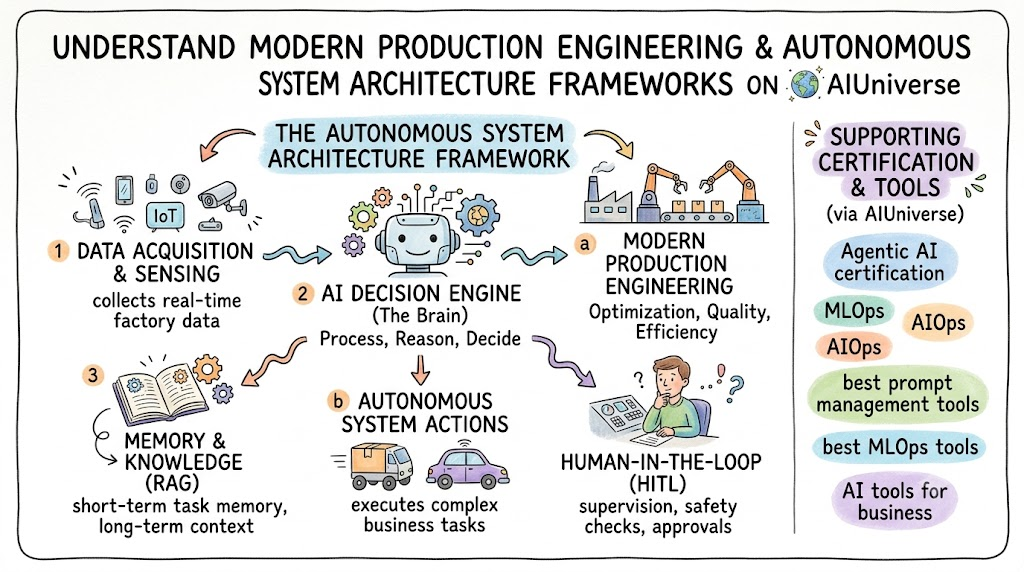
Artificial intelligence is rapidly shifting away from passive text-generating chatbots toward dynamic, goal-oriented systems. Modern applications can reason through multi-step logic, make autonomous decisions, and use digital tools to perform real work. Understanding these systems requires learning how planning, memory, and tool integration combine to execute complex workflows reliably. Studying an AIUniverse helps working professionals transition from basic prompt writing to designing production-ready automated systems. This detailed guide covers core architectural components, essential software skills, industry applications, operational monitoring, and risk management strategies. By reading through this resource, you will gain a practical blueprint for mastering autonomous agents, evaluating development tools, and advancing your technical career without falling for marketing hype.
What Is Agentic AI?
Agentic AI refers to software systems that act autonomously to achieve specified end goals using reasoning, dynamic planning, contextual memory, and external tools under proper human supervision. Instead of simply generating a single textual response to a static prompt, an AI agent breaks high-level directives into manageable sub-tasks, evaluates intermediate results, reflects on errors, and adjusts its approach until the goal is completed. For instance, if a business requests a competitive market analysis report, the agent autonomously retrieves web data, parses financial files, generates summary charts, checks output accuracy, and drafts a final document for human review.
How Agentic AI Differs from Traditional AI and Generative AI
Traditional rule-based automation follows strict, deterministic logic paths that fail when encountering unexpected input variations or system edge cases. Generative AI creates text, code, or images based on learned patterns but lacks the intrinsic ability to take external actions or verify facts independently. Conversational AI expands on generative models by maintaining dialogue history, yet it remains reactive to direct user prompts. Agentic AI combines generative reasoning with goal execution, tool usage, and self-reflection to achieve operational autonomy across dynamic environments.
| Technology Type | Main Capability | Level of Autonomy | Common Example |
| Traditional Automation | Executes rigid scripts | None (Deterministic) | Rule-based data entry |
| Generative AI | Creates original text and graphics | Low (Reactive) | Writing an essay draft |
| Conversational AI | Manages multi-turn dialogue | Low to Medium | Customer support bot |
| Agentic AI | Plans and completes multi-step tasks | High (Goal-driven) | Autonomous workflow agent |
Why Agentic AI Skills Matter for Working Professionals
Learning agentic concepts transforms standard workflows into efficient, automated pipelines across nearly every major technical and business domain. Software developers, DevOps specialists, and cloud engineers can automate code testing, environment provisioning, and deployment validation using intelligent agents. Data scientists and IT operations teams leverage agents for automated anomaly triage, dataset cleaning, and predictive infrastructure management. Furthermore, professionals in sales, finance, customer support, and project management use intelligent workflows to process lead lists, reconcile invoice discrepancies, answer complex customer queries, and update tracking systems without manual intervention.
What Is an Agentic AI Certification Course?
An Agentic AI certification course provides structured, step-by-step education focused on designing, deploying, securing, and maintaining autonomous intelligent systems. Quality programs combine expert video instruction with hands-on technical labs, practical architectural assignments, and production deployment evaluations. Learners build real projects that handle external API calls, vector database lookups, security controls, and multi-agent coordination. However, acquiring a digital credential alone is never enough to succeed; true professional mastery requires building verifiable portfolio projects that solve practical business challenges while adhering to enterprise safety standards.
Who Should Take an Agentic AI Certification Course?
- Working Professionals: Connect emerging agent capabilities directly with your industry domain to eliminate repetitive administrative tasks and boost daily productivity.
- AI Beginners: Build foundational knowledge step-by-step by moving systematically from core programming basics to advanced language model interactions.
- Developers and Engineers: Master complex API integrations, state management, vector databases, custom tool calling, and robust software deployment techniques.
- Managers and Business Leaders: Understand strategic use-case selection, ROI calculation, governance frameworks, risk mitigation, and team resource allocation.
- Enterprise Teams: Establish standardized design practices, common security protocols, and scalable automation patterns across cross-functional departments.
Skills Covered in an Agentic AI Certification Program
Artificial Intelligence Fundamentals
Mastering fundamental machine learning principles provides the necessary background for understanding how language models process context, evaluate probabilities, and make predictions.
Python Programming
Writing modular Python code enables developers to build custom agent tools, handle API connections, process structured JSON payloads, and implement robust error-handling mechanisms.
Large Language Model Fundamentals
Understanding token limits, context windows, vector embeddings, structured JSON outputs, and hallucination risks allows engineers to configure models effectively for production applications.
Prompt Engineering
Crafting structured system prompts with explicit role framing, behavioral constraints, context injection, and output formatting rules ensures predictable model responses across execution runs.
Prompt Management
Utilizing the best prompt management tools allows engineering teams to store, version, test, evaluate, collaborate on, and systematically track system prompts across complex production deployments.
API and Tool Integration
Connecting autonomous agents to REST APIs, SQL databases, customer relationship platforms, ticketing systems, and cloud infrastructure unlocks practical business utility.
Retrieval-Augmented Generation
Implementing RAG patterns using vector databases and text embeddings ensures agents retrieve fresh, accurate enterprise context before generating answers or executing actions.
Agent Memory
Designing effective short-term conversational buffers, long-term vector stores, task state histories, and user preference profiles helps agents maintain context over extended workflows.
Planning and Reasoning
Configuring structured reasoning frameworks enables agents to break down abstract business goals into logical steps, evaluate dynamic tool feedback, and correct execution errors autonomously.
Agent Evaluation
Evaluating agent accuracy, task completion speed, tool selection precision, execution latency, API costs, and human override rates ensures long-term operational quality.
Security and Governance
Implementing strict principle-of-least-privilege permissions, human-in-the-loop validation checkpoints, audit logging, and prompt injection defenses protects core corporate assets.
Agentic AI Learning Roadmap for Beginners
| Learning Stage | Main Topics | Practical Outcome |
| Stage 1: AI Fundamentals | Machine learning principles, neural networks, NLP basics | Solid theoretical understanding of modern AI |
| Stage 2: Python & APIs | Modular Python, REST endpoints, JSON parsing | Custom script that queries external endpoints |
| Stage 3: LLM Basics | Tokens, context windows, prompt formatting, RAG | Working question-answering terminal tool |
| Stage 4: Agent Architecture | Memory, goal planning, tool execution loops | Functional single-agent automation script |
| Stage 5: System Operations | MLOps pipelines, latency optimization, security, logging | Monitored production agent running safely |
Single-Agent and Multi-Agent Systems
Single-Agent Systems
Single-agent systems rely on one central language model loop to handle planning, memory retrieval, tool execution, and response validation. They are easy to design, debug, and monitor, making them the ideal starting point for developers building their first automation projects.
Multi-Agent Systems
Multi-agent architectures assign distinct, specialized roles to multiple independent agents that communicate, coordinate, and share state to complete complex tasks. For example, a software development workflow might feature a product manager agent writing specifications, a developer agent generating code, and a reviewer agent running unit tests. While highly capable, multi-agent networks add significant operational complexity, latency, and API costs, so developers should start with single-agent systems before scaling up.
Connection Between Agentic AI and MLOps
Deploying reliable AI agents requires robust machine learning operations principles to manage application lifecycles, monitor model drift, automate deployments, and track costs. Enrolling in an MLOps certification course equips engineers with the skills needed to build robust CI/CD deployment pipelines, implement automated unit testing, track prompt experiments, and manage seamless rollbacks when models fail. Selecting the best MLOps tools depends heavily on your team’s existing cloud architecture, security compliance demands, system scalability needs, budget limits, and technical integration requirements.
Connection Between Agentic AI and AIOps
Taking an AIOps certification course demonstrates how intelligent systems revolutionize IT infrastructure monitoring, automated log parsing, incident management, and performance optimization. An intelligent AIOps agent can detect an anomalous spike in server latency, correlate error logs across multiple microservices, isolate the root cause, and draft a remediation plan. Because production actions carry risk, automated system remediation must enforce strict permission limits, approval gates, logging, and instant rollback options.
Role of Federated Learning Platforms
Using modern federated learning platforms allows privacy-focused organizations to train shared machine learning models across decentralized edge devices without centralizing sensitive raw data. This distributed training approach offers massive data privacy benefits for highly regulated industries like healthcare, banking, and telecommunications. However, teams adopting federated systems must address underlying network communication latency, secure aggregation protocols, potential security vulnerabilities, variable data quality across nodes, and strict governance rules.
Practical Agentic AI Use Cases Across Industries
Customer Service
Agents parse customer tickets, query policy databases, and process simple refunds autonomously, though human representatives must approve complex dispute escalations to prevent financial errors.
Software Development
Agents automatically generate boilerplate code, identify syntax bugs, and draft documentation, but human developers must review pull requests to protect overall system architecture.
IT Operations
Agents monitor cloud resource utilization, reorganize database indexes, and flag network anomalies, while human administrators approve critical infrastructure changes to avoid unintended outages.
Sales and Marketing
Agents enrich inbound lead records, perform prospect research, and draft personalized email campaigns, though account managers must review output quality before sending high-value communications.
Finance and Accounting
Agents extract invoice details, cross-check receipts against purchase orders, and highlight audit discrepancies, but financial controllers must authorize final transaction payments.
Human Resources
Agents screen resume keywords, schedule interview slots, and answer basic benefit questions, while human managers conduct interviews to eliminate potential bias in hiring decisions.
Cybersecurity
Agents analyze firewall logs, flag suspicious login patterns, and isolate compromised endpoints, while security officers direct overall threat containment strategies.
Healthcare
Agents summarize patient visit histories and check drug interaction databases, yet licensed physicians must validate all recommendations to ensure complete patient safety.
Manufacturing
Agents monitor assembly line sensor telemetry and schedule preventive maintenance, but plant operators verify hardware adjustments to maintain physical safety standards.
Business Analytics
Agents query database warehouses, summarize trend anomalies, and format visual chart dashboards, while business executives retain final control over strategic business decisions.
Best AI Tools for Business Evaluation Guide
Choosing the best AI tools for business operations requires evaluating platforms through a structured, objective process rather than relying on promotional software claims. Organizations should always conduct controlled pilot projects using real business data before committing to expensive enterprise subscriptions.
| Evaluation Area | Questions Businesses Should Ask |
| Business Fit | Does this tool solve a specific operational bottleneck effectively? |
| Data Privacy | Is customer data encrypted and kept separate from public training sets? |
| Security | Does the platform support role-based access control and single sign-on? |
| Integration | Can the solution seamlessly connect with our existing software stack via APIs? |
| Scalability | Can the system handle higher transaction volumes without losing speed? |
| Cost Control | Are pricing tiers transparent regarding usage tokens and compute costs? |
Practical Agentic AI Project Ideas
Beginner Projects
Beginners should build focused projects such as a document question-answering assistant, a meeting notes summarizer, a personal task-planning script, or a basic company FAQ bot.
Intermediate Projects
Intermediate builders can design customer support ticket routing tools, sales lead qualification assistants, automated employee onboarding helpers, and IT incident triage log analyzers.
Advanced Projects
Advanced developers can tackle multi-agent software delivery systems, cloud deployment infrastructure management tools, enterprise knowledge retrieval networks, and supply chain monitoring platforms.
When showcasing projects, document the problem statement, system architecture, data flow, security boundaries, performance metrics, testing methods, cost analysis, and known limitations.
Common Challenges in Agentic AI Development
Hallucinated Information
Agents can invent incorrect facts, which developers can mitigate by connecting systems to authoritative vector databases using strict retrieval-augmented generation validation pipelines.
Incorrect Tool Usage
Agents occasionally pass bad parameters to external APIs, requiring engineers to define strict schema validation rules using typed output frameworks like Pydantic.
Prompt Injection
Malicious users attempt to overwrite system rules via untrusted input text, making strict input sanitization, security boundaries, and isolated execution sandboxes essential.
Data Leakage
Agents might expose confidential data, which teams prevent by masking sensitive variables, using secure network connections, and managing user access roles strictly.
Unlimited Action Loops
Flawed logic can cause agents to call tools infinitely, requiring developers to enforce max-iteration counters, timeout limits, and step execution controls.
High API Costs
Excessive model querying strains budgets, making context compression, caching techniques, and smaller dynamic routing models vital for cost management.
Slow Response Time
Complex reasoning steps add processing latency, which engineers minimize by streaming intermediate outputs, running API calls in parallel, and optimizing vector queries.
Difficult Evaluation
Non-deterministic model responses complicate quality testing, making automated evaluation benchmarks and regular human reviews necessary for testing system performance.
Weak Monitoring
Failing to log runtime telemetry hides background operational failures, requiring full observability setups that track token counts, execution latency, and error types.
Lack of Human Control
Fully autonomous operations can execute bad decisions, making human-in-the-loop review checkpoints essential before taking high-impact business actions.
Integration Problems
Legacy software platforms often lack clean APIs, forcing developers to build robust custom middleware translation layers to maintain stable network connections.
Regulatory and Compliance Issues
Deploying automated decision systems risks breaking data privacy regulations, requiring clear data handling policies, security audits, and searchable execution tracking logs.
Responsible Agentic AI Practices
- Grant agents the minimum system permissions necessary to complete their target tasks.
- Require explicit human approval before executing irreversible financial or system actions.
- Encrypt all sensitive data both in transit across networks and at rest in databases.
- Maintain strict separation between development testing sandboxes and production environments.
- Generate immutable, detailed audit logs capturing every agent action, tool input, and output.
- Conduct regular safety testing to protect applications against known prompt injection attacks.
- Enforce hard iteration ceilings to prevent agents from entering continuous tool execution loops.
- Set daily token and cost limit caps to prevent unexpected infrastructure expenses.
- Limit RAG retrieval sources to verified, internal enterprise knowledge databases.
- Validate agent response formats using schema enforcement tools like Pydantic.
- Implement fast system rollback procedures to restore previous operational states quickly.
- Review long-term conversational memory stores periodically to remove outdated context.
- Assign clear operational ownership to human team members for every deployed agent.
- Monitor real-time performance to detect accuracy drops or behavioral changes early.
- Document system capabilities and operational constraints clearly for end users.
Career Opportunities After Agentic AI Certification
Completing comprehensive technical education opens diverse career paths across the software industry, including roles like Agentic AI Developer, Generative AI Engineer, AI Application Architect, MLOps Engineer, AIOps Specialist, and AI Governance Analyst. While specific job descriptions, skill requirements, and titles vary across organizations, possessing hands-on experience in building, securing, and deploying production-grade autonomous tools gives applicants a major advantage in the hiring market.
How to Build a Strong Agentic AI Portfolio
A successful portfolio focuses on depth, engineering rigor, and real business value rather than a collection of simple tutorial projects. Showcase a few fully tested applications featuring modular Python code, architecture diagrams, secure RAG pipelines, API tool integrations, evaluation metrics, and comprehensive documentation explaining design trade-offs.
How to Choose AI Certification Courses Online
Selecting the right AI certification courses online requires evaluating curriculum quality over marketing promises. Look for programs offering practical lab environments, expert instructors, comprehensive MLOps coverage, enterprise security training, and project feedback. Be cautious of providers making job guarantees or promising instant expertise without significant practical effort.
Weekly Learning Plan for Working Professionals
- Monday (1 Hour): Review core architectural concepts, design patterns, and relevant theoretical background reading.
- Tuesday (1.5 Hours): Write modular Python code and practice integrating external REST endpoints and structured tools.
- Wednesday (1 Hour): Complete guided practical lab exercises focused on prompt management and model parameters.
- Thursday (1.5 Hours): Build and debug specific components of your ongoing capstone project module.
- Friday (1 Hour): Analyze system performance, monitor execution latency, and optimize API token usage.
- Saturday (2.5 Hours): Conduct end-to-end integration testing, refine RAG pipelines, and build security boundaries.
- Sunday (Rest & Review): Read industry documentation, rest, and organize code repositories for the next week.
Beginner Roadmap for Starting Agentic AI
- Learn standard Python programming syntax, functions, modules, and error-handling structures thoroughly.
- Master sending HTTP requests to REST APIs and handling structured JSON payload data accurately.
- Study fundamental machine learning principles, neural network concepts, and basic language processing workflows.
- Understand language model parameters, context window management, and structured output formatting rules.
- Practice writing structured system prompts using clear roles, explicit constraints, and step-by-step logic.
- Build a basic terminal application that processes user text and generates structured model responses.
- Connect vector databases to build simple retrieval-augmented generation search pipelines.
- Integrate custom external functions that allow the application to execute external API calls autonomously.
- Implement short-term conversational buffers and long-term memory lookup systems to preserve state context.
- Run systematic tests to evaluate output quality, edge-case behavior, execution speed, and token costs.
- Package the completed application using Docker containers and deploy it securely to a cloud environment.
- Set up logging pipelines and continuous monitoring scripts to maintain system health over time.
Corporate AI Training for Enterprise Teams
Organizing customized corporate AI training allows enterprise teams to build practical machine learning skills tailored to their existing tech stacks, internal workflows, and security requirements.
Executive AI Training
Focuses on strategic AI ROI calculation, risk management frameworks, use-case prioritization, and enterprise governance planning.
Developer and Engineering Training
Teaches technical staff how to design secure agent logic, construct vector databases, run API integrations, and automate workflows.
Operations and MLOps Training
Covers continuous model monitoring, automated CI/CD pipeline deployment, infrastructure cost control, and log management.
Business User Training
Helps non-technical employees utilize specialized AI software effectively while adhering to company data privacy guidelines.
AI Governance Training
Educates compliance officers on monitoring algorithmic bias, enforcing data security policies, and managing audit logs.
How AI Consulting Services Support Implementation
Engaging professional AI consulting services helps organizations navigate technical strategy, architecture design, and production deployment without taking on unnecessary risk. Specialized consultants assess infrastructure readiness, select optimal software platforms, design secure RAG pipelines, implement robust MLOps operations, and train internal teams to maintain long-term success.
How AIUniverse Supports Agentic AI Learning and Implementation
Navigating the rapidly evolving artificial intelligence ecosystem requires practical, hands-on educational resources grounded in production-grade engineering principles. AIUniverse provides targeted learning paths, software comparisons, and detailed technical guides designed for working professionals, developers, technology leaders, and enterprise teams. The platform offers structured resources covering our Agentic AI certification course, MLOps certification course, and AIOps certification course, helping learners master practical system design, monitoring pipelines, and intelligent automation.
Beyond core instructional programs, AIUniverse supports technical teams through comprehensive buyer guides covering the best prompt management tools, leading federated learning platforms, popular best MLOps tools, and practical best AI tools for business operations. Whether an enterprise requires customized corporate AI training or strategic AI consulting services, AIUniverse delivers real-world learning paths focused on governance, safety, and operational reliability.
Expert Tips for Agentic AI Learners
- Focus on solving one simple, well-defined business problem before attempting complex automated systems.
- Build and thoroughly test a single-agent architecture before attempting multi-agent coordination frameworks.
- Apply the principle of least privilege to every tool and external API integrated into your workflow.
- Require language models to return strictly typed JSON outputs using validation tools like Pydantic.
- Unit-test external custom tools separately before connecting them to language model execution loops.
- Build human review checkpoints into workflows that modify databases or trigger financial transactions.
- Track execution latency and cost per completed task to keep production deployments cost-effective.
- Maintain detailed runtime execution logs to simplify error debugging and security audits.
- Query verified internal vector databases instead of relying on open web searches for critical facts.
- Test system responses against adversarial inputs to build strong defenses against prompt injection attacks.
- Study foundational MLOps practices early to streamline software testing, containerization, and cloud deployment.
- Document system limits clearly so users understand exactly what tasks the application can and cannot execute.
- Connect portfolio projects directly to domain challenges from your current industry background.
- Prioritize writing clean, well-tested Python code over collecting quick proof-of-concept scripts.
- Monitor deployed systems continuously to catch software bugs, API latency, and data drift early.
Frequently Asked Questions
1. What core prerequisites are needed before starting an agentic course?
Having a functional foundation in basic Python programming, working knowledge of REST API interactions, understanding structured JSON data handling, and familiarizing yourself with basic language model concepts will help you progress smoothly through advanced practical exercises without getting stuck on technical setup basics.
2. How long does completing an agentic certification usually take?
Most dedicated working professionals spend roughly six to twelve weeks completing a comprehensive certification program, assuming they consistently allocate five to eight hours per week toward studying core concepts, completing practical lab assignments, building projects, and writing system documentation.
3. Do I need an advanced degree in computer science to learn these skills?
No advanced computer science degree is required, as modern development framework abstractions allow motivated professionals, software engineers, and technology enthusiasts with basic programming experience to learn agent architecture design, tool integration, and cloud deployment effectively through practical experience.
4. What programming languages are primary in agent development?
Python is the dominant programming language used across the artificial intelligence ecosystem due to its massive library support, simple API integration frameworks, dynamic data structures, robust developer community, and seamless integration with leading vector databases and evaluation platforms.
5. How do intelligent agents differ from standard RAG systems?
Standard RAG systems retrieve contextual document chunks from a database to answer a static query, whereas intelligent agents use that retrieved knowledge dynamically alongside planning logic, iterative feedback loops, memory state tracking, and external API tool executions to perform multi-step tasks.
6. Can small businesses benefit from deploying agentic tools?
Yes, small businesses can significantly improve operational efficiency by deploying targeted agents to automate repetitive administrative tasks, streamline customer support ticket sorting, process incoming invoices, research sales leads, and manage basic social media communication without expanding overhead costs.
7. What are the primary security risks when deploying autonomous agents?
Major security risks include prompt injection vulnerabilities, unauthorized data exposure, unintended tool execution, compromised system permissions, infinite execution loops spiking compute bills, and a lack of audit logging during automated data processing tasks.
8. Is a digital certificate enough to secure a professional job role?
A digital certificate validates structured learning, but securing competitive technical job roles requires building a public portfolio featuring functional software code, clear architectural diagrams, documented security configurations, thorough testing setups, and practical business use cases.
9. How do multi-agent systems coordinate work effectively?
Multi-agent networks coordinate execution by assigning specific operational roles to separate agents, passing structured message objects across shared state managers, using specialized orchestration controllers, and establishing strict supervisor logic to direct sub-task handoffs between agents cleanly.
10. Why is human supervision necessary in automated production workflows?
Human supervision ensures complex or high-risk decisions are verified before execution, preventing financial mistakes, brand damage, compliance violations, data corruption, and erroneous automated actions caused by model hallucinations or bad input data.
11. How do MLOps principles improve agent performance over time?
MLOps principles provide structured pipelines for experiment tracking, automated testing, continuous deployment, latency monitoring, prompt version control, model evaluation, and instant rollback capabilities when runtime issues or accuracy drops occur in production environments.
12. What cost factors should teams monitor when deploying agents?
Teams must carefully track language model token consumption fees, vector database hosting costs, API payload bandwidth, cloud execution infrastructure runtime charges, observability tool subscriptions, and administrative engineering maintenance hours to ensure positive project return on investment.
Conclusion
Mastering agentic artificial intelligence represents a natural and necessary evolution for technology professionals seeking to build resilient, next-generation automation systems. Moving beyond basic conversational interfaces requires a deep understanding of dynamic goal planning, tool integration, vector-based retrieval, system monitoring, and safety governance. While earning a certification provides structured educational direction, long-term technical success depends on building functional, production-ready portfolio projects that prioritize security and real business value. Platforms like AIUniverse support this journey by offering clear instructional programs, tool evaluations, and enterprise training designed for sustainable career growth. Developing practical skills today ensures you remain well-prepared to design, deploy, and govern production-grade intelligent systems responsibly across any industry.
