Introduction
Mainstream vacation hubs often push travelers into predictable, crowded alleys selling factory-made replicas and overpriced trinkets. In stark contrast, wandering through Bihar’s bustling shopping corridors feels like an invitation into living, generational history.
Here, commerce remains intimately tied to ancient artistic lineage, rural craftsmanship, and earthy culinary culture. From handloom silks spun along the Ganges to intricate motifs painted on handmade paper, every purchase carries an authentic human heartbeat.
Why Bihar is a must-visit city
Bihar serves as an essential, deeply grounding chapter for travelers who crave artistic depth over polished commercial uniformity. The region is the birthplace of celebrated global traditions, including Mithila folk art, Bhagalpuri Tussar weaves, and Sikki grass weaving. Geographically rooted along the fertile plains of the Ganga, its bazaar culture weaves ancient trade guild histories directly into lively, everyday community life.
Navigating Bihar’s premier trade and craft clusters has evolved smoothly in recent years. Excellent four-lane expressways, electrified broad-gauge railway networks, and expanded civil airports at Patna, Gaya, and Darbhanga make traveling between distinct artisan hubs straightforward for solo backpackers, couples, and traveling families alike.
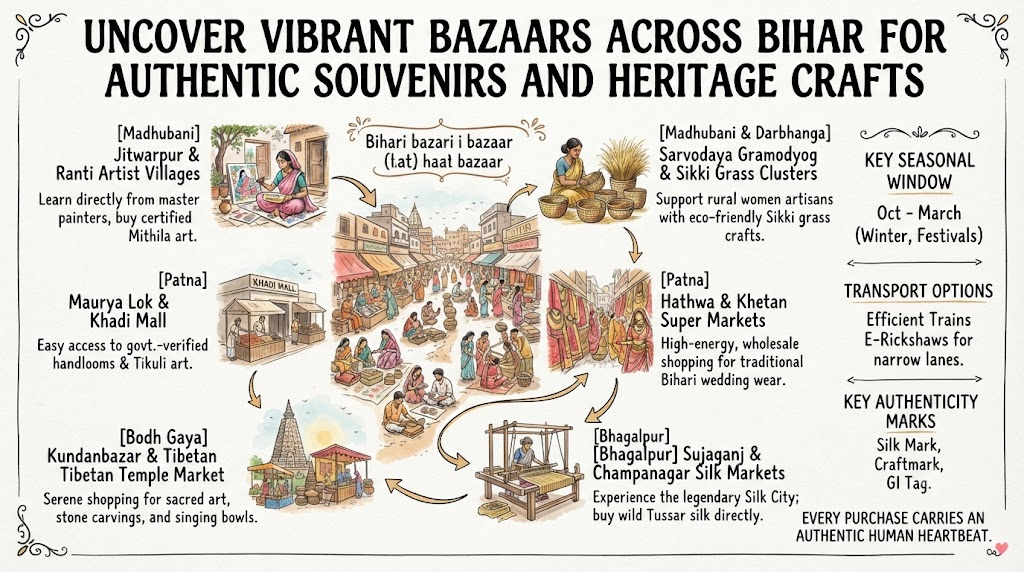
The primary shopping and craft circuit connects Patna (the central urban emporium hub), moving north into Madhubani and Darbhanga (the vibrant epicenters of folk art), dipping southeast toward Bhagalpur (the historic Silk City), and branching south into Bodh Gaya and Nalanda (stone carving and contemplative handicrafts).
| Regional Fact | Detail |
|---|---|
| Primary Artisan Hubs | Patna, Madhubani, Bhagalpur, Bodh Gaya, Muzaffarpur |
| Signature Craft Specialties | Madhubani Art, Tussar/Matka Silk, Sikki Grass, Tikuli Art, Stone Crafts |
| Busiest Shopping Seasons | October to March (Festive, Wedding, and Winter months) |
| Primary Transit Gateways | Patna Airport (PAT), Gaya Airport (GAY), Darbhanga Airport (DBR) |
| Typical Bazaar Trading Hours | 10:30 AM – 8:30 PM (Weekly market holidays vary by district) |
Best Places or Experiences
Authentic Bhagalpuri silk textiles on display.
1. Maurya Lok Complex & Upendra Maharathi Sansthan, Patna
Maurya Lok stands as Patna’s premier open-air shopping arcade, where contemporary retail spaces meet state-run craft emporiums like Amrapali and Khadi Mall. A brief transit across town takes you to the Upendra Maharathi Shilp Anusandhan Sansthan, where state-certified master artisans craft museum-grade heritage pieces under one tranquil canopy.
This vibrant corridor allows visitors to pick up verified, certified handloom artifacts without the stress of aggressive street bargaining. It is the premier spot to explore Tikuli art—an ancient, delicate technique of gold-leaf enameling on lacquerware—alongside bronze icons and government-stamped pure Khadi garments.
- Location: Dak Bungalow Road & Patliputra Industrial Area, Central Patna.
- Why it is worth visiting: It offers authentic, guaranteed fair-trade artisan crafts under regulated government pricing.
- Best things to do: Pick up authentic Tikuli art plates, sample hot litti-chokha at the open-air food kiosks, and browse hand-spun cotton garments inside the multi-story Bihar Khadi Mall.
- Best time to visit: Late afternoons between 3:00 PM and 7:30 PM.
- Ideal for whom: Family vacationers, cultural shoppers, and collectors looking for verified genuine craftwork.
- Travel tip: The nearby Khadi Mall offers structured tax invoicing and accepts major credit cards, avoiding the need for heavy cash withdrawals.
2. Sujaganj & Champanagar Silk Markets, Bhagalpur
Bhagalpur has earned its reputation as the legendary “Silk City” of eastern India, boasting an unbroken sericulture tradition that stretches back centuries. Entering the narrow lanes of Sujaganj and the weaver hamlets of Champanagar, the rhythmic clatter of pit looms drifts out from nearly every open doorway.
Here, natural textured Tussar, untreated wild Katiya, and breathable Matka silk are spun and sold directly by master weavers and family-run wholesale cooperatives. The fabrics retain their characteristic slubby texture, metallic golden sheen, and unmatched resilience, providing handloom treasures at a fraction of metropolitan retail prices.
- Location: Bhagalpur District, approximately 235 km east of Patna via NH-31 or express rail.
- Why it is worth visiting: Unfiltered access to authentic wild Tussar silk directly from the looms of generational weaving families.
- Best things to do: Watch natural silk cocoon extraction in Champanagar, purchase hand-printed Tussar sarees or stoles, and explore natural vegetable-dye printing yards.
- Best time to visit: Morning hours from 10:00 AM to 1:00 PM when weavers open fresh bales for wholesale viewing.
- Ideal for whom: Textile enthusiasts, bespoke fashion designers, and travelers seeking heirloom handlooms.
- Travel tip: Avoid roadside middlemen outside the railway station; head straight to authorized weaver cooperative societies in Champanagar for the finest purity grades.
3. Jitwarpur & Ranti Artist Villages, Madhubani
Stepping into the artisan villages of Jitwarpur and Ranti feels like stepping inside an expansive, living outdoor art gallery. Mud-plastered courtyard walls, verandahs, and village gateways are adorned with vivid, natural-pigment paintings depicting divine figures, celestial bodies, and local rural celebrations.
Both villages are home to multiple National Award and Padma Shri recipients, preserving distinct lineages such as Bharni, Kachni, and Godna styles. Instead of buying commercial prints in high-end galleries, you sit directly on woven mats with the artists themselves, listening to folk songs while choosing paintings on handmade paper, canvas, and bamboo trays.
Intricate handmade Madhubani folk artwork.
- Location: Madhubani District, approximately 175 km northeast of Patna via the Muzaffarpur-Darbhanga corridor.
- Why it is worth visiting: You purchase original, certified Mithila art directly from the painters, ensuring fair compensation for rural women artists.
- Best things to do: Observe the preparation of natural pigments using soot and floral extracts, commission customized wall hangings, and explore the Godna tattoo-art motifs.
- Best time to visit: November through February during pleasant daytime hours (10:00 AM to 4:00 PM).
- Ideal for whom: Art collectors, interior decorators, researchers, and slow travelers.
- Travel tip: Carry plenty of cash; while digital UPI payments are increasingly accepted, mobile data networks can fluctuate in village courtyards.
4. Kundanbazar & Tibetan Temple Market, Bodh Gaya
The spiritual enclave of Bodh Gaya supports a uniquely international, serene bazaar atmosphere that reflects its global Buddhist pilgrimage footprint. Located around the periphery of the sacred Mahabodhi Temple complex, this bazaar brings together Tibetan, Bhutanese, Burmese, and Bihari spiritual craft traditions.
The stalls feature beautiful hand-carved black stone sculptures, sandstone Buddha figures carved by regional artisans from Patharkatti, brass singing bowls, prayer wheels, and aromatic incense. In winter, Tibetan refugee markets pop up with woolen shawls, winter jackets, and silver filigree jewelry.
- Location: Bodh Gaya, 15 km south of Gaya city center and 115 km south of Patna.
- Why it is worth visiting: A peaceful shopping experience centered on authentic sacred art, stone carvings, and Himalayan craft traditions.
- Best things to do: Buy an authentic black-stone carved Buddha figurine from Patharkatti artisans, select hand-pressed organic incense, and explore handmade prayer beads (malas).
- Best time to visit: Late evening from 5:00 PM to 8:30 PM under golden illuminated temple surroundings.
- Ideal for whom: Spiritual seekers, solo travelers, collectors of mindful home decor, and couples.
- Travel tip: Authentic Patharkatti stone is dense and heavy; tap lightly to confirm it is natural quarried stone rather than poured cement or synthetic resin.
5. Hathwa Market & Khetan Super Market, Patna
For an authentic, high-energy immersion into Bihar’s traditional wedding, apparel, and jewelry shopping culture, nothing compares to the historic Bari Path corridor. Hathwa Market and the neighboring multi-tiered Khetan Super Market serve as the regional epicenter for bridal fabrics, festive wear, and fine accessories.
Wandering through these bustling lanes reveals hundreds of vibrant boutique stores filled with bridal lehengas, zari borders, handloom dupattas, and classic tikli bangles. The surrounding bazaars offer traditional Bihari jewelry styles alongside customary ceremonial items, making it a feast for travelers fascinated by rich regional wedding customs.
- Location: Bari Path, Bakerganj, Patna.
- Why it is worth visiting: The undeniable pulse of North Indian wedding commerce, offering unbeatable wholesale pricing on festive textiles.
- Best things to do: Explore specialty shops selling handcrafted wedding dupattas, purchase glass bangles, and discover traditional bridal accessories.
- Best time to visit: Weekday afternoons around 1:00 PM to avoid the overwhelming evening rush.
- Ideal for whom: Wedding shoppers, textile lovers, and budget-conscious cultural explorers.
- Travel tip: The alleyways are pedestrian-only; have your auto-rickshaw drop you at Gandhi Maidan or Machhua Toli and walk into the market on foot.
6. Sarvodaya Gramodyog & Sikki Grass Craft Clusters, Madhubani & Darbhanga
Sikki grass craft—often hailed as “golden grass of Bihar”—is a unique indigenous craft where wild, golden-tinted riverside reeds are gathered, dried, lacquered, and coiled into durable, decorative containers, baskets, and wall hangings. The Sarvodaya Gramodyog centers and rural cooperatives across the Mithila belt are the best places to buy these lightweight masterpieces.
Historically made by rural brides as part of their bridal trousseau, these items are completely natural, sustainable, and biodegradable. The finished products—including colorful pauti storage boxes, coasters, lampshades, and decorative figurines—showcase an organic aesthetic that fits effortlessly into modern, eco-conscious homes.
- Location: Rural fringes around Darbhanga and Madhubani districts (approx. 140 km from Patna).
- Why it is worth visiting: An opportunity to purchase eco-friendly, endangered folk craft that directly supports rural women self-help groups.
- Best things to do: Buy vibrant Sikki decorative storage boxes (pauti), learn how natural dyes color the golden grass stalks, and purchase handcrafted modern dining mats.
- Best time to visit: October to March between 10:00 AM and 5:00 PM.
- Ideal for whom: Eco-conscious consumers, home decor lovers, and sustainable fashion advocates.
- Travel tip: Keep Sikki grass products in dry environments; moisture can harm their natural fibers and long-term durability.
Offbeat Exploration: Hidden Gems Tourists Miss
The Black Stone Sculptors of Patharkatti, Gaya
Tucked off the primary tourist highway between Gaya and Rajgir lies Patharkatti, a quiet artisan village whose stone-carving lineage dates back to the reconstruction of the Vishnupad Temple by Queen Ahilyabai Holkar in the late 18th century. Generational stonemasons chip away at dense blue-black potstone to carve statues of the Buddha, Hindu deities, and functional kitchen mortars. Buying directly from these rustic open-air workshops gives you master craftsmanship at honest, village-level prices.
Manjusha Art Collectives of Kahalgaon & Champanagar
While Madhubani art enjoys international fame, few casual travelers know about Manjusha art, an indigenous folk art originating in the ancient Anga region (Bhagalpur). Characterized by strong line work, sequential scroll storytelling, and a strict palette of just three symbolic colors—pink, green, and yellow—these paintings depict the folklore of Bihula and Mansa Devi. Visiting local family-run art societies in Kahalgaon allows you to purchase rare, collector-worthy scrolls that generic craft emporiums rarely stock.
Sonepur Rural Woodcraft & Brass Pockets
Beyond its fame during the annual winter cattle fair, the countryside around Sonepur and Saran hides small clusters of metal casters and wood turners. These artisans specialize in brass utensils, cast-iron cookware, and carved wooden block-printing stamps. Exploring these quiet riverside settlements yields heirloom-quality kitchen tools and carved wooden blocks that make brilliant, compact souvenirs.
Detailed Practical Guidance for Travelers
| Destination | Standard Entry Fee | General Timings | Best Local Food Options Nearby | Recommended Nearby Attractions |
|---|---|---|---|---|
| Maurya Lok & Khadi Mall, Patna | Free entry | 10:30 AM – 8:30 PM (Khadi Mall open daily) | Authentic Champaran Ahuna Mutton, Litti Chokha stalls | Golghar, Bihar Museum, Eco Park |
| Sujaganj & Champanagar, Bhagalpur | Free entry | 10:00 AM – 8:00 PM (Closed Sundays) | Warm Dalpuri with spicy Alu Dam, famous Katarni Chuda sweets | Vikramshila University Ruins, Dolphin Sanctuary |
| Jitwarpur & Ranti, Madhubani | Free entry (Artisan homes) | 9:00 AM – 5:30 PM (Daylight hours) | Makhana Kheer, Maachh-Bhaat at local roadside dhabas | Saurath Sabha ground, Rajnagar Palace ruins |
| Tibetan Market, Bodh Gaya | Free entry | 8:00 AM – 9:00 PM (Seasonal: Oct–March) | Tibetan Thukpa, Tingmo, and Momos at local street cafes | Mahabodhi Temple, Giant Buddha Statue, Dungeshwari Caves |
| Hathwa & Khetan Market, Patna | Free entry | 11:00 AM – 8:30 PM (Closed Sundays) | Muradpur Khaja stalls, legendary Bihari street Chaat | Patna Sahib Gurudwara, Jalan Museum (Quila House) |
| Patharkatti Stone Guilds, Gaya | Free entry | 8:30 AM – 6:00 PM (Daily) | Traditional Gaya Tilkut, Khaja, and hot Kesariya tea | Vishnupad Temple, Pretshila Hill, Dungeshwari |
Logistics & On-Ground Navigation
Local Transport Options
- Railways: Bihar possesses one of India’s densest railway networks. Superfast Jan Shatabdi and Vande Bharat trains connect Patna to Bhagalpur, Darbhanga, and Gaya within 2 to 4 hours, making rail travel the most reliable inter-district choice.
- E-Rickshaws & Auto-Rickshaws: Inside bustling bazaar districts like Sujaganj (Bhagalpur) or Bari Path (Patna), four-wheelers quickly get caught in gridlock. Nimble battery-operated e-rickshaws are cheap (₹10–₹30 per shared hop) and navigate crowded market streets with ease.
- Chauffeured Car Rentals: For rural art runs—such as visiting the villages of Jitwarpur, Ranti, or Patharkatti—renting an air-conditioned sedan from Patna or Gaya (₹2,500–₹3,800 per day) offers essential flexibility for hauling fragile craft purchases.
- Ride-Hailing Apps: Ola and Uber operate smoothly across Patna and Gaya city boundaries, providing dependable, meter-free rides to and from train stations, airports, and major shopping complexes.
Budget Planning
- Budget / Backpacking Tier (₹1,200 – ₹2,000 per day): Clean guesthouse or budget hotel room (₹800–₹1,200), hearty street-food meals of litti-chokha and seasonal curries (₹300), and shared e-rickshaws for transit (₹150). Leaves plenty of room for purchasing small souvenir crafts like painted bookmarks and Sikki coasters.
- Mid-Range / Comfort Tier (₹4,500 – ₹8,000 per day): Well-appointed 3-star or 4-star boutique hotel (₹3,000–₹5,500), dedicated private rental car for craft village excursions (₹2,500), comfortable sit-down restaurant dining (₹1,000), and a healthy budget for authentic handloom silk sarees or large canvas Mithila paintings.
Safety and Inclusivity Tips
- For Families: The state’s artisan markets are welcoming and community-driven. When shopping with children, stick to afternoon visits at structured venues like Maurya Lok, Bihar Museum Souvenir Shop, and Khadi Mall to avoid dense market foot traffic.
- For Couples: Markets in Bodh Gaya and Patna’s upscale Boring Road or Dak Bungalow areas provide relaxed, hassle-free environments with cozy cafes and craft boutiques nearby.
- General Safety Awareness: Keep valuables, wallets, and mobile phones secure in zippered cross-body bags when navigating crowded old-city market lanes like Hathwa Market or Sujaganj. Carry hand sanitizer, drink bottled water, and rely on pre-booked transport after 9:30 PM in outer districts.
Strategic Travel Planning Guardrails
Travel Planning Tips for Bihar’s Craft Trails
- Plan Around the Winter Weather Window: Schedule your craft sourcing trip between October and March to enjoy comfortable walking weather and festive shopping energy.
- Embrace Hybrid Payments: While shopkeepers across urban Patna and Bodh Gaya use UPI QR codes for transactions, rural artists in Jitwarpur and Patharkatti often need immediate cash for bank deposits. Keep a reserve of clean currency notes handy.
- Verify Craft Authenticity Marks: Look for the Silk Mark label on Bhagalpuri silk textiles and the Craftmark or geographical indication (GI) tags when investing in museum-grade Madhubani paintings or Sikki grass art.
- Pack Practical Packing Materials: Bring a sturdy cylindrical drawing tube for rolled canvas paintings and bubble wrap if you plan to purchase delicate stone carvings or terracotta pieces.
- Practice Polite Market Etiquette: Always ask for permission before photographing weavers at work or recording women artists in rural courtyards. Engaging in genuine conversation often earns you a warm cup of sweet chai.
Common Mistakes to Avoid
- Relying Solely on Card Swipes: Assuming debit or credit cards will work at small artisan stalls and rural cooperatives will leave you empty-handed; network terminals are rare in craft villages.
- Rushing Between Distant Districts: Attempting to cover Bhagalpur (east) and Madhubani (north) on the same weekend results in travel fatigue; allocate dedicated days to each distinct craft zone.
- Dismissing State-Run Outlets: Assuming government-run emporiums are dull; Amrapali and Bihar Khadi Mall often curate the most authentic, ethically sourced products with fixed, fair pricing.
- Skipping Street-Level Sweets: Sticking only to hotel buffets means missing iconic regional delicacies like Silao ka Khaja, Gaya Tilkut, and Maner Laddoo sold right beside the bazaar alleys.
- Accepting First Quotes on Unbranded Souvenirs: Failing to negotiate gently in tourist-heavy flea markets can result in paying inflated prices for synthetic fabrics masquerading as natural tussar.
Suggested Itinerary Blueprints
1. Day Quick Dash (Patna Urban Heritage & Craft Loop)
Designed for business travelers or short-stay visitors based in the capital city:
- Morning: Begin with a curated visit to the Bihar Museum gift shop and the Upendra Maharathi Shilp Anusandhan Sansthan for verified Tikuli art and Sikki craft.
- Afternoon: Head to the multi-story Bihar Khadi Mall at Gandhi Maidan to buy certified khadi attire, Bhagalpuri stoles, and Madhubani stationery under one roof.
- Evening: Stroll through Maurya Lok Complex for street food, casual shopping, and dinner at local litti kiosks.
2. Day Deep-Dive (Mithila Art & Handloom Immersion)
A two-day creative trail through the northern heartland of folk painting:
- Day 1 (Darbhanga to Madhubani): Arrive at Darbhanga Airport; drive to Madhubani town. Spend your afternoon in Jitwarpur Village, meeting master artisans in their courtyard studios and sourcing natural-pigment art.
- Day 2 (Ranti Village & Sikki Grass Trail): Visit Ranti Village in the morning to see modern feminist interpretations of Mithila art. Tour the local Sikki grass weaving groups before driving back to Darbhanga for evening sweet shopping.
3. Complete Weekend Travel Plan (The Sacred Silk & Stone Circuit)
A complete loop exploring the cultural craft traditions of South and East Bihar:
- Friday (Patna to Bhagalpur): Take the morning train to Bhagalpur. Spend the afternoon exploring the Champanagar handloom corridors, sourcing raw Tussar and Matka silk yardage directly from weavers.
- Saturday (Bhagalpur to Gaya/Bodh Gaya): Board an early train or hire a taxi across to Gaya. Spend the afternoon in Patharkatti village watching master stone sculptors, followed by a visit to the sweet makers of Ramna for fresh seasonal Tilkut.
- Sunday (Bodh Gaya Sacred Market): Spend a peaceful morning visiting the Mahabodhi Temple, then browse the Tibetan market and handicraft stalls for singing bowls, stone sculptures, and incense. Return comfortably via Gaya Airport or an evening train to Patna.
Common Tourist Mistakes to Avoid
- Geographic Blunders: Don’t attempt to combine Madhubani (in the far north) and Bodh Gaya (in the south) on the exact same travel day. Cross-state traffic and river crossings over the Ganga require careful route planning; give each geographical zone its own dedicated travel day.
- Commercial Traps: Don’t spend valuable travel time wandering standard air-conditioned western shopping malls in outer Patna when atmospheric historical markets like Bari Path, Sujaganj, and Maurya Lok offer genuine cultural connection and unique local items.
- Neglecting Modern/Alternative Zones: Don’t overlook the creative, quieter contemporary expansions of Patna, such as the design galleries around Patliputra Colony, Boring Canal Road, and the museum gift shops, which offer well-curated craft pieces in relaxed settings.
- Transport Overpayment: Always negotiate auto-rickshaw fares beforehand or cross-reference pricing with the Ola or Uber app on your phone. This gives you an accurate local rate baseline and prevents paying tourist markups outside railway stations.
- Luxury Dining Bias: Eating exclusively in high-end hotel restaurants deprives you of Bihar’s finest culinary soul. The freshest Chana Ghugni, warm Dalpuri, Litti Chokha, and seasonal Tilkut are found at bustling bazaar stalls frequented by generations of loyal local shoppers.
Frequently Asked Questions
1. What is the most famous handicraft to buy when visiting Bihar?
Madhubani painting (Mithila art) and Bhagalpuri Tussar silk are the two most world-renowned traditional products to buy in Bihar.
Other prized indigenous souvenirs include golden Sikki grass home accessories, lacquer-based Tikuli art pieces, and stone carvings from Gaya.
2. Where can I buy authentic Madhubani paintings directly from the original artists?
The most authentic places are the artisan villages of Jitwarpur and Ranti, located directly in Madhubani district.
Visiting these villages allows you to interact directly with National Award-winning painters, watch their natural pigment preparation, and buy genuine original canvases without middleman markups.
3. How do I test the purity of Bhagalpuri Tussar silk while shopping in local bazaars?
Genuine Tussar silk has a naturally textured, irregular weave (slub) and a subtle, warm golden sheen rather than a blinding artificial shine.
You can ask the shopkeeper for a Silk Mark certification tag, or perform a traditional burn test on an extracted stray thread: pure natural silk burns slowly with a burnt-hair smell and leaves a crumbly black ash, while synthetic polyester melts into a hard plastic bead.
4. Are credit cards, debit cards, and mobile UPI payments widely accepted in Bihar’s markets?
UPI payments via phone apps are widely accepted across urban shops, emporiums, and roadside stalls in cities like Patna, Gaya, and Darbhanga.
However, rural artisan hamlets and traditional wholesale markets still rely heavily on cash, so keep ₹2,000 to ₹3,000 in clean currency notes with you for direct village purchases.
5. Which market in Patna is the best for wedding attire and festive jewelry shopping?
Hathwa Market and Khetan Super Market, located along the Bari Path corridor in Bakerganj, are the premier destinations for wedding shopping.
They host hundreds of specialized wholesale and retail shops offering bridal lehengas, silk sarees, ornate dupattas, and classic North Indian wedding accessories at competitive prices.
6. What is Sikki grass craft and where can I find it?
Sikki is a golden-colored wild riverside grass that artisans dry, treat, and weave into durable, eco-friendly storage baskets, coasters, and decorative items.
The finest pieces are made across the Mithila belt around Madhubani and Darbhanga, and they are also stocked reliably at the Upendra Maharathi Shilp Anusandhan Sansthan and Bihar Khadi Mall in Patna.
7. When is the best time of year to visit Bihar for shopping and craft tours?
The ideal window is from October through March, when the weather remains pleasantly cool for outdoor markets and village walking tours.
This period coincides with vibrant cultural festivals such as Chhath Puja, Diwali, and regional winter fairs, filling bazaars with seasonal foods and handicrafts.
8. What unique edible culinary souvenirs should I bring back from Bihar?
Popular culinary keepsakes include authentic Silao ka Khaja (a crisp, multi-layered pastry), Gaya Tilkut (crisp winter sesame and jaggery brittle), and roasted Katarni Chuda (aromatic beaten rice from Bhagalpur).
You can also pick up sealed jars of sun-dried Bihari mango pickles (Achar) and sattu (roasted gram flour) from local food markets.
9. Can I visit rural artisan villages in Madhubani and Gaya as a solo woman traveler?
Yes, rural artisan communities in Jitwarpur, Ranti, and Patharkatti are warm, welcoming, and largely matriarchal spaces where women artists lead the trade.
For maximum comfort, hire a reputable private taxi for day excursions from nearby transit hubs and plan your visits during daylight hours between 9:00 AM and 5:00 PM.
10. Where can I find authentic stone carvings and Buddhist souvenirs in Bodh Gaya?
The Tibetan Refugee Market and the pedestrian lanes surrounding the Mahabodhi Temple complex feature an array of singing bowls, prayer flags, and carved Buddha statues.
For the most authentic stonework, visit the nearby stone-carving village of Patharkatti, where generations of masonic artisans sculpt traditional statues from quarried green-black potstone.
11. What is Tikuli art and where can I purchase authentic pieces?
Tikuli is a 500-year-old Patna craft where delicate designs are painted on glazed, lacquered wooden surfaces using refined brushes and gold-leaf accents.
The best spot for verified, high-grade Tikuli trays, wall clocks, and wall hangings is the Upendra Maharathi Shilp Anusandhan Sansthan in Patliputra, Patna.
12. Is bargaining expected in the street markets of Bihar?
Gentle bargaining is standard practice in informal street markets, roadside clothing stalls, and flea bazaars.
However, fixed prices are observed in state-run venues like Khadi Mall, Amrapali Emporium, and established private showrooms; it is also polite to avoid aggressive bargaining when purchasing directly from rural artists in their home studios.
Conclusion
Choosing to explore Bihar’s vibrant markets over predictable urban shopping malls transforms simple souvenir shopping into an authentic, deeply meaningful cultural connection. Every handloom Tussar drape from Bhagalpur, natural-pigment Mithila painting from a village courtyard, and woven golden Sikki box carries an inspiring, human story of heritage preserved across centuries. As you step out of the bustling bazaars with your bags full and spirits lifted, you carry home far more than beautiful objects—you carry a living, vibrant piece of India’s cultural soul.
