Introduction
Most popular holiday destinations greet travelers with commercialized cafe strips, noisy queues, and prefabricated attractions. Bihar strikes a radically different chord. Here, the earth hums with millennia of unbroken civilizational memory, ancient philosophy, and profound spiritual roots that shaped global thought.
Walking across this land means retracing the steps of great philosophers, enlightened spiritual leaders, and emperors who transformed world history. From the shaded sanctuaries where meditative silence still lingers to red-brick architectural marvels that once housed scholars from across Asia, Bihar delivers raw, unfiltered cultural authenticity that modern commercial tourism simply cannot replicate.
Why Bihar is a must-visit city
Bihar represents the philosophical cradle of the Indian subcontinent, serving as the foundational epicenter for Buddhism and Jainism while nurturing seminal traditions in Hinduism and Sikhism. Geographically cradled by the fertile plains of the holy Ganga, this region anchored the mighty Magadha and Mauryan empires, fostering intellectual epics from Chanakya’s statecraft to Aryabhata’s astronomy. Today, smooth national expressways, expanding airport infrastructure at Patna and Gaya, and well-integrated railway lines make traversing this sacred corridor remarkably seamless for solo travelers, seniors, and multi-generational families alike.
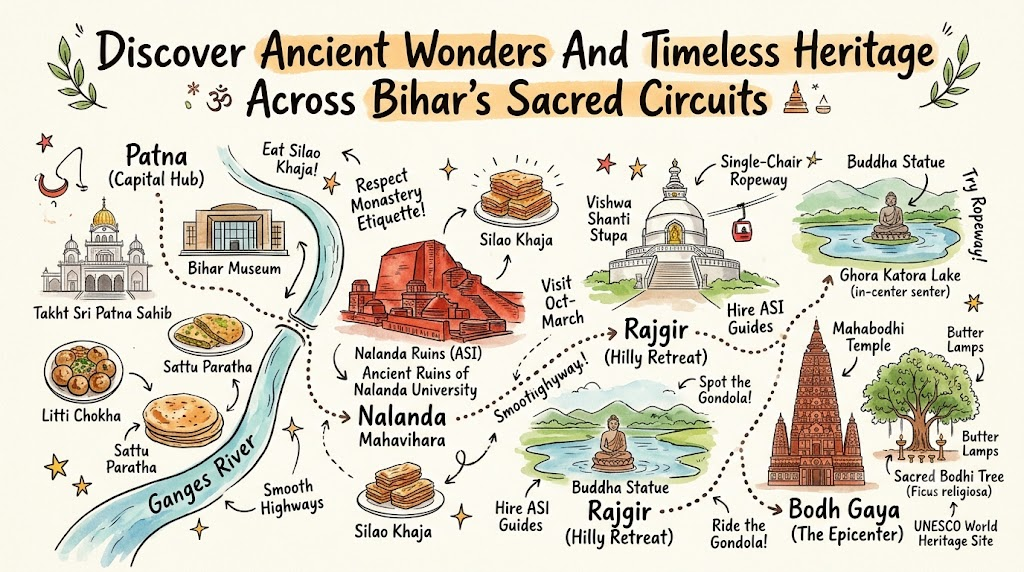
The quintessential journey centers on the celebrated Southern Heritage & Spiritual Circuit, uniting the state capital Patna with Nalanda, Rajgir, and Bodh Gaya. This dynamic loop balances world-class archaeological ruins, dramatic hilly retreats, scenic eco-sanctuaries, and vibrant bazaar culture.
| Metric / Attribute | Regional Details |
|---|---|
| Primary Circuit | Patna – Nalanda – Rajgir – Bodh Gaya |
| Best Travel Season | October to March (pleasant sunshine, cool breezes) |
| Closest Major Airports | Jay Prakash Narayan Airport, Patna (PAT) & Gaya Airport (GAY) |
| Signature Delicacies | Litti Chokha, Sattu Paratha, Khaja, Belgrami, Tilkut |
| UNESCO World Heritage Sites | Mahabodhi Temple Complex & Archaeological Ruins of Nalanda Mahavihara |
Top Places and Cultural Experiences in Bihar
Mahabodhi Temple Complex
The sacred epicenter of the Buddhist world, this ancient brick monument rises majestically into the sky, surrounded by tranquil stone railings dating back to the Mauryan and Sunga eras. At its rear stands the sacred Bodhi Tree, a direct descendant of the very Ficus religiosa beneath which Siddhartha Gautama attained supreme enlightenment over 2,500 years ago.
The atmosphere inside the temple grounds is deeply reverent. Golden butter lamps flicker against polished stone walkways, saffron-robed monks from around the globe chant sacred verses, and the scent of incense fills the cool dawn air. It is not merely an architectural treasure; it is a living center of global introspection and profound mindfulness.
Mahabodhi Temple in Bodh Gaya.
- Location: Bodh Gaya, Gaya District (approximately 115 km south of Patna). Maharashtra Gadkille
- Why it is worth visiting: It is a celebrated UNESCO World Heritage Site housing the sacred diamond throne (Vajrasana) and the venerated Bodhi Tree. Maharashtra Gadkille
- Best things to do: Sit quietly in the meditation park near the Bodhi Tree, admire the ancient votive stupas, and attend the resonant evening prayer chants. Maharashtra Gadkille
- Best time to visit: November to February; visit at 5:30 AM for sublime dawn light and peaceful contemplation.
- Ideal for whom: Spiritual seekers, history scholars, architecture enthusiasts, and serene travel groups.
- Travel tip: Mobile phones and large electronic bags are strictly barred inside; use the secured token lockers near the eastern entrance gate before entering the security queue.
Archaeological Ruins of Nalanda Mahavihara
Sprawling across manicured lawns lie the excavated remains of Nalanda, one of humanity’s earliest residential universities. Flourishing between the 5th and 12th centuries CE under the Gupta Empire and Emperor Harshavardhan, this ancient academy accommodated 10,000 international students and 2,000 masters of philosophy, astronomy, and medicine.
Walking along the wide red-brick corridors, you encounter well-planned monk dormitories, private meditation cells, sunken lecture halls, and elaborate drainage systems. The towering Sariputra Stupa commands the skyline with multiple historic tiers and intricately carved niche votives that evoke the intellectual heights of ancient India.
Ancient Nalanda University ruins.
- Location: Nalanda District (around 85 km southeast of Patna, 14 km from Rajgir). Trawell.in
- Why it is worth visiting: It showcases advanced ancient brick engineering, town planning, and the legendary intellectual crucible praised by Chinese scholar Xuanzang. Latehar Tourism
- Best things to do: Inspect the sculptural reliefs on the Sariputra Stupa, explore the student hostel hearths, and browse the bronze idols at the Nalanda Archaeological Museum directly opposite the gates. Trawell.in
- Best time to visit: October to March; early morning between 9:00 AM and 11:30 AM before the sun climbs overhead.
- Ideal for whom: History lovers, curious students, architectural photographers, and solo explorers.
- Travel tip: Hire an official government-licensed ASI guide near the ticket counter; unverified local touts often recite fanciful folklore rather than validated historical archaeology.
Vishwa Shanti Stupa and Ratnagiri Hill
Perched atop the rugged Ratnagiri Hill in Rajgir, this radiant white dome stands as a soaring monument to universal fraternity and peace. Built through the vision of the Japanese Buddhist preceptor Nichidatsu Fujii, the stupa features four lustrous golden statues depicting the birth, enlightenment, first sermon, and final passing of Lord Buddha.
Reaching the summit via India’s historic single-chair ropeway provides sweeping vistas of the surrounding five green hills that cradled the ancient capital of the Magadhan kings. The soft breeze at the summit carries the rhythmic beat of Japanese drums and the serene chanting of “Na Mu Myo Ho Ren Ge Kyo” across the valley.
Vishwa Shanti Stupa in Rajgir.
- Location: Rajgir, Nalanda District (approx. 102 km southeast of Patna).
- Why it is worth visiting: It blends tranquil spiritual heritage with panoramic hilltop perspectives and a historic aerial ropeway adventure. Maharashtra Gadkille
- Best things to do: Ride the open single-chair ropeway, join the Japanese prayer hall meditation, and follow the ridgeline trail toward historic Griddhakuta (Vulture’s Peak). Latehar Tourism
- Best time to visit: December to February; late afternoons (3:00 PM to 5:00 PM) to catch the golden sunset over the Rajgir hills.
- Ideal for whom: Multi-generational families, nature wanderers, photographers, and couples.
- Travel tip: If traveling with young toddlers or mobility-impaired elders, use the newly installed modern cabin ropeway or hire a sedan-chair (doli) rather than the vintage single-chair line.
Takht Sri Harimandir Ji Patna Sahib
Set within the lively, historic lanes of old Patna along the Ganga, this gleaming white marble temple stands as one of the five sacred Takhts (seats of temporal authority) of Sikhism. It marks the hallowed birthplace of Guru Gobind Singh Ji, the tenth Sikh Guru, who was born here in 1666.
Maharashtra Gadkille
The inner sanctum features exquisite gold-leaf embossing, intricate marble inlay work, and preserved historical relics including the Guru’s childhood wooden cradle (Pangura) and sacred weapons. The langar hall runs round the clock, serving wholesome, soul-nourishing vegetarian meals to all visitors regardless of background, embodying hospitality and community devotion.
- Location: Harmandir Gali, Patna City (approx. 12 km east of Patna Junction railway station).
- Why it is worth visiting: It is a revered global Sikh pilgrimage site with unmatched community warmth, historic weapons collections, and stunning sacred architecture.
- Best things to do: Offer prayers in the sanctum, volunteer at the community Langar kitchen, and examine the centuries-old manuscripts preserved in the upper gallery.
- Best time to visit: Year-round; evening prayers during sunset or during the luminous celebrations of Prakash Parv.
- Ideal for whom: Cultural seekers, family groups, devout pilgrims, and street heritage enthusiasts.
- Travel tip: Wear respectful modest attire covering knees and shoulders, remove footwear at the outer facility, and keep your head covered with a scarf or bandana before entering the complex.
Bihar Museum
Stretching across 13.9 acres along Bailey Road in the capital city, the Bihar Museum is a tour de force of contemporary landscape architecture and world-class curatorial storytelling. Designed by Japan’s Maki and Associates in collaboration with Opolis, the structure features weathering Corten steel and glass pavilions integrated with water courtyards.
The galleries take visitors on a captivating journey across prehistoric times, the golden era of the Mauryan Empire, and traditional regional folk art. The crowning jewel of the museum is the Didarganj Yakshi, a polished sandstone sculpture from the 3rd century BCE that represents the apex of Mauryan craftsmanship and aesthetic balance.
- Location: Jawaharlal Nehru Marg (Bailey Road), Patna city center.
- Why it is worth visiting: It offers interactive displays, climate-controlled comfort, and curated antiquities matching global museum standards.
- Best things to do: Admire the iconic Didarganj Yakshi, explore the interactive children’s discovery gallery, and enjoy traditional lunch at the museum’s artisanal cafe.
- Best time to visit: Throughout the year; weekdays from 10:30 AM to 2:00 PM offer quiet galleries for deep appreciation.
- Ideal for whom: Art lovers, international travelers, families with curious children, and architecture buffs.
- Travel tip: Purchase the audio guide device at the reception counter; it delivers detailed context on ancient inscriptions and coins that generic placards omit.
Ghora Katora Lake
Tucked between steep rocky ridges near Rajgir, Ghora Katora (literally meaning “Horse Bowl”) is an eco-protected lake shaped naturally like an equestrian hoof. Motorized private vehicles are strictly restricted at the forest entry barrier, preserving an untouched natural sanctuary filled with migratory birds and mountain breezes.
In the center of the shimmering, emerald-hued water stands a majestic 70-foot pink sandstone statue of Lord Buddha seated on a lotus pedestal. Visitors glide silently across the reservoir on pedal boats, enveloped by tranquil forested hills and pristine skies far removed from city clamor.
- Location: Near Rajgir town boundary (approx. 12 km from Rajgir city center).
- Why it is worth visiting: It is an immaculate, zero-emission eco-tourism hotspot featuring clean waters and a grand mid-lake Buddha statue.
- Best things to do: Take a pedal boat ride out to the floating Buddha statue, rent a bicycle at the reserve check-post, and birdwatch along the water margins.
- Best time to visit: October to February; arrive by 8:30 AM when the morning mist rises off the lake surface.
- Ideal for whom: Honeymooners, nature enthusiasts, photographers, and eco-conscious travelers.
- Travel tip: Private combustion cars are halted 5 km before the lake; take the forest department’s shared electric carts, hire an e-rickshaw, or rent a pedal bike for the scenic forest path.
Offbeat Exploration: Hidden Gems Tourists Miss
Barabar Caves (Jehanabad)
Carved into massive granite boulders dating back to the 3rd century BCE during the reign of Emperor Ashoka, the Barabar Caves are the oldest surviving rock-cut chambers in India. The interior chambers of the Lomas Rishi and Sudama caves feature astonishing mirror-like stone polish and acoustic resonance that amplifies a single vocal hum into a rolling vibration lasting several seconds.
Pawapuri Jal Mandir
Located roughly 38 km from Rajgir, this serene white marble temple sits directly in the center of an enormous water tank filled with pink lotus blossoms. It marks the sacred spot where Lord Mahavira, the 24th Tirthankara of Jainism, attained Nirvana. Walking across the long red stone footbridge to the temple while cool breezes ripple across the water offers profound peace.
Dungeshwari (Mahakala) Cave Temples
Perched on rugged hill ridges northeast of Bodh Gaya, these quiet rock shrines mark the precise terrain where Gautama Buddha practiced severe ascetic austerities for six years prior to reaching Bodh Gaya. A golden emaciated Buddha statue inside the cliff cave captures the intense physical renunciation that led him to embrace the Middle Path.
Detailed Practical Guidance for Travelers
| Destination | Standard Entry Fee | General Timings | Best Local Food Options Nearby | Recommended Nearby Attractions |
|---|---|---|---|---|
| Mahabodhi Temple | Free (Camera Fee: ₹100, Video: ₹500) | 5:00 AM – 9:00 PM | Be Happy Cafe (Pasta & Tibetan momos), Mohammad’s Restaurant | Great Buddha Statue (80 ft), Sujata Stupa, Royal Bhutan Monastery |
| Nalanda Ruins | ₹50 (Indian citizens), ₹600 (Foreign nationals) | 9:00 AM – 5:00 PM | Green Mango Restaurant, Local roadside stalls for fresh Silao Khaja | Xuanzang Memorial Hall, Nalanda Archaeological Museum, Kundalpur |
| Vishwa Shanti Stupa | Free (Ropeway ticket: approx. ₹100 – ₹150) | 8:30 AM – 5:00 PM (Lunch break 1–2 PM) | Hotel Samrat Restaurant, Garden View Dhaba near Bus Stand | Griddhakuta Peak, Bimbisara’s Jail, Swarna Bhandar Caves |
| Takht Sri Patna Sahib | Free entry | 4:30 AM – 9:30 PM | Guru Ka Langar inside gurudwara, Ashok Kachori in Patna City chowk | Gurudwara Bal Leela, Mangal Talab, Qila House (Jalan Museum) |
| Bihar Museum | ₹100 (Adults), ₹50 (Children) | 10:30 AM – 5:00 PM (Closed Mondays) | The Potbelly (Bihari regional cuisine on-site), Pind Balluchi | Patna Planetarium, Golghar, Buddha Smriti Park |
| Ghora Katora Lake | Forest entry: ₹30 (Boating extra: ₹100) | 9:00 AM – 4:00 PM | Eco-canteen near electric stand (pack bottled water and nuts) | Rajgir Zoo Safari, Nature Safari Glass Bridge, Pandu Pokhar |
Logistics & On-Ground Navigation
Local Transport Options
- Intercity Trains: The state features dense rail links; Patna Junction, Gaya Junction, and Rajgir are connected by frequent express services like the Jan Shatabdi and Vande Bharat routes.
- Private Taxis & Ride-Hailing: Uber and Ola operate extensively in Patna and Gaya. For the entire multi-day Nalanda-Rajgir-Bodh Gaya loop, pre-book a private air-conditioned cab through your hotel or verified regional travel desks.
- Auto-Rickshaws & E-Rickshaws: Battery-powered e-rickshaws are the most convenient, low-cost option for navigating narrow market streets in Bodh Gaya, Rajgir, and Old Patna. Always agree on a negotiated fare before stepping in.
- Bicycle Rentals: Bodh Gaya and Rajgir have flat terrain that is great for cycling; many guesthouses offer sturdy cruiser bikes for ₹100–₹150 per day.
Budget Planning
- Budget / Backpacker Tier: Expect to spend around ₹1,200 to ₹1,800 per person per day. This covers clean monastery guesthouses or budget traveler dorms (₹600–₹900/night), shared public transport or e-rickshaws, and filling meals of Litti Chokha, local thalis, and street-side chai.
- Mid-Range / Comfort Tier: Budget approximately ₹4,000 to ₹7,000 for two people per day. This covers boutique heritage hotels or 3/4-star properties (₹3,000–₹5,000/night), a dedicated chauffeur-driven AC sedan for touring, sit-down dining at regional restaurants, museum admissions, and audio guides.
Safety and Inclusivity Tips
- For Families: Bihari culture is family-centric and welcoming. Keep snacks and bottled water handy during rural drives, and select hotels in established areas like Fraser Road in Patna or the Temple Zone in Bodh Gaya.
- For Couples: Tourist circuits are accustomed to domestic and international travelers. Exercise common-sense social discretion in crowded temple courtyards and bazaars.
- General Safety: Avoid traversing unlit rural highways late at night; plan road transfers during daylight hours. Keep emergency contacts stored and stick to verified licensed tourist guides.
Strategic Travel Planning Guardrails
Travel Planning Tips for Bihar
- Prioritize Winter Visits: Schedule your trip between October and early March to enjoy mild temperatures and avoid scorching summer heat.
- Carry Liquid Cash: While UPI digital payments are widely accepted at roadside stalls, rural ticket counters and interior monuments frequently face network dead-zones.
- Respect Monastery Etiquette: Remove hats, sunglasses, and footwear before stepping onto temple carpets or wooden temple halls; walk clockwise around Buddhist stupas and circumambulation paths.
- Pack Easy-Slip Footwear: Since you will remove your shoes at numerous shrines and heritage courtyards daily, wear comfortable sandals or loafers with breathable cotton socks.
- Pre-Book Winter Accommodations: The Kalachakra and Buddhist pilgrimage season brings high occupancy to Bodh Gaya and Rajgir from December to January; secure rooms well in advance.
Common Mistakes to Avoid
- Overcrowding Day Itineraries: Do not try to pack Patna, Nalanda, Rajgir, and Bodh Gaya into a single rushed weekend; you will spend most of your trip inside a car.
- Overlooking Regional Cuisine: Avoid sticking only to familiar multi-cuisine hotel buffets; you would miss authentic delights like fresh sattu drink, Chana Ghugni, and Silao Khaja.
- Relying Solely on Card Swipes: Handheld POS terminals often fail in rural monuments; do not rely exclusively on credit or debit cards.
- Skipping the Government Audio Guides: Monuments like the Bihar Museum and Nalanda Ruins lose much of their depth without knowledgeable commentary.
- Underestimating Road Distances: Factor in standard transit times across rural market towns where agricultural tractors and market haulers slow down highway traffic.
Suggested Itinerary Blueprints
1. Day Quick Dash (The Capital & Nalanda Highway Sprint)
Designed for business visitors or short-stay travelers based in Patna.
- Morning: Start at 8:00 AM with a visit to the Bihar Museum to explore the Mauryan gallery. Drive to Old Patna for prayers and breakfast at Takht Sri Patna Sahib. Maharashtra Gadkille
- Afternoon: Embark on a 2-hour drive via the Bakhtiyarpur four-lane expressway to the Nalanda University Ruins. Spend two hours exploring the excavated monastic sites and stop for fresh sweets in Silao. Maharashtra Gadkille
- Evening: Return to Patna along the sunset corridor and enjoy an authentic Litti Chokha dinner along Boring Canal Road.
2. Day Deep-Dive (The Sacred Triangle Circuit)
Tailored for heritage explorers and cultural travelers seeking deeper connections.
- Day 1 (Patna to Rajgir): Depart Patna early toward Rajgir. Ride the ropeway up to Vishwa Shanti Stupa and explore Griddhakuta Peak. After lunch, enjoy a quiet eco-boat ride on Ghora Katora Lake. Overnight in Rajgir. Latehar Tourism+ 2
- Day 2 (Nalanda to Bodh Gaya): Spend the morning walking through the Nalanda Ruins and Xuanzang Memorial Hall. After an authentic regional lunch, take a scenic 2-hour drive to Bodh Gaya. Spend the evening in deep reflection beneath the illuminated branches of the Bodhi Tree inside the Mahabodhi Temple complex. Latehar Tourism+ 2
3. Complete Weekend Travel Plan (Spiritual Roots & Monastic Trail)
A comprehensive 3-day loop starting and ending at Gaya Airport or Patna Junction.
- Friday (Arrival in Bodh Gaya): Check in and spend your afternoon visiting the towering 80-foot Great Buddha Statue and distinctive international monasteries (Thai, Tibetan, and Japanese Zen temples). Attend evening butter-lamp lighting at the Mahabodhi Temple. Maharashtra Gadkille
- Saturday (Rajgir Hilly Retreat): Drive to Rajgir. Explore Bimbisara’s Jail and Swarna Bhandar Caves, take the aerial ropeway to the World Peace Pagoda, and relax around Venu Vana’s bamboo groves. Overnight in Rajgir. Maharashtra Gadkille+ 2
- Sunday (Nalanda & Patna Departure): Tour the monumental brick halls of Nalanda University and the Archaeological Museum. Journey onward to Patna, stop at Golghar for historic Ganga river vistas, and conclude with dinner featuring Bihari Champaran meat or dal pitha. Maharashtra Gadkille+ 1
Common Tourist Mistakes to Avoid
- Geographic Blunders: Many tourists attempt to combine Bodh Gaya with far-flung northern districts like Valmiki Tiger Reserve in a single weekend. Stick firmly to the connected southern cultural belt (Patna, Nalanda, Rajgir, Gaya) to keep transit relaxed and enjoyable.
- Commercial Traps: Do not spend precious vacation hours inside generic modern malls along Patna’s outskirts. Instead, wander the atmospheric historical markets of Patna City, where traditional brassware, handloom weaving, and heritage sweet shops have thrived for generations.
- Neglecting Modern/Alternative Zones: Visitors often rush exclusively between ancient stupas while completely bypassing modern, curated cultural centers. Skipping the world-class Bihar Museum or the manicured open parks along the Ganga riverfront misses the creative energy of modern Bihar.
- Transport Overpayment: Avoid accepting the first arbitrary fare quote from unmetered taxi brokers outside major railway stations. Use ride-hailing apps like Uber or Ola to gauge realistic baseline prices, or hire prepaid government counters at the arrival terminals.
- Luxury Dining Bias: Sticking only to predictable multi-cuisine hotel buffets deprives you of the true culinary heart of the state. Step out to sample wood-coal roasted Litti Chokha tossed in pure desi ghee, crispy multi-layered Silao Khaja, and delicate winter Tilkut crafted right before your eyes.
Frequently Asked Questions
1. What is the absolute best time of year to explore Bihar’s heritage circuit?
The ideal window is between October and March when the weather is consistently pleasant, dry, and cool. Daytime temperatures remain comfortable for walking through open archaeological grounds, while nights are crisp. Avoid the scorching summer months of May and June when afternoon temperatures frequently exceed 42 degrees Celsius.
2. Is Bodh Gaya safe for solo travelers and international backpackers?
Yes, Bodh Gaya is one of the most welcoming and internationally oriented pilgrimage towns in northern India. The local population is accustomed to hosting visitors from across the world. Basic travel precautions apply: avoid poorly lit alleys late at night and use reliable transportation arranged by your guesthouse.
3. Are mobile phones and cameras allowed inside the Mahabodhi Temple?
Mobile phones, smartwatches, and large electronics are strictly prohibited inside the main Mahabodhi Temple complex for security reasons. Secure token-based lockers are available at the entrance gate. Still cameras are permitted with an official nominal camera permit ticket purchased at the entry counter.
4. How do I travel between Rajgir and Nalanda?
Rajgir and Nalanda are located just 14 km apart, making transit between them very quick. You can easily hire an auto-rickshaw or taxi for the 25-minute drive along State Highway 71. Frequent shared public transport and local buses also shuttle continuously between both towns throughout the day.
Trawell.in
5. What is special about the sweet treat called Silao Khaja?
Silao Khaja is a celebrated traditional sweet from the village of Silao, located directly between Nalanda and Rajgir. Awarded a prestigious Geographical Indication (GI) tag, this delicacy consists of up to 52 paper-thin, crispy wheat-flour layers fried in ghee and dipped in clear sugar syrup. It offers an irresistible, flaky crunch.
6. Do I need permits to visit ancient historical ruins in Bihar?
No special inner-line permits are required for Indian or foreign nationals visiting standard tourist locations like Nalanda, Rajgir, Bodh Gaya, or Patna. Standard entry fees apply at ticketing counters managed by the Archaeological Survey of India (ASI) or state departments, payable via digital QR or cash.
7. Can I find good vegetarian and vegan food options easily?
Bihar is exceptionally accommodating for vegetarians and vegans. Traditional local cuisine relies on lentils, roasted chickpea flour (sattu), fresh seasonal vegetables, and mustard seeds. Popular regional dishes such as Litti Chokha, Dal Pitha, Ghugni, and diverse stir-fries are naturally vegetarian and easily adapted to vegan diets.
8. Which airport provides the most convenient access to the Buddhist circuit?
Gaya International Airport (GAY) is the closest hub, situated just 10 km from Bodh Gaya. It handles seasonal international flights from Southeast Asia alongside domestic connections. Alternatively, Patna’s Jay Prakash Narayan Airport (PAT) operates high-frequency domestic flights daily and is 110 km from Rajgir and Bodh Gaya.
9. How many days are recommended for a fulfilling tour of the main circuit?
A 4 to 5-day itinerary is recommended to explore the core circuit at a comfortable pace without fatigue. This allows one full day for Patna’s museums and heritage sites, two days for Nalanda and Rajgir, and two days to soak in the contemplative beauty and monastery gardens of Bodh Gaya.
Maharashtra Gadkille
10. What unique authentic souvenirs should I purchase in Bihar?
Look for genuine handmade Madhubani (Mithila) paintings on handmade paper or tussar silk directly from local artisan cooperatives. Other unique regional keepsakes include Bhagalpuri silk shawls, Sikki grass woven crafts, Tikuli art coasters, and wooden miniature statues hand-carved in Rajgir.
Maharashtra Gadkille
11. Is the ropeway to the World Peace Pagoda in Rajgir suitable for seniors?
Yes, the Rajgir site features an eight-seater enclosed gondola-style ropeway operating alongside the historic single-seat aerial lift. This modern enclosed cabin provides smooth, steady boarding and comfortable seating, making it well-suited for seniors and young children reaching the hilltop stupa safely.
12. What dress code is expected when visiting religious and archaeological sites?
Modest, respectful attire is appreciated throughout the region. Both men and women should wear clothing that covers shoulders, chests, and knees when visiting active temples, monasteries, and gurudwaras. Slip-on shoes and light socks are ideal, as you will remove footwear frequently at sacred thresholds.
Conclusion
Traveling through Bihar is an experience that resonates long after your suitcase is unpacked. Far from the predictable rhythm of conventional holiday spots, this storied land invites you to slow down, disconnect from modern distractions, and walk along pathways where great thinkers once shaped humanity’s spiritual conscience. Whether you are meditating under the sacred Bodhi Tree at first light, running your fingers along the weathered bricks of Nalanda’s ancient halls, or sharing a warm meal of Litti Chokha with hospitable locals, you will discover that Bihar is not just a destination to check off a bucket list—it is an inspiring pilgrimage of discovery that reconnects you with the roots of our shared heritage.
