Introduction
Most popular holiday destinations sell manufactured leisure, crowded selfie corridors, and homogenized resorts stripped of character. Bihar shatters that veneer completely by offering an unfiltered encounter with human civilization’s most profound intellectual and spiritual turning points.
Here, earth is scented with roasted gram flour, river mist, and three millennia of recorded philosophy. Travelers walking these plains move across ground where ancient kings surrendered armaments for dhamma and scholars preserved global repositories of science and debate.
Why Bihar is a must-visit city
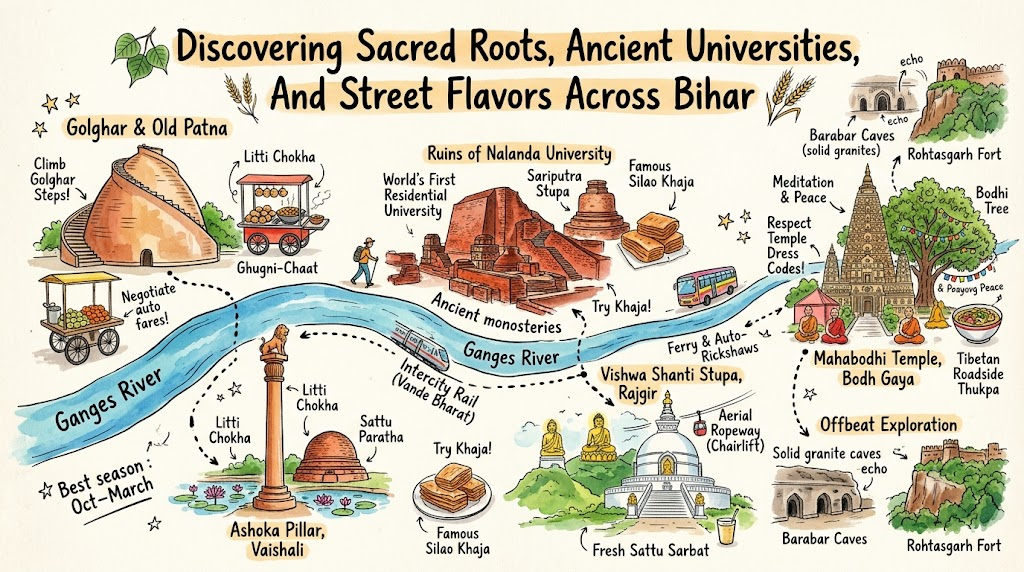
Bihar anchors the historical foundation of the subcontinent, holding the cradle of major world faiths including Buddhism and Jainism alongside pivotal dynasties like the Mauryan Empire. Its geographical location along the fertile Gangetic plain nurtures an agrarian food culture celebrated for rustic, fire-roasted staples and delicate, unrefined sweets. Today, modern four-lane expressways, electrified broad-gauge rail corridors, and upgraded regional air hubs connect quiet heritage enclaves with seamless hospitality.
The core travel circuit ribbons southward from the riverside capital down through monastic centers and scenic hilltops. Backpackers, historians, and culinary wanderers can chart smooth transitions from morning street feasts into contemplative afternoon heritage tours.
| Metric | Snapshot Details |
|---|---|
| Capital Hub | Patna Click to open side panel for more information (Jay Prakash Narayan International Airport) |
| Primary Circuit | Patna – Vaishali Click to open side panel for more information – Nalanda Click to open side panel for more information – Rajgir Click to open side panel for more information – Bodh Gaya Click to open side panel for more information |
| Peak Season | October through March |
| Culinary Signatures | Litti Chokha, Khaja, Sattu Paratha, Thekua, Malpua |
| Transit Backbone | East Central Railway network, NH-22, NH-31 |
Top Landmarks and Culinary Cultural Stops

Mahabodhi Temple
Mahabodhi Temple Complex
The Mahabodhi Temple Click to open side panel for more information in Bodh Gaya Click to open side panel for more information is an architectural and spiritual marvel, marked by a 50-meter-high grand pyramidal sandstone spire crowned with intricate geometric carvings. Standing beneath the sprawling canopy of the sacred Bodhi Tree where Siddhartha Gautama attained enlightenment over two millennia ago, the grounds resonate with deep chanting and fluttering prayer flags.
Surrounding the central sanctum are polished stone railings dating back to the Sunga period, enclosing votive stupas placed by pilgrims across centuries. The courtyard remains peaceful and serene, scented with frankincense and natural butter lamps that warm the evening air.
- Location: Gaya District, 115 km south of Patna.
- Why it is worth visiting: Global epicenter of Buddhist heritage and a designated UNESCO World Heritage site of unmatched tranquility.
- Best things to do: Sit quietly in meditation beside the Vajrasana stone platform, circle the exterior circumambulation path during evening butter-lamp lighting, and browse the monastery quarter across town.
- Best time to visit: November through February; early morning at 5:30 AM offers peaceful dawn light.
- Ideal for whom: Spiritual seekers, solo backpackers, architectural photographers, and culture buffs.
- Travel tip: Mobile phones and large electronic devices are strictly prohibited within the inner sanctum; store them in the cloakroom lockers near the main entrance gate.

Ruins of Nalanda University Bihar
Ruins of Nalanda University
The excavated red-brick monasteries and classrooms at the Ruins of Nalanda University Bihar Click to open side panel for more information evoke an era when over 10,000 international scholars studied astronomy, logic, medicine, and philosophy. The ruins reveal complex residential quarters equipped with private meditation cells, shared wells, and drainage systems that rival modern civic architecture.
Sariputra Stupa commands the skyline with multiple layers of terracotta bas-relief sculptures and sculpted stucco niches. Walking along the wide paths between excavated brick compounds gives an intimate sense of the ancient university’s grandeur.
- Location: Nalanda District, 85 km southeast of Patna.
- Why it is worth visiting: One of the world’s first residential universities, representing an apex of classical Buddhist scholasticism.
- Best things to do: Inspect the surviving terracotta relief work on Stupa Site 3, tour the adjoining Archaeological Museum’s bronze collection, and wander the monks’ residential dormitories.
- Best time to visit: 8:30 AM to 11:30 AM from November to February for crisp weather and soft morning illumination.
- Ideal for whom: Historians, student groups, family heritage travelers, and photography enthusiasts.
- Travel tip: Book an authorized Bihar State Tourism Development Corporation guide at the ticket counter to interpret complex archaeological layouts.

Viswa Shanti Stupa Rajgir
Vishwa Shanti Stupa
Perched high on the crest of Gridhakuta Hill (Vulture Peak), the brilliant white dome of Viswa Shanti Stupa Rajgir Click to open side panel for more information stands above the rocky forest valley of Rajgir Click to open side panel for more information . Established by Japanese Buddhist monk Nichidatsu Fujii, the white stupa features four golden statues depicting the Buddha’s life stages from birth to parinirvana.
Reaching the summit via the historic single-seat aerial ropeway lift takes visitors gliding above lush green ridge tops. The hilltop provides panoramic vantage points over the ancient capital hills where kings ruled and sages gave sermons.
- Location: Rajgir, Nalanda District, 102 km southeast of Patna.
- Why it is worth visiting: Dramatic hilltop vistas coupled with an evocative modern monument honoring universal peace.
- Best things to do: Ride the historic open chairlift ropeway up Ratnagiri Hill, visit the ancient caves of Vulture Peak nearby, and observe the rhythmic drum ceremonies at the Japanese temple.
- Best time to visit: Late afternoon between 3:00 PM and 5:00 PM to capture golden-hour valley panoramas.
- Ideal for whom: Nature lovers, couples, family travelers, and walking enthusiasts.
- Travel tip: Wear sturdy walking footwear with good grip, as descending steps along the stone path down to the bottom can become slippery.

Golghar
Golghar and Old Patna Riverside Enclave
Constructed by Captain John Garstin in 1786 in the wake of the devastating 1770 Bengal famine, Golghar Click to open side panel for more information stands as a pillarless, beehive-shaped granary engineered to store tonnes of grain. A double spiral staircase wraps around its brick shell, designed so porters could carry grain sacks up one flight and descend down the other.
Reaching the top platform rewards visitors with sweeping panoramic views of the city and the wide silver waters of the Ganges. The surrounding park provides a leafy sanctuary from lively bazaar traffic in central Patna.
- Location: Ashok Rajpath, Patna city center.
- Why it is worth visiting: A unique example of stupa-inspired British colonial architecture offering an elevated view over the Ganges River.
- Best things to do: Climb the exterior spiral steps for riverfront views, walk the landscaped gardens, and taste street-side ghugni-chaat along the park perimeter.
- Best time to visit: 3:30 PM to 5:00 PM on clear winter afternoons.
- Ideal for whom: Architecture enthusiasts, urban explorers, couples, and casual daytime walkers.
- Travel tip: The staircase may close during wet conditions; visit on clear, dry afternoons for open stairway access.

Ashoka Pillar
Ashokan Pillar and Relic Stupa
Located at the ancient trading crossroads of Vaishali Click to open side panel for more information , the Ashoka Pillar Click to open side panel for more information at Kolhua stands as a polished monolithic red-sandstone column crowned by a life-sized Asiatic lion. Built under Emperor Ashoka, the pillar sits alongside the excavated brick ruins of a large monastery bath tank known as the Markata-Hrada.
Vaishali also hosts the ancient mud-brick relic stupa, where a portion of the Buddha’s earthly ashes were originally enshrined by the Licchavis. The surrounding rural fields and lotus ponds reflect the democratic birthplace of the world’s earliest known republic.
- Location: Vaishali District, 55 km north of Patna across the Mahatma Gandhi Setu.
- Why it is worth visiting: One of the best-preserved monolithic Ashokan lion pillars still standing in its original archaeological context.
- Best things to do: Examine the mirror-like Mauryan polish on the sandstone shaft, view the brick stupa ruins, and visit the Vaishali Archaeological Museum.
- Best time to visit: Morning between 7:00 AM and 10:30 AM before daytime temperatures rise.
- Ideal for whom: History students, solo heritage explorers, and peace-seeking travelers.
- Travel tip: Combine your visit with a short drive to the nearby Buddha Smriti Stupa complex to see modern international monastic monuments.
Offbeat Exploration: Hidden Gems Tourists Miss
The Acoustic Enigma of Barabar Caves

Barabar Caves Sultanpur Bihar
Carved straight into solid granite boulders dating to the 3rd century BCE, the rock-cut halls at Barabar Caves Sultanpur Bihar Click to open side panel for more information feature internal surfaces polished to glass-like perfection. A soft whisper inside these vault-shaped chambers produces an eerie, resonant echo lasting several seconds.
The Forest Ramparts of Rohtasgarh Fort

Rohtasgarh Fort
Perched 1,500 feet above the Son River valley on the Kaimur plateau, Rohtasgarh Fort Click to open side panel for more information ranks among the largest hill fortifications in India. It preserves grand arched palaces, stepwells, and forested stone battlements far off standard tourist bus trails.
Maner Sharif Sufi Dargah
Located just west of Patna, the carved chiseled sandstone mausoleums of Hazrat Makhdum Yahya Maneri and Shah Daulat present refined Mughal stone jaali patterns and serene water tanks tucked into a quiet, sacred pilgrimage town.
Detailed Practical Guidance for Travelers
| Destination | Standard Entry Fee | General Timings | Best Local Food Options Nearby | Recommended Nearby Attractions |
|---|---|---|---|---|
| Mahabodhi Temple | Free (Camera fee: ₹100) | 5:00 AM – 9:00 PM | Bodh Gaya Tibetan roadside thukpa, tent cafes | Giant Buddha Statue, Royal Bhutan Monastery |
| Nalanda Ruins | ₹45 (Indians), ₹300 (Foreigners) | 9:00 AM – 5:00 PM | Silao Khaja confectioners on Rajgir-Bihar Sharif road | Xuanzang Memorial Hall, Kundalpur |
| Vishwa Shanti Stupa | Free (Ropeway: ₹100 round-trip) | 9:00 AM – 5:00 PM | Fresh roasted sattu sarbat stalls at foothill stalls | Ghora Katora Lake, Venu Vana Bamboo Grove |
| Golghar | ₹15 per person | 9:00 AM – 5:00 PM | Maurya Lok litti chokha carts, Ashok Rajpath samosas | Patna Museum, Bihar Museum, Gandhi Ghat |
| Ashoka Pillar, Kolhua | ₹25 (Indians), ₹300 (Foreigners) | 6:00 AM – 6:00 PM | Rural roadside dhabas serving sattu parathas, jalebi | Relic Stupa, Vaishali Peace Pagoda |
Logistics & On-Ground Navigation
Local Transport Options
- Intercity Rail: Express trains like the Vande Bharat and Jan Shatabdi link Patna, Gaya, and Rajgir with rapid frequencies and reliable schedules.
- Auto-Rickshaws and E-Rickshaws: Shared and reserved battery e-rickshaws dominate city centers; negotiate the fare before stepping onboard.
- Private Taxis and Car Rentals: Booking a full-day private taxi via Patna-based fleet services offers flexibility for completing rural triangle day-trips.
- State Buses: Bihar State Road Transport Corporation (BSRTC) operates air-conditioned buses connecting Patna with Gaya, Nalanda, and Muzaffarpur.
Budget Planning
- Backpacker / Budget Tier: ₹1,000 – ₹1,600 per day covers budget guest-house stays, authentic street meals, train transit, and state museum entries.
- Mid-Range / Comfort Tier: ₹3,000 – ₹5,500 per day covers clean heritage hotels, private air-conditioned cab rentals, and sit-down dining.
Safety and Inclusivity Tips
- For Families: Stick to daytime highway commutes between regional towns, and choose pre-booked verified heritage hotels around Bodh Gaya and central Patna.
- For Couples: Public monuments and major archaeological complexes are peaceful and welcoming; dress respectfully covering shoulders and knees at religious shrines.
- General Safety: Keep cash secure, avoid venturing into unlit rural bypass roads late at night, and drink bottled or purified water from reputable shops.
Strategic Travel Planning Guardrails
Travel Planning Tips for Bihar
- Book your winter accommodation at Bodh Gaya well in advance, as monasteries fill up during international Buddhist teaching cycles.
- Keep small paper currency notes handy; roadside litti carts and small village transport operators rarely take card payments.
- Take shoes off at all active temples and shrines, keeping thick socks in your day bag for sunny afternoons on heated stone tiles.
- Use regional state tourism facilitation counters at Patna and Gaya railway junctions for authentic town maps and flat-rate cab bookings.
- Allocate early mornings to travel between districts to bypass dense market traffic inside towns.
Common Mistakes to Avoid
- Do not cram Vaishali and Bodh Gaya into one single day; they lie on opposite sides of the Ganges with heavy city traffic between them.
- Avoid relying exclusively on mobile network data in deeper valleys like the Barabar hills; download offline regional maps beforehand.
- Do not skip tasting local Silao Khaja just because it looks simple; fresh flaky batches from village ovens offer an unmatched delicacy.
- Never board unmetered auto-rickshaws at rail junctions without confirming the drop-off landmark and total price.
- Avoid wearing shorts or sleeveless shirts when visiting sacred monastic complexes and historic temples.
Suggested Itinerary Blueprints
1. Day Quick Dash (Patna Heritage Loop)
Targeted for business visitors and whirlwind travelers:
- Morning: Begin early with a visit to the sprawling galleries of the world-class Bihar Museum, followed by a climb up Golghar’s spiral steps.
- Afternoon: Head over to the historic alleys of Patna Sahib to experience gurudwara hospitality and taste street-side litti chokha.
- Evening: Watch the dusk Aarti ceremony over the broad waters of the Ganges at Gandhi Ghat.
2. Day Deep-Dive (Ancient Wisdom Corridor)
A two-day exploration of scholarship and meditation:
- Day 1: Drive from Patna to Nalanda to inspect the excavated university ruins, followed by an afternoon ride up the Rajgir Ropeway to the Vishwa Shanti Stupa.
- Day 2: Drive south to Bodh Gaya, dedicating your morning to the Mahabodhi Temple and your afternoon to browsing international Buddhist monasteries.
3. Complete Weekend Travel Plan (Grand Heritage Circuit)
A complete three-day cultural immersion:
- Friday: Arrive in Patna, explore the Bihar Museum, and drive across the Mahatma Gandhi Setu bridge to explore Vaishali’s Ashokan Pillar.
- Saturday: Journey south toward Rajgir, exploring the cyclopean stone walls, Vulture Peak, and the warm springs, ending the night in Bodh Gaya.
- Sunday: Spend dawn beneath the sacred Bodhi Tree, tour the Great Buddha statue, enjoy a riverside meal, and catch an evening departure from Gaya Junction.
Common Tourist Mistakes to Avoid
- Geographic Blunders: Attempting to combine north-bank destinations like Vaishali with southern hill towns like Rajgir on the same calendar day leads to long, tiring hours stuck in traffic corridors.
- Commercial Traps: Spending hours wandering standard shopping malls along Bailey Road in Patna strips away the chance to visit local weavers producing fine Bhagalpuri silks and Madhubani canvas paintings.
- Neglecting Modern/Alternative Zones: Skipping the thoughtfully curated Bihar Museum—one of South Asia’s most sophisticated architectural museums—in favor of only ancient ruins misses the broader historical narrative.
- Transport Overpayment: Agreeing to arbitrary round-trip quotes from private taxi operators without checking standard pre-paid taxi union counters at Patna Airport or Gaya Junction leads to steep overcharges.
- Luxury Dining Bias: Eating only inside upscale hotel dining rooms causes travelers to miss out on wood-smoked litti chokha dipped in pure ghee and flaky, multi-layered sweet khaja freshly made on rural highways.
Frequently Asked Questions
1. What is the most famous authentic food item to try across Bihar?
Litti Chokha remains the undisputed culinary star of the state, prepared by stuffing spiced roasted gram flour (sattu) into whole wheat dough balls, roasting them over cow-dung or coal embers, and dipping them in pure desi ghee alongside mashed roasted eggplant, tomatoes, and potatoes.
2. Which months provide the most comfortable weather for touring ancient ruins?
The winter window spanning late October through early March delivers crisp sunny days and cool pleasant evenings, making long outdoor walking tours across open archaeological excavations comfortable.
3. Is Bihar safe for solo travelers and small family groups?
Yes, popular historical and religious destinations such as Bodh Gaya, Rajgir, Nalanda, and Patna welcome millions of domestic and international visitors each year with standard personal travel precautions.
4. How can international travelers reach Bodh Gaya directly?
Gaya Airport operates regular seasonal flights connecting international hubs in Southeast Asia, while Jay Prakash Narayan International Airport in Patna offers comprehensive domestic connections throughout India.
5. What is the traditional sweet that travelers must taste near Nalanda?
Silao Khaja, a delicate, multi-layered crispy sweet pastry originating from the village of Silao located between Nalanda and Rajgir, holds a prestigious Geographical Indication (GI) tag.
6. Do visitors have to pay an entry fee at the Mahabodhi Temple?
Entry into the main sanctum and temple grounds is free, though nominal fees are levied for carrying authorized video recording equipment into the courtyard.
7. Are electronic devices allowed inside the sacred grounds of Bodh Gaya?
Cell phones and larger camera accessories are barred from the inner sanctum courtyard for security reasons and must be deposited in safe locker facilities at the outer gate.
8. How do travelers commute between Rajgir and Nalanda easily?
Local auto-rickshaws, private taxis, and regular shuttle buses cover the 15-kilometer stretch along the well-paved highway connecting Rajgir and Nalanda in under 30 minutes.
9. What makes the modern Bihar Museum in Patna worth a dedicated stop?
The Bihar Museum is an internationally acclaimed cultural institution featuring immersive experiential galleries, world-famous Mauryan sculptures like the Didarganj Yakshi, and child-friendly educational exhibits.
10. What clothes should travelers pack for a temple-centric itinerary in Bihar?
Pack modest, breathable cotton clothing that covers shoulders and knees, along with slip-on walking shoes and extra pairs of socks for walking comfortably across sun-warmed stone courtyards.
11. Is digital UPI payment widely accepted at small food stalls and transport kiosks?
Most roadside snack vendors and market shops accept digital UPI payments through QR codes, but keeping a few small paper cash notes remains essential for village rickshaws and rural monuments.
12. What authentic traditional handicrafts make the best souvenirs to buy?
Authentic hand-painted Madhubani artworks on handmade paper, handloom Bhagalpuri tussar silk sarees, and stone-carved miniature sculptures from Gaya make cherished, sustainable keepsakes.
Conclusion
Choosing a journey through Bihar replaces sanitized holiday routines with a direct, grounding connection to the foundations of human thought. Standing in the cool shade of ancient brick stupas, hearing temple bells carry across quiet groves, and sharing hot ember-baked meals with warm local hosts transforms ordinary travel into a deeply meaningful personal pilgrimage.
