Introduction
Mainstream Indian travel circuits often push food lovers toward saturated, heavily commercialized metropolises where traditional recipes have surrendered to homogenized culinary fads. In stark contrast, Bihar offers an unfiltered, deeply grounded gastronomic landscape where recipes remain tethered to centuries of soil, woodfire cooking, and communal kinship. Here, dining is neither theatrical nor manicured; it is an intimate encounter with agrarian abundance, sacred baking techniques, and regional pride.
From the rustic crackle of roasted cow-dung embers baking savory wheat dough to ancient syrup-steeped confections perfected along monastery routes, the region serves memories on dried sal leaves. Navigating this landscape means participating in living heritage, where every mustard-crusted curry and flaky sweet tells an unvarnished story of northern India’s fertile heartland.
Why Bihar is a must-visit city
Bihar is an epicurean and historical titan whose roots stretch back through the Mauryan and Gupta empires, early Buddhist monastic councils, and medieval Sufi gatherings. Geographically nourished by the mighty Ganges, Gandak, and Son rivers, its agrarian soils yield distinctive ingredients—from pungent yellow mustard and nutrient-dense roasted gram flour (sattu) to winter sesame, fragrant Katarni rice, and lush seasonal winter greens. This micro-regional bounty fostered an earthy culinary philosophy prioritizing gut health, seasonal balance, and robust, unpretentious spices over masking sauces.
The state’s culinary circuit is easily explored through modernized infrastructure. Four-lane highways link capital food hubs to historic dessert clusters, high-speed Vande Bharat and express rail corridors stitch eastern and western gastronomic junctions together, and welcoming hospitality makes navigation effortless for curious backpackers, cultural documentarians, and road-tripping families alike.
| Circuit Indicator | Key Regional Specification |
|---|---|
| Primary Culinary Hubs | Patna, Gaya, Silao, Rajgir, Begusarai, Muzaffarpur |
| Core Heritage Ingredients | Roasted Gram (Chana Sattu), Mustard Oil, White Sesame, Jaggery, Khoya |
| Culinary Season of Abundance | October to March (Winter Tilkut, fresh cane jaggery, mustard greens) |
| Transit Arteries | NH-31, NH-22, Purvanchal-linked express corridors, East Central Railway network |
| Dining Archetype | Ancestral woodfire/charcoal hearths, family sweetshops (Halwai), heritage dhabas |
Best Food Places or Experiences
Maurya Lok Complex, Patna
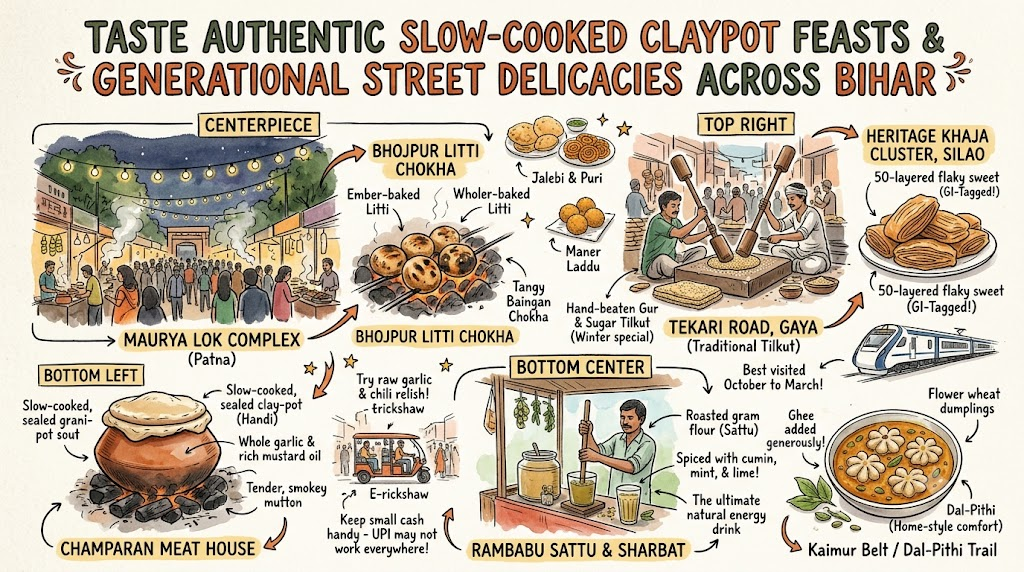
Maurya Lok Complex is the undisputed culinary town-square of modern Patna, pulsating with aromatic steam and youthful energy every evening. Established in the late twentieth century as an urban commercial plaza, this sprawling civic center quickly transformed into a lively street-food paradise where city bureaucrats, university students, and visiting families gather for authentic local snacks.
The courtyard comes alive under string lights, with the clatter of iron spoons against deep woks and the sweet fragrance of roasting gram flour filling the evening air. Beyond the legendary Litti Chokha stalls that anchor the plaza, vendors serve fresh fruit juices, steaming plates of savory Chaat, and thick cups of spiced milk tea, making it the premier open-air orientation to contemporary Bihari food culture.
- Location: Fraser Road, Central Patna, approximately 2.5 km from Patna Junction railway station.
- Why it is worth visiting: It offers an accessible, safe, and bustling introduction to diverse regional specialties in one lively enclave.
- Best things to do: Feast on coal-roasted Litti drenched in melted desi ghee; try the tangy, beaten curd Papdi Chaat at roadside counters; and sip kulhad chai while people-watching at dusk.
- Best time to visit: Evenings between 5:30 PM and 9:30 PM, when vendors are fully operational and the plaza is at its most vibrant.
- Ideal for whom: Street-food lovers, budget backpackers, families, and solo explorers seeking an authentic local vibe.
- Travel tip: Parking can get congested after 7:00 PM, so arrive via e-rickshaw or park along Fraser Road to avoid traffic bottlenecks.
Bhojpur Litti Chokha Corner, Boring Road, Patna
Tucked along the bustling student artery of Boring Road, this unassuming stall represents the gold standard of rustic Magahi cuisine. It honors the ancient rural tradition where farmhands, soldiers, and travelers prepared dense roasted flour globes directly over slow-burning wood and cow-dung embers (goitha), locking in a distinctive smoky aroma impossible to duplicate on modern stovetops.
The kitchen runs with rhythmic efficiency: unleavened whole wheat dough balls are carefully filled with spiced roasted gram flour (sattu), crushed carom seeds, nigella, green chilies, and pungent raw mustard oil before being baked over glowing coals. Once roasted to a blistered perfection, each globe is vigorously dusted of ash, hand-crushed, and dipped generously into a cauldron of hot country ghee before being plated alongside a mash of charred eggplants, roasted tomatoes, and garlic.
- Location: Near Boring Road Crossing, Western Patna, roughly 4.5 km from Patna Junction.
- Why it is worth visiting: It delivers the authentic, unfiltered smokiness of ember-baked Litti without needing a trip into remote agricultural villages.
- Best things to do: Watch the cooks roast the dough on traditional live coals; ask for an extra dollop of fiery raw garlic chutney; and pair your meal with roasted green chili pickle.
- Best time to visit: 12:30 PM to 3:30 PM for lunch, or 7:00 PM for the freshest evening batches.
- Ideal for whom: Culinary purists, documentary photographers, and lovers of bold, spicy flavors.
- Travel tip: Ghee is added very generously by default, so if you prefer a lighter meal, explicitly request dry Littis before they take the plunge.
Kalu Sweets & Traditional Tilkut Artisans, Tekari Road, Gaya
Tekari Road in the ancient pilgrimage city of Gaya is a sensory wonderland steeped in the aromas of toasted sesame and melting winter jaggery. For generations, this labyrinthine lane has housed the state’s most revered sweetmakers, who preserve a delicate culinary art practiced exclusively throughout the winter chill.
Visitors are greeted by the rhythmic, hypnotic thud of wooden mallets wielded by master artisans (karigars). They repeatedly hammer boiled sugarcane jaggery or refined sugar candy together with fragrant, dry-roasted white sesame seeds until the mixture forms a paper-thin, crispy, melt-in-the-mouth disc of Tilkut. The precision required to balance tensile sweetness with nutty crunch makes Gaya’s confectioners famous across South Asia.
- Location: Tekari Road / Ramna Bazaar, Gaya District, about 3 km from Gaya Junction and 14 km from Bodh Gaya.
- Why it is worth visiting: Gaya holds the geographical and ancestral heart of Tilkut making, producing textures vastly superior to commercial factory versions.
- Best things to do: Watch artisans hand-beat hot jaggery strings with heavy wooden hammers; sample warm, freshly pressed Gur Tilkut right off the block; and purchase artisanal packs of Khaja and Anarsa.
- Best time to visit: November through February (peak winter season), ideally between 9:00 AM and 1:00 PM when morning production is at its height.
- Ideal for whom: Culinary heritage travelers, dessert lovers, cultural photographers, and souvenir hunters.
- Travel tip: Sugar-based Tilkut is whiter and crisper, but the brown jaggery (gur) variant offers far richer, caramel-like undertones and better digestive qualities.
Heritage Khaja Cluster, Silao
Situated between the ancient ruins of Nalanda University and the scenic hot springs of Rajgir, the roadside sweetshops of Silao are an essential pilgrimage for food historians. Legend holds that even Lord Buddha and ancient Mauryan royalty enjoyed these delicate confections while journeying between monastic universities and hill capitals.
Silao Khaja is an engineering marvel of confectionery art, consisting of up to fifty micro-layers of wheat flour folded with clarified butter, fried to a golden hue, and gently bathed in warm sugar syrup. Unlike heavy sweets, an authentic Silao Khaja is exceptionally light, shattering into sweet, airy flakes at the gentlest bite. The town gained official Geographical Indication (GI) status, safeguarding its ancestral recipe and localized spring-water baking secrets.
- Location: Silao Highway Stretch (SH-49), Nalanda District, 12 km from Rajgir and 95 km from Patna.
- Why it is worth visiting: It is a GI-tagged heritage confectionery tradition with documented archaeological and historical lineage.
- Best things to do: Watch sweetmakers hand-roll and layer intricate sheets of dough before frying; savor a steaming, hot-off-the-pan Khaja; and pack vacuum-sealed sweet boxes for your travels.
- Best time to visit: 10:00 AM to 4:00 PM during a road transit between Rajgir and Nalanda.
- Ideal for whom: History lovers, dessert enthusiasts, road-trippers, and architectural travelers.
- Travel tip: Look for shops proudly displaying their GI-registration certification along the main highway row to ensure you get authentic ghee versions rather than hydrogenated-oil imitations.
Champaran Meat House, Bailey Road & Kankarbagh, Patna
Ahuna Meat, also widely celebrated as Champaran Mutton, is northern Bihar’s greatest gift to slow-food enthusiasts. Originating in the lush rural plains of West and East Champaran along the Indo-Nepal border, this rustic cooking technique is rooted in centuries-old earthen craftsmanship.
Marinated chunks of mutton are tossed with whole mustard oil, robust whole pods of garlic, cracked cloves, black pepper, and stone-ground spices before being sealed inside unglazed clay pots (handi) with dough. The pots are placed over beds of glowing charcoal, left to braise slowly in their own rendered juices without a single drop of water. The clay walls impart a delicate mineral depth to the rich, peppery gravy, while the whole garlic bulbs melt into sweet, buttery delicacies.
- Location: Multiple authentic branches along Bailey Road and Kankarbagh Main Road, Patna.
- Why it is worth visiting: It is an iconic regional meat specialty prepared through pure earthen slow-cooking, without artificial tenderizers.
- Best things to do: Savor the tender, fall-apart mutton with roomali roti or steamed rice; squeeze open whole braised garlic pods over your gravy; and observe the clay pots breaking open their dough seals.
- Best time to visit: 1:00 PM to 3:30 PM for fresh lunch servings, or 8:00 PM for dinner.
- Ideal for whom: Non-vegetarian travelers, culinary meat enthusiasts, and lovers of rustic, traditional cooking.
- Travel tip: Arrive early for lunch; because each clay pot takes over 90 minutes to braise, the day’s limited batches often sell out quickly.
Rambabu Sattu & Sharbat Counter, Gandhi Maidan, Patna
In the sweltering heat of the northern plains, roasted gram flour (sattu) is revered as both a beloved culinary staple and a nutritional lifesaver. Stationed on the perimeter of historic Gandhi Maidan, this iconic open-air stand has refreshed weary travelers, workers, and scholars for decades with traditional, energizing drinks.
The vendor transforms roasted and stone-ground Bengal gram into a savory, silky elixir mixed with chilled water, black salt, dry roasted cumin, chopped mint, diced green chilies, and a squeeze of fresh Kagzi lime. It is an extraordinary display of culinary simplicity: rich in plant protein, cooling for the stomach, and delightfully savory, providing a refreshing break from sweet and oily travel fare.
- Location: Gate No. 10 Perimeter, Gandhi Maidan, Central Patna, 3 km from Patna Junction.
- Why it is worth visiting: It is the quintessential local wellness and thirst-quenching drink of Bihar, made fresh to order right in front of you.
- Best things to do: Savor a chilled glass of spiced savory Sattu drink; watch the vendor whisk the roasted flour with wooden churners; and try their sweet jaggery-infused Sattu shake.
- Best time to visit: 10:00 AM to 1:00 PM, especially on sunny or warmer days.
- Ideal for whom: Health-conscious travelers, backpackers, culinary minimalists, and vegans.
- Travel tip: If you have a sensitive palate regarding raw heat, politely ask the vendor to omit the freshly chopped green chilies (hari mirch).
Offbeat Exploration: Hidden Gems Tourists Miss
Makhana Poha & Roasting Clusters, Darbhanga
The Mithila wetlands surrounding Darbhanga harvest the majority of the world’s gorgon nut (fox nut or makhana). Early in the morning, local rural hearths roast the dried pond-lily seeds in clay ovens before hand-cracking them with small wooden mallets. Roadside tea vendors in Darbhanga serve freshly popped makhana lightly tossed in cow ghee, crushed black pepper, and curry leaves alongside local flattened-rice poha, delivering an unbeatably fresh, nutty breakfast that packaged snacks simply cannot match.
Surajgarha & Maner Ka Halwa-Laddu, Maner Sharif
Located roughly 30 km west of Patna, the medieval Sufi town of Maner is famous for its grand sandstone mausoleums and its legendary Maner Laddu. Made using fine gram-flour pearls (boondi) fried exclusively in pure ghee, sweetened with syrup, and infused with saffron, melon seeds, and fragrant spices, these golden globes melt effortlessly on the tongue. Sampling them warm directly across from the serene water tank of Chhoti Dargah is a sublime culinary and architectural pairing.
Kudra Ghamahia Chana & Dal-Pithi Trail, Kaimur Belt
Deep in southwestern Bihar along the Grand Trunk Road, rural village kitchens preserve Dal-Pithi—handcrafted, flower-shaped wheat dumplings simmered in a spiced, slow-cooked yellow lentil stew. Seasoned with fried garlic, whole cumin, hing, and wild dried red chilies, this hearty home-style dish serves as the ultimate comfort meal, completely absent from commercial restaurant menus.
Detailed Practical Guidance for Travelers
| Destination | Standard Entry Fee | General Timings | Best Local Food Options Nearby | Recommended Nearby Attractions |
|---|---|---|---|---|
| Maurya Lok Complex | Free Public Access | 10:00 AM – 10:30 PM | Ember Litti, Dahi Puchka, Paneer Roll | Patna Museum, Buddha Smriti Park |
| Bhojpur Litti Corner | Free Public Access | 11:30 AM – 10:00 PM | Mustard Sattu Litti, Baingan Chokha | Golghar, Ganga Riverfront Drive |
| Tekari Road Sweet Bazaar | Free Public Access | 8:00 AM – 9:00 PM | Hand-pounded Tilkut, Anarsa, Balushahi | Vishnupad Temple, Falgu Ghats |
| Silao Khaja Stretch | Free Public Access | 7:00 AM – 9:30 PM | Multi-layered Ghee Khaja, Kheer Mohan | Nalanda Ruins, Rajgir Ropeway |
| Champaran Meat House | Free Public Access | 12:30 PM – 10:30 PM | Ahuna Clay-pot Mutton, Tandoori Roti | Bihar Museum, Eco Park Patna |
| Gandhi Maidan Drink Stalls | Free Public Access | 9:00 AM – 8:00 PM | Savory Chana Sattu Ghol, Sweet Lassi | Golghar, Khuda Bakhsh Library |
Logistics & On-Ground Navigation
Local Transport Options
- Railways: Exceptional intercity connectivity; frequent express and local passenger trains connect Patna, Gaya, Jehanabad, and Nalanda within 1.5 to 3 hours.
- Auto-Rickshaws & E-Rickshaws: The backbone of intra-city food hopping. E-rickshaws are cheap, whisper-quiet, and navigate tight historic market streets with ease.
- App-Based Cabs & Private Rentals: Ola, Uber, and city taxis operate smoothly across Patna. For multi-stop outstation food circuits (Patna–Silao–Rajgir–Gaya), hiring an air-conditioned private taxi provides the greatest comfort and freedom.
Budget Planning
- Budget / Street-Food Tier: ₹600 – ₹1,000 per person/day. This comfortably covers multiple street-side meals, artisanal sweet samplings, local chai, fresh sattu drinks, and e-rickshaw transit.
- Mid-Range / Comfort Tier: ₹2,000 – ₹3,800 per person/day. This includes sit-down air-conditioned specialty dining (such as Ahuna mutton meals), private day-cab rentals, souvenir sweet gift boxes, and quality heritage guesthouse stays.
Safety and Inclusivity Tips
- For Families: Stick to well-established, busy culinary hubs like Maurya Lok and certified heritage sweet outlets. Always verify that water used for cold beverages comes from sealed or purified sources.
- For Couples: Historic food lanes are vibrant, safe, and family-oriented during daytime hours. In late evenings, opt for prominent sit-down eateries along Bailey Road and Patliputra Colony for comfortable seating and privacy.
- General Traveler Safety: Bihar’s bustling food markets are warm and welcoming, but standard street smarts apply. Keep mobile phones and wallets secure in dense market crowds around Tekari Road and Patna Junction.
Food Lover’s Secret: When ordering authentic Litti Chokha, always request a small dish of raw crushed garlic and green chili relish soaked in cold-pressed mustard oil (kacchi ghani). Mixing this fiery drizzle into your roasted eggplant mash elevates the earthy, rustic flavors to a whole new level.
Strategic Travel Planning Guardrails
Travel Planning Tips for Bihar
- Plan for Winter Visits: To experience regional confections like Tilkut, Gur Khaja, and Anarsa at their peak, plan your trip between November and late February.
- Carry Liquid Currency: While UPI and mobile QR payments are widespread, modest street vendors and traditional sweetmakers in older districts often operate exclusively in physical cash.
- Start Early: Master sweetmakers and breakfast vendors roll out their best batches between 7:30 AM and 10:00 AM, making early mornings ideal for food exploration.
- Embrace Mustard Oil Flavors: Local cooking relies heavily on authentic cold-pressed mustard oil; give your palate a day or two to appreciate its pungent warmth.
- Stay Well Hydrated: Keep a refillable water bottle handy and enjoy fresh Sattu Sharbat or green coconut water during long market walks.
Common Mistakes to Avoid
- Skipping Rustic Roadside Stalls: Over-relying on sanitized, continental hotel menus means missing out on the state’s true culinary soul.
- Underestimating Driving Times: Don’t crowd too many outstation food districts into one day; rural road crossings can easily slow down your transit.
- Overlooking Cash for Tolls and Sweets: Passing through historic sweet hamlets without small currency notes can cost you precious sampling opportunities.
- Assuming All Food Is Spicy: Bihari cuisine uses complex spices rather than pure chili heat; take time to explore mellow lentil, curd, and vegetable preparations.
- Ignoring Batch Freshness: Avoid buying pre-packaged sweets sitting on shelf displays; always ask for confections freshly taken out of the frying wok or cooling tray.
Suggested Itinerary Blueprints
1. Day Quick Dash (Patna Urban Flavor Trail)
Designed for business travelers or short-layover visitors eager to savor the capital’s most iconic bites in a single day.
- 08:30 AM: Start with a hearty breakfast of warm Bedmi Puri, spicy Chana Sabzi, and hot Jalebi near Patna Junction.
- 12:30 PM: Savor an authentic clay-pot Ahuna Mutton or royal vegetarian thali at a renowned spot on Bailey Road.
- 03:30 PM: Recharge with an energizing savory Sattu Sharbat while enjoying a stroll through Buddha Smriti Park.
- 06:30 PM: Immerse yourself in the bustling evening energy of Maurya Lok Complex for woodfire-roasted Litti Chokha and creamy Dahi Papdi Chaat.
2. Day Deep-Dive (Heritage Heartlands & Sweet Trails)
A two-day culinary expedition bridging ancient political capitals and world-famous confectionery corridors.
- Day 1 (Patna to Nalanda & Rajgir): Drive south via NH-22. Stop mid-morning at the Silao highway cluster to taste fresh, multi-layered Khaja. Explore the ruins of Nalanda, then head into Rajgir for lunch featuring traditional rustic Kadhi-Badi. Enjoy an evening chairlift ride up Ratnagiri Hill, finishing with hot milk tea and crispy pakodas.
- Day 2 (Rajgir to Gaya & Return): Rise early and travel to Gaya. Walk the fragrant lanes of Tekari Road to watch the rhythmic creation of hand-beaten winter Tilkut and saffron Anarsa. Savor a comforting traditional lunch of Dal-Pithi and roasted tomato mash before returning to Patna by late evening.
3. Complete Weekend Travel Plan (Grand Magadh Epicurean Circuit)
A Friday-to-Sunday loop balancing architectural wonders with slow-cooked culinary adventures.
- Friday: Arrive in Patna. Spend a leisurely afternoon admiring the exhibits at the Bihar Museum, followed by dinner at a Champaran meat house and dessert at a heritage sweet counter on Fraser Road.
- Saturday: Take an early drive through Jehanabad to Gaya. Sample fresh winter sweets in the old bazaars, visit the Falgu River ghats, and spend a peaceful afternoon in Bodh Gaya enjoying Tibetan thukpa and momos along the temple lanes.
- Sunday: Journey toward the hills of Rajgir and the ancient university ruins of Nalanda. Treat yourself to fresh Silao Khaja and rural woodfire Litti Chokha at highway eateries, returning to Patna in time for evening departures.
Common Tourist Mistakes to Avoid
Geographic Blunders
Attempting to cover the sweets of Gaya, the riverfront cuisine of Bhagalpur, and the street food of Patna in a single calendar day is a recipe for exhaustion. The distances are substantial, and heavy inter-district traffic will leave you stuck in vehicles instead of enjoying local eateries. Focus on one region at a time.
Commercial Traps
Spending dining budgets inside generic western malls and franchised cafes completely undermines the point of visiting Bihar. Modern shopping malls offer the same standard options found anywhere else, whereas the historic bazaars boast cooking traditions refined over hundreds of years.
Neglecting Modern/Alternative Zones
Don’t focus solely on historic city centers; explore newer, vibrant lifestyle quarters like Patna’s Marine Drive (JP Ganga Path). Here, modern food trucks, artisanal coffee stalls, and open-air riverside seating showcase the state’s evolving contemporary dining culture.
Transport Overpayment
Relying entirely on unmetered long-distance autos hailed on the fly often results in inflated prices. Cross-check prevailing distances on ride-sharing applications or have your hotel desk confirm standard local taxi charges before embarking on multi-town food trails.
Luxury Dining Bias
High-end, five-star hotel dining rooms often mute authentic spices to cater to international, homogenized tastes. The true depth of Bihari gastronomy thrives along highway stops, family-run halwai counters, and lively community plazas.
Frequently Asked Questions
1. What makes authentic Bihari Litti distinct from Rajasthan’s Baati?
While both are delicious unleavened baked wheat globes, Litti is stuffed with spiced roasted Bengal gram flour (sattu), carom seeds, and raw mustard oil, then roasted over live cow-dung or charcoal embers. Baati is usually unstuffed, baked in ovens, and paired with mixed lentils rather than roasted eggplant mash.
2. Is mustard oil used in all traditional Bihari cooking?
Yes, cold-pressed raw mustard oil (kacchi ghani) is the signature cooking medium for curries, marinades, and chutneys across Bihar. It lends a signature pungent aroma and sharp warmth that balances beautifully with earthy vegetables and slow-cooked meats.
3. What exactly is Sattu, and why is it so celebrated in the region?
Sattu is made by dry-roasting whole brown chickpeas (chana) and grinding them into a fine flour. It is an affordable, protein-rich staple that requires no cooking. Locals mix it into cooling savory drinks or use it as a flavorful stuffing for flatbreads and roasted littis.
4. Where can I find the most authentic Champaran Ahuna Mutton in Patna?
Authentic versions are found at dedicated Champaran meat outlets along Bailey Road and Kankarbagh. Look for eateries that display their sealed clay pots braising over live, smoking charcoal embers in clear view of the dining floor.
5. Are traditional sweets in Bihar vegetarian and eggless?
Virtually all heritage sweets across Bihar—including Silao Khaja, Gaya Tilkut, Anarsa, and Balushahi—are strictly vegetarian, egg-free, and prepared using pure dairy ghee, jaggery, sugar, and roasted grains.
6. Why is Tilkut primarily prepared during the winter months?
Tilkut relies on fresh white sesame seeds and early-harvest sugarcane jaggery, both revered in Ayurvedic nutrition for warming the body. The crisp confection softens and melts quickly in humid summer air, making the dry, cold winter months the only time it achieves its signature flaky texture.
7. Can vegetarian travelers easily find wholesome meals across Bihar?
Vegetarian options are abundant and celebrated throughout the region. From hearty ember-baked Litti Chokha and fragrant Dal-Pithi to fresh Kadhi-Badi, spiced pumpkin curries, and comforting roasted gram flatbreads, vegetarian diners are treated to diverse, nutrient-rich dishes.
8. What is the significance of the Geographical Indication (GI) tag for Silao Khaja?
The GI tag certifies that Silao Khaja is officially recognized for its unique heritage, localized water minerals, and ancestral multi-layering methods. It ensures you are enjoying a time-honored recipe that cannot be replicated under the same name elsewhere.
9. Is street food in Patna safe for international and first-time travelers?
Street food is widely enjoyed and safe if you practice smart traveler habits. Choose busy, high-turnover stalls where food is freshly cooked over open flames, avoid pre-cut fruits, and opt for bottled or purified water.
10. What is Anarsa, and how is it traditionally made?
Anarsa is a beloved ceremonial sweet crafted from fermented rice flour, clarified butter, and raw sugar, rolled in toasted sesame seeds and fried until golden. It boasts a unique texture: delightfully crisp on the outside, and pleasantly chewy and soft within.
11. Is tipping expected at rustic food stalls and highway dhabas?
Tipping is not mandatory at modest street counters and roadside food stalls, but rounding up the bill or leaving a modest tip of ₹20 to ₹50 is always appreciated by hardworking kitchen staff.
12. How long does Silao Khaja stay fresh if purchased as a travel souvenir?
When kept in a sealed, airtight container away from moisture, authentic dry-layered Khaja stays wonderfully crisp and fresh for up to two to three weeks without refrigeration.
Conclusion
Setting out on a culinary journey through Bihar offers something far more meaningful than a standard dining getaway; it is a soulful connection with northern India’s deepest culinary roots. Here, meals are unhurried, rich with history, and shared with open-hearted hospitality that makes every traveler feel right at home. Leave the predictable tourist trails behind, embrace the aroma of roasting embers, and let this timeless, bountiful land surprise your palate at every turn.
