Introduction
While conventional tourist trails funnel crowds into commercialized, neon-lit corridors and crowded hill stations, Bihar remains an anchor of authentic spiritual discovery. Here, spiritual journeys are not manufactured experiences; they are woven into the soil, stone, and riverbanks where profound philosophies were born.
Walking these ancient circuits means retracing footsteps where Prince Siddhartha attained supreme enlightenment, where Lord Mahavira preached absolute non-violence, and where Guru Gobind Singh took his first breath. The air carries an evocative stillness, contrasting sharp urban haste with deep meditative roots, unbroken devotion, and timeless silence.
Why Bihar is a must-visit city
To understand the core foundations of Asian philosophy and Indian spiritual traditions, one must travel through Bihar. Its geographical landscape, cradled by the sacred currents of the Ganga and Falgu rivers, served as the spiritual cradle for Buddhism, Jainism, Hinduism, and Sikhism. The region holds unmatched global weight, drawing seekers from Tokyo, Bangkok, and Colombo alongside domestic pilgrims completing generational rites of passage.
Modern connectivity makes this sacred realm exceptionally accessible for every traveler archetype. The Gaya International Airport and Patna Airport offer direct flights, while high-speed trains like the Vande Bharat Express link prime pilgrimage stops. Modern expressways like NH22 and NH31 provide smooth transit across forested hills, monastic valleys, and holy river ghats.
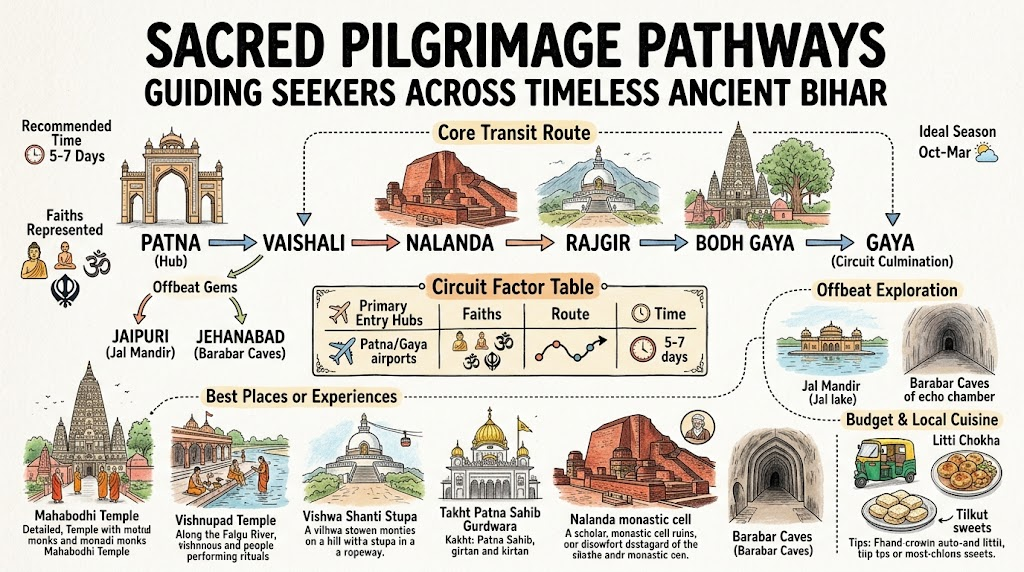
The core spiritual circuit forms a natural trail running from Patna down through Nalanda, Rajgir, and Bodh Gaya, culminating in the sacred ghats of Gaya. Each hub is equipped with pilgrim accommodations ranging from humble dharamsalas and peaceful Zen monasteries to modern heritage hotels.
| Circuit Factor | Core Information |
|---|---|
| Primary Entry Hubs | Jay Prakash Narayan Airport (Patna), Gaya International Airport (GAY) |
| Ideal Circuit Season | October to March (Crisp air, sunny days, pleasant temperatures) |
| Faiths Represented | Buddhism, Jainism, Hinduism, Sikhism, Sufism |
| Core Transit Route | Patna → Vaishali → Nalanda → Rajgir → Bodh Gaya → Gaya |
| Recommended Time | 5 to 7 Days for a comprehensive pilgrimage |
Best Places or Experiences
Mahabodhi Temple Complex, Bodh Gaya
The Mahabodhi Temple Complex stands as the spiritual axis of the Buddhist world. Centered around the iconic 50-meter-tall pyramidal stone temple, the complex marks the precise spot where Siddhartha Gautama meditated under the sacred Bodhi Tree and attained complete awakening. The architecture reflects centuries of devotion, displaying intricate Gupta-period brickwork, stone railings carved during the Sunga dynasty, and golden spires radiating quiet grandeur.
Entering the inner courtyard at dawn shifts your consciousness immediately. Saffron-robed monks from Tibet, Sri Lanka, Thailand, and Myanmar softly chant ancient Pali verses while circumambulating the stupa. The Vajrasana (Diamond Throne), positioned directly beneath the Bodhi Tree, anchors a space where silence carries palpable weight.
The iconic Mahabodhi Temple spires.
- Location: Bodh Gaya, Gaya District; 115 km south of Patna, 14 km from Gaya Junction.
- Why it is worth visiting: The supreme epicenter of Buddhist enlightenment featuring the fourth-generation descendant of the original Bodhi Tree.
- Best things to do: Meditate under the Bodhi Tree during morning prayers, sit by the sacred Muchalinda Lake, and examine the ancient Ashokan sandstone railing carvings.
- Best time to visit: 5:30 AM to 7:30 AM for undisturbed dawn meditation and chanting.
- Ideal for whom: Solitary spiritual seekers, meditators, philosophy scholars, and global pilgrims.
- Travel tip: Mobile phones and large electronic devices are strictly banned inside; safely store them at the official electronic cloakroom counter outside the gate.
Vishnupad Temple and Falgu River Ghats, Gaya
Perched along the rocky banks of the sacred Falgu River, the Vishnupad Temple is the heart of ancestral devotion in Sanatana Dharma. Commissioned in 1787 by the revered Queen Ahilyabai Holkar of Indore, the 100-foot-tall sanctuary is crafted from massive, intricately carved black basalt blocks. Inside the sanctum lies the revered Dharmasila, an 18-inch footprint of Lord Vishnu embedded into solid rock.
Pilgrims arrive from across the globe to perform Pind Daan, an ancient Vedic ritual dedicated to the liberation of departed ancestral souls. Beyond the main temple courtyard, stone ghats step down toward the mystical Falgu River, which flows underground beneath dry sand for long stretches of the year. The atmosphere is filled with the scent of burning camphor, floral offerings, and rhythmic Sanskrit mantras.
Falgu River Ghats, Gaya.
- Location: Gaya City, Gaya District; 105 km south of Patna, 4 km from Gaya Junction.
- Why it is worth visiting: The preeminent destination on the subcontinent for performing ancestral liberation rites and experiencing sacred basalt temple architecture.
- Best things to do: Pay homage at the sacred Vishnu footprint, observe traditional Vedic Pind Daan rituals along the ghats, and admire Ahilyabai Holkar’s stone architecture.
- Best time to visit: October to February, or during the auspicious annual Pitru Paksha fair.
- Ideal for whom: Devout Hindu pilgrims, families honoring ancestral lineages, and cultural heritage observers.
- Travel tip: Non-Hindus are restricted from the innermost sanctum; coordinate with verified panda priests outside to avoid exorbitant ritual fees.
Vishwa Shanti Stupa and Griddhakuta Hill, Rajgir
Rising dramatically over the rugged Ratnagiri Hill in Rajgir, the gleaming white Vishwa Shanti Stupa (World Peace Pagoda) stands as a beacon of universal brotherhood. Constructed under the spiritual guidance of Japanese Buddhist monk Nichidatsu Fujii, the massive white marble dome features four golden statues depicting Lord Buddha’s birth, enlightenment, first sermon, and parinirvana.
Adjacent to the peace stupa lies Griddhakuta Hill (Vulture’s Peak), reached via a tranquil stone pathway. This natural rocky outcrop served as Lord Buddha’s favorite retreat, where he delivered seminal teachings, including the Lotus Sutra and the Heart Sutra. Looking out across the five surrounding hill ranges from this summit provides a sweeping sense of serenity.
Vishwa Shanti Stupa atop Ratnagiri.
- Location: Rajgir, Nalanda District; 100 km southeast of Patna.
- Why it is worth visiting: A mountaintop monument where historical Buddhist discourses occurred amid undisturbed panoramic valley views.
- Best things to do: Take the single-seater chairlift aerial ropeway, sit in silent reflection at the Lotus Sutra platform on Vulture’s Peak, and join the rhythmic evening Japanese drum prayer at the Nipponzan Myohoji monastery.
- Best time to visit: 6:30 AM to 9:30 AM to avoid midday heat and enjoy morning mist rising off the valley.
- Ideal for whom: Peaceful hikers, peace activists, panoramic photographers, and Buddhist devotees.
- Travel tip: The aerial ropeway chairlift operates between 9:00 AM and 5:00 PM; if you want to catch the dawn light, hike the paved stone stairs starting at 6:00 AM.
Takht Sri Harmandir Ji Patna Sahib, Patna
Nestled within the old city quarter of Patna, Takht Sri Harmandir Ji Patna Sahib is one of the five holy seats of authority (Takhts) in Sikhism. This pristine white marble gurdwara marks the birthplace of the tenth Sikh Guru, Guru Gobind Singh Ji, who was born here in 1666. The current structure, constructed with pure white marble and gilded domes, combines classic Rajasthani and Mughal architectural motifs.
The inner chamber houses priceless sacred relics, including the childhood cradle of Guru Gobind Singh, his sacred daggers, four golden arrows, and handwritten copies of the Guru Granth Sahib. Walking into the complex carries you into a world of selfless community service, where the continuous sound of Gurbani kirtan fills the air and the community kitchen serves hot, wholesome meals to thousands every day.
- Location: Jhauganj, Patna City (Old Patna); 12 km east of Patna Junction.
- Why it is worth visiting: One of the supreme spiritual seats of Sikhism, preserving historic weaponry, sacred relics, and an unbroken tradition of langar.
- Best things to do: Listen to live evening Raag kirtan in the marble congregation hall, partake in community service at the Langar, and view the sacred weapons museum.
- Best time to visit: Early morning hours around 4:30 AM during Amrit Vela or during the festive celebration of Prakash Parv.
- Ideal for whom: Inter-faith pilgrims, families, Sikh devotees, and lovers of sacred music.
- Travel tip: Ensure your head is covered with a clean scarf and shoes are left at the designated shoe counter before passing through the foot-cleansing water channel.
Ruins of Ancient Nalanda Mahavihara, Nalanda
Although categorized as an archaeological monument, the UNESCO World Heritage Nalanda Mahavihara was fundamentally a monastic sanctuary devoted to higher spiritual truth. Established in the 5th century CE under the Gupta Empire, Nalanda flourished for over 700 years as the world’s premier residential Buddhist university, housing 10,000 monk-scholars and 2,000 teachers from across Asia.
Walking through the excavated red-brick monasteries, one discovers meditative prayer cells, lecture courtyards, and communal wells. The iconic Temple No. 3, with its tiered flight of steps and stucco sculpted stupas depicting Buddhas and Bodhisattvas, stands out against the landscape. The ancient brick corridors continue to radiate the scholarly focus of historic masters like Nagarjuna and Aryadeva.
The monastic ruins of Nalanda.
- Location: Badaon, Nalanda District; 85 km southeast of Patna, 15 km from Rajgir.
- Why it is worth visiting: The ancient global intellectual heart of Buddhist monastic scholarship and Mahayana philosophical development.
- Best things to do: Contemplate in the monk cells of Monastery 1, photograph the towering steps of Temple No. 3, and visit the nearby Nalanda Archaeological Museum.
- Best time to visit: 9:00 AM to 11:30 AM when natural morning light highlights the warm red brickwork.
- Ideal for whom: Monastic scholars, history buffs, spiritual seekers, and architecture admirers.
- Travel tip: Hire a certified guide at the entrance gate; the ruins come alive when you understand the spiritual mechanics behind each monastic drainage and meditation chamber.
Offbeat Exploration: Hidden Gems Tourists Miss
Jal Mandir, Pawapuri
Located in a tranquil lake covered with pink lotus flowers, Jal Mandir marks the sacred spot where Lord Mahavira, the 24th Tirthankara of Jainism, attained Nirvana (Moksha) in 527 BCE. According to legend, the lake was formed when countless devotees gathered ashes from his funeral pyre, scooping away soil until an enormous basin emerged. A pristine white marble causeway spans 600 feet from the shore to the central island temple, creating a serene, mirror-like approach.
Barabar Caves, Jehanabad
Carved directly into monolithic granite boulders during the reign of Emperor Ashoka in the 3rd century BCE, the Barabar Caves are the oldest surviving rock-cut sanctuaries in India. Dedicated to the ascetic Ajivika sect, these dark subterranean chambers feature a brilliant glass-like interior polish that creates unique sonic resonance. Chanting a single sacred syllable inside the Lomas Rishi Cave creates rolling echoes that continue for seconds, offering an intense auditory meditation.
Sujata Kuti and Stupa, Bakraur
Just across the dry bed of the Falgu River from Bodh Gaya lies the ancient brick stupa of Sujata Kuti. This quiet monument honors Sujata, the village maiden who offered a bowl of milk-rice (kheer) to an emaciated Siddhartha after his years of extreme ascetic penance. This simple gift restored his strength, inspiring the Middle Path that led directly to his enlightenment under the Bodhi Tree.
Detailed Practical Guidance for Travelers
| Destination | Standard Entry Fee | General Timings | Best Local Food Options Nearby | Recommended Nearby Attractions |
|---|---|---|---|---|
| Mahabodhi Temple | Free (Camera pass: ₹100) | 5:00 AM – 9:00 PM | Tibetan Cafe (Thukpa & Tingmo), Fujiya Green Bakery | Great Buddha Statue, Thai & Bhutanese Monasteries |
| Vishnupad Temple | Free (Priest dakshina voluntary) | 5:00 AM – 8:00 PM | Pramod Sweets (Hot Tilkut, Kesaria Peda, Khaja) | Mangla Gauri Temple, Akshayavat Tree, Falgu Ghats |
| Vishwa Shanti Stupa | Free (Ropeway ticket: ₹100) | 6:00 AM – 6:00 PM | Green Hotel (Traditional Vegetarian Thali, Sattu Drink) | Vulture’s Peak, Bimbisara Jail, Ghora Katora Lake |
| Takht Patna Sahib | Free (All welcome) | 4:00 AM – 10:00 PM | Gurdwara Guru Ka Langar, Harilal Sweets (Jalebi & Puri) | Guru Ka Bagh, Padri Ki Haveli, Patna Museum |
| Nalanda Ruins | ₹40 (Indian), ₹600 (Foreign) | 9:00 AM – 5:00 PM | Local roadside dhabas serving Dal-Bhaat and Sattu Paratha | Xuanzang Memorial Hall, Kundalpur Jain Teerth |
| Jal Mandir, Pawapuri | Free | 6:00 AM – 7:30 PM | Jain Bhojanshala (Strict satvik meals without roots) | Samosharan Temple, Pawapuri Gaon Mandir |
Logistics & On-Ground Navigation
Local Transport Options
- Railways: The Indian Railways network connects the state efficiently. Daily superfast and express trains run between Patna Junction and Gaya Junction, while local passenger routes serve Rajgir and Nalanda.
- Auto-Rickshaws & E-Rickshaws: Battery-operated e-rickshaws are the cleanest, quietest way to get around compact pilgrimage towns like Bodh Gaya and Rajgir. Always agree on the fare before stepping inside.
- Private Car Rentals: For a multi-day spiritual circuit, booking an air-conditioned cab through an agency in Patna or Gaya offers the best comfort, flexibility, and freedom to stop at rural monuments.
- Bicycle Rentals: Bodh Gaya features several small shops renting standard cruiser cycles for ₹100–₹150 per day, making it easy to hop between international Buddhist monasteries.
Budget Planning
- Budget / Pilgrim Tier: ₹1,200 – ₹1,800 per person/day. This includes staying in clean monastery guest rooms or pilgrim dharamsalas, traveling via trains and shared e-rickshaws, and eating at gurdwara langars, ashrams, and local vegetarian dhabas.
- Mid-Range / Comfort Tier: ₹4,000 – ₹7,500 per person/day. This includes staying in 3-star or 4-star heritage hotels, dining at multi-cuisine restaurants, and booking a private air-conditioned car with a driver for the full circuit.
Safety and Inclusivity Tips
- For Families: The spiritual circuit is family-friendly with well-paved pathways around Bodh Gaya, Rajgir, and Patna Sahib. Keep elders hydrated during hill visits, and take advantage of the chairlift at Ratnagiri Hill.
- For Couples: Pilgrimage towns emphasize respectful community decorum. Dress modestly with shoulders and knees covered, and avoid outward displays of affection around holy temples.
- General Safety: Wear well-cushioned slip-on footwear, as you will frequently take off your shoes before entering sanctums and temples. Keep personal valuables securely zipped during large religious festivals and crowded river ghat gatherings.
Strategic Travel Planning Guardrails
Travel Planning Tips for Bihar
- Target the Winter Window: Plan your visit between October and March to take advantage of comfortable daytime temperatures (15°C to 25°C) that make temple walks enjoyable.
- Carry Paper Currency: While digital UPI payments work at city hotels and restaurants, you will need physical cash for rural transport, monastery donations, shoe counters, and guide tips.
- Carry Slip-On Shoes and Warm Socks: You will be removing your shoes at every shrine, stupa, and gurdwara. Marble and stone courtyards get freezing cold in winter mornings, making thick cotton socks essential.
- Respect Photography Rules: Strict bans on mobile phones and cameras apply inside the Mahabodhi Temple sanctum and Takht Patna Sahib. Always look for signage or ask local attendants before shooting pictures.
- Secure Monastery Accommodations Ahead: Many Buddhist monasteries in Bodh Gaya rent simple guest rooms to travelers, but these fill up months in advance during international teaching seminars.
Common Mistakes to Avoid
- Overpacking the Itinerary: Trying to see Patna, Nalanda, Rajgir, and Bodh Gaya all in a single weekend leads to rushed transit rather than meaningful reflection.
- Ignoring Temple Dress Codes: Wearing sleeveless tops, shorts, or tight athletic clothing can lead to entry refusal at sacred places like Vishnupad, Takht Patna Sahib, and Mahabodhi.
- Skipping Regional Cuisine: Do not settle solely for generic hotel food; make sure to taste authentic Litti Chokha roasted over cow dung embers, sweet Tilkut, and flaky Khaja.
- Engaging Unofficial Priests: Unregistered touts frequently approach visitors at river ghats demanding high fees for ancestral blessings. Arrange your ceremonies through verified temple trust offices.
- Overpaying for Local Rickshaws: Never climb aboard an unmetered auto-rickshaw or taxi without fixing the exact destination price first.
Suggested Itinerary Blueprints
1. Day Quick Dash (Sacred Enlightenment Dash)
This focused route is designed for weekend travelers flying in and out of Gaya International Airport.
- 06:00 AM – 09:30 AM: Silent meditation, pradakshina, and contemplation beneath the sacred Bodhi Tree inside the Mahabodhi Temple Complex.
- 10:00 AM – 01:00 PM: Exploration of international Buddhist monasteries, including the Tibetan Namgyal Monastery, Royal Thai Wat, and the 80-foot Great Buddha Statue.
- 02:00 PM – 04:30 PM: Short drive to Gaya to witness ancestral rites and visit the grand basalt architecture of Vishnupad Temple along the Falgu River.
- 05:30 PM – 07:00 PM: Return to Bodh Gaya to experience evening circumambulation and soothing chanting under the illuminated temple spires.
2. Day Deep-Dive (Monastic Valleys & Ancient Hills)
A balanced two-day itinerary linking the monastic remains of Nalanda with the sacred hills of Rajgir.
- Day 1 (Nalanda & Pawapuri): Depart Patna early toward Nalanda. Spend the morning walking through the red-brick monastic cells of ancient Nalanda University. After lunch, travel 25 minutes south to Pawapuri for peaceful reflection at the marble Jal Mandir sitting in its lotus lake. Overnight stay in Rajgir.
- Day 2 (Rajgir Valley): Take the morning chairlift up Ratnagiri Hill to the Vishwa Shanti Stupa. Hike down along the stone ridge to Vulture’s Peak to meditate where Lord Buddha preached. In the afternoon, explore the ancient stone-built Cyclopean Wall and the sacred hot springs of Brahmakund before returning to Patna.
3. Complete Weekend Travel Plan (Grand Spiritual Circuit Loop)
A definitive three-day loop connecting the prominent holy landmarks of central Bihar.
- Friday (Patna to Rajgir): Begin early at Takht Sri Harmandir Ji Patna Sahib for morning Gurbani kirtan and community langar. Drive south via NH31 toward Nalanda to explore the excavated monastic ruins. Arrive in Rajgir for sunset and an overnight stay.
- Saturday (Rajgir to Bodh Gaya): Board the morning chairlift to Vishwa Shanti Stupa, followed by silent meditation at Vulture’s Peak. Drive two hours to Bodh Gaya in the afternoon. Check in to your monastery guest house and attend evening prayers under the Bodhi Tree.
- Sunday (Bodh Gaya & Gaya): Begin with sunrise contemplation at Mahabodhi Temple, followed by a visit to the Great Buddha Statue and Sujata Kuti across the Falgu River. Spend your afternoon touring Vishnupad Temple in Gaya before boarding your evening train or flight home.
Common Tourist Mistakes to Avoid
Geographic Blunders
A frequent error is trying to combine Sasaram’s historic tomb, Bodh Gaya’s temples, and Bhagalpur’s Vikramshila ruins into a single short trip. These sites sit in completely opposite sectors of the state; keep your focus anchored along the central Patna–Nalanda–Rajgir–Gaya corridor.
Commercial Traps
Spending precious trip hours browsing modern shopping malls in central Patna cuts you off from authentic heritage. Head instead to historic bazaars like Patna City’s old markets, where brass puja implements, handwoven fabrics, and seasonal sweets have been sold for centuries.
Neglecting Modern/Alternative Zones
Do not overlook modern cultural spaces like the Bihar Museum in Patna. Its contemporary galleries, landscaped courtyards, and well-curated exhibits provide helpful historical context for the spiritual sites you will visit across the state.
Transport Overpayment
To avoid paying inflated fares for taxis and autos, ask your hotel desk for prevailing local rates before stepping out. In Patna and Gaya, use ride-hailing smartphone apps whenever possible to ensure transparent, metered pricing.
Luxury Dining Bias
Relying entirely on upscale international hotel buffets means missing out on the authentic flavors of the region. Step out to sample traditional Litti Chokha with roasted baingan bharta, sattu coolers, and fresh sweets from busy neighborhood confectioners.
Frequently Asked Questions
1. What makes Bihar one of the world’s most significant destinations for spiritual travelers?
Bihar is the birthplace of Buddhism and Jainism, and holds immense importance in Sikhism and Hinduism. It is home to the Bodhi Tree where the Buddha attained awakening, the birthplace of Guru Gobind Singh, and the sacred site of Mahavira’s nirvana, making it an extraordinary center of global faith.
2. Are mobile phones permitted inside the Mahabodhi Temple complex in Bodh Gaya?
No, visitors cannot carry mobile phones or smartwatches inside the Mahabodhi Temple complex due to strict security regulations. You must leave your devices at secure, government-managed electronic cloakroom counters located near the entrance before passing through security screening checkpoints.
3. What is the absolute best time of year to complete this spiritual circuit?
The best period is between October and March, when daytime temperatures range from a pleasant 15°C to 25°C. Traveling during these months ensures clear skies, cool mornings, and comfortable conditions for barefoot temple walking and outdoor archaeological explorations.
4. Can non-Hindu travelers enter the inner sanctum of the Vishnupad Temple in Gaya?
Entry into the sanctum sanctorum of the Vishnupad Temple is reserved exclusively for practicing Hindus according to traditional temple regulations. However, visitors of all backgrounds can explore the exterior courtyards, admire the 18th-century black basalt architecture, and observe rituals along the Falgu River ghats.
5. How physically demanding is the visit to Vishwa Shanti Stupa in Rajgir?
Visiting the stupa requires minimal physical strain because an aerial chairlift ropeway carries visitors directly to the top of Ratnagiri Hill. Travelers who prefer walking can use a paved stone staircase, which takes about twenty to thirty minutes at an easy, moderate hiking pace.
6. What is the appropriate attire when visiting holy places across Bihar?
Visitors should dress modestly, wearing clothing that covers both shoulders and knees at all religious shrines. When entering gurdwara premises like Takht Patna Sahib, travelers must also cover their heads with a scarf or bandana and remove their footwear at the entrance.
7. How do I reach Bodh Gaya from Patna using public transportation?
The most efficient way to travel from Patna to Bodh Gaya is taking a morning express train from Patna Junction to Gaya Junction, which takes about two hours. From Gaya station, battery-operated e-rickshaws and auto-rickshaws can take you to Bodh Gaya in under thirty minutes.
8. What is the traditional significance of performing Pind Daan in Gaya?
Performing Pind Daan along the banks of the Falgu River is an ancient Vedic ritual believed to grant spiritual liberation to deceased ancestors. Devotees offer balls made of rice flour and sesame seeds while priests chant mantras to bring peace to family lineages.
9. Can tourists stay inside Buddhist monasteries located in Bodh Gaya?
Yes, several international Buddhist monasteries, including Sri Lankan, Thai, and Tibetan institutions, offer simple guest accommodations for travelers and meditators. These rooms are clean and economical, but guests are expected to follow monastery guidelines, maintain quiet, and book well in advance.
10. What are the key sacred relics preserved at Takht Sri Harmandir Ji Patna Sahib?
The gurdwara preserves irreplaceable relics belonging to Guru Gobind Singh Ji, including his childhood wooden cradle, his personal prayer book, four golden arrows, a sacred dagger, and his footwear. These items are brought out for public viewing during specific daily prayer ceremonies.
11. Is it safe for solo spiritual travelers to explore this regional circuit?
Yes, the core spiritual corridor connecting Patna, Nalanda, Rajgir, and Bodh Gaya is well-traveled, welcoming, and safe for solo pilgrims. It is best to travel during daylight hours, use pre-arranged cabs or trains for intercity trips, and choose licensed accommodations near main temple complexes.
12. What iconic local food should spiritual pilgrims try on this journey?
Travelers should enjoy authentic satvik cuisine, starting with traditional wood-fired Litti Chokha served with mashed eggplant. Other regional favorites include crispy Silao Khaja pastries, sweet roasted sesame Tilkut from Gaya, and wholesome community meals served daily at the Patna Sahib langar.
Conclusion
Embarking on a journey across Bihar is far more than a typical sightseeing trip—it is an encounter with the living roots of world spirituality. Standing beneath the rustling leaves of the sacred Bodhi Tree, listening to evening hymns echo across marble courtyards, or walking along ancient red-brick monastic corridors brings a rare and lasting inner stillness. This sacred landscape invites you to slow down, leave behind everyday distractions, and connect with timeless wisdom that has guided seekers for thousands of years.
