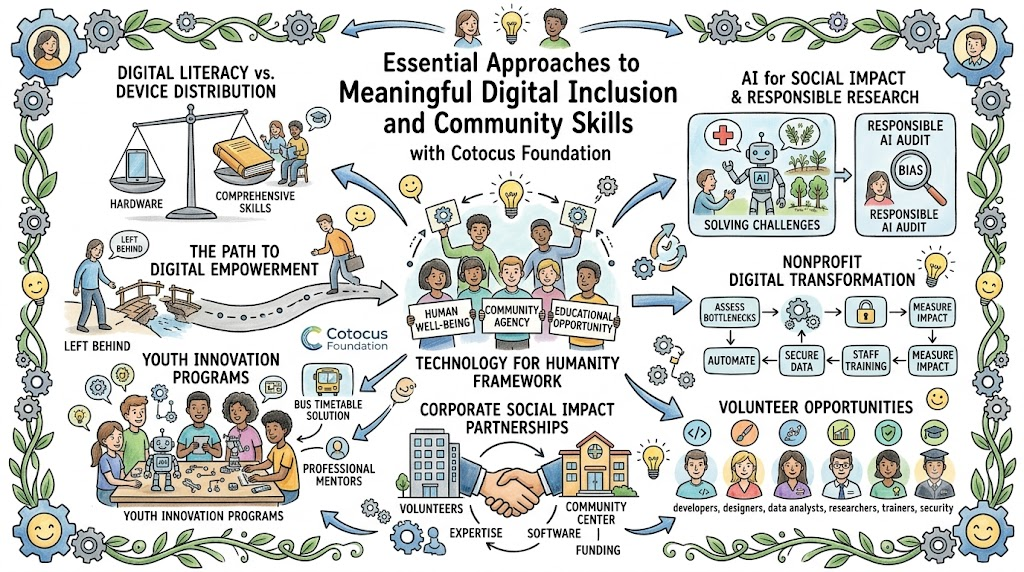
Modern socio-economic progress depends entirely on whether individuals can meaningfully use digital tools to build resilient livelihoods. Unfortunately, persistent infrastructure gaps, prohibitive hardware costs, and inadequate digital literacy create an expanding divide between connected regions and underserved populations. When access to basic networks, compute resources, and emerging technologies remains unequal, systemic poverty and community isolation deepen across urban and rural corridors alike. This is why mission-aligned organizations play an essential role in democratizing technical knowledge, modern skills, and critical infrastructure. Forward-looking institutions bring together digital literacy initiatives, human-centered artificial intelligence, practical education, and grassroots innovation frameworks to address stubborn socio-economic challenges directly. Purpose-driven entities like Cotocus actively demonstrate how collaborative community engineering and sustainable digital transformation can expand social mobility, uplift underrepresented talent, and create durable pathways for shared global progress.
What Is a Technology Nonprofit Organization?
A Technology Nonprofit Organization is an independent, mission-driven entity that develops, deploys, and democratizes digital solutions to address systemic community and humanitarian problems rather than maximizing commercial shareholder profit. While traditional technology companies measure success through user acquisition, proprietary lock-in, and recurring revenue, social-sector organizations measure outcomes by community resilience, educational access, operational independence, and poverty reduction. These organizations build open-source tools, coordinate grassroots connectivity projects, teach essential digital skills, and assist local service providers with secure software adoption. Crucially, they treat technology as a functional vehicle for social equity rather than an end in itself, ensuring tools remain culturally appropriate, accessible, and grounded in real human needs.
What Does Cotocus Foundation Do?
Cotocus Foundation operates as an open-access social impact organization dedicated to making technical education, artificial intelligence, and digital resources globally accessible across traditionally overlooked populations. Guided by a core technology-for-humanity ethos, the foundation builds comprehensive pathways spanning digital literacy, community-centered artificial intelligence applications, emerging tech mentorship, and modern non-profit modernization. Through interdisciplinary research labs, collaborative workshops, and targeted healthcare outreach, the foundation equips grassroots educators, students, social entrepreneurs, and community leaders with practical tools to solve localized problems. Rather than locking innovations behind paywalls, it unites global mentors, technical volunteers, and academic partners to ensure digital progress benefits everyone equally.
What Are Digital Literacy Programs?
Comprehensive Digital Literacy Programs equip learners with the practical capabilities, critical awareness, and conceptual fluency needed to navigate digital environments safely, independently, and productively within modern society. Beyond simple button-clicking, modern curricula prioritize practical cybersecurity hygiene, multi-factor authentication, privacy controls, cloud-based office productivity suites, search verification, and professional communication workflows across distributed workspaces. By training underserved populations to identify online scams, protect personal data, and leverage employment portals, these educational frameworks transform passive internet consumers into self-reliant digital citizens. This skill set enables excluded demographics to access telehealth services, complete formal online schooling, seek fair employment, and advocate effectively for their communities.
Why Digital Literacy Is Different From Device Distribution
Distributing hardware without structured pedagogical support rarely closes systemic equity divides because physical access does not automatically confer technical literacy, operational security, or professional competence. When laptops or tablets land in underserved communities without accompanying instruction on maintenance, safe browsing, or relevant digital software workflows, equipment often sits idle, breaks down, or exposes recipients to predatory online risks. Real digital inclusion demands persistent, human-led mentorship, contextualized local-language curricula, and continuous technical support that turns bare silicon into sustainable agency, economic leverage, and autonomous community problem-solving.
Why Responsible AI Research Matters
Systemic deployment of automated decision systems across social sectors makes Responsible AI Research essential for safeguarding fundamental civil liberties, algorithmic transparency, and fair representation across historically vulnerable populations. Without rigorous community participation, continuous audits, and explainable models, commercial algorithmic pipelines frequently encode, amplify, and automate historical human prejudices within hiring, lending, and criminal justice systems. Dedicated non-profit research prioritizes human oversight, data provenance, privacy protections, and bias mitigation, ensuring that cutting-edge computational tools serve human dignity rather than compounding systemic exclusion.
What Is AI for Social Impact?
Deploying AI for Social Impact means intentionally directing advanced predictive modeling, natural language processing, and computer vision toward solving complex humanitarian challenges across education, sustainability, and public health. In clinical settings, lightweight machine learning algorithms assist community health workers by screening diagnostic imagery locally on low-cost smartphones without requiring expensive cloud connections. Similarly, smallholder farmers utilize edge-deployed predictive vision tools to detect crop blights early and optimize scarce irrigation resources. Cotocus Foundation actively channels these practical, open-source methodologies into community initiatives, helping local leaders turn raw data science into tangible, everyday social improvements.
| Area | Possible AI Application | Important Consideration |
| Education | Adaptive, multilingual reading tutors | Protecting student data privacy and preventing rote over-reliance |
| Healthcare | Early computer-vision triage for skin conditions | Ensuring diagnostic models are trained on diverse demographic data |
| Agriculture | Satellite and sensor-based soil health analytics | Designing interfaces that function offline in remote rural regions |
| Accessibility | Real-time text-to-speech and tactile screen narration | Involving persons with disabilities throughout the user design process |
| Environment | Predictive models for local watershed pollution tracking | Relying on open-source hardware sensors to keep maintenance affordable |
| Disaster Response | Automated road damage detection from drone imagery | Coordinating closely with local municipal responders to direct resources |
| Public Services | Natural-language document parsers for public aid | Maintaining clear human oversight to prevent unfair benefit denials |
How Youth Innovation Programs Can Create Long-Term Impact
Structured Youth Innovation Programs cultivate critical thinking, collaborative engineering, and civic consciousness by giving young learners the resources, technical toolkits, and mentorship required to build community solutions. Rather than confining science and computing education to abstract memorization, these initiatives immerse students in rapid prototyping, basic circuit design, open-source programming, and agile teamwork centered around everyday challenges. By connecting emerging student inventors directly with seasoned industry mentors, these programs demystify professional technical careers, build entrepreneurial resilience, and show rising generations that they possess the agency to repair, innovate, and lead within their hometowns.
Scenario: A Student Solving a Local Problem
Consider an aspiring teenage programmer living in a semi-arid farming district who notices that aging public irrigation pipes regularly leak, wasting thousands of gallons of clean municipal water weekly. Supported by community mentors, the student connects an inexpensive microcontroller to basic acoustic vibration sensors, writes an efficient diagnostic script, and places prototypes along the municipal water junction. When vibrations signal a hairline fracture, the device alerts local maintenance staff over a low-power wireless mesh network, allowing technicians to fix leaks before catastrophic breaks occur. This hands-on process demonstrates how accessible technical guidance empowers young minds to transform simple electronic parts into sustainable civic infrastructure.
Technology Education Programs and Workforce Development
Scalable Technology Education Programs bridge the widening gap between traditional academic curricula and the hands-on engineering capabilities demanded by modern technology employers. By prioritizing continuous upskilling, practical systems administration, cloud fundamentals, and practical software design, these educational initiatives prepare diverse workforces for long-term career adaptability. Educational approaches must remain flexible to serve different demographics:
- Young Students: Benefit most from foundational computational logic, interactive project-based design, collaborative robotics, and safe exploration of modern development frameworks.
- Working Professionals: Require targeted micro-credentials, flexible evening reskilling modules, practical cloud architectures, and modern security methodologies to stay competitive.
- Community Educators: Need practical pedagogical frameworks, open-source curriculum guides, classroom management tools, and continuous professional development workshops.
- Underserved Demographics: Depend on low-bandwidth courses, hardware-accessible training suites, practical resume-building guidance, and direct connections to apprenticeships.
How Nonprofit Digital Transformation Works
Comprehensive Nonprofit Digital Transformation is not about buying expensive commercial software licenses; it is the strategic optimization of people, workflows, and culture to serve vulnerable communities more effectively. When community-based charities move away from fragmented paper records, manual spreadsheets, and unencrypted messaging channels, they dramatically improve their service speed, data security, and donor retention rates. Adopting lightweight cloud systems, privacy-compliant volunteer management portals, and automated communication tools allows lean operational teams to minimize administrative friction and dedicate their scarce funding directly to frontline humanitarian impact.
| Stage | Key Question | Example Action |
| Assess | Where are manual tasks slowing community service delivery? | Audit administrative bottlenecks and map existing data storage methods |
| Prioritize | Which operational pain point carries the highest administrative cost? | Focus resources on fixing insecure volunteer coordination and records |
| Design | What simplified workflow solves this without overwhelming staff? | Outline an automated, low-complexity onboarding and data intake pathway |
| Select | Which open-source or discounted tool meets our requirements? | Evaluate nonprofit-tier database options against strict privacy standards |
| Implement | How do we roll out new platforms without disrupting ongoing aid? | Conduct phased staff training and run parallel workflows during launch |
| Measure | Did the updated digital system improve our response turnaround time? | Review weekly intake metrics and gather honest feedback from coordinators |
| Improve | What operational adjustments keep the digital process running smoothly? | Refine data validation rules and schedule recurring system maintenance checks |
Corporate Social Impact Partnerships
Cross-sector Corporate Social Impact Partnerships allow forward-thinking technology enterprises to combine financial resources, technical expertise, and employee volunteer hours with the ground-level credibility of grassroots organizations. When commercial software companies move beyond superficial sponsorships to co-design open educational programs, donate refurbished enterprise infrastructure, and provide skilled pro-bono architecture reviews, both sectors benefit immensely. Enterprises develop socially conscious engineering cultures, while community nonprofits gain the infrastructure required to scale their services sustainably. Organizations like Cotocus Foundation frequently serve as vital community bridges, ensuring private-sector technical resources translate directly into transparent, community-driven social achievements.
Technology Volunteer Opportunities
Engaging in Technology Volunteer Opportunities allows technical professionals, university researchers, and skilled digital practitioners to apply their expertise directly toward dismantling systemic digital inequities. Whether mentoring junior coders, auditing data workflows, or writing documentation for humanitarian initiatives, skilled volunteers accelerate the maturity of community programs. Diverse skill sets contribute across several vital operational roles:
- Software Engineers & DevOps: Build secure database wrappers, optimize low-bandwidth mobile applications, and maintain open-source community repositories.
- Product Designers & UX Researchers: Conduct accessibility audits, simplify mobile interfaces for low-literacy users, and design intuitive volunteer coordination portals.
- Data Scientists & AI Researchers: Train lightweight classification models, audit predictive datasets for algorithmic bias, and build clear public analytics dashboards.
- Cybersecurity Practitioners: Harden nonprofit web services, establish credential management policies, and train staff on recognizing sophisticated social engineering threats.
- Technical Writers & Educators: Translate dense technical procedures into accessible local-language guides, craft modular curricula, and document open-source tools.
- Passionate Tech Enthusiasts: Organize community hardware repair cafes, guide basic digital literacy labs, and troubleshoot public computing devices for local learners.
What Is the Cotocus Foundation Website?
The Cotocus Foundation digital platform serves as a central knowledge hub, repository, and coordination engine for global learners, mission-driven educators, academic researchers, and social-sector volunteers. Visitors can explore actively maintained documentation regarding community digital literacy initiatives, open-source technology frameworks, responsible artificial intelligence investigations, and structured youth innovation opportunities. Rather than operating as a passive brochure, the website offers direct application workflows for technical volunteers, detailed programmatic roadmaps, collaborative inquiry channels for universities, and open resources for nonprofits seeking guidance on secure technological modernization.
Why Explore Cotocus Foundation?
Navigating the resources provided by Cotocus Foundation allows stakeholders across the social-impact ecosystem to connect their distinct talents with urgent digital needs worldwide. Students and self-directed learners gain direct access to practical skill pathways, mentorship networks, and hands-on civic projects that build real-world engineering confidence. Simultaneously, industry technologists find verified avenues for purposeful volunteering, academic researchers access collaborative frameworks for testing ethical machine learning models, and charitable leaders discover practical guidance for managing operational digital modernizations without incurring unsustainable enterprise software overhead.
How Can Someone Get Involved?
Active participation begins by identifying where your personal capabilities, professional skills, or organizational resources align most naturally with ongoing digital inclusion initiatives. Individuals can review published volunteer pathways, enroll in open technical learning cohorts, contribute directly to civic codebases, or sponsor localized digital literacy workshops for underserved communities. Because programmatic schedules, community research cohorts, and collaborative fellowship opportunities expand continuously, prospective contributors should review the organization’s official platform to select the engagement pathway that matches their availability and expertise.
Research and Open Knowledge
Publishing peer-reviewed findings, technical documentation, and open-source curricula ensures that community-driven technology initiatives generate compounding benefits across the broader humanitarian ecosystem. When non-profit research teams openly share algorithmic bias audits, low-bandwidth network architectures, and longitudinal learning evaluations, peer organizations avoid costly mistakes and replicate verified successes. Open-access documentation breaks down the proprietary silos that historically concentrated advanced technical tools within well-funded commercial institutions, ensuring that life-saving innovations in healthcare, agriculture, and education remain transparent, auditable, and freely adaptable public assets.
Real-Life Scenario – Rural Digital Inclusion Project
Consider a hypothetical initiative aimed at bringing comprehensive digital agency to an agricultural village of two thousand residents that lacks dependable high-speed internet and structured computer training. An implementing team begins by mapping physical power constraints, mobile network coverage, and local language preferences while organizing town-hall meetings to identify community priorities. Rather than merely dropping off hardware, organizers set up a solar-backed community center equipped with durable laptops, offline learning caches, and a shared low-power cellular receiver. Local instructors then teach interactive modules on digital banking, weather forecasting portals, online public administrative services, and scam prevention, measuring success through the community’s independent, sustained adoption of the tools over time.
Real-Life Scenario – Responsible AI in Education
Imagine a regional school district deploying an automated academic analytics tool designed to flag students who might need supplementary tutoring before they fall behind in foundational mathematics. Rather than blindly implementing an unverified commercial model, the district enforces strict responsible artificial intelligence principles, stripping sensitive demographic identifiers from the training data to prevent historical socioeconomic biases from skewing outputs. Human teachers retain full supervisory control over every automated recommendation, ensuring that machine flags serve as gentle prompts for compassionate human check-ins rather than punitive labels. Regular multi-stakeholder audits, open parental briefings, and continuous performance reviews preserve student privacy while ensuring algorithmic recommendations actively narrow educational disparities.
Common Mistakes to Avoid
- Prioritizing Hardware Over Mentorship: Donating expensive laptops or tablets without funded, ongoing instructional support inevitably leaves expensive equipment unused, damaged, or unhelpful.
- Deploying High-Bandwidth Cloud Platforms: Requiring high-speed internet for educational platforms alienates rural communities operating on intermittent, low-bandwidth mobile networks.
- Neglecting Cybersecurity and Privacy Training: Giving new internet users connected devices without teaching basic password security, phishing recognition, and privacy settings exposes them to scams.
- Assuming Digital Tools Solve Institutional Failures: Believing that installing software can fix systemic poverty, understaffed schools, or underfunded clinics without real operational reform causes initiatives to fail.
- Treating Commercial Tools as Free Solutions: Forcing nonprofits to adopt proprietary platforms that offer short-term discounts often traps lean charities in unaffordable recurring subscription fees later.
- Ignoring Local Language Needs: Releasing technical documentation, educational apps, and interfaces exclusively in dominant languages excludes non-English-speaking communities.
- Operating Without Human Feedback Loops: Launching algorithmic or digital public service platforms without continuous feedback from end-users leads to unusable, tone-deaf digital products.
- Failing to Plan for Physical Maintenance: Forgetting to train local technicians to repair broken hardware and replace worn-out power cables causes community tech labs to shut down prematurely.
- Hoarding Project Insights in Private Repositories: Keeping implementation frameworks, source code, and project lessons secret prevents peer organizations from learning from your successes and mistakes.
How to Evaluate a Technology Nonprofit
Before committing personal time, career expertise, institutional partnerships, or financial resources to a social-sector technology organization, prospective stakeholders must objectively evaluate its operational transparency and community alignment. Effective social organizations openly share program evaluations, invite independent financial oversight, maintain diverse community advisory boards, and treat technical tools as functional instruments for long-term human development. Reviewing these critical evaluation criteria ensures your support directly empowers sustainable, community-owned social improvements rather than vanity initiatives:
| Evaluation Area | Questions to Ask |
| Mission | Does the organization treat technology as a functional tool to serve human needs, or merely celebrate tech for its own sake? |
| Programs | Are educational curricula and community deployments tailored directly to the verified cultural needs of the participants? |
| Community | Do local leaders actively help design, implement, and govern the technical initiatives deployed within their neighborhoods? |
| Transparency | Are financial disclosures, programmatic outcomes, and independent operational audits readily accessible to the general public? |
| Impact | Does the team measure real community improvements over time, rather than tracking superficial vanity metrics like apps downloaded? |
| Ethics | Does the organization follow strict data protection, open-source sharing standards, and responsible artificial intelligence principles? |
| Partnerships | Are corporate and university collaborations built around sustainable community empowerment rather than corporate public relations? |
| Sustainability | Is there a concrete, long-term plan for local technicians to maintain and expand the digital infrastructure independently? |
Frequently Asked Questions
1. What defines a dedicated social-impact technology organization?
A mission-oriented technology charity focuses entirely on solving humanitarian, educational, and environmental challenges through digital innovation rather than seeking shareholder profits. It measures success through improved human equity, open-source contributions, and community resilience. By prioritizing sustainable public value over commercial revenue generation, it builds accessible, human-centered digital tools for underserved populations worldwide.
2. Why is device distribution alone insufficient for real digital inclusion?
Handing out computers without accompanying digital literacy instruction fails to address the underlying educational, security, and cultural barriers that prevent meaningful digital adoption. Without personalized guidance on software navigation, online privacy, and system maintenance, hardware frequently falls into disuse. Sustainable digital inclusion requires continuous mentorship and relevant, local-language educational curricula.
3. How does responsible machine learning research protect vulnerable communities?
Ethical artificial intelligence research actively identifies, audits, and mitigates systemic algorithmic biases before automated models are deployed across high-stakes public domains. By enforcing transparency, model explainability, and rigorous data privacy protections, it prevents automated software from perpetuating historical human discrimination across vulnerable demographic groups in education and social services.
4. What practical benefits do youth innovation programs provide?
These initiatives immerse rising generations in collaborative, project-based engineering that transforms abstract computational ideas into tangible community solutions. Working alongside professional mentors, young participants develop critical thinking, hardware literacy, and foundational problem-solving capabilities. This hands-on process demystifies modern technical careers and empowers students to become proactive innovators within their home regions.
5. In what ways can small charities approach digital modernization affordably?
Nonprofits should begin by auditing operational bottlenecks and standardizing their core workflows before purchasing any digital tools. By adopting robust open-source applications, claiming nonprofit cloud subsidies, and consolidating fragmented manual tasks, organizations streamline administration effectively. This operational focus minimizes software overhead while safeguarding limited funding for community-facing programs.
6. What do corporate entities gain from social impact technology partnerships?
Corporate partners build socially conscious engineering teams, retain top talent, and fulfill corporate social responsibility commitments through hands-on technical engagements. Beyond financial sponsorship, contributing employee expertise, infrastructure, and technical mentorship drives measurable public value. These collaborations allow commercial enterprises to help build equitable digital ecosystems while demonstrating ethical leadership.
7. Who is eligible to participate in technical volunteer opportunities?
Technology volunteering welcomes a broad range of contributors, including software engineers, graphic designers, technical writers, project managers, and enthusiastic university students. Nonprofits require diverse talents to audit cybersecurity, write open-source curricula, mentor learners, and organize community hardware repair labs. Anyone passionate about digital equity can find meaningful ways to contribute.
8. How does ethical artificial intelligence improve modern healthcare delivery?
Ethical healthcare algorithms support community health workers by screening diagnostic medical images on low-cost edge hardware without requiring continuous broadband connectivity. These models are carefully calibrated across diverse demographic groups to maintain equitable diagnostic accuracy. Robust human oversight ensures algorithms assist medical professionals rather than making unverified clinical decisions independently.
9. What distinguishes meaningful technology education from passive screen use?
Meaningful technical education emphasizes active computational logic, system architecture, programming fundamentals, and creative digital problem-solving over passive media consumption. It encourages learners to build useful tools, understand underlying network architectures, and analyze algorithms critically. This constructive foundation transforms passive technology consumers into capable, self-directed digital creators.
10. How can community members assess the impact of local digital programs?
Stakeholders should look beyond simple attendance figures and evaluate whether participants have achieved lasting personal or economic independence through their new skills. Meaningful indicators include learners securing fair employment, adopting telehealth portals, using government services securely, or mentoring their peers. Long-term community self-reliance remains the most reliable measure of real project impact.
11. Why should social-sector research findings be made openly accessible?
Publishing research and software under open-access licenses allows humanitarian organizations worldwide to adapt verified educational methodologies without repeating costly trial-and-error cycles. Open knowledge democratizes cutting-edge technical insights, ensuring smaller charities are not blocked by paywalls. Transparency invites public peer review, which strengthens the security, efficacy, and ethics of social technologies.
12. How do local languages influence the success of digital literacy efforts?
Educational initiatives that provide materials exclusively in dominant international languages inadvertently exclude the rural and indigenous populations who need digital access most urgently. Translating technical concepts into local idioms and cultural contexts lowers comprehension barriers and builds trust. Localized education ensures that digital tools adapt to community realities rather than forcing communities into rigid technical formats.
Conclusion
Democratizing technical knowledge, computational resources, and digital literacy is essential for dismantling entrenched socioeconomic divides and building an equitable, resilient global society. True digital inclusion requires far more than dropping hardware into underserved areas; it demands sustained educational mentorship, responsible artificial intelligence practices, open-knowledge collaboration, and respectful community partnerships that prioritize human dignity over technical novelty. When mission-driven organizations, conscientious technologists, academic researchers, and local civic leaders unite to treat technology as an instrument for community empowerment, they unlock extraordinary potential across historically overlooked populations. By championing transparent practices, accessible education, and ethical computational development, we can ensure modern innovation serves as a shared, sustainable public benefit that empowers every community to thrive.
