Introduction
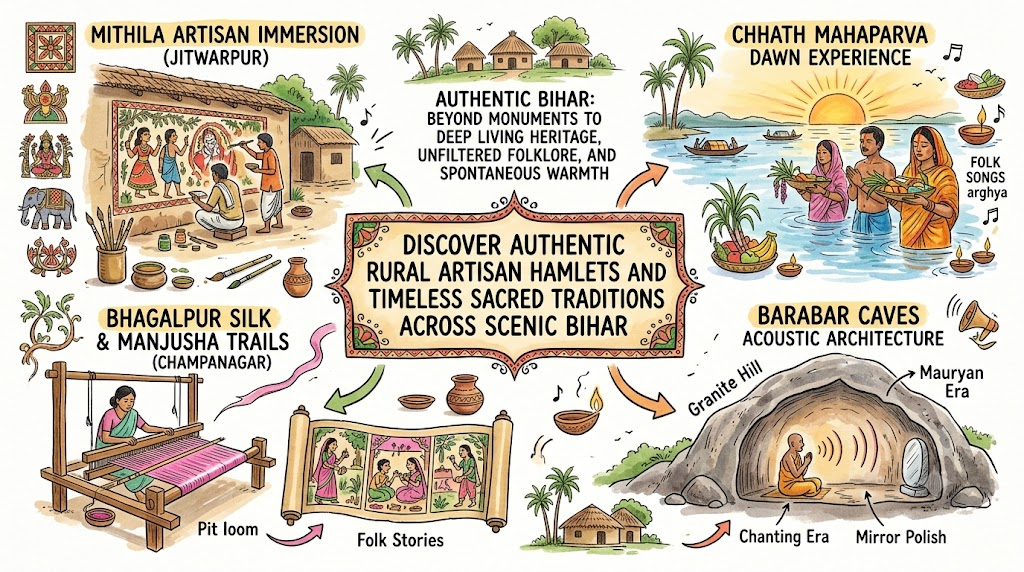
While mass tourism directs hurried crowds toward commercialized circuits and selfie points, authentic Bihar lives in the unhurried rhythms of village courtyards, artisanal loom settlements, and age-old kitchen hearths. Traveling here means moving beyond superficial monuments to encounter deep living heritage, unfiltered folklore, and spontaneous warmth that mainstream holidays rarely touch.
Stepping into a quiet artisan hamlet in Madhubani or boarding a country boat at dawn with local fishermen redefines cultural exploration. Embracing grassroots experiences in Bihar connects your journey with living traditions, sacred ecological rituals, and communities whose creative lineages stretch back through thousands of unbroken years.
Why Bihar is a must-visit city
Bihar holds an undeniable position as an intellectual, philosophical, and spiritual crucible of South Asia. As the cradle of Mauryan governance, ancient university learning, and indigenous artistic schools, the state offers unmatched cultural substance. Modern four-lane highways, widespread rail links including Vande Bharat routes, and active commercial airports at Patna and Gaya now make this profound terrain accessible to intrepid explorers and leisure travelers alike.
An experiential journey through the state weaves through distinct cultural zones: the artistic soil of Mithila, the riverine weaving communities of Anga, and the sacred pastoral tracts of Magadh. Moving through these corridors allows you to engage with master artisans, sample hyperlocal agricultural flavors, and experience communal river celebrations without artificial tourist packaging.
| Key Cultural Facts | Ground Details |
| Primary Entry Gateways | Patna Airport, Gaya Airport, Darbhanga Airport |
| Core Cultural Hubs | Mithilanchal (North), Magadh (Central/South), Anga (East) |
| Peak Experiential Season | October to March (Crisp weather, major harvest festivals) |
| Living Art Forms | Mithila/Madhubani, Manjusha Scroll Art, Sujani Embroidery, Sikki Grass Work |
| Intangible Highlights | Chhath Mahaparva, Baidyanath Yatra songs, village Haat culture |
Best Places or Experiences
Jitwarpur Artisan Village Immersion
In the village of Jitwarpur near Madhubani, art is neither an industry nor a museum exhibit—it is daily breath. Passing through narrow dirt lanes reveals mud-plastered facades adorned with natural pigments derived from lampblack, turmeric, palash blossoms, and crushed leaves. Generations of families work on open verandahs, applying fine bamboo twigs and nibs onto handmade paper and fabric with fluid precision.
The village holds an extraordinary cultural legacy, having produced multiple National Award and Padma Shri winning masters across distinct stylistic sub-genres like Kachni, Bharni, and Godna. Spending a morning here allows you to sit beside master painters, listen to Maithili folk songs woven into every brushstroke, and understand the deep cosmological stories embedded in ceremonial Kohbar murals.
- Location: Madhubani District; approximately 175 km northeast of Patna and 4 km from Madhubani railway town.
- Why it is worth visiting: Direct interaction with living master artists in their ancestral home studios without retail middlemen.
- Best things to do: Attend a hands-on natural pigment workshop, watch Godna tattoo art painted onto cotton canvas, and purchase certified folk paintings directly from women-led cooperatives.
- Best time to visit: November through February; early mornings between 8:00 AM and 11:00 AM when artists paint in soft courtyard light.
- Ideal for whom: Art collectors, textile students, slow travelers, and cultural researchers.
- Travel tip: Always ask for permission before photographing domestic verandahs, and carry sufficient cash since village home studios rarely operate card machines.
Champanagar Tussar Silk and Manjusha Trails
Champanagar in Bhagalpur represents an ancient mercantile center where the rhythmic clatter of wooden pit looms has echoed for centuries. Known historically as “Silk City,” this neighborhood is the beating heart of wild Tussar and mulberry silk weaving. Wandering through its narrow streets leads to family-run workshops where raw cocoon processing, spinning, and handloom weaving occur within interconnected family quarters.
Complementing this weaving heritage is Manjusha art, an indigenous narrative scroll painting form unique to the Anga region. Centered on the folklore of Bihula and the serpent goddess Bishahari, this vibrant craft uses an unmistakable palette of only three colors—pink, green, and yellow—often painted directly onto raw silk running yardage.
- Location: Bhagalpur District; 235 km east of Patna via NH31 and Vikramshila Setu.
- Why it is worth visiting: Witnessing the complete farm-to-fabric lifecycle of wild Tussar silk combined with rare tribal serpent scroll painting.
- Best things to do: Observe the reel-spinning of silk yarn from local cocoons, commission custom Manjusha-painted dupattas, and talk with master weavers preserving heritage weaves.
- Best time to visit: October to March; midday hours (10:00 AM to 3:00 PM) when weaver looms operate in natural light.
- Ideal for whom: Textile purists, handloom aficionados, and design historians.
- Travel tip: Purchase unstitched silk fabrics by weight or meter directly from registered weavers’ credit societies for verified purity.
Chhath Mahaparva Riverfront Dawn Experience
Chhath is not merely a festival; it is the ultimate ecological and egalitarian celebration of the sun god and water bodies, observed with unbending devotion across Bihar. During the four-day observance in autumn and spring, hundreds of thousands of devotees gather at the banks of the Ganges in Patna and rural village ponds. Devotees offer arghya (libations) to the setting and rising sun while standing waist-deep in cool water, accompanied by ancestral folk chants sung in unison.
The visual and spiritual impact of the riverbanks at dawn is unmatched. Thousands of bamboo soop baskets filled with seasonal thekua, sugarcane, pomelos, and brass lamps glow against the predawn river mist. Experiencing Chhath from a quiet wooden boat or alongside a welcoming local host family offers a humbling glimpse into community solidarity and nature reverence devoid of priestly intermediaries.
- Location: Along the Ganga Ghats of Patna (Collectorate Ghat, Digha Ghat, Gaighat) and rural riversides statewide.
- Why it is worth visiting: The world’s most authentic, community-driven solar veneration ritual celebrated without commercial staging.
- Best things to do: Board a pre-dawn wooden country boat to watch the sunrise arghya, sample consecrated traditional Thekua prasad, and listen to devotional folk ballads sung by women elders.
- Best time to visit: Kartik Chhath (October–November) or Chaiti Chhath (March–April); pre-dawn hours between 4:30 AM and 7:00 AM.
- Ideal for whom: Cultural documentarians, spiritual travelers, and audio-visual storytellers.
- Travel tip: Riverfront banks are extremely sacred during rituals; remove footwear where requested, respect personal prayer spaces, and never step over prayer baskets.
Barabar Caves Acoustic Architecture Expedition
Carved out of monolithic granite hills in Jehanabad, the Barabar Caves date back to the Mauryan Empire under Emperor Ashoka and his grandson Dasharatha. Built primarily for ascetics of the ancient Ajivika sect, these subterranean chambers showcase an astonishing feat of engineering: interiors polished to a mirror-like sheen that reflect lantern light like burnished glass.
The real marvel of caves like the Lomas Rishi and Sudama chambers lies in their resonant acoustic properties. A soft human vocal drone or sustained chant inside the circular chamber reverberates for several seconds, transforming the stone hollow into an acoustic meditation space. Outside, the windswept granite boulders offer panoramic views of the surrounding agrarian plains.
- Location: Jehanabad District; approximately 70 km south of Patna and 35 km north of Gaya.
- Why it is worth visiting: The oldest surviving rock-cut cave monuments in India featuring mirror-polished granite interiors and otherworldly natural echo chambers.
- Best things to do: Test the sonic resonance by chanting inside the inner sanctum of Sudama cave, photograph the carved chaitya archway of Lomas Rishi cave, and hike the granite ridge for sweeping countryside views.
- Best time to visit: November to February; late morning (10:00 AM to 1:00 PM) when the sunlight strikes the cave entrances.
- Ideal for whom: Architecture historians, acoustic enthusiasts, sound designers, and off-grid wanderers.
- Travel tip: Carry a powerful headlamp or torch because interior chambers have zero artificial illumination and remain pitch black.
Village Haat and Organic Sattu Kitchens
To understand the culinary soul of rural Bihar, you must spend a late morning navigating a weekly rural haat (bazaar) in the agricultural belts of Bhojpur or Vaishali. Unlike modern retail zones, these open-air markets overflow with earthen pots, woven bamboo gear, cold-pressed mustard oil, and seasonal produce plucked hours earlier from alluvial river flats.
The culinary anchor here is sattu—roasted gram flour—prepared freshly on cast-iron roasting pans filled with heated river sand. Tasting stone-ground sattu mixed into a cooling savory summer beverage seasoned with green chilies, mint, and black salt, or baked into charcoal-roasted litti basted with pure desi ghee, introduces you to the rustic, nourishing roots of Bihari cuisine.
- Location: Rural zones across Vaishali, Bhojpur, and Saran districts; easily accessible within 30 to 50 km from Patna.
- Why it is worth visiting: Direct access to time-honored slow food, ancient processing methods, and vibrant village barter culture.
- Best things to do: Watch traditional sand-roasting of black chickpeas, eat steaming litti-chokha prepared over dried cow-dung cake fires, and pick up pure mustard oil or handmade clay water bottles.
- Best time to visit: Year-round; mornings from 7:30 AM to 11:30 AM on designated local market days (usually Wednesdays and Sundays).
- Ideal for whom: Culinary adventurers, food writers, and slow-life seekers.
- Travel tip: Look for vendors roasting litti directly over traditional earthen stoves and avoid commercial stalls using stale frying oil.
Offbeat Exploration: Hidden Gems Tourists Miss
Telhar Kund and Karkat Waterfalls, Kaimur
Tucked away in the forested plateaus of Kaimur, Telhar Kund is a dramatic natural waterfall tumbling over vertical rocky cliffs into a deep emerald pool. Unlike crowded hill station falls, this forest sanctuary remains largely serene on weekdays. The surrounding deciduous jungle provides excellent canopy birding and hidden canyon hiking trails leading toward the nearby Karkat eco-tourism zone.
Cyclopean Wall and Chariot Marks, Rajgir
While most visitors head straight for the Rajgir ropeway, few spend time walking along the ancient Cyclopean Wall—a massive 40-kilometer defensive barrier of raw, unhewn stone blocks constructed without mortar before the 3rd century BCE. Nearby, deeply etched parallel ruts carved into solid rock, known as the Chariot Wheel Marks, point to the legendary military pathways of ancient Magadha.
Simaria Riverfront Ghats, Begusarai
Located along the northern bank of the Ganges, Simaria is the sacred birthplace of national poet Ramdhari Singh Dinkar. The vast sandbanks here host traditional spiritual congregations and uncommercialized boat-making yards. Visiting in early winter offers misty views of migratory Siberian waterfowl landing on seasonal river shoals without a single tour bus in sight.
Detailed Practical Guidance for Travelers
| Destination | Standard Entry Fee | General Timings | Best Local Food Options Nearby | Recommended Nearby Attractions |
| Jitwarpur Village | Free | Sunrise to Sunset | Maithili Fish Curry, Makhana Kheer | Saurath Sabha ground, Rajnagar Palace ruins |
| Champanagar Weavers | Free | 9:00 AM – 6:00 PM | Bhagalpuri Katarni Chura, Kadhi Bari | Vikramshila University ruins, Mandar Hill |
| Chhath Riverfront | Free | Open 24 Hours (Event Based) | Traditional Thekua, Litti Chokha | Patna Museum, Bihar Museum, Golghar |
| Barabar Caves | Free (ASI site) | 6:00 AM – 5:30 PM | Sattu Paratha, Bihari Thali at Jehanabad | Nagarjuni Caves, Kauva Dol archaeological hill |
| Rural Sattu Kitchens | Free (Pay per meal) | 7:00 AM – 2:00 PM | Chokha, Roasted Sattu Sharbat | Vaishali Ashokan Pillar, Kutagarasala Vihara |
Logistics & On-Ground Navigation
Local Transport Options
- Railways: The backbone of intra-state travel; high-speed superfast and express trains link Patna with Madhubani, Bhagalpur, Gaya, and Darbhanga seamlessly.
- Auto-Rickshaws & E-Rickshaws: Excellent for short hops in district towns and craft clusters; e-rickshaws dominate rural lanes in Madhubani and Champanagar.
- Private Car Rentals: Hiring an air-conditioned commercial vehicle with an experienced local driver is the most reliable way to access off-grid locations like Barabar and Kaimur.
- State Transport Buses: Bihar State Road Transport Corporation (BSRTC) operates comfortable AC electric and deluxe buses linking Patna to all major district headquarters.
Budget Planning
- Backpacker / Solo Explorer: ₹1,000 – ₹1,600 per day (Covers homestays or budget lodges, local rail and shared autos, and hearty authentic roadside meals).
- Mid-Range / Comfort Explorer: ₹3,200 – ₹5,500 per day (Covers heritage hotels or quality 3-star properties, dedicated private taxi, guide fees, and sit-down dining).
Safety and Inclusivity Tips
- Families: Well-paved expressways make road trips smooth; carry packaged water and pre-arranged snack boxes when venturing into rural districts.
- Couples: Rural communities are conservative but warm; modest dress codes and discreet public demeanor ensure a welcoming reception.
- General Safety: Rural roads lack street lighting; wrap up outdoor explorations by twilight and reach district headquarters before late night hours.
Strategic Travel Planning Guardrails
Travel Planning Tips for Bihar
- Time Visits Around Art and Harvest Cycles: Travel between October and March to catch clear skies, cultural celebrations, and active painting seasons.
- Carry Liquid Cash for Rural Crafts: Small weaver families and village artists rarely possess card swipe machines; carry cash denominations of ₹100 and ₹500.
- Respect Matriarchal Studio Traditions: In Mithila villages, women artists maintain sacred ritual workspaces; always remove footwear before stepping onto painted verandahs.
- Adopt the Early-Morning Rhythm: Village life and rural haats start bustling right after dawn and slow down by mid-afternoon.
- Pack Portable Illumination: Monolithic caves and rural foot trails require a dedicated torch or headlamp with strong battery life.
Common Mistakes to Avoid
- Overpacking Opposing Sectors: Do not attempt to visit Madhubani in the far north and the Kaimur waterfalls in the far south in a tight two-day span.
- Relying Exclusively on Digital Payments: Remote craft hamlets often face mobile network fluctuations, making UPI transfers temporarily unreliable.
- Ignoring Village Elders: Always greet village mukhiyas or courtyard matriarchs politely before setting up tripods or sketchbooks in hamlets.
- Skipping Seasonal Produce: Overlooking local farm-to-table specialties like tender Parwal sweets, fresh Makhana, or winter Tilkut robs your palate of true regional flavors.
- Treating Living Culture as a Photo Booth: Spend time conversing with artisans and listening to their lineage stories rather than just capturing hurried portraits.
Suggested Itinerary Blueprints
1. Day Quick Dash (Patna Living Heritage Circuit)
Tailored for transit travelers and business visitors seeking authentic local flavor within 12 hours.
- 06:00 AM – 08:30 AM: Early morning wooden boat ride along the historic ghats of old Patna, watching morning prayers and river life.
- 09:00 AM – 10:30 AM: Authentic local breakfast of piping-hot litti chokha and jalebi at a trusted neighborhood establishment near Gandhi Maidan.
- 11:00 AM – 02:00 PM: Exploring the folk art, terracotta, and textile galleries inside the world-class Bihar Museum.
- 03:00 PM – 06:00 PM: Artisan visit to the Upendra Maharathi Shilp Anusandhan Sansthan to observe live lacquerware, sikki grass, and stone carving.
2. Day Deep-Dive (Mithila Art and Rural Life Loop)
An immersive two-day escape exploring the artistic heartlands of North Bihar.
- Day 1: Morning arrival at Darbhanga Airport; drive to Madhubani. Spend the day in Jitwarpur and Ranti villages sitting with master artists and practicing line drawing. Overnight at a heritage home or city guesthouse in Madhubani.
- Day 2: Visit the historic Rajnagar Palace ruins at dawn for architectural photography. Continue to Saurath village to learn about traditional palm-leaf genealogy manuscripts before driving back to Darbhanga for evening flights.
3. Complete Weekend Travel Plan (South Bihar Stone and Silk Corridor)
A balanced three-day road circuit blending acoustic archaeology, sacred geology, and textile heritage.
- Friday: Early morning drive from Patna to the monolithic Barabar Caves; spend four hours exploring acoustic chambers and rock-cut inscriptions. Evening transit to Gaya.
- Saturday: Explore traditional pit-weaving cooperatives and stone-carving settlements in the rural outskirts of Bodh Gaya and Patwa Toli.
- Sunday: Early departure eastward toward Bhagalpur; spend the afternoon exploring Champanagar’s Tussar silk looms and Manjusha scroll studios. Return to Patna by late evening.
Common Tourist Mistakes to Avoid
Geographic Blunders
Many travelers mistake Bihar for a compact single-circuit destination. Attempting to combine the northern Mithila wetlands with the southern Vindhyan plateaus on the same weekend leads to exhausting hours on the road rather than meaningful cultural engagement.
Commercial Traps
Spending days confined within standard air-conditioned souvenir emporiums in major towns often leaves you with overpriced, factory-produced replicas. True art enthusiasts go directly to the village clusters where artisans work on their own terms.
Neglecting Modern/Alternative Zones
Overlooking emerging creative spaces like Patna’s active art collectives, riverside walking promenades, and youth-led literary cafes ignores the progressive cultural pulse shaping the state’s modern identity.
Transport Overpayment
Hiring unmetered auto-rickshaws outside railway terminals without inquiring about standard local rates can lead to paying double. Verify standard point-to-point fares with hotel staff or use app-based aggregators where available.
Luxury Dining Bias
Confining all your meals to hotel buffets means missing out on the culinary mastery found in humble local dhabas. Hand-pounded spice curries, hot sattu kachoris, and seasonal sweet treats like Belgrami belong to street-level vendors.
Frequently Asked Questions
1. How do I arrange an authentic art workshop with painters in Jitwarpur?
You can walk directly into village tolas like Dakshin Bari or Paswan Tola and request an audience with local cooperative heads or national awardees. Most artists welcome visitors warmly and will arrange private, paid half-day painting sessions on their verandahs.
2. Is it safe to explore remote artisan villages in Bihar independently?
Yes, rural communities in regions like Madhubani, Bhagalpur, and Vaishali are peaceful and hospitable. Traveling during daylight hours and hiring a verified local taxi ensures a hassle-free experience.
3. What makes Bhagalpur Tussar silk different from conventional silk?
Tussar silk is wild silk harvested from forest cocoons rather than domesticated mulberry worms, giving it a rich natural gold texture, porous breathability, and deep tactile durability.
4. Can non-Hindu travelers observe or participate in Chhath Puja rituals?
Yes, Chhath is fundamentally an egalitarian, community-driven nature festival. Visitors from all backgrounds are welcomed along the riverbanks with immense warmth, provided they maintain clean conduct and respect sacred ritual areas.
5. How physically demanding is the walk to the Barabar Caves?
Reaching the caves involves climbing a well-laid stone staircase of approximately 150 to 200 gentle steps over granite rock. It is manageable for travelers of moderate fitness levels.
6. Where can I buy genuine GI-tagged Madhubani paintings to ensure authenticity?
Purchase directly from certified artists in villages like Jitwarpur and Ranti, or from state-run emporiums like Bihar Emporium (Amrapali) where artworks carry official craft certifications.
7. What is the traditional etiquette when entering a rural home workshop?
Always remove your footwear outside the living room or open verandah where canvases and pigments are arranged. Accepting a cup of tea or a brass tumbler of water is considered a polite sign of mutual respect.
8. Are credit cards accepted for buying handloom fabrics in Champanagar?
Most small weaver cottages operate solely on cash or direct mobile UPI payments. It is best to carry cash or keep your mobile payment app active.
9. What is the primary seasoning used in authentic Bihari Litti Chokha?
The stuffing uses roasted gram flour (sattu) mixed with crushed garlic, ginger, green chilies, kalonji (nigella seeds), ajwain (carom seeds), and aged mustard oil scooped from pickle jars for a tangy kick.
10. What clothes should I pack for visiting sacred ghats and artisan hamlets?
Pack loose, comfortable cotton clothing that covers shoulders and knees. In winter months (December to January), pack warm woolens as morning river temperatures can drop significantly.
11. Can I record audio inside the acoustic chambers of the Barabar Caves?
Yes, recording audio inside Sudama and Lomas Rishi caves is permitted for personal use and captures extraordinary vocal reverberations.
12. How can I reach the offbeat waterfalls of Kaimur without personal transport?
Direct public transport into the interior forests of Kaimur is minimal. The most reliable approach is hiring a private utility vehicle or taxi from Bhabua Road railway station or Sasaram town.
Conclusion
Stepping off the beaten path in Bihar rewards the open-hearted traveler with something increasingly rare in our connected world: pure, unvarnished human connection grounded in living antiquity. From the rhythm of village looms and natural pigments drying under the winter sun to the shared quietude of pre-dawn riverbanks, this is a land that reveals its beauty not to the hurried tourist, but to the patient explorer. Choosing to experience Bihar through its grassroots culture leaves you enriched with stories, flavors, and memories that stay vibrant long after the journey ends.
