Introduction
Most mainstream holiday destinations trade personal connection for curated crowds, polished gift shops, and cookie-cutter tourist corridors. Bihar strips away that artificial veneer, inviting travelers into living civilizational roots where philosophy, empires, and spiritual awakening genuinely took shape. Walking through these timeless landscapes means connecting with quiet courtyards, ancient monasteries, and soul-nourishing local thalis crafted with generational warmth.
Why Bihar is a must-visit city
Bihar represents an essential cornerstone of world history, where the intellectual and spiritual foundations of Buddhism, Jainism, and ancient democratic republics first emerged. Geographically cradled by the fertile Indo-Gangetic plain, the region offers remarkable cultural depth across interconnected historic epicenters. Modern four-lane expressways, dedicated Vande Bharat rail connections, and upgraded airport hubs in Patna and Gaya make navigating this sacred terrain smoother than ever for families, heritage enthusiasts, and mindful wanderers.
The primary travel circuit moves gracefully through the sacred triangle connecting the provincial capital of Patna, the academic marvel of Nalanda, the serene hills of Rajgir, and the spiritual awakening grounds of Bodh Gaya. Along the journey, travelers encounter traditional vegetarian hospitality where sattvic recipes, roasted gram delicacies, and wholesome farm-to-table flavors take center stage.
GetYourGuide
| Key Metric | Regional Detail |
|---|---|
| Geographic Zone | Eastern Indo-Gangetic Plain, India |
| Primary Transit Gateways | Patna Airport (PAT), Gaya International Airport (GAY) |
| Core Heritage Circuits | Buddhist Circuit, Jain Circuit, Sufi Trail, Ramayana Circuit |
| Culinary Identity | Sattvic thalis, sattu preparations, pure ghee slow-cooking, winter sweets |
| Peak Visiting Months | October through March |
Best Places or Experiences
Mahabodhi Temple Complex
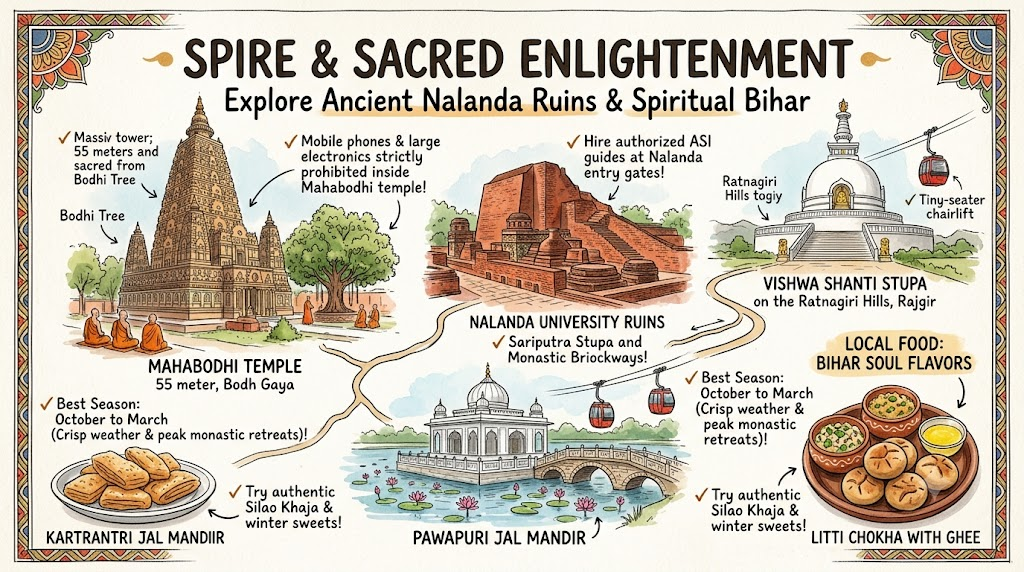
The Mahabodhi Temple stands as the eternal epicenter of Buddhist enlightenment, towering gracefully at 55 meters above manicured sanctum grounds. Beneath the descendant of the original sacred Bodhi Tree, the sandstone Diamond Throne (Vajrasana) marks the exact spot where Prince Siddhartha attained supreme liberation over 2,500 years ago.
The brick-vault architecture showcases master engineering from the Gupta and late Pala periods, covered in exquisite friezes, lotus medallions, and niches holding gilded figures. Sitting in the serene outer circumambulation path while butter lamps flicker in the twilight offers an unmatched sense of inner stillness.
Mahabodhi Temple complex in Bodh Gaya.
- Location: Bodh Gaya, Gaya District; 110 km south of Patna.
- Why it is worth visiting: A premier UNESCO World Heritage Site housing the revered Bodhi Tree and Diamond Throne. GetYourGuide
- Best things to do: Meditate beside the sacred Bodhi Tree, observe butter lamp chanting ceremonies at dawn, and explore the ancient votive stupas surrounding the main spire. Thrillophilia
- Best time to visit: November to February; visit at 5:30 AM for serene morning chanting.
- Ideal for whom: Spiritual seekers, multi-generational families, and architectural historians.
- Travel tip: Mobile phones and large electronics are strictly prohibited inside the inner complex; make sure to use the secure token-based cloakrooms at the outer gate.
Archaeological Ruins of Nalanda Mahavihara
Founded in the 5th century CE under the patronage of the Gupta dynasty, Nalanda Mahavihara functioned as the world’s most distinguished residential university for over seven centuries. Scholars like Xuanzang traversed continents to study philosophy, logic, astronomy, and medicine across its sprawling academic halls and towering libraries.
Today, the excavated red-brick expanse reveals meticulously organized monasteries, classrooms, drainage canals, and prayer halls. The dramatic Sariputra Stupa anchors the vista, featuring seven structural layers built over successive dynasties adorned with delicate stucco terracotta panels.
Excavated brick monasteries of Nalanda Mahavihara.
- Location: Nalanda District; 88 km southeast of Patna, 14 km from Rajgir. Trawell.in
- Why it is worth visiting: The celebrated UNESCO-listed cradle of ancient higher education and Buddhist philosophy. GetYourGuide
- Best things to do: Examine the multi-tiered Sariputra Stupa, explore the residential dormitories and granaries in Monastery 1, and inspect the bronzes and seals in the on-site ASI Archaeological Museum. Trawell.in
- Best time to visit: October to March; early morning between 9:00 AM and 11:30 AM before midday sun exposure.
- Ideal for whom: History buffs, school groups, solo travelers, and culture enthusiasts.
- Travel tip: Hire an authorized Archaeological Survey of India (ASI) guide at the entry gate, as signage alone does not convey the full architectural layout.
Vishwa Shanti Stupa & Griddhakuta Peak
Perched on the rolling crest of the Ratnagiri Hills, the Vishwa Shanti Stupa (World Peace Pagoda) gleams in pristine white marble, housing four golden statues depicting milestones of Gautama Buddha’s lifespan. Nearby lies Griddhakuta (Vulture’s Peak), where the Buddha delivered his celebrated Lotus Sutra discourses to devoted disciples.
Reaching the summit via the historic single-seater ropeway chairlift offers panoramic views over green valleys, ancient defensive stone fortifications, and rugged ridges. The tranquil atmosphere on the plateau creates an exceptional setting for silent contemplation away from bustling roads.
Vishwa Shanti Stupa crowning Ratnagiri Hill.
- Location: Rajgir, Nalanda District; 102 km southeast of Patna.
- Why it is worth visiting: An iconic panoramic landmark symbolizing global harmony, accessible by India’s pioneer scenic aerial chairlift.
- Best things to do: Take the vintage chairlift ride to the hilltop, walk down the stone pathway to meditate at Vulture’s Peak, and visit the Japanese Buddhist temple complex. Latehar Tourism
- Best time to visit: October to February; late afternoons (3:30 PM to 5:00 PM) offer golden hill light.
- Ideal for whom: Nature lovers, adventure-seeking families, and photographers.
- Travel tip: Single-chair ropeway tickets can sell out during holiday weekends; arrive before 9:00 AM to secure boarding tokens without waiting in line.
Pawapuri Jal Mandir
Pawapuri is deeply sacred to Jainism as the holy ground where the 24th Tirthankara, Lord Mahavira, achieved Mahaparinirvana in 527 BCE. Legend recounts that the demand for his cremation ashes was so intense that devotees gathered quantities of soil, excavating the massive lake that now shelters the shrine.
The Jal Mandir is crafted from pure white Makrana marble, glowing like an isolated jewel in the center of a sixteen-acre water body adorned with pink lotuses. Crossing the stone bridge as fresh breezes drift across the water evokes an immediate feeling of sanctity and purity.
White marble Jal Mandir in Pawapuri.
- Location: Pawapuri, Nalanda District; 19 km from Rajgir and 90 km from Patna.
- Why it is worth visiting: The revered Nirvana place of Lord Mahavira situated in an enchanting lake sanctuary.
- Best things to do: Walk along the scenic red-stone causeway to the central sanctum, feed fish in the clear lotus pond, and pay homage at the ancient Charan Paduka.
- Best time to visit: November through February; early morning mist over the lotus pond offers remarkable vistas.
- Ideal for whom: Jain pilgrims, spiritual travelers, and families seeking serene retreats.
- Travel tip: Maintain quiet inside the sanctum; dress modestly and remove leather belts, wallets, and shoes at the outer causeway entrance.
Bihar Museum
Designed by Pritzker Prize-winning architecture firm Maki and Associates, the Bihar Museum spans over 13 acres of contemporary weathering-steel and stone courtyards in the heart of Patna. It redefines regional storytelling through world-class experiential galleries, interactive children’s zones, and rare archaeological finds.
The museum houses the iconic 3rd-century BCE Didarganj Yakshi, a polished sandstone masterpiece that stands as an enduring emblem of Mauryan sculpting precision. Interactive touchscreens, life-sized diaspora displays, and open courtyard cafes make exploring thousands of years of regional history deeply engaging for all ages.
- Location: Bailey Road, Patna; 4 km from Patna Junction Railway Station.
- Why it is worth visiting: One of Asia’s finest contemporary cultural museums, housing celebrated Mauryan and Pala sculptural treasures.
- Best things to do: View the Didarganj Yakshi in the Masterpiece Gallery, explore the interactive children’s experiential zone, and dine on regional vegetarian delicacies at the museum’s bistro.
- Best time to visit: All year; ideal for an afternoon retreat between 1:00 PM and 5:00 PM (closed Mondays).
- Ideal for whom: Art curators, international travelers, families with young children, and architecture enthusiasts.
- Travel tip: Set aside a minimum of 3 to 4 hours to view the galleries thoroughly; consider buying photography permits at the ticket counter.
Ghora Katora Lake
Cradled on all sides by the forested Rajgir hills, Ghora Katora translates to “horse bowl,” reflecting the unique equine contours of the surrounding valley. The lake remains an eco-protected reserve where fossil-fuel motor vehicles are prohibited, preserving crisp air and unhurried stillness.
In the center of the clean water stands an imposing 70-foot pink sandstone statue of Lord Buddha seated on a lotus pedestal. Electric rickshaws, horse-drawn buggies (tangas), or rented bicycles provide the only transport along the paved forest trail leading to the water’s edge.
- Location: Rajgir reserve forest; 12 km from central Rajgir town.
- Why it is worth visiting: An eco-tourism lake retreat featuring an inspiring mid-water Buddha monument.
- Best things to do: Take an eco-friendly paddle boat out to the central Buddha statue, enjoy birdwatching along the forest rim, and cycle the quiet pathway.
- Best time to visit: October to February; morning hours between 9:00 AM and noon for gentle weather.
- Ideal for whom: Nature enthusiasts, couples, photographers, and multi-generational families.
- Travel tip: Electric cart lines back to the entrance can back up on Sunday afternoons; wrap up your visit by 3:00 PM to ensure easy return transport.
Offbeat Exploration: Hidden Gems Tourists Miss
The Cyclopean Wall of Rajgir
Over four millennia old, this massive stone rampart once encircled ancient Rajgir across a perimeter of nearly 40 kilometers. Built of colossal, unhewn limestone boulders fitted together without mortar, it rivals the Bronze Age fortifications of Mycenae and represents one of the oldest surviving cyclopean structures on the subcontinent.
Barabar Caves (The Lomas Rishi Cave)
Located 40 km north of Gaya, these 3rd-century BCE rock-cut chambers were excavated during the reign of Emperor Ashoka for ascetics of the Ajivika sect. The interior granite chambers are polished to a glassy, mirror-like finish that generates an acoustic resonance where a single hum echoes for several seconds.
Telhara Ancient University Excavations
Situated near Ekangarsarai in Nalanda district, this newly excavated monastic university predates Nalanda and Hiuen Tsang’s early accounts. Visitors can observe active archaeology sites, delicate three-story foundational brickworks, and unearthed terracotta seals without the usual tourist footprints.
Detailed Practical Guidance for Travelers
| Destination | Standard Entry Fee | General Timings | Best Local Food Options Nearby | Recommended Nearby Attractions |
|---|---|---|---|---|
| Mahabodhi Temple | Free (camera fee: ₹100) | 5:00 AM – 9:00 PM | Bodh Gaya Pure Veg Thali, Nirvana Cafe | Great Buddha Statue, Royal Bhutan Monastery |
| Nalanda Mahavihara | ₹40 (Indians), ₹600 (Foreigners) | 9:00 AM – 5:00 PM | Nalanda Highway Dhaba (Sattu paratha & curd) | Xuanzang Memorial Hall, ASI Museum |
| Vishwa Shanti Stupa | Free (Ropeway: ₹120 roundtrip) | 9:00 AM – 5:00 PM | Green Hotel (Pure Ghee Litti Chokha) | Griddhakuta Peak, Bimbisara Jail |
| Pawapuri Jal Mandir | Free | 6:00 AM – 8:00 PM | Vardhman Jain Bhojanalaya (Pure Sattvic Meal) | Samosharan Temple, Gaon Mandir |
| Bihar Museum | ₹100 (Adults), ₹50 (Children) | 10:30 AM – 5:00 PM (Closed Mon) | Potbelly Rooftop Cafe (Bhojpuri & Maithili platters) | Patna Golghar, Patna Planetarium |
| Ghora Katora Lake | ₹30 (E-cart: ₹100 return) | 9:00 AM – 5:00 PM | Lake view stalls (Fresh coconut water & roasted corn) | Rajgir Glass Bridge, Nature Safari |
Logistics & On-Ground Navigation
Local Transport Options
- Intercity Trains: The high-speed Vande Bharat and Jan Shatabdi expresses connect Patna to Gaya and Rajgir with exceptional punctuality, safety, and air-conditioned family comfort.
- Private Taxis & Cabs: App-based platforms operate seamlessly within Patna and Gaya; booking dedicated round-trip outstation cabs (Innova or Dzire) through registered tour operators is best for rural circuits like Nalanda and Rajgir.
- E-Rickshaws (Totos): The most practical, pollution-free transport option within Bodh Gaya and Rajgir towns; typical short hops cost ₹15 to ₹30 per passenger.
- Traditional Tangas: Quaint horse-drawn carriages operating along heritage stretches of Rajgir offer a slower, nostalgic perspective between hot springs and historical gates.
Budget Planning
- Budget / Backpacking Tier: Expect to spend ₹1,200 to ₹1,800 per day covering clean pilgrim guesthouse stays, communal vegetarian bhojanalayas or street stalls, local passenger trains, and e-rickshaws.
- Mid-Range / Family Comfort Tier: Plan for ₹4,500 to ₹7,000 per day covering 3-star heritage boutique hotels, AC private car charters, guided historical tours, and air-conditioned specialty dining establishments.
Safety and Inclusivity Tips
- For Families: The major heritage hubs are welcoming and conservative. Family suites are widely available; opt for bottled mineral water and freshly prepared hot food for young children.
- For Couples: Bodh Gaya and Rajgir offer relaxed, peaceful environments; respectful, modest attire covering shoulders and knees is recommended at religious sanctuaries.
- General Safety: Highways between major cities are well-patrolled, but it is wise to avoid late-night road transit through isolated rural corridors after 9:30 PM.
Strategic Travel Planning Guardrails
Travel Planning Tips for Bihar
- Book winter weekend accommodation in Bodh Gaya and Rajgir at least six weeks in advance, especially during the annual international monastic retreats.
- Keep moderate cash bills (₹100 and ₹200) handy; while UPI QR codes are universally accepted, remote highway stalls and rural e-rickshaws occasionally face spotty cell connectivity.
- Dress in modest, easily removable slip-on footwear, as you will need to remove your shoes frequently when visiting temples and sanctums.
- Pack high-SPF sun protection, wide-brim hats, and polarized sunglasses when exploring open brick sites like Nalanda or walking the vast grounds of Bodh Gaya.
- Schedule your visits to outdoor stone ruins for morning hours to avoid afternoon glare on the brick courtyards.
Common Mistakes to Avoid
- Rushing the circuit in a single day: Trying to cover Patna, Nalanda, Rajgir, and Bodh Gaya together in one rush will leave you exhausted and unable to appreciate the sites.
- Skipping licensed ASI guides: Wandering Nalanda or Rajgir without an accredited local guide leaves you missing the fascinating history behind unlabelled stone foundations.
- Relying solely on express buses: Regional highway buses often make unscheduled stops; private taxi charters or intercity rail offer far more dependable schedules.
- Ignoring regional seasonal sweets: Missing winter delicacies like Tilkut from Gaya, Khaja from Silao, or Balushahi from Runni Saidpur means skipping essential culinary heritage.
- Assuming digital payments everywhere: Never head into rural hinterlands or ancient caves without sufficient cash in your pocket.
Suggested Itinerary Blueprints
1. Day Quick Dash (The Sacred Core: Bodh Gaya)
Targeted at travelers with limited time seeking pure spiritual immersion:
- Morning: Arrive at Gaya Junction or Airport; check in and head straight to the Mahabodhi Temple for morning circumambulation and quiet meditation under the Bodhi Tree.
- Afternoon: Tour the 80-Foot Great Buddha Statue and explore the surrounding Thai, Japanese, and Royal Bhutanese monasteries.
- Evening: Experience evening butter-lamp lighting chants, then enjoy a warm, multi-course vegetarian thali along Temple Road before your night departure.
2. Day Deep-Dive (Kings, Monks, & Scholars)
Designed for heritage enthusiasts and multi-generational families wanting a balanced, relaxed loop:
- Day 1 (Nalanda & Pawapuri): Depart early from Patna toward Pawapuri; explore the tranquil Jal Mandir over the lotus lake. Continue to the ancient ruins of Nalanda Mahavihara for a 3-hour guided tour; visit the ASI Museum and Xuanzang Memorial Hall. Overnight in Rajgir. Trawell.in+ 1
- Day 2 (Royal Rajgir): Take the morning chairlift to Vishwa Shanti Stupa and Vulture’s Peak. Take an afternoon electric buggy to Ghora Katora Lake, sample authentic Silao Khaja, and return comfortably to Patna. Latehar Tourism+ 1
3. Complete Weekend Travel Plan (The Grand Cultural Loop)
A 3-day regional circuit linking capital history with sacred shrines:
- Friday (Patna): Arrive in Patna; tour the Bihar Museum and Golghar; enjoy authentic litti chokha and Bihari vegetarian delights along Frazer Road.
- Saturday (Nalanda & Rajgir): Drive south via Bakhtiyarpur; explore Nalanda ruins; ride the Rajgir ropeway up Ratnagiri Hill; check into a thermal resort hotel in Rajgir. GetYourGuide+ 1
- Sunday (Bodh Gaya & Departure): Early drive to Bodh Gaya; spend the day touring the Mahabodhi Temple and international monasteries; depart via Gaya International Airport or Gaya Railway Station. Latehar Tourism
Common Tourist Mistakes to Avoid
- Geographic Blunders: Don’t attempt to visit Bodh Gaya and northern spots like Vaishali on the same afternoon. Crossing the Ganges bridge can take significant time; always organize travel strictly by north-bank and south-bank circuits.
- Commercial Traps: Avoid spending your evenings in generic shopping malls in central Patna. Instead, stroll through the vibrant lanes of Maurya Lok or local artisan bazaars to pick up Madhubani handlooms, Tikuli crafts, and stone carvings directly from craftsmen.
- Neglecting Modern/Alternative Zones: Don’t overlook Patna’s evolving contemporary cultural spaces, such as the galleries of the Bihar Museum, the scenic Ganga Marine Drive promenade at sunset, and the lush riverfront parks.
- Transport Overpayment: Always agree on fares with unmetered auto-rickshaws before boarding, or cross-reference standard rates on ride-hailing apps like Ola or Uber in Patna to ensure fair pricing.
- Luxury Dining Bias: Sticking exclusively to five-star hotel menus deprives you of regional soul food. Traditional roadside bhojanalayas serve incredible coal-roasted litti chokha, tender sattu parathas, and spiced baigan bharta that fine-dining spots rarely match.
Frequently Asked Questions
1. Is Bihar safe for solo travelers and families?
Yes, Bihar’s primary tourism circuits are welcoming and safe for families, couples, and solo travelers. State tourism police patrol popular monuments, though standard travel common sense applies: avoid traveling down unlit rural roads late at night.
2. Which airport provides the closest access to the Buddhist Circuit?
Gaya International Airport (GAY) is the closest, sitting just 10 kilometers from Bodh Gaya. Patna’s Jay Prakash Narayan Airport (PAT) is located 110 kilometers north and offers extensive domestic flight connectivity across India.
3. What is the signature vegetarian dish to try across the region?
Litti Chokha remains the undisputed crown jewel. It features whole wheat dough balls stuffed with roasted gram flour (sattu) and fragrant herbs, baked over charcoal, dipped in pure ghee, and paired with smoky mashed eggplant and spiced potatoes.
4. Are shoes allowed inside the Mahabodhi Temple complex?
Shoes and footwear are strictly forbidden past the main entrance gate. Dedicated shoe counters provide free tokens where visitors can securely store footwear before entering the temple gardens.
5. How long does a thorough visit to the Nalanda University ruins take?
Plan for at least 2.5 to 3 hours to comfortably walk the excavated monasteries, the central stupa, and the adjacent museum. Engaging an authorized guide ensures you understand the deep historical context behind the structures.
6. Can senior citizens easily access the Vishwa Shanti Stupa in Rajgir?
Yes, the aerial chairlift ropeway takes passengers directly up to the hill crest without any steep walking. From the drop-off station, flat paved ramps lead right up to the Peace Pagoda.
7. What makes Silao Khaja so unique, and where should I buy it?
Silao Khaja is a celebrated GI-tagged puff-pastry treat made with over fifty crisp, layered wheat folds fried in pure ghee and lightly sweetened. Pick up fresh batches directly from heritage sweet shops lining the main road through Silao between Nalanda and Rajgir.
8. What is the dress code when visiting Buddhist and Jain temples in Bihar?
Modest, respectful attire is required at all sacred shrines. Both men and women should wear clothing that covers their shoulders and knees; avoid sleeveless tops, shorts, or tight garments.
9. Are mobile phones permitted inside the Mahabodhi Temple in Bodh Gaya?
No, mobile phones, tablets, smartwatches, and camera drones are strictly prohibited within the inner sanctum. Free, secure electronic lockers are located beside the main temple entry check-point.
10. What unique handicrafts should travelers bring home from Bihar?
Look for genuine hand-painted Madhubani art on tussar silk, Tikuli lacquer artwork, Sikki grass woven storage baskets, and miniature black-stone carvings crafted by master artisans in Gaya.
11. Which season offers the best weather for exploring the state?
The winter months from October to March bring pleasant days with temperatures ranging between 12°C and 25°C, making them ideal for touring outdoor brick ruins, hiking scenic hills, and wandering temple grounds.
12. Is pure sattvic and Jain food readily available on this travel route?
Yes, Jain dharamshalas and vegetarian bhojanalayas abound around Pawapuri, Rajgir, and Bodh Gaya. These kitchens serve delicious meals prepared strictly without onion or garlic upon request.
Conclusion
Choosing to explore Bihar is far more than an ordinary holiday—it is a grounding pilgrimage into the philosophical cradle of the subcontinent. Standing amidst the ruins of Nalanda or resting under the Bodhi Tree connects you to a timeless spiritual resonance that mainstream destinations cannot replicate. As the aroma of fresh ghee and roasting sattu drifts from nearby village kitchens, you realize this land doesn’t just display history; it invites you to slow down, reflect, and share in its enduring legacy of peace and wisdom.
