Introduction
While standard travel feeds flood your timeline with repetitive beach lounges and crowded commercial hill stations, Bihar stands as a raw cultural goldmine waiting to be captured through a creative lens. Beyond the typical tourist paths lies a land where ancient red-brick universities, floating sandstone tombs, and serene glass bridges meet the morning mist.
Framing your story here connects your visual aesthetic directly with deep historical roots, authentic spiritual traditions, and dramatic landscapes. Every corner of this ancient region offers vivid colors, symmetry, and rich textures that elevate your travel photography.
Why Bihar is a must-visit city
Bihar forms a foundational chapter in global spiritual, political, and academic history. From the sacred grounds where enlightenment blossomed under the Bodhi tree to the seats of ancient empires, this land carries immense cultural weight. Modern infrastructure makes exploring the state seamless, with smooth four-lane expressways connecting Patna to regional heritage hubs, robust railway connectivity, and upgraded airports at Patna and Gaya.
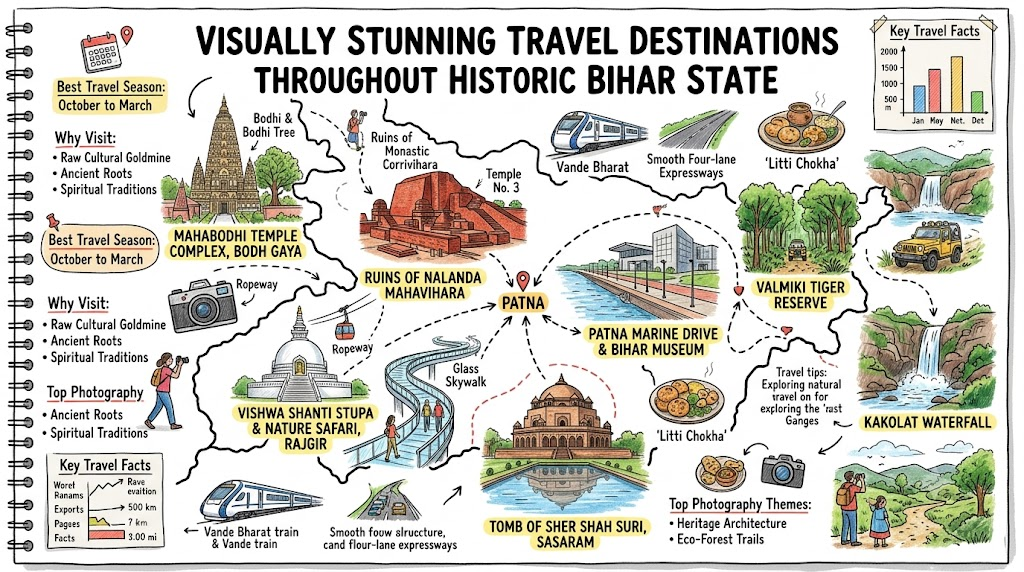
The primary travel circuit seamlessly bridges modern urban riverfronts, forested valley eco-zones, and UNESCO World Heritage sites. Photographers and curious travelers alike can easily navigate well-connected routes while capturing diverse visual stories ranging from golden-hour water reflections to intricate stone carvings.
| Key Travel Fact | Details |
|---|---|
| Primary Gateways | Jay Prakash Narayan Airport (Patna), Gaya International Airport |
| Best Travel Season | October to March (Crisp air, pleasant sunshine, clear skies) |
| Top Photography Themes | Heritage Architecture, Eco-Forest Trails, Riverine Landscapes |
| Transport Connectivity | Vande Bharat Express routes, broad NH networks, private car rentals |
| Ideal Trip Duration | 3 to 5 Days for a comprehensive multi-zone circuit |
Best Places or Experiences
1. Mahabodhi Temple Complex, Bodh Gaya
The Mahabodhi Temple stands as a magnificent masterpiece of early Indian brick architecture, reaching over 55 meters into the sky. Built around the exact spot where Prince Siddhartha attained enlightenment, the soaring pyramid-shaped spire features intricate geometric carvings that create compelling shadow patterns throughout the day.
As soft morning light filters through the leaves of the sacred Bodhi Tree, maroon-robed monks circumambulate the ancient stone railings. The interplay between vibrant prayer flags, golden sunlight, and polished stone offers endlessly rich visual framing.
- Location: Gaya District, approximately 115 km south of Patna capital and 15 km from Gaya Junction.
- Why it is worth visiting: UNESCO World Heritage status boasting a 180-foot ancient brick temple spire with unmatched spiritual ambiance.
- Best things to do: Frame wide-angle shots of the main spire from the lotus pond, capture dappled sunlight under the sacred Bodhi Tree, and photograph serene monastery gardens.
- Best time to visit: November to February; visit between 5:30 AM and 7:00 AM for soft golden-hour illumination and morning chanting.
- Ideal for whom: Culture documentarians, architecture enthusiasts, and solo travel storytellers.
- Travel tip: Mobile phones must be deposited in security lockers outside, so bring a dedicated DSLR or mirrorless camera with an official camera permit purchased at the gate.
Mahabodhi Temple towering over Bodh Gaya.
2. Ruins of Nalanda Mahavihara
Stretching across acres of manicured green lawns, the excavated red-brick ruins of Nalanda University showcase the world’s earliest residential learning center. The site features imposing monastic cells, ancient stupas, and grand lecture halls crafted from vibrant crimson bricks that glow under the sun.
Temple No. 3 dominates the central visual corridor, featuring dramatic flight steps flanked by smaller votive stupas and detailed stucco carvings. Walking through the narrow monastic corridors provides stunning leading lines and framing opportunities for creative photography.
- Location: Nalanda District, around 85 km southeast of Patna and 15 km from Rajgir.
- Why it is worth visiting: A UNESCO World Heritage archaeological site offering striking red-brick symmetry and dramatic ancient ruins.
- Best things to do: Capture symmetrical wide shots along Monastery Row, frame Temple No. 3 against the open sky, and document intricate stucco bas-reliefs.
- Best time to visit: October to March; visit around 9:00 AM at opening or late afternoon near 4:00 PM for warm brick tones.
- Ideal for whom: History buffs, landscape photographers, and creative storytellers.
- Travel tip: Position yourself on the elevated western perimeter ridge to capture a bird’s-eye view of the entire monastic layout.
Red-brick ruins of ancient Nalanda Mahavihara.
3. Vishwa Shanti Stupa & Nature Safari, Rajgir
Perched atop the lush forested Ratnagiri Hill, the stark white Vishwa Shanti Stupa rises as a symbol of universal peace. The massive dome houses golden statues of the Buddha on four sides, set against sweeping panoramic views of the surrounding five green hills.
Adjacent to the hill complex lies the modern Rajgir Nature Safari, home to the famous hanging Glass Skywalk bridge. Suspended high above a deep forest canyon, the transparent bridge provides thrilling, surreal photo opportunities.
- Location: Rajgir, Nalanda District, located 100 km south of Patna.
- Why it is worth visiting: Features a gleaming white hilltop stupa alongside India’s premier high-altitude Glass Skywalk.
- Best things to do: Ride the scenic aerial chairlift ropeway, walk across the Glass Skywalk bridge, and capture 360-degree valley vistas.
- Best time to visit: November to February; schedule early morning visits at 8:00 AM to avoid long lines at the ropeway and skywalk.
- Ideal for whom: Adventure seekers, couples, and nature lovers.
- Travel tip: Book your Glass Skywalk tickets online well in advance via the official state eco-tourism portal, as walk-in slots fill quickly.
Vishwa Shanti Stupa in Rajgir.
4. Tomb of Sher Shah Suri, Sasaram
Floating gracefully in the center of a large square artificial lake, this octagonal mausoleum represents the pinnacle of Indo-Islamic architecture. Built from warm red sandstone, the 122-foot grand dome rises above tiered kiosks and arched galleries accessed via a long stone causeway.
On calm days, the surrounding water turns into a perfect mirror, creating stunning symmetrical reflection shots. The contrast between the weathered stone structure, blue water, and open sky produces a majestic visual composition.
- Location: Sasaram, Rohtas District, 150 km southwest of Patna along National Highway 19.
- Why it is worth visiting: An architectural marvel known as the ‘Second Taj Mahal of India’, featuring incredible water reflection views.
- Best things to do: Shoot symmetrical reflections from the main stone causeway, photograph arched hallways, and capture sunset silhouettes across the lake.
- Best time to visit: October to March; early morning between 6:30 AM and 8:00 AM offers mirror-like water surfaces and soft lighting.
- Ideal for whom: Architecture enthusiasts, fine-art photographers, and road-trippers.
- Travel tip: Stand precisely at the midpoint of the access causeway with a wide-angle lens to get a balanced, perfectly centered reflection shot.
Symmetrical reflection of Sher Shah Suri’s Tomb.
5. Patna Marine Drive & Bihar Museum
JP Ganga Path, popularly known as Patna Marine Drive, stretches gracefully along the banks of the Ganges River. This elevated bypass expressway features sleek modern engineering alongside wide pedestrian promenades overlooking the wide expanse of the sacred river.
A short drive away stands the Bihar Museum, a world-class architectural complex designed with weathered steel, Japanese wood finishings, and expansive courtyard water features. Its minimalist galleries and artistic courtyards offer striking backdrops for modern travel portraits.
- Location: Patna City Center, within 5 km of Patna Junction railway station.
- Why it is worth visiting: Blends state-of-the-art modern museum architecture with riverfront sunset viewpoints.
- Best things to do: Walk the outdoor courtyards of Bihar Museum, watch the sunset over the Ganges from Marine Drive, and sample local street snacks.
- Best time to visit: Year-round; visit Bihar Museum in the afternoon at 2:00 PM, then head to Marine Drive for sunset at 5:00 PM.
- Ideal for whom: Modern travelers, urban photographers, and art lovers.
- Travel tip: The Bihar Museum is closed on Mondays, so plan your city itinerary accordingly to avoid missing the interior galleries.
6. Valmiki Tiger Reserve, West Champaran
Located along the Indo-Nepal border, Valmiki Tiger Reserve protects dense sal forests, rocky mountain streams, and tall grasslands along the Gandak River. The raw wilderness offers an eco-tourism landscape dramatically different from the state’s urban heritage circuits.
Early morning safari drives take you through misty forest corridors where sunlight breaks through dense canopy trees. Watching the river flow against the backdrop of the Himalayan foothills provides serene, untamed natural landscapes.
- Location: West Champaran District, roughly 290 km northwest of Patna.
- Why it is worth visiting: Bihar’s premier national park, featuring dense sal forests, river safaris, and rich biodiversity.
- Best things to do: Take a jungle jeep safari, enjoy a boat ride along the Gandak River, and stay in eco-friendly treehouses.
- Best time to visit: November to March when forest tracks are fully accessible and wildlife spotting is optimal.
- Ideal for whom: Wildlife photographers, nature enthusiasts, and adventure travel groups.
- Travel tip: Book forest rest house accommodation at Valmikinagar well in advance through the state forest department portal.
7. Kakolat Waterfall, Nawada
Cascading down from a height of over 150 feet into a natural freshwater pool, Kakolat Waterfall is nestled within scenic green hills. The rushing white water creates a striking contrast against the dark jagged rock face and surrounding forest canopy.
The mist rising from the plunge pool creates a natural soft-focus effect in photographs, especially during early morning hours. Surrounded by local folklore, this natural water feature provides a refreshing escape into nature.
- Location: Nawada District, approximately 135 km southeast of Patna and 35 km from Nawada town.
- Why it is worth visiting: A dramatic 150-foot natural waterfall forming a cool, emerald plunge pool amidst rocky hills.
- Best things to do: Capture long-exposure waterfall shots, swim in the natural pool, and enjoy a forest picnic.
- Best time to visit: October to February for pleasant weather and manageable water flow.
- Ideal for whom: Nature lovers, adventure groups, and portrait photographers.
- Travel tip: Visit on weekdays rather than weekends to shoot clean landscape frames without large holiday crowds.
Offbeat Exploration: Hidden Gems Tourists Miss
Ghora Katora Lake, Rajgir
Tucked away between three steep green hills, Ghora Katora is a secluded, motor-free natural lake shape like a horse. Visitors reach the water via horse-drawn carriages or electric rickshaws, protecting the serene silence of the valley. In the middle of the quiet blue water sits a towering pink granite Buddha statue, creating a peaceful scene for fine-art landscape photography.
Serene waters of Ghora Katora Lake.
Barabar Caves, Jehanabad
Dating back to the Mauryan Empire under Emperor Ashoka, the Barabar Caves are the oldest surviving rock-cut caves in India. Carved out of massive granite monoliths, the cave interiors feature a mirror-like polish that reflects light in extraordinary ways. The surrounding rocky boulder landscape offers raw, ancient textures ideal for dramatic travel portraits.
Rohtasgarh Fort, Rohtas
Perched atop a soaring plateau 1,500 feet above the Sone River valley, the expansive ruins of Rohtasgarh Fort remain one of India’s most untouched hill forts. The complex includes grand stone gateways, royal palaces, and carved temples surrounded by misty cliff edges. Photographers who trek up the plateau are rewarded with sweeping views and ancient stone arches free from tourist crowds.
Detailed Practical Guidance for Travelers
| Destination | Standard Entry Fee | General Timings | Best Local Food Options Nearby | Recommended Nearby Attractions |
|---|---|---|---|---|
| Mahabodhi Temple | Free (Camera: ₹100) | 5:00 AM – 9:00 PM | Tibetan Thukpa, Monks Cafe Bakery | Great Buddha Statue, Thai Monastery |
| Nalanda Ruins | ₹40 (Indian), ₹600 (Foreigner) | 9:00 AM – 5:00 PM | Khaja, Authentic Bihari Thali | Archaeological Museum, Xuanzang Memorial |
| Vishwa Shanti Stupa | Free (Ropeway: ₹100) | 6:00 AM – 6:00 PM | Fresh Guava, Rajgir Khaja | Glass Skywalk, Griddhakuta Hill |
| Sher Shah Suri Tomb | ₹25 (Indian), ₹300 (Foreigner) | 6:00 AM – 6:00 PM | Sattu Paratha, Local Sweets | Rohtasgarh Fort, Pilot Baba Temple |
| Bihar Museum | ₹100 (Indian), ₹500 (Foreigner) | 10:30 AM – 5:00 PM (Mon Closed) | Potbelly Cafe (Litti & Ahuna Mutton) | Patna Marine Drive, Golghar |
| Valmiki Tiger Reserve | ₹100 (Safari Extra) | 6:00 AM – 5:00 PM | Local Tharu Fish Curry, Dehati Rice | Someshwar Fort Peak, Gandak Barrage |
| Kakolat Waterfall | Free (Parking nominal) | 8:00 AM – 5:00 PM | Local Roasted Corn, Sattu Drinks | Sekho Devta Hills, Rajgir Circuit |
Logistics & On-Ground Navigation
Local Transport Options
- Railways: Major junctions including Patna Junction, Gaya Junction, and Rajgir offer frequent express connections across districts.
- Auto-Rickshaws & E-Rickshaws: E-rickshaws are the most convenient option for short hops within heritage towns like Bodh Gaya and Rajgir.
- Car Rentals: Hiring a private AC sedan or SUV with a driver provides the most flexibility for multi-stop heritage photography tours.
- Inter-District Expressways: Modern state highways ensure smooth driving between Patna, Nalanda, and Gaya.
Budget Planning
- Backpacker Tier: ₹1,200 – ₹1,800 per day (Covers budget guesthouses, public transport, and authentic street-side eateries).
- Mid-Range Comfort Tier: ₹3,500 – ₹6,000 per day (Covers 3-star heritage hotels, private car rentals, and sit-down dining).
Safety and Inclusivity Tips
- Families: Major heritage sites feature paved pathways, making them easy to navigate with children and elderly travelers.
- Couples: Bodh Gaya and Rajgir offer serene, peaceful environments; maintain respectful decorum around religious sites.
- General Safety: Well-traveled heritage corridors are welcoming and safe; use pre-arranged taxis for early morning or late-night transfers.
Strategic Travel Planning Guardrails
Travel Planning Tips for Bihar
- Pre-Book Winter Stays: Bodh Gaya experiences high international pilgrim volume between November and February, so book hotels well in advance.
- Carry Cash for Rural Spots: While digital UPI payments work widely in cities, carry cash for entry tickets and small vendors in remote areas.
- Dress Respectfully at Sacred Sites: Wear clothing that covers shoulders and knees when visiting active temples and monasteries.
- Layer Up for Winter Dawns: Morning temperatures in December and January drop to 8°C–12°C, requiring light jackets for early shoots.
- Plan Around Weekly Closures: Note monument closures (e.g., Bihar Museum on Mondays) when organizing your daily schedule.
Common Mistakes to Avoid
- Overpacking Daily Routes: Avoid cramming distant districts like Sasaram and Bhagalpur into a single day due to transit times.
- Skipping Regional Cuisine: Don’t stick only to standard hotel menus; sample authentic regional specialties like Litti Chokha and Khaja.
- Assuming Early Public Buses: Do not rely on local buses for 5:00 AM sunrise shoots; arrange private cabs in advance.
- Ignoring Camera Permits: Always check ticket counters for camera permits to avoid delays at monument gates.
- Rushing Sacred Spaces: Allocate enough time to quietly soak in the peaceful atmosphere of Bodh Gaya rather than rushing through for photos.
Suggested Itinerary Blueprints
1. Day Quick Dash (Capital & Culture Loop)
Designed for travelers on a tight schedule focusing on urban heritage and modern landmarks.
- Morning: Start at 8:00 AM exploring the historic Golghar and the nearby Patan Devi temple area.
- Afternoon: Spend three hours browsing the world-class galleries and courtyards of the Bihar Museum.
- Evening: Enjoy sunset views along Patna Marine Drive while sampling street food like Litti Chokha.
2. Day Deep-Dive (The Sacred Heritage Triangle)
A balanced two-day itinerary connecting the state’s most iconic archaeological and spiritual centers.
- Day 1 (Rajgir & Nalanda): Morning chairlift ride to Vishwa Shanti Stupa in Rajgir, followed by an afternoon tour of the red-brick ruins of Nalanda University.
- Day 2 (Bodh Gaya): Spend the morning inside the Mahabodhi Temple complex, followed by an afternoon visit to the Great Buddha Statue and international monasteries.
3. Complete Weekend Travel Plan (Grand Southern Circuit)
A comprehensive three-day road trip covering nature, history, and architectural wonders.
- Friday: Arrive in Patna, explore Bihar Museum, and take an evening walk along Ganga Path.
- Saturday: Drive early to Sasaram to photograph Sher Shah Suri’s Tomb, then head to Rajgir for an evening visit to Ghora Katora Lake.
- Sunday: Explore the Glass Skywalk at Rajgir Nature Safari, visit Nalanda ruins, and return to Patna for departure.
Common Tourist Mistakes to Avoid
Geographic Blunders
Trying to visit Sasaram in the west and Bhagalpur in the east on the same day involves over 300 km of driving across districts. Group your stops logically into Northern, Central, and Southern circuits.
Commercial Traps
Spending valuable time inside generic city shopping malls deprives you of experiencing authentic local bazaars, heritage craft centers, and historic neighborhoods.
Neglecting Modern/Alternative Zones
Focusing exclusively on ancient ruins causes travelers to miss modern cultural spaces like Patna’s vibrant art murals, landscaped river promenades, and contemporary museum cafes.
Transport Overpayment
Always check ride-sharing app rates or consult hotel concierges regarding standard auto fares before agreeing to unmetered private transport.
Luxury Dining Bias
Relying solely on hotel dining rooms deprives you of experiencing authentic local flavors, such as freshly fried Khaja in Rajgir or warm Tilkut in Gaya.
Frequently Asked Questions
1. What is the best season to visit Bihar for travel photography?
The best season is from October to March, when the weather is pleasant, skies are clear, and morning temperatures are comfortable for outdoor shoots.
2. Are professional cameras allowed inside the Mahabodhi Temple in Bodh Gaya?
Yes, DSLR and mirrorless cameras are allowed inside after purchasing an official camera permit at the entry counter, though mobile phones are restricted.
3. How do I book tickets for the Glass Skywalk in Rajgir?
Glass Skywalk tickets can be booked online through the official Bihar Eco-Tourism portal, or purchased at the Rajgir Nature Safari ticket counter early in the morning.
4. What is the most iconic local food to try while traveling in Bihar?
Litti Chokha—baked wheat balls stuffed with spiced roasted gram flour, served with mashed eggplant and potatoes—is the signature dish to try across the state.
5. How far is Nalanda University from Patna, and how can I travel there?
Nalanda is roughly 85 km from Patna and can be reached in about two hours via the smooth Patna-Bakhtiyarpur-Rajgir highway by private car or express train.
6. Is it safe for solo travelers to explore the heritage sites?
Yes, major travel corridors like Bodh Gaya, Rajgir, Nalanda, and Patna are welcoming and safe for solo travelers, with active tourist police present at major monuments.
7. Do I need permission to fly a camera drone at heritage monuments in Bihar?
Yes, flying photography drones over protected ASI monuments like Nalanda ruins and Sher Shah Suri Tomb is strictly prohibited without prior written permission from authorities.
8. How much does a typical 3-day mid-range trip to Bihar cost?
A mid-range traveler can expect to spend around ₹3,500 to ₹6,000 per day, including 3-star hotel stays, private car transfers, entry fees, and sit-down meals.
9. What are the timings for visiting the Tomb of Sher Shah Suri in Sasaram?
The mausoleum is open daily to visitors from sunrise to sunset, roughly between 6:00 AM and 6:00 PM.
10. Which international monasteries in Bodh Gaya are most photogenic?
The Thai Monastery with its curved gold roof, the Bhutanese Monastery featuring vibrant wall murals, and the Japanese Daijokyo Temple are exceptionally photogenic.
11. Are credit cards and UPI digital payments widely accepted in Bihar?
Digital UPI payments are accepted almost everywhere in cities and towns, though carrying liquid cash is advisable for small rural vendors and roadside stalls.
12. How much time is needed to explore the Bihar Museum in Patna?
Plan to spend at least two to three hours to comfortably tour the historical galleries, outdoor courtyards, and architectural installations.
Conclusion
Choosing a journey through Bihar offers something rare in modern travel: the opportunity to experience genuinely authentic history and living traditions. From the timeless reflection of sandstone tombs across quiet lakes to the red-brick corridors of ancient universities, every destination rewards curious travelers with unforgettable visual stories. Step off the well-trodden tourist path, pack your camera, and discover the rich cultural heritage waiting across this extraordinary landscape.
