Introduction
Mainstream travel circuits often herd solo travelers into commercialized hubs packed with chain cafes, overpriced hostels, and manufactured photo booths. Bihar offers the exact opposite: an unfiltered, deeply grounded immersion into the cradle of Eastern civilization. Traveling alone here does not mean navigating artificial tourist enclaves; it means walking the very paths where intellectual giants, spiritual masters, and empire builders shaped world history.
From the quiet rustle of the sacred Bodhi Tree at dawn to the colossal brick courtyards of ancient Nalanda, this land demands presence. Solo travelers will discover a landscape defined by raw warmth, profound spiritual resonance, and authentic connections that make standard vacation spots feel hollow.
Why Bihar is a must-visit city
Bihar occupies an unrivaled position in global cultural geography. As the birthplace of Buddhism and Jainism, the cradle of the Mauryan and Gupta Empires, and home to the world’s earliest residential university, this state is an open-air historical archive. Its physical topography transitions from the fertile Gangetic plains in the north to the rugged granite hills and dense sal forests of the south, offering varied backdrops for independent exploration.
Modern Bihar is accessible and welcoming to independent backpackers and comfort-focused solo explorers alike. The state features four-lane expressways, regular Vande Bharat and express rail connections, and functional airports at Patna, Gaya, and Darbhanga. The hospitality landscape caters smoothly to solo wanderers through monastery guesthouses, state-run tourism hotels, and budget-friendly boutique stays.
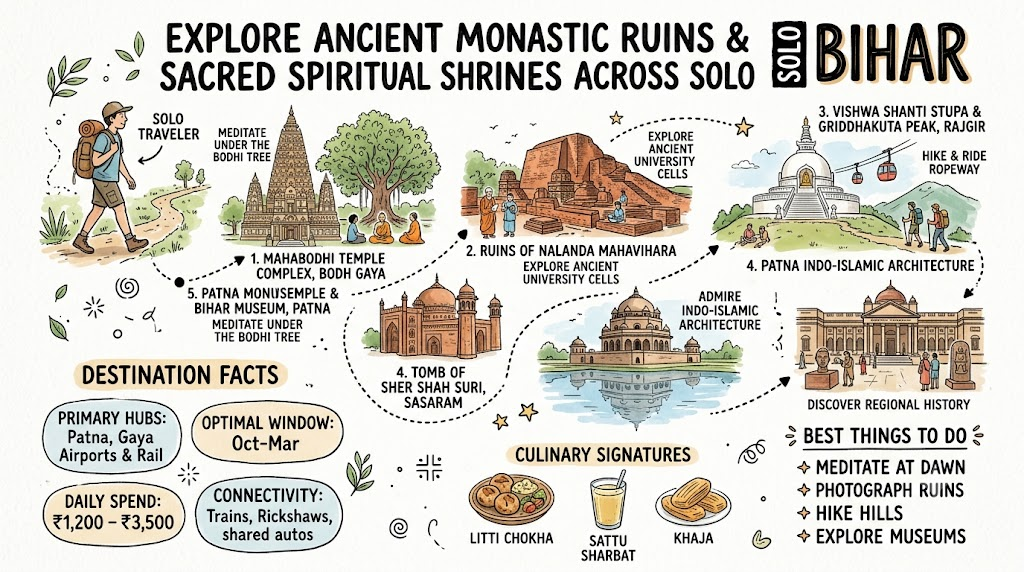
The core solo travel circuit anchors itself around the historic Magadh belt: Patna – Nalanda – Rajgir – Bodh Gaya. This route provides a balanced blend of archaeological wonders, peaceful meditation zones, hilltop nature walks, and vibrant culinary discoveries.
| Metric / Attribute | Traveler Factsheet |
|---|---|
| Primary Transit Hubs | Jay Prakash Narayan Airport (Patna), Gaya Airport, Patna Junction |
| Circuit Geography | South-Central Bihar (Patna, Nalanda, Gaya districts) |
| Optimal Travel Window | October to March (Crisp mornings, pleasant afternoon sun) |
| Typical Solo Daily Spend | ₹1,200 – ₹3,500 ($15 – $42 USD) |
| Local Connectivity | Broad-gauge express trains, electric rickshaws, shared autos, app-cabs |
| Culinary Signatures | Litti Chokha, Sattu Sharbat, Khaja, Tilkut, Dal Pitha |
Best Places or Experiences
1. Mahabodhi Temple Complex, Bodh Gaya
The Mahabodhi Temple stands as the spiritual epicenter of the Buddhist world, marking the precise spot where Siddhartha Gautama attained enlightenment beneath the sacred Bodhi Tree. Dating structurally to the Gupta and Pala periods with roots planted by Emperor Ashoka in the 3rd century BCE, the 55-meter grand pyramidal spire dominates the skyline with intricate brickwork and stucco reliefs. Walking through the inner circumambulation path surrounded by votive stupas transports any solo traveler into deep introspection, accompanied by the gentle drone of multi-national monastic chants.
The complex welcomes visitors without prejudice, offering serene corners where you can sit undisturbed for hours with a book or journal. Beyond the main shrine, the sacred Bodhi Tree—a direct descendant of the original ficus tree—drops leaves that pilgrims and wanderers revere as cherished keepsakes. The surrounding village of Bodh Gaya is peppered with distinct architectural monasteries built by nations including Japan, Thailand, Bhutan, and Sri Lanka, creating a vibrant global village right in rural Bihar.
Mahabodhi Temple spire at Bodh Gaya.
- Location: Gaya District; approximately 115 km south of Patna and 15 km from Gaya Junction.
- Why it is worth visiting: It is a UNESCO World Heritage site that offers an unmatched atmosphere of peace, historical depth, and cross-cultural spiritual energy.
- Best things to do: Meditate under the sacred Bodhi Tree at dawn, photograph the ornate votive stupas during golden hour, and explore the nearby Thai and Japanese monasteries.
- Best time to visit: November to February; visit between 5:30 AM and 7:30 AM or after 6:00 PM for peak atmospheric tranquility.
- Ideal for whom: Solo spiritual seekers, culture documentarians, and history enthusiasts.
- Travel tip: Mobile phones are strictly prohibited inside the main sanctum; store them safely in the free locker facility at the security entrance, or purchase a separate ticket for digital cameras.
2. Ruins of Nalanda Mahavihara
Nalanda was the ancient world’s premier residential seat of higher learning, flourishing from the 5th to the 12th century CE under the patronage of the Guptas and King Harshavardhana. At its zenith, this sprawling university accommodated over 10,000 students and 2,000 teachers from across Asia, housing a legendary multi-story library known as Dharmaganja. Today, the excavated red-brick complex covers an impressive 14 hectares, revealing sophisticated multi-tiered monasteries (viharas), classrooms, prayer halls, and ingenious drainage systems.
For a solo explorer, Nalanda is an awe-inspiring playground for the imagination. Standing before Temple No. 3, with its stepped towers and stucco images of the Buddha, you can trace the intellectual footprint of scholars like Aryabhata and Xuanzang. The manicured lawns between the ancient monastic cells provide ample quiet space to absorb the sheer architectural genius of ancient India’s brick engineering.
Ancient brick ruins of Nalanda University.
- Location: Nalanda District; 85 km southeast of Patna and 15 km from Rajgir.
- Why it is worth visiting: It is a UNESCO World Heritage site and a poignant architectural tribute to global intellectual history.
- Best things to do: Admire the bas-relief stucco panels on Temple No. 3, explore the preserved monk dormitory cells with individual stone beds, and visit the adjacent Archaeological Museum.
- Best time to visit: October to March; early morning between 9:00 AM and 11:30 AM avoids the midday sun.
- Ideal for whom: Independent history buffs, architectural photographers, and solo backpackers.
- Travel tip: Hire an authorized ASI guide at the entry gate; their spoken storytelling brings the cold bricks alive with vivid historical anecdotes you cannot find on display boards.
3. Vishwa Shanti Stupa & Griddhakuta Peak, Rajgir
Perched atop the rugged Ratnagiri Hill, the Vishwa Shanti Stupa (World Peace Pagoda) is a gleaming white marble monument constructed by the Japanese Buddhist community under Nipponzan Myohoji. Accessible via a historic single-chair ropeway or a scenic stone stair trail, the stupa houses four golden Buddha statues representing his birth, enlightenment, first sermon, and death. The vantage point looks out over panoramic views of the five surrounding hills of Rajgir, which once served as the natural defensive ramparts of ancient Magadha’s first capital.
A short walk along the ridgeline brings you to Griddhakuta (Vulture’s Peak), the historic mountain hermitage where Gautama Buddha spent seasons preaching the Lotus Sutra. The cool morning breeze and expansive hilltop views make this an invigorating experience for solo adventurers who appreciate light trekking combined with spiritual heritage.
Vishwa Shanti Stupa atop Ratnagiri Hill. Source: Dinodia Photo / Getty Images
- Location: Rajgir, Nalanda District; approximately 100 km south of Patna.
- Why it is worth visiting: It combines breezy aerial ropeway thrills, hill hiking, and deeply venerated Buddhist pilgrimage trails.
- Best things to do: Ride the historic single-chair aerial ropeway to the hilltop, hike down through Vulture’s Peak, and sit quietly at the Japanese Peace Pagoda during midday bell chimes.
- Best time to visit: October to February; 8:30 AM to 11:00 AM offers clear valley visibility and moderate temperatures.
- Ideal for whom: Adventure-loving solo travelers, trekking enthusiasts, and landscape photographers.
- Travel tip: The open chairlift ropeway has specific operating hours with a lunch closure; confirm timings at the base to avoid hiking back in the afternoon heat.
4. Tomb of Sher Shah Suri, Sasaram
Rising majestically out of a massive artificial square lake, the Tomb of Sher Shah Suri in Sasaram is an undisputed masterpiece of Indo-Islamic architecture. Built from fine Chunar sandstone in the mid-16th century, this three-tiered octagonal mausoleum stands on a stepped plinth, connected to the mainland by a wide stone causeway. Its grand central dome spans over 22 meters, rivaling contemporary monuments in Delhi and Agra in structural boldness and proportion.
Approaching the monument alone at sunrise is a dream for landscape photographers. The water reflects the sandstone arches, domed kiosks (chattris), and octagonal verandas with glass-like clarity. The site remains largely uncrowded compared to northern circuits, allowing solo visitors to admire its grand stone engineering in peaceful solitude.
Sher Shah Suri Tomb reflected on lake waters.
- Location: Sasaram, Rohtas District; 150 km southwest of Patna, directly on the Grand Trunk Road / NH19.
- Why it is worth visiting: An architectural bridge between the Lodi style and Mughal grandeur, sitting dramatically on water.
- Best things to do: Walk the full perimeter of the water tank for reflection photography, inspect the calligraphic stone carvings on the tomb arches, and visit the nearby unfinished tomb of Islam Shah.
- Best time to visit: November to February; arrive right at 6:30 AM for golden reflections on the lake.
- Ideal for whom: Heritage photographers, solo train travelers, and architecture scholars.
- Travel tip: Sasaram is well connected along the Grand Chord railway line; it makes a convenient day-trip stop between Varanasi and Gaya.
5. Patna Museum & Bihar Museum, Patna
Patna offers a fascinating juxtaposition of historical eras through two world-class museum facilities. The heritage Patna Museum, constructed in 1917 with Mughal-Rajput architecture, houses the famous Didarganj Yakshi and rare fossil collections. A few kilometers down Bailey Road stands the modern Bihar Museum, a sprawling 13-acre contemporary architectural wonder designed by Japan’s Maki and Associates.
The Bihar Museum features immersive, world-class galleries tracing regional human history from the Paleolithic era to modern times. Solo visitors can comfortably spend an entire afternoon wandering through climate-controlled halls filled with ancient bronzes, terracotta pottery, folk art traditions, and experiential dioramas. It is an essential primer before venturing into the archaeological fields of the state.
- Location: Bailey Road, Central Patna; 4 km from Patna Junction.
- Why it is worth visiting: It is one of South Asia’s finest contemporary museum spaces, providing an engaging, high-tech breakdown of regional civilization.
- Best things to do: Walk through the Historical Galleries at the Bihar Museum, examine the 3rd-century BCE Didarganj Yakshi, and relax in the museum’s courtyard cafe.
- Best time to visit: Year-round; 10:30 AM to 5:00 PM (Closed on Mondays).
- Ideal for whom: Solo urban explorers, culture buffs, and solo female travelers looking for safe, curated cultural spaces.
- Travel tip: Buy a combined ticket if you plan to visit both the Old Patna Museum and the Bihar Museum, and pick up an audio guide for the best self-paced solo tour.
Offbeat Exploration: Hidden Gems Tourists Miss
Ghora Katora Lake, Rajgir
Tucked away inside a secluded valley ringed by hills, Ghora Katora is an eco-friendly lake where motorized traffic is strictly banned. Solo travelers can hire a horse-drawn cart (tonga), an electric rickshaw, or rent a bicycle from the entry checkpoint to navigate the scenic dirt trail. In the center of the lake sits a 70-foot pink sandstone statue of the Buddha, reachable by pedal boat. The sheer silence of this spot offers a welcome break from urban bustle.
Barabar Caves, Jehanabad
Carved into giant granite hills during the reign of Emperor Ashoka and his grandson Dasharatha, the Barabar Caves are the oldest surviving rock-cut caves in India. Created for ascetics of the ancient Ajivika sect, chambers like the Lomas Rishi Cave feature mirror-polished granite interiors and arched facade carvings that defy modern understanding. Solo travelers with a passion for offbeat archaeology will enjoy the surreal echo dynamics inside the dark, glassy rock sanctums.
Cyclopean Wall of Rajgir
Stretching over 40 kilometers across the hills surrounding Rajgir, this massive pre-Mauryan stone wall was assembled using unhewn raw boulders fitted together without mortar. Built over 2,500 years ago to protect the ancient city of Girivraja, it remains one of the oldest dry-stone fortifications in the world. Walking along its accessible sections near the town boundary lets you touch raw, ancient defense architecture largely overlooked by ordinary tour buses.
Detailed Practical Guidance for Travelers
| Destination | Standard Entry Fee | General Timings | Best Local Food Options Nearby | Recommended Nearby Attractions |
|---|---|---|---|---|
| Mahabodhi Temple | Free (Digital Camera: ₹100) | 5:00 AM – 9:00 PM | Tibetan cafes, Root Institute bakery, street thukpa | Great Buddha Statue, Thai Monastery, Dungeshwari Caves |
| Nalanda Ruins | ₹40 (Indians), ₹600 (Foreigners) | 9:00 AM – 5:00 PM | Local roadside dhabas for hot Dal Pitha and chai | Nalanda Archaeological Museum, Xuanzang Memorial Hall |
| Vishwa Shanti Stupa | Free (Ropeway: ₹100–₹120) | 9:00 AM – 5:00 PM | Silao Khaja shops on Rajgir road, roadside fresh fruits | Griddhakuta Peak, Venu Vana, Saptaparni Cave |
| Sher Shah Suri Tomb | ₹25 (Indians), ₹300 (Foreigners) | 6:00 AM – 6:00 PM | Grand Trunk Road dhabas for roasted sattu paratha | Rohtasgarh Fort, Manjhar Kund Waterfalls |
| Bihar Museum | ₹100 (Indians), ₹500 (Foreigners) | 10:30 AM – 5:00 PM (Mon closed) | In-house Potbelly Cafe (authentic regional delicacies) | Patna Museum, Golghar, Patna Planetarium |
Logistics & On-Ground Navigation
Local Transport Options
- Railways: The backbone of travel across the state. Express and passenger trains run frequently between Patna, Gaya, Rajgir, and Sasaram, offering a budget-friendly and reliable mode of solo travel.
- Shared Auto-Rickshaws & E-Rickshaws: Abundant in every town. Shared autos are ideal for commuting between Gaya Junction and Bodh Gaya (approx. ₹30–₹40 per seat) or between Rajgir railway station and the ropeway.
- App-Based Cabs & Rentals: Ola and Uber operate reliably within Patna for airport and museum transfers. For day trips to Nalanda or Barabar Caves, pre-booking a private cab via local agencies provides peace of mind.
- Bicycles & Walking: Bodh Gaya and Rajgir are compact towns easily explored on foot or via rented bicycles available from local guest houses.
Budget Planning
- Budget / Backpacking Tier (₹1,200 – ₹1,800 per day): Stay in basic guesthouses or monastery dormitories in Bodh Gaya (₹500–₹800/night). Eat delicious local meals like Litti Chokha and roadside thalis (₹300/day). Use shared autos, buses, and general/sleeper train coaches for transit (₹200–₹400/day).
- Mid-Range / Comfort Tier (₹3,000 – ₹5,500 per day): Stay in reputable 3-star heritage hotels or boutique guesthouses (₹2,000–₹3,500/night). Enjoy sit-down dining at regional restaurants and museum cafes (₹700–₹1,000/day). Use reserved AC rail coaches and hire private auto-rickshaws or app-cabs for day-long sightseeing (₹1,000–₹1,800/day).
Safety and Inclusivity Tips
- Solo Female Travelers: Stick to well-traveled heritage centers like Bodh Gaya and Rajgir, which have a welcoming, pilgrim-friendly atmosphere. Avoid commuting between towns on public buses late at night; instead, schedule rail journeys that arrive before sunset.
- Couples & Independent Duos: Dress respectfully when visiting active religious temples, monasteries, and rural villages to align with local sensibilities.
- General Health and Safety: Drink packaged or filtered water, especially while sampling spicy street delicacies. Keep emergency contacts and hotel visiting cards saved on your phone.
Strategic Travel Planning Guardrails
Travel Planning Tips for Bihar
- Time Your Visit for Winter: Plan your trip between late October and early March to enjoy mild temperatures and avoid the intense dry summer heat of the plains.
- Embrace Monastery Accommodations: When in Bodh Gaya, consider lodging at monastery guesthouses (such as the Mahabodhi Society or Bhutanese Monastery) for a quiet, mindful atmosphere.
- Carry Physical Cash: While UPI digital payments are ubiquitous in cities and restaurants, small rural vendors, battery-rickshaw drivers, and ticket windows in smaller towns often need cash.
- Dress Modestly at Heritage Sites: Keep shoulders and knees covered when entering Buddhist temples, Hindu shrines, and Islamic tombs. Slip-on shoes save time at temple entrances.
- Pre-Book Trains During Festivals: Festivals like Chhath Puja (October/November) see millions of diaspora travelers returning home; book intercity train tickets well in advance.
Common Mistakes to Avoid
- Overpacking Daily Itineraries: Do not try to conquer Patna, Nalanda, Rajgir, and Bodh Gaya in two days. Rural transit takes time; allow yourself space to soak in each location.
- Skipping Silao Khaja: Rushing from Nalanda to Rajgir without stopping at the village of Silao means missing out on freshly made, 52-layered crispy Khaja pastries.
- Relying Solely on Google Maps for Rural Walking Routes: Network dead zones can occur around hilly passes; check routing tips with local shopkeepers before heading out on foot.
- Assuming Bodh Gaya Closes Early: Bodh Gaya thrives in the evening; spending after-dark hours inside hotel rooms means missing the vibrant temple circumambulations and butter-lamp lightings.
- Overpaying for Unmetered Autos: Always negotiate and fix auto-rickshaw fares before boarding, or ask your hotel reception for the standard local flat rate.
Suggested Itinerary Blueprints
1. Day Quick Dash (Patna to Nalanda & Rajgir)
Target Audience: Time-pressed solo travelers, business travelers on weekend layovers.
- 06:30 AM – 09:30 AM: Early morning drive or train from Patna to Rajgir; drop bags at a local stay.
- 10:00 AM – 01:00 PM: Take the chairlift up Ratnagiri Hill to explore the Vishwa Shanti Stupa and Vulture’s Peak.
- 01:30 PM – 02:30 PM: Lunch break in Rajgir; sample fresh litti chokha and sweets.
- 03:00 PM – 05:00 PM: Visit the ancient ruins of Nalanda Mahavihara and the Archaeological Museum.
- 06:00 PM onwards: Return train or cab back to Patna.
2. Day Deep-Dive (Heritage Heartlands: Rajgir & Bodh Gaya)
Target Audience: Culture enthusiasts and mindful backpackers seeking a thorough cultural circuit.
- Day 1 (Nalanda & Rajgir): Arrive in Nalanda early to walk the monastic ruins before school tour groups arrive. Proceed to Rajgir, explore the ancient Cyclopean Wall, ride the ropeway to Vishwa Shanti Stupa, and take an evening boat ride at the peaceful Ghora Katora Lake. Overnight in Rajgir.
- Day 2 (Bodh Gaya): Take a morning train or cab to Bodh Gaya (approx. 2 hours). Check into a monastery guesthouse. Spend the afternoon visiting the giant Great Buddha Statue, the Japanese temple, and the Royal Thai Monastery. Spend your evening meditating and wandering the sunlit stone courtyards of the Mahabodhi Temple Complex.
3. Complete Weekend Travel Plan (Patna – Sasaram – Bodh Gaya Loop)
Target Audience: Independent explorers looking for the complete heritage, architecture, and spiritual loop.
- Friday (The Capital & Modern Culture): Land in Patna. Spend the morning browsing the galleries of the Bihar Museum. In the afternoon, explore Golghar and enjoy sunset views along the Ganga Marine Drive. Enjoy a traditional dinner at The Potbelly Cafe.
- Saturday (Architectural Marvels): Catch an early morning train along the Grand Chord line to Sasaram. Spend 2–3 hours photographing the floating water tomb of Sher Shah Suri. Catch an afternoon connecting train to Gaya, then take an e-rickshaw into Bodh Gaya for evening butter-lamp lighting at Mahabodhi Temple.
- Sunday (Spiritual Immersion & Return): Rise early at 5:30 AM to walk alongside chanting monks under the Bodhi Tree. Tour the international monasteries of Bodh Gaya, shop for local handicrafts and singing bowls, and depart via Gaya Airport or Gaya Junction.
Common Tourist Mistakes to Avoid
Geographic Blunders
A frequent blunder made by first-time visitors is attempting to pair north-Gangetic heritage sites like Vaishali or Kesaria with southern destinations like Bodh Gaya or Sasaram on the same day. Crossing the Ganges during peak transit hours introduces bridge delays. Keep your days grouped strictly by district clusters.
Commercial Traps
Spending your evenings wandering through modern commercial malls in western Patna instead of exploring atmospheric heritage markets is a missed opportunity. Spend that time walking the old alleys of Patna City near the river, or browsing the vibrant monastery markets of Bodh Gaya.
Neglecting Modern/Alternative Zones
Many travelers view Bihar exclusively through the lens of ancient ruins, skipping dynamic contemporary spaces. The Bihar Museum’s architecture and Patna’s newly developed Ganga Path (Marine Drive) offer fantastic waterfront vibes, open-air snacking, and river breezes.
Transport Overpayment
Auto drivers waiting directly outside railway stations frequently quote inflated rates to arriving solo backpackers. Walk a few hundred meters away from the main station exit gates to find standard shared stands, or hail app-cabs where available.
Luxury Dining Bias
Confining yourself to generic continental buffets in modern business hotels deprives you of Bihar’s rich culinary traditions. Street-side eateries serve freshly roasted Litti dipped in desi ghee, flavorful chana ghugni, and hot jalebis prepared right in front of you with unmatched authenticity.
Frequently Asked Questions
1. Is Bihar safe for solo travelers, particularly solo women?
Yes, Bihar is safe for solo travelers when you stick to well-established cultural hubs like Bodh Gaya, Rajgir, and Patna. These towns receive a steady stream of domestic and international pilgrims. Take standard travel precautions: book reputable guesthouses, avoid isolated roads late at night, and use verified transport options.
2. What is the most budget-friendly way to travel between Patna, Rajgir, and Bodh Gaya?
The Indian Railways network is by far the most economical choice. Daily express and passenger trains connect Patna Junction with Gaya and Rajgir for nominal fares. Once you arrive at the stations, shared auto-rickshaws and e-rickshaws cost only a fraction of private taxi rentals.
3. Do I need special permits to visit ancient monuments in Bihar?
No special travel permits are required for Indian or foreign nationals visiting standard ASI sites like Nalanda, Rajgir, or Bodh Gaya. Standard entry tickets can be purchased directly at monument entry gates or online via the official Archaeological Survey of India ticketing portal.
4. Can solo travelers stay inside Buddhist monasteries in Bodh Gaya?
Yes, several international monasteries in Bodh Gaya, including the Mahabodhi Society, the Bhutanese Monastery, and the Root Institute, offer peaceful guesthouse facilities for visitors. Rooms are clean, basic, and very economical, though you must respect internal curfews, silence hours, and behavioral codes.
5. What is the best month to plan a solo trip to Bihar?
The best window runs from October through March. Winter temperatures range between 10°C and 25°C, making walking tours and hill hikes very comfortable. Summers (April to June) are scorching with intense dry heat, while monsoon season (July to September) brings high humidity.
6. What are the essential local foods a solo traveler must sample?
Do not miss authentic Litti Chokha roasted over cow-dung or coal embers and served with baingan-tamatar chokha and ghee. Other regional specialties include Silao Khaja, sweet sattu sharbat, dal pitha, champaran meat (for non-vegetarians), and the winter sesame specialty known as Gaya Tilkut.
7. How reliable is digital mobile payment (UPI) in rural areas of the state?
UPI digital payment is widely accepted at restaurants, hotels, and established shops across both cities and towns. However, carry around ₹1,500 to ₹2,000 in small cash notes for local battery-rickshaws, roadside snack stalls, tea counters, and shoe storage tokens at temples.
8. How many days are ideal for a comprehensive solo tour of Bihar?
A 4 to 5-day itinerary lets you comfortably explore Patna, Nalanda, Rajgir, and Bodh Gaya without exhausting yourself. If you plan to add offbeat excursions like the Tomb of Sher Shah Suri in Sasaram or the Barabar Caves, budget a full 6 to 7 days.
9. Are photography cameras permitted inside the Mahabodhi Temple?
Mobile phones are completely prohibited inside the Mahabodhi Temple complex to maintain security and meditative peace. Dedicated digital SLR cameras and camcorders are permitted, but you must purchase a camera permit at the entrance ticket counter before passing through security.
10. What clothes should I pack for a solo trip to Bihar in winter?
Pack light woolen sweaters or a fleece jacket for early mornings and late evenings, as temperatures drop considerably in open plains and hill valleys. For daytime walking, comfortable cotton clothing, walking sneakers, and a wide-brim sun hat are ideal.
11. Is English widely understood across the tourist circuits of Bihar?
Yes, English is understood and spoken by hotel staff, monument guides, ticket clerks, and shopkeepers in Bodh Gaya, Rajgir, and Patna. Hindi is the primary lingua franca, and learning a few basic polite phrases in Hindi will make your daily interactions even smoother.
12. What unique souvenirs should a solo traveler buy in Bihar?
Look for original Madhubani paintings on handmade paper or fabric directly from artisan cooperatives. Other authentic souvenirs include handwoven Bhagalpuri tussar silk sarees, stone-carved Buddha statuettes from Gaya artisans, Tikuli craft decor, and boxes of fresh Silao Khaja.
Conclusion
Stepping into Bihar as a solo traveler rewards you with a rare quality of travel: pure, unvarnished human and historical connection. In a world where tourist hotspots feel increasingly commercialized, standing quietly before the ancient brick courtyards of Nalanda or sitting under the Bodhi Tree offers profound intellectual and spiritual grounding. You arrive with curiosity and depart with a refreshed perspective, carrying memories of warm smiles, ancient stones, and a deep appreciation for the cradle of Indian civilization.
