Introduction
While standard travel itineraries herd crowds toward commercialized, packaged hill stations and identical beach resorts, Bihar offers an untouched alternative steeped in raw spirit, ancient philosophy, and timeless tradition. Here, travel is not merely sightseeing—it is walking through the physical cradle of major world religions, ancient republics, and monumental scholarship.
Preparing for this terrain requires thoughtful planning. Packing for Bihar means balancing reverence at sacred pilgrimage sites with preparedness for rugged archaeological ruins, broad riverfront plains, and fluctuating seasonal climates. A well-curated suitcase allows you to navigate ancient monasteries, bustling bazaars, and rural heartlands with effortless comfort.
Why Bihar is a must-visit city
Bihar is a foundational chapter in world heritage, boasting historical weight that few places on Earth can rival. From the enlightenment grounds of Gautama Buddha and the birthplace of Lord Mahavira to the architectural remnants of Nalanda—one of humanity’s earliest residential universities—the region represents an intellectual and spiritual zenith. Today, modern infrastructure seamlessly bridges these ancient circuits, featuring four-lane expressways, upgraded rail terminals, and expanding regional airports in Patna, Gaya, and Darbhanga.
Whether you are an independent backpacker seeking sacred tranquility, an architecture aficionado tracing Mauryan stone craft, or a family exploring royal dynasties, Bihar rewards travelers who arrive well-prepared. Navigating the primary heritage circuit—linking Patna, Nalanda, Rajgir, Bodh Gaya, and Sasaram—demands a versatile wardrobe, comfortable footwear, and key travel essentials tailored to local customs.
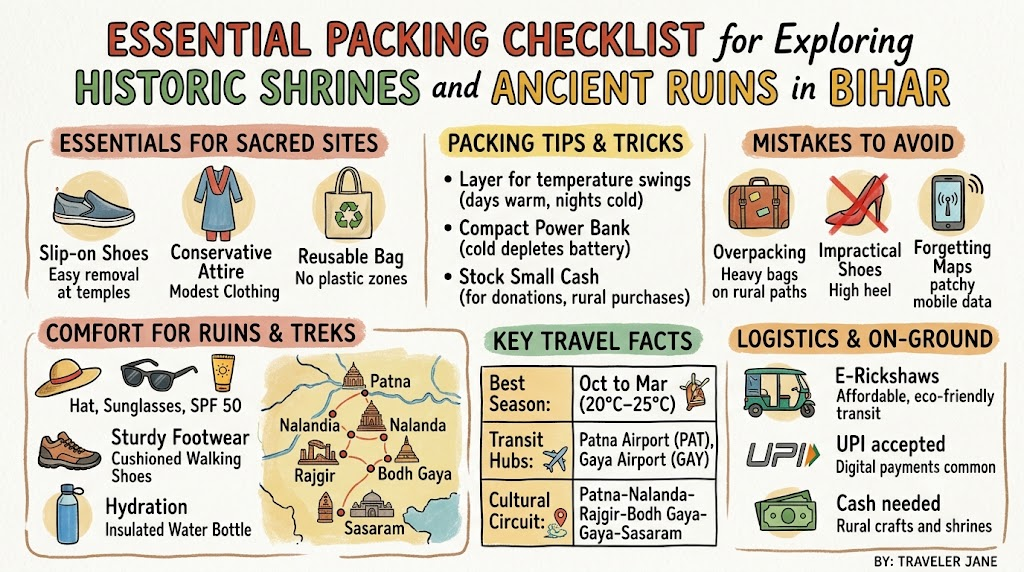
| Key Travel Fact | Details |
|---|---|
| Primary Transit Hubs | Patna Airport (PAT), Gaya Airport (GAY), Patna Junction Rail |
| Best Travel Season | October to March (Pleasant daytime highs of 20°C–25°C, cool nights) |
| Essential Wardrobe Style | Modest, breathable cottons, sturdy slip-on walking shoes, light winter woolens |
| Primary Cultural Circuit | Patna – Vaishali – Nalanda – Rajgir – Bodh Gaya – Sasaram |
| Local Currency Norms | Digital payments (UPI) widely accepted; cash vital for rural crafts and shrines |
Best Places or Experiences
1. Mahabodhi Temple Complex, Bodh Gaya
The Mahabodhi Temple stands as the epicenter of Buddhist pilgrimage, marking the exact spot where Prince Siddhartha attained supreme enlightenment beneath the sacred Bodhi Tree. Its towering 50-meter-high grand pyramidal spire, intricate stone relief carvings, and ancient polished sandstone railings represent a high-water mark of classical Indian brick and stone architecture.
Walking through the inner sanctum as the air hums with multilingual chants and burning butter lamps evokes a profound sense of inner calm. Because travelers spend hours walking across open stone courtyards, packing slip-on shoes, thick socks for cold or sun-baked stones, and conservative attire covering shoulders and knees is mandatory.
Mahabodhi Temple spire in Bodh Gaya.
- Location: Gaya District; 115 km south of Patna, 15 km from Gaya Junction.
- Why it is worth visiting: A UNESCO World Heritage masterpiece housing the direct descendant of the original Bodhi Tree. MakeMyTrip
- Best things to do: Meditate under the Bodhi Tree, admire the ancient Vajrasana (Diamond Throne), and photograph monks in prayer during dawn. Club Mahindra
- Best time to visit: 5:00 AM to 7:00 AM or sunset around 5:30 PM for cooling stone floors and atmospheric chanting.
- Ideal for whom: Spiritual seekers, international cultural travelers, and architecture purists. Club Mahindra
- Travel tip: Mobile phones, smartwatches, and large electronic bags are strictly forbidden inside; leave them safely in your hotel or utilize the free security lockers at the main gate.
2. Ancient Ruins of Nalanda Mahavihara
Dating back to the 5th century CE, Nalanda was an illustrious international center of higher learning that attracted over 10,000 scholars from across Asia before its destruction in the 12th century. The excavated archaeological zone unfolds across 14 hectares of manicured lawns, revealing tiered brick stupas, sophisticated drainage channels, meditation cells, and communal lecture halls.
The monumental Temple No. 3 dominates the central axis, its weathered votive stupas standing as silent sentinels to ancient intellectual debates. Exploring this sprawling open-air heritage site requires sun protection, wide-brimmed hats, and reliable walking shoes capable of handling uneven brick staircases.
Archaeological ruins of ancient Nalanda University.
- Location: Nalanda District; 90 km southeast of Patna, 15 km from Rajgir.
- Why it is worth visiting: The world’s preeminent ancient residential monastic university and a UNESCO World Heritage marvel. TripCrafters.com
- Best things to do: Climb the viewing steps around Temple No. 3, examine ancient stucco sculptures, and tour the adjacent ASI Archaeological Museum.
- Best time to visit: October to February, specifically mid-morning between 9:00 AM and 11:30 AM before direct noon heat sets in.
- Ideal for whom: History buffs, archaeology lovers, academics, and curious families.
- Travel tip: The terrain is almost entirely exposed brickwork; pack a dedicated UV-blocking umbrella and carry an insulated water bottle.
3. Vishwa Shanti Stupa & Griddhakuta Hill, Rajgir
Nestled amidst five rolling green hills, Rajgir was the historic first capital of the Magadha Empire and a beloved retreat for both Lord Buddha and Lord Mahavira. Perched atop Ratnagiri Hill stands the dazzling white Vishwa Shanti Stupa (World Peace Pagoda), erected by the Japanese Buddhist community to radiate tranquility across the valley.
Visitors reach the summit either via an adventurous single-chair aerial ropeway or by hiking the scenic stone trail past Griddhakuta (Vulture’s Peak), where Buddha preached foundational Mahayana sutras. The hilltop offers sweeping panoramic vistas, necessitating comfortable trekking apparel and secure daypacks for your cameras and sunglasses.
Vishwa Shanti Stupa atop Ratnagiri Hill.
- Location: Rajgir, Nalanda District; 102 km south of Patna.
- Why it is worth visiting: Breathtaking hill panoramas paired with monumental Indo-Japanese peace architecture.
- Best things to do: Ride the historic aerial ropeway, hike up to Vulture’s Peak, and observe morning prayers at the Japanese temple. Club Mahindra
- Best time to visit: Early morning between 8:00 AM and 10:30 AM, or late afternoon for sunset views over the valley.
- Ideal for whom: Trekking enthusiasts, landscape photographers, families, and pilgrimage travelers. Club Mahindra
- Travel tip: Beware of wild macaque monkeys near the trail and ropeway queue; ensure your sunglasses, snacks, and loose electronics are zipped away inside your backpack.
4. Tomb of Sher Shah Suri, Sasaram
Rising like a floating sandstone fortress from the center of a grand artificial lake, the Tomb of Sher Shah Suri is a triumph of medieval Indo-Islamic engineering. Built in 1545 CE, this 122-foot-high octagonal mausoleum stands on a stepped stone plinth connected to the mainland by a grand arched causeway.
The sheer symmetry of the dome reflected across the water produces a hypnotic visual scene, particularly in early morning light. Because Sasaram is a quieter, less commercialized city, bringing your own lens cleaning supplies, charging banks, and comfortable walking gear is essential for an uninterrupted half-day excursion.
- Location: Sasaram, Rohtas District; 155 km southwest of Patna via NH19.
- Why it is worth visiting: An architectural bridge between the Sultanate and Mughal styles, featuring one of the largest ancient domes in India.
- Best things to do: Stroll along the water perimeter for mirror-like lake reflections, examine interior acoustic domes, and photograph stone chhatris.
- Best time to visit: 6:30 AM to 8:30 AM for still waters and golden-hour sandstone reflections.
- Ideal for whom: Heritage architects, fine-art photographers, and solo explorers.
- Travel tip: Wear slip-on shoes; you will need to remove your footwear before walking across the polished stone tomb terrace.
5. Bihar Museum & Ganga Riverfront, Patna
Patna, the ancient imperial capital of Pataliputra, showcases an extraordinary blend of deep antiquity and progressive modern culture. The crown jewel of modern urban exploration is the Bihar Museum, a masterwork of contemporary architecture with Corten-steel facades and climate-controlled galleries housing treasures like the celebrated Didarganj Yakshi.
A short drive away, the expansive promenade of JP Ganga Path (Patna Marine Drive) offers cool river breezes, riverboat excursions, and evening views over the sacred Ganges. Navigating both upscale museum halls and bustling street markets requires a neat casual travel wardrobe and a versatile crossbody bag.
- Location: Central Patna; 4 km from Patna Junction, 3 km from Patna Airport.
- Why it is worth visiting: A world-class repository of Mauryan stone artifacts paired with a lively modern riverfront culture.
- Best things to do: Marvel at the 2,300-year-old Didarganj Yakshi, take a sunset boat ride along the Ganga ghats, and taste piping-hot Litti Chokha along Marine Drive.
- Best time to visit: Museum hours from 10:30 AM to 4:30 PM (closed Mondays); riverfront promenade from 5:00 PM onwards.
- Ideal for whom: Urban wanderers, museum enthusiasts, families, and art scholars.
- Travel tip: Photography is allowed inside museum galleries for a small ticket fee; pack a compact prime lens for low-light indoor artifact displays.
Offbeat Exploration: Hidden Gems Tourists Miss
Barabar Caves, Jehanabad
Carved into colossal granite monoliths during the reign of Emperor Ashoka in the 3rd century BCE, the Barabar Caves are the oldest surviving rock-cut chambers in India. The interiors feature the legendary “Mauryan polish”—glass-like, mirror-smooth granite walls that create mesmerizing acoustic reverberations. Pack a sturdy, high-lumen pocket flashlight and flat-soled hiking shoes to navigate these unlit, sacred rock sanctuaries safely.
Ghora Katora Eco-Lake, Rajgir
Tucked inside a natural bowl formed by three forested hills near Rajgir, Ghora Katora is an eco-sensitive freshwater haven completely closed to motorized vehicles. Access is restricted to horse-drawn tongas, electric rickshaws, or bicycles, preserving pristine air and total silence. A colossal pink marble statue of Lord Buddha sits meditatively atop an island in the lake; pack binoculars for birdwatching and a light picnic mat.
Rohtasgarh Fort, Kaimur Hills
Sprawling over an elevated plateau 1,500 feet above the Sone River valley, Rohtasgarh Fort is one of the largest and most dramatic ruined hill fortresses in Asia. The complex contains fortified gates, palaces, and hanging balconies overgrown with wild vines. Reaching it requires a moderate uphill hike; pack a mini-first-aid kit, electrolyte hydration tablets, trekking poles, and reliable trail shoes.
Detailed Practical Guidance for Travelers
| Destination | Standard Entry Fee | General Timings | Best Local Food Options Nearby | Recommended Nearby Attractions |
|---|---|---|---|---|
| Mahabodhi Temple | Free (Locker services free) | 5:00 AM – 9:00 PM | Tibetan Thukpa, Monks Cafe, Kesariya Chai | Great Buddha Statue, Dungeshwari Cave |
| Nalanda Ruins | ₹40 (Indian), ₹600 (Foreigner) | 9:00 AM – 5:00 PM | Silao Khaja stalls, Local vegetarian Thali | Xuanzang Memorial, Nalanda Kund |
| Vishwa Shanti Stupa | Free (Ropeway: ₹100 round-trip) | 8:00 AM – 5:00 PM | Fresh Guava with chaat masala, Peda | Griddhakuta Peak, Venu Vana Bamboo Grove |
| Sher Shah Suri Tomb | ₹25 (Indian), ₹300 (Foreigner) | 6:00 AM – 6:00 PM | Sattu Paratha, Bihari Dal Puri stalls | Rohtasgarh Fort, Chhatri of Hasan Khan |
| Bihar Museum | ₹100 (Indian), ₹500 (Foreigner) | 10:30 AM – 5:30 PM (Closed Mon) | Potbelly Cafe (Bihari delicacies inside) | Golghar, Patna Planetarium, Ganga Ghats |
Logistics & On-Ground Navigation
Local Transport Options
- Intercity Railways: The backbone of Bihar transit; express and Vande Bharat trains connect Patna Junction effortlessly to Gaya, Rajgir, and Sasaram.
- Pre-Booked Private Cabs: The most reliable and stress-free option for day excursions across the Nalanda-Rajgir-Bodh Gaya triangle.
- Electric Rickshaws (E-Rickshaws): The dominant transit mode inside Bodh Gaya and Rajgir; affordable, eco-friendly, and perfect for short hops between temples.
- App-Based Taxis: Uber and Ola operate extensively within Patna municipal boundaries, offering transparent pricing for airport transfers.
Budget Planning
- Backpacker / Solo Explorer Tier: ₹1,200 – ₹1,800 per day (Covers clean monastery guesthouses, state buses/shared autos, and authentic local street meals).
- Mid-Range / Comfort Tier: ₹3,500 – ₹6,000 per day (Includes 3-star heritage hotels, dedicated air-conditioned rental car with driver, entry passes, and upscale regional dining).
Safety and Inclusivity Tips
- For Families: Paved walkways at Nalanda and the Bihar Museum accommodate strollers easily; carry packaged snacks and sealed water bottles during long heritage walks.
- For Couples: Bodh Gaya and Rajgir are remarkably peaceful, international pilgrimage destinations; dressing modestly avoids unwanted scrutiny.
- General Safety: While highways and major pilgrimage corridors are well-patrolled, avoid driving through unlit rural interior roads late at night; conclude inter-district highway travel by 8:30 PM.
Strategic Travel Planning Guardrails
Travel Planning Tips for Bihar
- Pack for Temperature Swings: Winter days (November–February) can be comfortably warm (22°C), but night temperatures can drop sharply to 6°C–8°C; pack smart thermal innerwear and packable fleece jackets.
- Bring a Quick-Dry Microfiber Towel: Essential for visiting thermal springs in Rajgir or washing feet after walking barefoot on pilgrimage stone pathways.
- Prioritize Slip-On Footwear: You will remove your shoes dozens of times daily at temples, stupas, and excavated sanctums; lace-free shoes or sturdy sandals save significant time.
- Carry a Compact Power Bank: Cold winter mornings deplete smartphone batteries rapidly while capturing hundreds of monument photographs.
- Stock Cash in Small Denominations: Keep ₹50 and ₹100 notes handy for monastery donations, shoe-keeping stands, and countryside fruit vendors.
- Pack Reusable Cotton Bags: Plastic bags are prohibited around major eco-zones like Ghora Katora and sacred heritage perimeters.
Common Mistakes to Avoid
- Overpacking Heavy Wardrobes: Dragging oversized roller luggage across rural train stations or cobbled monastery paths creates unnecessary hassle; travel light with a durable 40L duffel or backpack.
- Wearing Impractical Footwear: High heels, stiff dress shoes, or slippery boots are completely unsuitable for crumbling brick monasteries and rocky hill climbs.
- Forgetting Offline Maps: Mobile data can be patchy around remote ruins like Barabar or Rohtasgarh; download offline regional maps before leaving your hotel.
- Disregarding Sun Protection: Winter sun in Eastern India feels deceptively mild, but extended exposure during 4-hour open-air ruins tours causes severe dehydration and sunburn; pack sunscreen and polarized sunglasses. MakeMyTrip
- Skipping a First-Aid Pouch: Local pharmacies may not stock specific digestive aids or allergy medications in rural heritage outposts.
Suggested Itinerary Blueprints
1. Day Quick Dash (Patna Heritage Express)
Targeted at business travelers and rapid layovers looking to experience capital highlights in under 12 hours.
- 07:30 AM – 09:30 AM: Morning heritage walk along the ancient ghats of the Ganges, followed by freshly fried Litti Chokha breakfast along Marine Drive.
- 10:00 AM – 01:30 PM: Deep-dive exploration of the world-class artifacts at the Bihar Museum.
- 02:30 PM – 04:30 PM: Architecture visit to the massive 18th-century granary of Golghar and historic Patna Sahib Gurudwara. Club Mahindra
- 05:30 PM: Sunset riverboat cruise from Gandhi Ghat before airport or rail departure.
2. Day Deep-Dive (Monastic Heartland Route)
A classic 48-hour loop covering the intellectual and spiritual foundations of ancient Magadha.
- Day 1 (Nalanda & Rajgir): Depart Patna early by car (2 hours); spend the morning exploring the sprawling UNESCO ruins of Nalanda University. Drive 25 minutes to Rajgir for an afternoon ropeway ride to Vishwa Shanti Stupa, followed by an evening soak near the natural hot springs. Overnight in Rajgir. TripCrafters.com
- Day 2 (Bodh Gaya): Morning 2-hour drive to Bodh Gaya; dedicate the morning to meditation and photography inside the sacred Mahabodhi Temple complex. Spend the afternoon visiting the giant 80-foot Buddha statue and Thai, Japanese, and Bhutanese monasteries before returning to Patna or catching a night train from Gaya.
3. Complete Weekend Travel Plan (Grand Southern Heritage Loop)
The definitive three-day circuit taking you from sacred shrines to medieval lake fortresses.
- Friday: Arrive in Patna; tour the Bihar Museum and enjoy traditional regional cuisine at an atmospheric city eatery. Evening private cab transfer to Rajgir for an overnight stay. Club Mahindra
- Saturday: Early morning trek to Vulture’s Peak (Griddhakuta), followed by an eco-boat ride on Ghora Katora Lake. Afternoon transfer to Bodh Gaya to experience evening circumambulation chants around the Bodhi Tree. Overnight in Bodh Gaya.
- Sunday: Sunrise departure toward Sasaram (2.5 hours via Grand Trunk Road); marvel at the floating sandstone Tomb of Sher Shah Suri. Complete your loop back to Patna Airport by evening.
Common Tourist Mistakes to Avoid
Geographic Blunders
Trying to combine geographically opposed hubs like the Vikramshila ruins in Bhagalpur with Sasaram on the same day is an impossible itinerary error. Bihar is vast; always split your travel into distinct geographic corridors: Central (Patna), Southern (Gaya-Rajgir-Nalanda), and Western (Rohtas-Sasaram).
Commercial Traps
Spending precious daytime hours browsing generic shopping malls in commercial Patna neighborhoods robs you of authentic local interactions. Seek out rural weavers in Madhubani craft centers, local handloom cooperatives, and authentic street vendors instead.
Neglecting Modern/Alternative Zones
Many visitors assume Bihar consists only of ancient, dusty ruins and bypass the immaculate contemporary art galleries, landscaped waterfronts, and chic regional restaurants emerging across modern Patna. Balance historical tours with these dynamic urban cultural hubs.
Transport Overpayment
Avoid negotiating fares with aggressive unregulated taxi drivers outside terminal gates without a benchmark. Cross-reference estimated fares on standard ride-sharing apps, or book official prepaid taxi booths at Patna Airport and Gaya Junction to guarantee transparent pricing.
Luxury Dining Bias
Confining your meals exclusively to sterile four-star hotel buffets deprives you of the state’s extraordinary culinary heritage. Savoring hot Dal Puri, smoky coal-roasted Litti Chokha, Khaja pastries from Silao, and milk-fudge Pedas from Gaya is where the destination’s authentic soul truly resides.
Frequently Asked Questions
1. What type of clothing is most appropriate to pack for Bihar’s temples?
Modest, breathable clothing that covers both shoulders and knees is appropriate across all temples and monasteries. Loose linen pants, long cotton kurtas, and lightweight scarves are ideal. Because you must remove your shoes frequently, wear slip-on sandals or carry thick cotton socks to walk comfortably over hot or cold stone floors.
2. Is a heavy jacket necessary for a trip to Bihar during winter?
Yes, packing layered winter clothing is crucial between December and January. While afternoons can be pleasantly sunny with temperatures around 22°C, night and early-morning temperatures frequently dip below 8°C. A windproof fleece jacket, thermal innerwear, and a light woolen shawl ensure you stay warm during dawn sightseeing sessions.
3. Are mobile phones and cameras allowed inside the Mahabodhi Temple?
Mobile phones, smartwatches, and camera bags are completely banned inside the main Mahabodhi Temple complex to preserve spiritual sanctity. Dedicated professional still cameras are permitted only if you purchase an official camera permit at the entrance ticket counter. Free secure locker facilities are provided outside the temple gates for personal belongings.
MakeMyTrip
4. What essential items should I pack for walking around the Nalanda ruins?
The excavated ruins at Nalanda are vast, open, and feature unshaded brick pathways. You should pack a wide-brimmed sun hat, polarized sunglasses, SPF 50 sunscreen, and a durable insulated water bottle. Wear well-cushioned walking sneakers, as a comprehensive walking tour of the monasteries easily covers three to four kilometers.
5. How widely accepted are digital payments like UPI in tourist zones?
Digital payments via UPI QR codes (Google Pay, PhonePe, Paytm) are widely accepted across hotels, sit-down restaurants, entry ticket counters, and auto-rickshaws in major cities. However, packing ₹2,000 to ₹3,000 in cash denominations of ₹50 and ₹100 is vital for rural handicraft stalls, shoe counters, and boatmen along the river.
6. What medical and wellness items should I keep in my daypack?
Carry an insulated daypack stocked with personal prescription medications, oral rehydration salts (ORS), antacids, motion sickness tablets for winding hill roads, and mosquito repellent spray. A compact hand sanitizer bottle and pocket-sized wet wipes are invaluable during street food excursions and countryside tours where hand-washing stations may be limited.
7. Can I easily buy authentic Madhubani paintings and local souvenirs?
Yes, authentic Madhubani hand-painted artworks, Sikki grass crafts, and Bhagalpuri silk can be purchased directly from government-certified emporiums such as Upendra Maharathi Shilp Anusandhan Sansthan in Patna. Pack an expandable travel folder or rigid document tube inside your luggage to transport delicate hand-painted canvases without creasing or tearing them during transit.
8. Is it safe to drink local tap water while traveling through Bihar?
It is strongly advised to drink only filtered, boiled, or commercially packaged bottled water from reputable sealed brands across the state. Pack a personal reusable water bottle equipped with an integrated purification filter, or ensure that you inspect the manufacturer seals on all bottled mineral water purchased at local highway stalls.
9. Are power adapters needed for electronic devices in Bihar?
Bihar uses standard Indian electrical outlets: Type C, D, and M plugs operating on a 230V supply voltage and 50Hz frequency. If you are an international traveler carrying devices from Europe, North America, or Southeast Asia, pack a universal multi-pin travel adapter and a compact surge-protected power strip to charge multiple camera batteries simultaneously.
10. What bag style is best suited for daily heritage sightseeing?
A lightweight, anti-theft 15- to 20-liter daypack with zippered compartments is the most practical choice. It easily holds your water flask, guidebook, sunscreen, and shawl while leaving your hands free for ropeways and ruin staircases. Avoid bulky wheeled luggage during daily excursions, as heritage sites feature high stone thresholds and unpaved pathways.
11. What special gear should I pack for visiting wildlife sanctuaries in Bihar?
If visiting Valmiki National Park or Kanwar Lake Bird Sanctuary, pack high-magnification binoculars, neutral earth-toned clothing (khakis, greens, and browns), and an effective insect repellent cream. Brightly colored apparel can startle wildlife, and early morning forest safaris can be misty and cold, demanding an extra windproof jacket layer.
12. Is modest dress required for men at religious and archaeological sites?
Yes, cultural modesty applies equally to male travelers at religious monuments throughout Bihar. Men should avoid wearing sleeveless vests, tank tops, or short gym shorts when entering active shrines, stupas, or rural villages. Lightweight linen trousers, full-length jeans, or formal shorts falling well below the knees paired with breathable cotton shirts are recommended.
Conclusion
Choosing a journey through Bihar offers something exceptionally rare in contemporary travel: an unscripted encounter with living history and authentic human heritage. By packing thoughtfully—balancing cultural respect with functional travel gear—you liberate yourself to absorb the sacred whispers of the Bodhi Tree, the grandeur of ancient brick universities, and the quiet dignity of sunrise over the Ganges. Pack with purpose, step boldly off the generic tourist trail, and let Bihar reveal its monumental legacy to you.
