Introduction
While modern travelers often chase overcrowded, over-commercialized hill retreats and sanitized resort corridors, Bihar offers a raw, authentic journey through civilization itself. This is not a manufactured vacation destination; it is an encounter with the ancient soils where global religions took root, world-first universities thrived, and empires wrote history.
Stepping into this land strips away commercial travel cliches and replaces them with spiritual stillness, magnificent brick architecture, and profound cultural immersion. A three-day journey through Bihar lets you walk the very paths trodden by the Buddha, Mahavira, and Chanakya, bringing you face-to-face with humanity’s deepest heritage without the tourist traps.
Why Bihar is a must-visit city
Bihar represents an indispensable chapter in the history of human thought, spirituality, and statecraft. From the fertile plains of the Ganges to the rugged granite ridges of Rajgir, this geographical expanse nurtured the Mauryan and Gupta golden eras, gifted the world the concept of Ahimsa, and hosted scholars across Asia at the ancient Nalanda University.
Today, world-class infrastructure connects these legendary landmarks seamlessly. Wide expressways, rapid Vande Bharat rail connections, and upgraded international airports at Patna and Gaya welcome history buffs, spiritual seekers, and backpacking explorers alike with traditional, heartfelt hospitality.
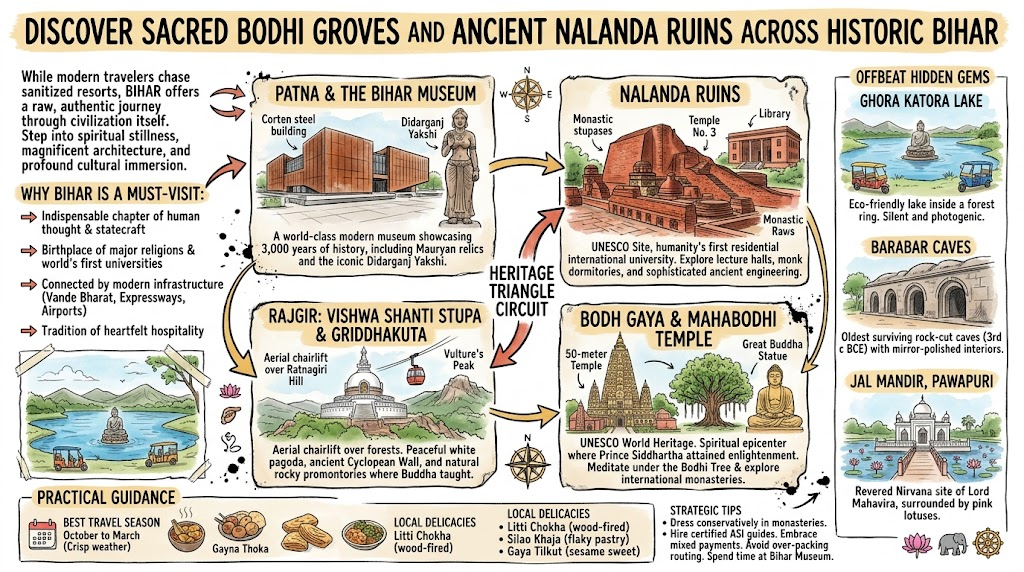
The standard three-day travel circuit centers around the Patna–Nalanda–Rajgir–Bodh Gaya heritage triangle. This route traces ancient Magadha’s evolution through grand archaeological excavations, mist-covered sacred hills, and tranquil global monasteries.
| Travel Dimension | Quick Insight |
|---|---|
| Circuit Covered | Patna – Nalanda – Rajgir – Bodh Gaya |
| Ideal Gateway | Patna Airport (PAT) or Gaya International Airport (GAY) |
| Best Travel Season | October to March (Crisp mornings, pleasant daytime temperatures) |
| Primary Route Highway | NH 22, NH 120, and Bakhtiyarpur-Rajgir 4-Lane Highway |
| Top Travel Theme | Ancient History, Living Spirituality, Archaeological Heritage |
Best Places or Experiences
Mahabodhi Temple Complex, Bodh Gaya
Rising majestically into the sky with its intricate 50-meter pyramidal stone spire, the Mahabodhi Temple stands as the spiritual epicenter of the Buddhist world. Constructed around the sacred spot where Prince Siddhartha attained supreme enlightenment beneath the Bodhi Tree in 531 BCE, this UNESCO World Heritage Site is an architectural and spiritual marvel. The temple walls feature ornate stucco carvings, ancient votive stupas, and polished granite railings originally commissioned by Emperor Ashoka.
Walking into the inner courtyard as monastic chants float on the morning air evokes a profound, grounding stillness. Monks draped in saffron, maroon, and crimson robes practice prostrations along stone walkways, while butter lamps flicker quietly around the Diamond Throne (Vajrasana). The lush meditation gardens, serene lotus pond, and the sprawling branches of the holy tree create an environment that encourages quiet reflection.
- Location: Bodh Gaya, Gaya District; roughly 115 km south of Patna and 12 km from Gaya Junction Railway Station.
- Why it is worth visiting: It is the direct cradle of Buddhism, offering an unmatched peaceful atmosphere and ancient Mauryan architectural roots.
- Best things to do: Sit for silent meditation beneath the sacred Bodhi Tree, admire the 7th-century gilded Buddha idol inside the inner sanctum, and walk around the Muchalinda Lake.
- Best time to visit: October to February; visit between 5:30 AM and 7:00 AM for morning chanting sessions.
- Ideal for whom: Spiritual pilgrims, solo travelers, philosophy enthusiasts, and architectural historians.
- Travel tip: Mobile phones, cameras, and large bags are strictly barred from the inner sanctum; deposit them securely at the free entrance baggage counters before queuing.
Ruins of Nalanda Mahavihara
The evocative red-brick ruins of Nalanda Mahavihara evoke the grandeur of humanity’s first residential international university. Established in the 5th century CE under the patronage of the Gupta Empire, this educational citadel once housed over 10,000 students and 2,000 revered teachers hailing from China, Korea, Tibet, and Central Asia. The sprawling complex comprised grand lecture halls, meditation chambers, multi-story dormitories, and a legendary nine-story library known as Dharmaganja.
Wandering through the excavated ruins reveals an astonishing ancient architectural intelligence. You will discover sophisticated underground drainage systems, double-walled classrooms for thermal insulation, individual prayer niches, and personal student quarters with built-in stone beds and book shelves. The monumental Temple No. 3, with its tiered staircases and intricately sculpted plaster panels of Buddha, stands proudly against the open sky.
- Location: Nalanda District; 90 km southeast of Patna and 15 km north of Rajgir.
- Why it is worth visiting: It is a UNESCO World Heritage monument showcasing the unmatched educational and architectural zenith of ancient India.
- Best things to do: Explore the massive, staircased stupa of Temple No. 3, walk through the monk dormitories of Monastery Site 1, and inspect the stucco art at the on-site Archaeological Museum.
- Best time to visit: November through February; early mornings at 9:00 AM allow you to beat both the afternoon sun and school bus crowds.
- Ideal for whom: History buffs, architecture students, photographers, and curious families.
- Travel tip: Hire an authorized, badge-wearing ASI guide at the main ticket gate; the unmarked ruins reveal their brilliance through detailed historical storytelling.
Vishwa Shanti Stupa & Ratnagiri Hill, Rajgir
Perched high atop the mist-veiled Ratnagiri Hill, the Vishwa Shanti Stupa (World Peace Pagoda) radiates pure white serenity across the Rajgir valley. Erected in 1969 under the guidance of Japanese Buddhist monk Nichidatsu Fujii, this massive hemispherical dome houses four gleaming golden statues of the Buddha depicting his birth, enlightenment, first sermon, and death. Surrounding hills form an amphitheater of craggy green ridges that once shielded the ancient capital city of Magadha.
Accessing the peak via the single-passenger aerial ropeway—one of the earliest operating chairlifts in India—offers a thrilling glide over lush forest canopies. As you ascend, the ancient stone fortifications known as the Cyclopean Wall trace the ridge contours below. At the summit, ringing bells, rhythmic drum ceremonies from the Japanese temple, and cool mountain breezes offer a striking sensory retreat.
- Location: Rajgir, Nalanda District; approximately 102 km southeast of Patna.
- Why it is worth visiting: It combines exhilarating aerial chairlift views with peaceful Buddhist monuments atop historic hills.
- Best things to do: Take the vintage chairlift ride up the hill, circumambulate the marble terrace of the Peace Pagoda, and hike the downhill trail toward Griddhakuta (Vulture’s Peak).
- Best time to visit: October to March; plan your visit between 8:30 AM and 11:00 AM or late afternoon for gentle sunlight.
- Ideal for whom: Adventure enthusiasts, panoramic landscape photographers, and families.
- Travel tip: Keep sunglasses, hats, and small pouches secure during the chairlift ride; local rhesus monkeys frequent the summit trees.
Griddhakuta (Vulture’s Peak), Rajgir
A short, scenic stone trail descending from Ratnagiri Hill leads directly to Griddhakuta, or Vulture’s Peak, a naturally formed rocky promontory revered throughout Buddhist scripture. Here, Lord Buddha retreated during the monsoons to meditate and deliver profound discourses, including the Lotus Sutra and the Heart Sutra. The rock formations resemble the beak and folded wings of a resting vulture, lending the crag its historic name.
Standing on this open stone ledge at daybreak or dusk provides an immense emotional connection to antiquity. The vantage point looks out over endless valleys, ancient stone defense ramparts, and forest canopies untouched by urban development. The open-air brick terrace where the Buddha taught remains carpeted with incense sticks, golden marigolds, and colorful prayer banners tied by travelers from across the globe.
- Location: Rajgir, Nalanda District; connected via stone steps from Ratnagiri Hill, 105 km from Patna.
- Why it is worth visiting: It is an intimate, spiritually charged open-air site where fundamental philosophical treatises were first spoken.
- Best things to do: Walk the smooth stone pathway built by King Bimbisara, sit on the cliff edge for meditation, and photograph the rolling Rajgir valley.
- Best time to visit: Early mornings from 6:30 AM to 8:30 AM to catch low golden sunlight spilling across the crags.
- Ideal for whom: Meditators, spiritual seekers, trekkers, and cultural pilgrims.
- Travel tip: Wear slip-resistant walking shoes; the ancient stone flagstones have been polished smooth by centuries of pilgrims’ feet.
The Bihar Museum, Patna
Spanning a verdant 13.9-acre campus in the heart of Patna, The Bihar Museum is a world-class architectural marvel designed by Japan’s Maki and Associates. Clad in weathered Corten steel and polished local stone, the building effortlessly balances regional rustic warmth with cutting-edge minimalist aesthetics. It stands as one of South Asia’s finest contemporary cultural institutions, created to reintroduce the world to Bihar’s immense historical contributions.
The museum’s expansive galleries take visitors on a chronological journey spanning prehistoric artifacts, Indus Valley connections, Mauryan empires, and intricate medieval bronzes. Its crown jewel is the 3rd-century BCE Didarganj Yakshi, a life-sized sculpture carved from lustrous Chunar sandstone that represents the pinnacle of ancient Indian sculpture. Interactive children’s wings, open courtyards, and multimedia installations make this cultural space deeply engaging.
- Location: Bailey Road, Patna; 4 km from Patna Junction Railway Station and 3 km from Patna Airport.
- Why it is worth visiting: It houses priceless ancient treasures, including the Didarganj Yakshi, inside world-class modern architecture.
- Best things to do: Admire the Didarganj Yakshi in the Masterpiece Gallery, explore the interactive Children’s Discovery gallery, and walk through the tranquil outdoor Corten steel corridors.
- Best time to visit: Year-round; mornings between 10:30 AM and 1:30 PM provide quiet viewing conditions.
- Ideal for whom: Art lovers, design enthusiasts, international travelers, and families.
- Travel tip: The museum remains strictly closed on Mondays; plan at least 2.5 hours to properly view the permanent galleries without rushing.
The Great Buddha Statue & International Monasteries, Bodh Gaya
Towering 80 feet into the open sky, the Great Buddha Statue (Daibutsu) of Bodh Gaya depicts the Buddha in a seated meditation pose atop a giant stone lotus. Sculpted from red granite and sandstone blocks by Japanese master carvers, the monument took seven years to complete. Flanked by ten life-sized bronze disciples, the statue provides a grand visual landmark against Bodh Gaya’s tranquil skyline.
Surrounding this centerpiece are dozens of ornate, authentic international monasteries built by Buddhist nations across Asia and Europe. In a single morning, you can stroll from the soaring pagodas of the Thai Monastery to the peaceful Zen rock gardens of the Indosan Nipponji Japanese Temple, followed by the colorful dragons and silk tapestries of the Bhutanese and Tibetan Monasteries.
- Location: West of the Mahabodhi Temple, central Bodh Gaya; 13 km from Gaya Junction.
- Why it is worth visiting: It offers an incredible architectural tapestry of global Buddhist cultures nestled in one walkable town.
- Best things to do: Stand before the 80-foot Great Buddha statue, visit the Thai Monastery to view its gold-leaf roof, and admire the Japanese temple’s minimalist wood architecture.
- Best time to visit: Late afternoon from 3:30 PM to 5:30 PM when the sunlight casts a warm glow on the red sandstone.
- Ideal for whom: Cultural enthusiasts, street photographers, families, and architecture admirers.
- Travel tip: Respect monastery visiting hours; several international monasteries close their interior prayer halls to visitors between 12:00 PM and 2:00 PM.
Offbeat Exploration: Hidden Gems Tourists Miss
Ghora Katora Lake, Rajgir
Tucked away inside a ring of densely forested hills near Rajgir lies Ghora Katora, an emerald-green natural lake shaped like a horse’s hoof. To preserve this fragile eco-zone, all fossil-fuel vehicles are strictly banned along the 5-kilometer approach road.
Visitors arrive via zero-emission electric rickshaws, horse-drawn tongas, or scenic bicycle trails. Emerging at the lakeshore reveals a colossal 70-foot pink sandstone statue of Lord Buddha standing serenely in the center of the water. The mirror-like waters and surrounding hills make this one of Bihar’s most peaceful, photogenic natural landscapes.
Pristine surroundings of Ghora Katora Lake.
Barabar Caves, Jehanabad
Located about 40 kilometers north of Gaya, the Barabar Caves are the oldest surviving rock-cut caves in India, dating directly to the 3rd century BCE reign of Emperor Ashoka. Carved out of colossal isolated granite boulders, these chambers were created for the ascetic monks of the ancient Ajivika sect.
Stepping inside the Lomas Rishi and Sudama caves reveals an astonishing archaeological marvel: the granite interiors are ground to a glass-like, mirror polish that produces a haunting, cathedral-grade acoustic echo lasting several seconds. Most hurried tourists skip this detour, leaving these ancient caverns wonderfully quiet for intrepid visitors.
Jal Mandir, Pawapuri
Just 18 kilometers from Rajgir, Jal Mandir at Pawapuri is the revered Nirvana site of Lord Mahavira, the 24th Tirthankara of Jainism. Built entirely from shimmering white marble, this temple appears to float magically in the center of an expansive 16-acre water tank blanketed with pink lotus blossoms.
A 600-foot red sandstone bridge connects the shoreline to the central sanctuary. Watching the morning mist lift off the water while migratory birds skim the surface offers an unforgettable sanctuary of quiet, spiritual beauty.
Detailed Practical Guidance for Travelers
| Destination | Standard Entry Fee | General Timings | Best Local Food Options Nearby | Recommended Nearby Attractions |
|---|---|---|---|---|
| Bihar Museum (Patna) | ₹100 (Adults), ₹500 (Foreigners) | 10:30 AM – 5:00 PM (Closed Mondays) | Museum Potbelly Cafe (Bihari Thali, Champaran Meat) | Golghar, Patna Marine Drive, Buddha Smriti Park |
| Nalanda Ruins (Nalanda) | ₹30–₹40 (Indians), ₹300–₹600 (Foreigners) | 9:00 AM – 5:00 PM (Daily) | Silao Khaja stalls, roadside Sattu Paratha counters | Nalanda Archaeological Museum, Xuanzang Memorial Hall |
| Vishwa Shanti Stupa (Rajgir) | Free entry; Ropeway: ₹60–₹100 | 8:00 AM – 5:00 PM (Ropeway timings) | Fresh green sugarcane juice, authentic Rajgir Peda | Griddhakuta Peak, Venuvana Bamboo Grove |
| Mahabodhi Temple (Bodh Gaya) | Free entry; Camera fees applicable | 5:00 AM – 9:00 PM (Daily) | Be Happy Cafe (Pizzas & Organic Coffee), Tibetan Momos | 80-Foot Great Buddha, Thai Monastery, Lotus Pond |
| Ghora Katora Lake (Rajgir) | Free site entry; ₹200–₹300 for E-Rickshaw ride | 9:00 AM – 5:00 PM (Daily) | Roasted spiced corn, tender coconut water | Rajgir Wildlife Safari, Nature Safari Glass Bridge |
| Jal Mandir (Pawapuri) | Free entry (All visitors) | 6:00 AM – 6:00 PM (Daily) | Pure vegetarian Jain Bhojanalayas, fresh Chena sweets | Samosharan Temple, Kakolat Falls (45 km away) |
Logistics & On-Ground Navigation
Local Transport Options
- Intercity Private Cabs: Hiring an air-conditioned sedan or SUV from Patna for the full 3-day circuit (₹3,500 – ₹4,500 per day including tolls and driver allowance) is the most efficient and reliable way to handle regional transit.
- Railways: Excellent, affordable rail transit connects Patna Junction, Rajgir, and Gaya Junction. Express trains like the Vande Bharat and Jan Shatabdi connect the hubs quickly and comfortably.
- E-Rickshaws & Autos: In tourist pockets like Bodh Gaya and Rajgir, eco-friendly e-rickshaws are cheap, ubiquitous, and ideal for short hops between monasteries and ruins.
- App-Based Rides: Uber and Ola operate extensively in urban Patna, offering predictable pricing for airport pick-ups, hotel shuttles, and museum hops.
Budget Planning
- Budget / Backpacking Tier (₹1,200 – ₹1,800 per day): Includes comfortable stays in clean monastery guest rooms or budget ashrams, dining on authentic street-side Litti Chokha and Dal Bhat thalis, and using local trains and shared e-rickshaws.
- Mid-Range / Comfort Tier (₹4,500 – ₹7,500 per day): Includes well-appointed 3-star and 4-star boutique hotels in Patna and Bodh Gaya, dining at established local and continental cafes, dedicated private AC cab hire, and monument guide services.
Safety and Inclusivity Tips
- Families: The circuit is exceptionally welcoming for children and multi-generational families. The wide, manicured gardens at the Bihar Museum and Nalanda Ruins provide spacious, clean environments for safe, leisurely strolls.
- Couples: Bodh Gaya and Rajgir offer safe, quiet, and romantic environments with tranquil cafes and scenic nature trails. Dressing respectfully at religious landmarks ensures a comfortable experience.
- General Safety & Health: Stick to sealed bottled mineral water, avoid poorly lit rural bypass roads late at night, and carry insect repellent for evening monastery grounds.
Local Secret: When traveling between Nalanda and Rajgir, pull over in the heritage village of Silao. This tiny hamlet has been baking Silao Khaja—a sweet, multi-layered crispy pastry—for centuries. Legend says Lord Buddha was offered Khaja as he passed through!
Strategic Travel Planning Guardrails
Travel Planning Tips for Bihar
- Target the Winter Window: Plan your itinerary strictly between late October and early March. Winter temperatures range between 12°C and 25°C, making monument walks pleasant. Summers can exceed 40°C with dry, scorching heat.
- Pre-Book Winter Monastic Stays: Bodh Gaya experiences a high influx of international travelers and pilgrims during winter monastic festivals. Secure your hotel or monastery guesthouse reservations several weeks ahead.
- Embrace Mixed Payments: While digital UPI payments work at nearly all restaurants and city hotels, keep ₹2,000–₹3,000 in crisp paper cash for rural e-rickshaws, parking attendants, shoe minders, and street-food stalls.
- Dress Conservatively for Monasteries: When touring temples and ruins, wear lightweight clothing that covers your shoulders and knees. Slip-on footwear is invaluable because you will remove shoes at every shrine entrance.
- Hire Certified ASI Guides: Skip freelance touts lingering outside monuments. Walk to the authorized ticket windows and ask for an official Archaeological Survey of India (ASI) badge-holding guide to hear legitimate history.
Common Mistakes to Avoid
- Over-Packing Your Routing: Trying to squeeze Vikramshila, Sasaram, and Bodh Gaya into a single weekend will leave you stranded in traffic. Stick tightly to the classic Patna–Nalanda–Rajgir–Bodh Gaya spine.
- Skipping Bihar’s World-Class Museum: Many tourists rush out of Patna immediately. Spending half a day at the magnificent Bihar Museum grounds you in the deep historical context of the sites you will visit.
- Rushing Nalanda During Midday Heat: Avoid exploring the vast, unshaded brick ruins of Nalanda between 12:30 PM and 2:30 PM. The baked bricks radiate heat; visit first thing in the morning.
- Ignoring Local Street Delicacies: Relying solely on hotel buffets deprives you of Bihar’s incredible culinary traditions. Make time for wood-fire baked Litti Chokha, Khaja, and Tilkut.
- Underestimating Bodh Gaya Monastic Closures: Monasteries are living, working places of prayer, and many close their inner halls between 12:00 PM and 2:00 PM. Schedule your visits around morning or late afternoon hours.
Suggested Itinerary Blueprints
1. Day Quick Dash (The Enlightenment Express)
- Target Audience: Business travelers, quick spiritual weekenders, and tight-scheduled explorers.
- Routing: Fly into Gaya Airport or arrive early at Gaya Junction. Spend the morning in quiet meditation beneath the sacred Bodhi Tree at the Mahabodhi Temple. By noon, tour the Giant 80-Foot Buddha and visit the nearby Thai and Japanese Monasteries. In the afternoon, hire a private cab for a 90-minute drive to Rajgir. Take the ropeway up to Vishwa Shanti Stupa, catch the valley sunset from Ratnagiri Hill, and catch an evening departure train out of Rajgir or Gaya.
2. Day Deep-Dive (Imperial Magadha Trail)
- Target Audience: Heritage enthusiasts and culture documentarians with two full days.
- Day 1: Start in Patna with a morning tour of the Bihar Museum, admiring the Didarganj Yakshi and Mauryan relics. Enjoy lunch at The Potbelly Cafe, then take the 4-lane highway to Nalanda (2 hours). Spend 2.5 hours exploring the ancient university ruins and its museum. Overnight in Rajgir.
- Day 2: Ride the early morning Rajgir ropeway to Vishwa Shanti Stupa and hike to Griddhakuta. Take an e-rickshaw out to Ghora Katora Lake. After a lunch of Silao Khaja and regional thalis, drive 90 minutes down to Bodh Gaya. Immerse yourself in the glowing evening lamps and chanting ceremonies at the Mahabodhi Temple complex.
3. Complete Weekend Travel Plan (The Grand 3-Day Buddhist & Heritage Loop)
- Target Audience: First-time travelers, slow-travel explorers, and families wanting a comprehensive, unhurried journey.
- Friday (Arrival in Patna & Ancient Imperial Roots): Arrive in Patna by 9:00 AM. Check into your hotel, then spend the morning exploring the sprawling galleries of the Bihar Museum. Savor lunch featuring authentic Champaran handi mutton or sattu platters. In the afternoon, visit the Mauryan ruins at Kumhrar, take a sunset stroll along the modern JP Ganga Path (Patna Marine Drive), and enjoy the cool river breeze.
- Saturday (Scholars & Monarchy: Nalanda & Rajgir): Depart Patna at 6:30 AM via NH 20. Arrive at Nalanda Mahavihara as gates open at 9:00 AM to explore the expansive monastic ruins with an ASI guide. Stop in Silao to taste fresh, flaky Khaja pastries. Head into Rajgir for lunch, then take the aerial chairlift to the Vishwa Shanti Stupa. Walk down the stone path to Griddhakuta Peak, followed by an evening visit to the peaceful Venuvana Bamboo Grove. Overnight in Rajgir or Bodh Gaya.
- Sunday (Spiritual Zenith: Bodh Gaya to Gaya Departure): Begin at 6:00 AM inside the Mahabodhi Temple Complex in Bodh Gaya. Meditate under the Bodhi Tree while the world around you fills with morning chants. Enjoy a wholesome breakfast at an international traveler cafe, followed by visits to the 80-Foot Great Buddha and nearby Bhutanese, Japanese, and Thai Monasteries. In the afternoon, make a brief detour to the ancient granite Barabar Caves before heading to Gaya Junction or Gaya Airport for your evening flight home.
Common Tourist Mistakes to Avoid
Geographic Blunders
A frequent blunder made by ambitious travelers is trying to bundle geographically distant sites like the Vikramshila ruins near Bhagalpur or Sher Shah Suri’s tomb in Sasaram into this central 3-day loop. Distances in Bihar look deceptively short on a map, but regional traffic and winding bypass roads will consume valuable hours. Keep your three-day itinerary strictly focused on the core Patna–Nalanda–Rajgir–Bodh Gaya corridor.
Commercial Traps
Avoid spending your precious vacation hours wandering around the modern shopping malls or multiplexes popping up along Bailey Road in Patna. Instead, head to atmospheric, historically rich pockets such as the old bazaars near Patna City, the peaceful courtyards of Khuda Bakhsh Oriental Public Library, or genuine artisan centers selling handmade Madhubani folk art and Sikki grass crafts.
Neglecting Modern/Alternative Zones
While history dominates the narrative, do not ignore the charming contemporary spaces flourishing across the state. In Patna, spend an evening at the vibrant waterfront of the JP Ganga Path (Marine Drive) watching the sun set over the Ganges while snacking on roasted corn. In Bodh Gaya, explore the bohemian cafe culture where Tibetan bakeries and organic coffee houses serve international travelers and resident monks.
Transport Overpayment
When arriving at Patna Junction or Gaya Railway Station, never accept flat-rate rides called out by unvetted auto-rickshaw touts outside the exit gates. Use prepaid taxi booths, cross-reference pricing with ride-hailing apps like Uber and Ola, or request that your hotel arrange a vetted driver to ensure fair, transparent pricing.
Luxury Dining Bias
Confining all your meals to sterile five-star hotel buffets strips away one of Bihar’s greatest pleasures: its vibrant, earthy food culture. Step out to try Litti Chokha roasted over open cow-dung coal fires, dipped in golden melted ghee, and served with spicy roasted brinjal mash. Sample crispy flaky Silao Khaja, sweet Gaya Tilkut made from beaten sesame seeds, and light, refreshing Sattu Sharbat.
Culinary Note: Bihar’s food reflects the seasons. If visiting during winter, do not leave without buying fresh Gaya Tilkut made from pounded jaggery and white sesame seeds. It melts on your tongue like sweet winter snow!
Frequently Asked Questions
1. Is a 3-day trip enough to explore the major attractions of Bihar?
Yes, three full days are ideal to cover the core heritage triangle of Patna, Nalanda, Rajgir, and Bodh Gaya. This timeline allows you to visit major UNESCO sites, take the Rajgir ropeway, explore Nalanda’s ruins, and enjoy local food without spending too much time in transit.
2. Which airport is the best gateway for this three-day travel itinerary?
Flying into Jay Prakash Narayan Airport in Patna and flying out of Gaya International Airport is the most efficient open-jaw flight strategy. If booking round-trip tickets, Patna is the best base due to frequent flight connections to major Indian metros.
3. What are the must-eat local dishes during a short journey through Bihar?
You should make time to savor wood-fired Litti Chokha served with spicy brinjal mash, authentic slow-cooked Champaran Handi meat, crispy sweet Silao Khaja, pounded sesame Tilkut from Gaya, and cooling roasted gram-flour Sattu Sharbat served with green chilies and lemon juice.
4. How safe is traveling across Bihar for solo travelers and families?
Traveling the popular Patna–Nalanda–Rajgir–Bodh Gaya tourist circuit is very safe for solo travelers and families. The main tourist hubs are welcoming and active. As a standard precaution, book reputable private taxis for intercity travel and avoid poorly lit rural bypass roads late at night.
5. What is the dress code for entering temples and monasteries in Bodh Gaya?
There is no formal uniform, but respectful and modest attire covering your shoulders and knees is mandatory at the Mahabodhi Temple and surrounding monasteries. You must remove your footwear at the outer gates, so wearing slip-on sandals or easily removable shoes is highly recommended.
6. Are mobile phones and electronic cameras allowed inside the Mahabodhi Temple?
Mobile phones, smartwatches, and large electronics are strictly prohibited inside the main Mahabodhi Temple complex due to security protocols. Free electronic storage lockers are provided at the entrance. Standalone professional still cameras require an official entry permit purchased at the gate counter.
7. Can the Rajgir Glass Bridge and Nature Safari be covered on this trip?
Yes, you can visit the Rajgir Glass Bridge and Nature Safari, but tickets must be pre-booked online well in advance through the official Bihar Tourism portal. Walk-in tickets are extremely limited and long morning queues can disrupt the rest of your travel schedule.
8. How do I hire an authorized historical guide at the Nalanda Ruins?
You can hire official Archaeological Survey of India (ASI) guides directly at the Nalanda monument ticket counter. Look for licensed guides wearing official government ID badges rather than unvetted touts outside, and agree on the standardized fee before beginning your walking tour.
9. What is the best month to plan a comfortable trip to Bihar?
The best time to visit is from November through February. During these winter months, temperatures stay pleasantly between 12°C and 25°C, making daytime strolls around the vast outdoor ruins of Nalanda and open-air monasteries comfortable. Avoid the extreme summer heat between April and June.
10. What unique authentic souvenirs should I buy when visiting Bihar?
Look for authentic hand-painted Madhubani (Mithila) folk paintings directly from registered artisan societies, hand-woven tussar and Bhagalpuri silk shawls, eco-friendly Sikki grass woven baskets, fine stone-carved Buddha miniatures in Bodh Gaya, and boxed boxes of freshly prepared Silao Khaja pastries.
11. Is it easy to find pure vegetarian and Jain food across this circuit?
Finding pure vegetarian food across this circuit is very easy. Bodh Gaya and Rajgir have numerous dedicated pure vegetarian restaurants, Tibetan monastic kitchens, and specialized Jain Bhojanalayas catering to pilgrims traveling to the holy Nirvana site of Pawapuri and sacred Rajgir hills.
12. Is it necessary to pre-book intercity private taxis in advance?
Pre-booking an air-conditioned cab via your hotel or a reputable travel operator is strongly recommended for this three-day circuit. Having a dedicated vehicle waiting for you eliminates morning negotiations, ensures timely sunrise starts, and makes transitions between Patna, Nalanda, and Bodh Gaya seamless.
Conclusion
Stepping away from predictable vacations to embark on a three-day journey through Bihar is deeply rewarding. Standing beneath the ancient Bodhi Tree where the Buddha found inner stillness, touching the weathered bricks of Nalanda where centuries of scholars gathered, and taking in the misty hill views of Rajgir leaves an indelible mark.
This trip is not about ticking tourist sights off a checklist; it is an encounter with the living spiritual and intellectual heritage of humanity. Pack your bags, leave your preconceptions behind, and let the timeless horizons of Bihar show you the true power of mindful, grounded travel.
