Introduction
When most people think of a quick getaway or a cultural holiday in India, their minds immediately drift to the chaotic ghats of Varanasi or the manicured fortresses of Rajasthan. Mainstream travel brochures have a habit of recycling the same crowded backdrops, leaving conscious travelers craving something raw, deeply rooted, and radically authentic. If you are tired of curated tourist traps and want to touch the living pulse of ancient India, it is time to tilt your compass toward Bihar.
Nestled right in the heart of its bustling capital city, Patna, stands a structural marvel that defies conventional architectural logic: the Golghar. Far from a typical palace or a religious shrine, this monumental beehive-shaped granary tells an incredible story of survival, colonial engineering miscalculations, and deep regional pride. It is a striking introduction to a state that shaped empires, birthed global religions, and continues to preserve a unique, soulful identity away from commercialized tourism.
Why Patna is a must visit city
Patna, historically known as Pataliputra, is not just another urban center; it is a macro-level chapter in world history. Serving as the nerve center for the Maurya and Gupta empires, this fertile land along the banks of the holy river Ganges has witnessed the rise of legendary figures like Emperor Ashoka and Chandragupta Maurya. Geographically, it forms the perfect anchor point for India’s core spiritual and heritage circuits. Whether you are charting a path along the Buddhist Circuit (Bodhgaya, Nalanda, Rajgir) or exploring sacred Sufi and Sikh shrines (Takht Sri Patna Sahib), all roads inevitably pass through Patna.
The city is highly accessible for all travelers, boasting a massive railway network connecting it to every corner of India, an expanding international airport, and smoothly paved national highways. Modern Patna effortlessly blends its timeless heritage with updated hospitality infrastructure, featuring budget backpacking hubs alongside premium boutique hotels. For anyone seeking to understand the socio-cultural blueprint of India, exploring the historical timeline of Patna is an absolute necessity.
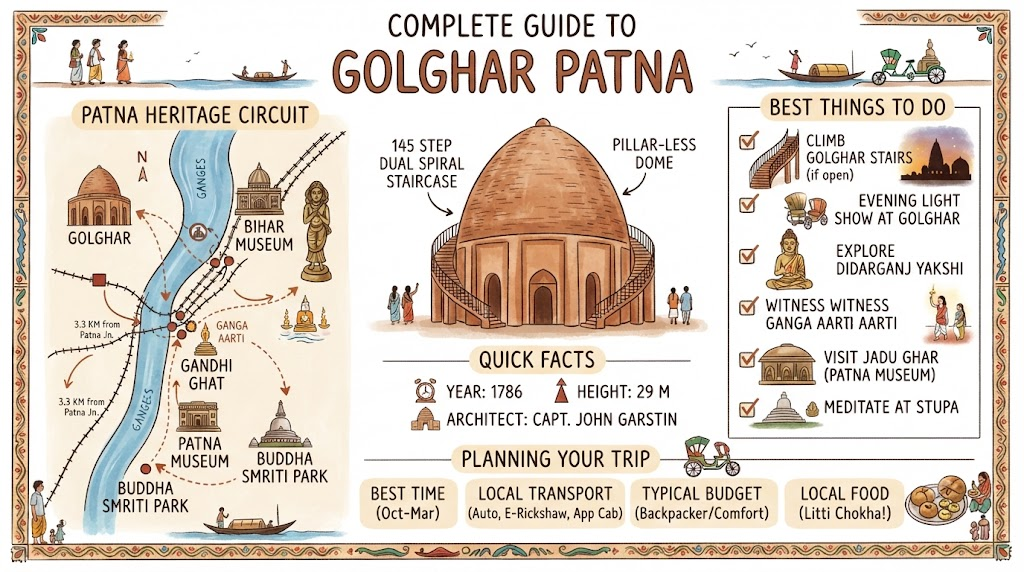
Quick Facts: Golghar & Patna At A Glance
| Key Parameter | Details & Logistics |
| Primary Monument | Golghar (The Great Granary of Patna) |
| Year of Completion | July 20, 1786 |
| Architect / Builder | Captain John Garstin (Bengal Engineers) |
| Structural Height | 29 meters (Pillar-less dome design) |
| Nearest Transit Hub | Patna Junction Railway Station (approx. 3.3 km) |
| Ideal Visiting Months | October to March (Mild, pleasant winter) |
Best Places or Experiences
Golghar Granary
The Golghar is a breathtaking testament to late 18th-century engineering, built under the directives of Warren Hastings following the catastrophic Bengal Famine of 1770. Designed by Captain John Garstin, this enormous, pillar-less, beehive-shaped structure was constructed using locally sourced bricks and lime mortar to serve as a perpetual storage solution for the British army’s grain supply. Its massive architectural volume features walls that are 3.6 meters thick at the base, tapering up to a unique circular opening at the very top through which grain bags were meant to be emptied.
What makes the Golghar universally famous is its dual external spiral staircases consisting of 145 steps. These stairs were meticulously designed to allow a continuous loop of workers to ascend with heavy sacks on one side and descend smoothly on the other. Standing at the base and looking up at its smooth, curved geometry provides an unforgettable visual experience, and the acoustic design inside creates a remarkable echo chamber.
- Location: Ashok Rajpath, Opposite Government Girls High School, West of Gandhi Maidan, Patna (3.3 km from Patna Junction).
- Why it is worth visiting: It is a marvel of colonial architecture and one of the largest pillar-less brick domes in the world, offering a look into historical disaster-management strategies.
- Best things to do: Walk around the massive manicured green lawns, observe the detailed brickwork alignment at the base, and attend the evening musical laser light and sound show.
- Best time to visit: Late afternoon between 4:00 PM and 5:30 PM to catch the soft golden hour lighting shifting over the dome’s facade.
- Ideal for whom: Architecture enthusiasts, history buffs, landscape photographers, and families traveling with children.
- Travel tip: > Note: Access to climb the spiral stairs to the top platform is occasionally restricted for structural safety and ongoing conservation works. Always check with the local guards at the entrance gate before planning a climb.
Bihar Museum
The Bihar Museum is a world-class, multi-acre cultural complex that elevates the storytelling of regional heritage to an international standard. Designed by a collaborative Japanese-Indian architectural firm, its sweeping corten-steel and concrete structures mirror the industrial and earthly history of the state. Inside, the galleries hold thousands of years of human civilization, including artifacts that date back to pre-historic eras, majestic terracotta pieces, and ancient bronze sculptures.
The undisputed crowning jewel of this museum is the Didarganj Yakshi, a breathtaking sandstone sculpture carved in the 3rd century BCE that showcases the peak of Mauryan polish and artistic mastery. The museum uses innovative interactive displays, audio guides, and immersive light installations to make history feel tangible. It stands as a brilliant contrast to the chaotic streets outside, providing a quiet sanctuary of deep intellectual learning.
- Location: Bailey Road, Near Jawaharlal Nehru Marg, Patna (approx. 2.5 km from Golghar).
- Why it is worth visiting: It is widely considered one of the finest contemporary museums in South Asia, masterfully displaying the timeless heritage of Bihar.
- Best things to do: Spend time admiring the Didarganj Yakshi, browse the interactive children’s gallery, and relax by the outdoor water reflection pools.
- Best time to visit: Plan for morning hours between 10:30 AM and 1:30 PM to explore the massive galleries before afternoon foot traffic grows.
- Ideal for whom: Art lovers, heritage scholars, global travelers, and solo explorers.
- Travel tip: The museum remains strictly closed on Mondays. Give yourself at least 2 to 3 hours to do proper justice to the expansive indoor display wings.
Gandhi Ghat and the Ganga Aarti
Gandhi Ghat, situated right on the banks of the sacred river Ganges, holds a profound spiritual and historical energy. It is named after Mahatma Gandhi, whose ashes were immersed at this precise spot in 1948, linking the destination forever to the story of India’s independence struggle. The ghat features wide concrete stairs leading down into the river, framed by traditional pavilions that look out over the vast, expansive waters of the Ganges.
As dusk approaches, the entire riverbank transforms into a vibrant spiritual stage for the evening Ganga Aarti. Saffron-robed priests chant rhythmic Vedic hymns while hoisting multi-tiered, blazing brass lamps in perfectly synchronized movements. The reflection of the fire on the dark river water, accompanied by the scent of burning incense and the sound of conch shells, creates an deeply moving sensory experience.
- Location: Ashok Rajpath, Near Patna University Campus, Patna (approx. 4.2 km from Golghar).
- Why it is worth visiting: To experience Patna’s spiritual soul and witness a mesmerizing riverside fire ritual that rivals the ghats of Rishikesh and Varanasi.
- Best things to do: Book a seat on the Bihar Tourism development boat to watch the Aarti from the river, listen to live devotional music, and float a small clay diya.
- Best time to visit: Weekends (Saturdays and Sundays) around 5:30 PM to secure an excellent viewing spot before the ritual starts at dusk.
- Ideal for whom: Spiritual seekers, culture documentarians, couples, and multi-generational families.
- Travel tip: Keep a close eye on your footwear near the steps, and prioritize booking the official government-operated cruise ferry for a safe, uncrowded viewpoint.
Patna Museum
Often referred to locally as the Jadu Ghar (House of Magic), the Patna Museum is a stunning example of Indo-Saracenic architecture built by the British in 1917. Surrounded by deep green gardens, its exterior features intricate stone jali work, towering arches, and classic Rajasthani chhatris. The museum was created to house the archaeological treasures unearthed across nearby historical sites like Pataliputra, Nalanda, and Vaishali.
The interior galleries hold an invaluable collection, including a fossilized tree trunk that is over 200 million years old, fine Mauryan stone heads, and a rare collection of Tibetan Thangka paintings. It serves as an incredible time capsule, reflecting a vintage style of curation that preserves the romantic charm of early 20th-century exploration.
- Location: Budh Marg, Near Patna Junction, Patna (approx. 2 km from Golghar).
- Why it is worth visiting: For its stunning historical architecture and a massive collection of ancient stone sculptures that map out the dynasties of Eastern India.
- Best things to do: Photograph the elegant British-era structural arches, view the prehistoric fossilized tree trunk, and explore the ancient weapons gallery.
- Best time to visit: Between 11:00 AM and 2:00 PM on weekdays when the ambient noise inside the galleries is lowest.
- Ideal for whom: Academic researchers, architectural photographers, vintage enthusiasts, and student groups.
- Travel tip: Ensure you purchase a separate photography permit at the main ticket counter if you intend to bring in a professional DSLR camera setup.
Buddha Smriti Park
Spanning across 22 acres of lush landscaping in the absolute center of Patna’s urban chaos, Buddha Smriti Park is a modern urban oasis dedicated to the life and teachings of Lord Buddha. Inaugurated by the Dalai Lama, the park’s central focal point is the magnificent Patliputra Karuna Stupa, a towering 200-foot-tall structure built to look like a traditional dome temple. Inside the stupa rests a sacred relic chamber containing authentic artifacts of Buddha brought from across various Asian nations.
The park features manicured meditation gardens, dedicated seating zones around water fountains, and a museum mapping the journey of Buddhism from Bihar to the rest of the world. At night, the stupa is lit up beautifully, offering a tranquil space where locals and travelers come to escape the city noises.
- Location: Frazer Road, Directly opposite Patna Junction Railway Station, Patna (approx. 2.8 km from Golghar).
- Why it is worth visiting: To see the spectacular modern architectural stupa and experience a quiet, meditative space right in the center of the city.
- Best things to do: Walk through the peaceful meditation paths, view the indoor relic chamber, and enjoy the musical fountain show in the evening.
- Best time to visit: 5:00 PM to 7:30 PM to enjoy the cool evening breeze and see the illuminated stupa reflection.
- Ideal for whom: Solitary travelers, couples looking for a quiet evening stroll, and mindfulness practitioners.
- Travel tip: Electronic items and large luggage backpacks are restricted at the gate. Use the designated locker facility available at the ticket entrance to secure your items.
Offbeat Exploration: Hidden Gems Tourists Miss
The Acoustic Whispering Wall of Jalan Museum (Quila House)
Perched right over the foundations of the historic Sher Shah Suri fort in Old Patna city, this private museum is an absolute hidden gem. It houses a jaw-dropping collection of European jade, Chinese porcelain, and royal silver beds belonging to the Jalan family. What tourists miss is the architectural acoustic anomaly near the old river-facing balcony—if you whisper softly into one corner of the structural wall, your voice carries clearly to a person standing diagonally across the room, a secret design quirk used by historical elites to overhear conspiracies.
Sanjay Gandhi Jaivik Udyan’s Botanical Canopy Walk
While standard tour operators label this site simply as a city zoo, offbeat travelers head straight past the animal enclosures to the dense, isolated botanical rear section. Home to an extensive collection of rare medicinal herbs, orchids, and a massive banyan grove, this area features a quiet canopy path. Early in the morning, it transforms into an incredible birdwatching paradise where you can spot migratory blue kingfishers and hornbills completely shielded from the urban rush outside.
Detailed Practical Guidance for Travelers
| Destination | Standard Entry Fee | General Timings | Best Local Food Options Nearby | Recommended Nearby Attractions |
| Golghar Granary | Free Grounds Entry (Light Show: ₹30) | 9:30 AM – 6:00 PM | Litti Chokha at Maurya Lok complex | Gandhi Maidan, S.K. Science Centre |
| Bihar Museum | ₹100 for Indian Adults | 10:30 AM – 5:00 PM (Closed Mon) | Amber Restaurant / In-house Cafe | Eco Park, Patna High Court |
| Gandhi Ghat | Free Access (Boat Ride: ₹50) | Open 24 Hours (Aarti at 6:00 PM) | Street Chat and Kulfi at NIT Mor | Khuda Bakhsh Library, Patna University |
| Patna Museum | ₹50 per person | 10:30 AM – 4:30 PM (Closed Mon) | Bansi Vihar (Authentic South Indian) | Buddha Smriti Park, Patna Junction |
| Buddha Smriti Park | ₹20 per person | 9:00 AM – 7:00 PM (Closed Mon) | Real Chimney Restaurant on Frazer Road | Mahavir Mandir, Pal Hotel eateries |
Logistics & On-Ground Navigation
Local Transport Options
- Railways & Long Distance Buses: Patna Junction remains the primary railway gateway. For inter-state bus travel, the state-of-the-art New ISBT Patna handles luxury bus lines connecting to Ranchi, Varanasi, and Gaya.
- Auto-Rickshaws (Shared & Reserved): The lifeline of Patna’s daily commute. Shared autos run on fixed routes along Ashok Rajpath and Bailey Road for a nominal fee (₹10–₹30). For point-to-point privacy, always negotiate a fixed rate before stepping in.
- E-Rickshaws: These silent, battery-operated vehicles are perfect for short hops (under 2 km) through narrow alleys, especially when exploring Old Patna or the back lanes of Golghar.
- App-Based Car Rentals: Ola, Uber, and Rapido operate extensively across Patna. Booking through an app is the most reliable way to avoid price negotiations when traveling from the airport to your hotel late at night.
Budget Planning
[Budget/Backpacker Tier]: ₹1,200 – ₹1,800 per day
• Stay: Shared hostel beds or basic guesthouses near Patna Junction.
• Food: Local street stalls, Litti stalls, and sweet shops.
• Transport: Shared auto-rickshaws and E-rickshaws.

[Mid-Range/Comfort Tier]: ₹3,500 – ₹6,000 per day
• Stay: 3-star business hotels near Frazer Road or Boring Road.
• Food: Sit-down heritage restaurants and modern cafes.
• Transport: App-based reserved cabs for day-long sightseeing.
Safety and Inclusivity Tips
- For Families: Patna is generally very welcoming to multi-generational family units. Stick to early evening visits for major public spaces like Gandhi Maidan and secure your transport in advance during major local festivals.
- For Couples: Public parks like Eco Park and the gardens of Buddha Smriti Park offer clean, safe spaces for couples. Avoid poorly lit river stretch pathways along the old ghats after 8:00 PM.
- General Safety: Stick to main, well-lit roads during late night travel. Keep your personal items secure in crowded market areas like Hathwa Market and Khaitan Market.
Strategic Travel Planning Guardrails
Travel Planning Tips for Patna
- Digital vs. Cash Payments: While major museums, upscale restaurants, and app cabs accept UPI payments, always carry small cash denominations (₹20, ₹50, ₹100) for local street food vendors and shared auto rides.
- Physical Preparation for Climbs: If you plan on walking long distances around massive historical sites like the Bihar Museum, lightweight cotton clothes and sturdy, broken-in walking shoes are an absolute necessity.
- Navigating Local Etiquette: Remove your shoes before entering religious spaces or sacred platforms. Dress modestly when visiting cultural landmarks to respect the local traditions.
- Festival Planning Safeguards: If you are traveling during Chhath Puja (late autumn), book your train tickets and hotel rooms months in advance, as millions of people return home to Bihar during this time.
- Hydration Checks: The weather can get warm and humid outside of the winter months. Always carry a reusable water bottle during your afternoon walks around the city landmarks.
Common Mistakes to Avoid
- Over-packing Your Daily Itinerary: Do not try to pack Golghar, Bihar Museum, Takht Sri Patna Sahib, and a ghat boat ride into a single day. The cross-city traffic can slow down your travel.
- Skipping the Local Street Food Vendors: Dining exclusively inside luxury hotel buffets means you completely miss out on authentic culinary staples like freshly grilled Litti Chokha or sweet, flaky Khaja.
- Assuming All Sites Remain Open Daily: Planning major museum visits on a Monday will result in disappointment, as most state-run heritage sites observe a strict weekly holiday on Mondays.
- Forgetting to Cross-Check Ride-Hailing Apps: Accepting the very first quote from unmetered transport drivers right outside transport hubs can result in overpaying. Always check app pricing for a baseline reference.
- Ignoring the Modern Cafe Scene: Do not skip the newer residential developments along Boring Road and Patliputra Colony, which house great local art cafes and independent bookstores.
Suggested Itinerary Blueprints
1-Day Quick Dash (The Heritage Core)
This rapid routing is designed for corporate transit travelers or short-stay tourists. Start your morning at 9:30 AM with a peaceful walk around Golghar. Move immediately to the spectacular galleries of the Bihar Museum for a 3-hour deep-dive. Grab an authentic lunch at Maurya Lok, and spend your evening watching the mesmerizing Ganga Aarti at Gandhi Ghat before catching your night train or flight.
2-Day Deep-Dive (Dynasties & Spiritual Tracks)
- Day 1: Explore the classic Indo-Saracenic Patna Museum in the morning, followed by a quiet lunch near Frazer Road. Spend your afternoon exploring the relic chambers of Buddha Smriti Park and wind down with the evening laser show at Golghar.
- Day 2: Head deep into Old Patna early in the morning to pay respects at the historic Takht Sri Patna Sahib. Spend your afternoon tracking down hidden relics at the private Jalan Museum and finish your journey with a sunset boat ride along the Ganges river.
Complete Weekend Travel Plan (The Ultimate Capital Loop)
- Friday Evening: Arrive in Patna, check into your hotel, and head straight to Frazer Road for hot sweets and a relaxed night walk around the illuminated fountains of Buddha Smriti Park.
- Saturday: Dedicate your morning to the expansive Bihar Museum. In the afternoon, enjoy a picnic at Eco Park, explore the historical structure of Golghar, and enjoy the spiritual evening energy of the Ganga Aarti at Gandhi Ghat.
- Sunday: Start with an early morning walk through the botanical canopy of Sanjay Gandhi Jaivik Udyan. Spend your afternoon shopping for traditional Madhubani paintings at Maurya Lok and checking out the vintage collections inside the Patna Museum before heading home.
Common Tourist Mistakes to Avoid
- Geographic Blunders: A common mistake is attempting to explore Takht Sri Patna Sahib (in the far eastern part of the city) and the Bihar Museum (in the western zone) back-to-back within a two-hour window. The linear layout of Patna means traffic can back up along the main roads during rush hour.
- Commercial Traps: Do not spend your limited holiday time inside modern glass shopping malls that look exactly like the ones back home. Instead, dive directly into the narrow lanes of local markets to discover true regional flavors and craftsmanship.
- Neglecting Modern/Alternative Zones: Many visitors focus so heavily on ancient history that they miss out on the quieter, artistic spaces sprouting up around Patliputra Colony, which feature beautiful contemporary art galleries and community performance spaces.
- Transport Overpayment: Always check standard ride-sharing apps on your smartphone to reference current baseline pricing before entering long negotiations with local auto-drivers outside stations.
- Luxury Dining Bias: Avoiding small roadside vendors out of hesitation can be a mistake. The true culinary mastery of Bihar lives on the streets—from the smoky aroma of charcoal-roasted Litti to the crisp layers of fresh sweets.
Frequently Asked Questions
1. Is Golghar Patna open for tourists every day?
Yes, the grounds and gardens of Golghar are open every day of the week from 9:30 AM to 6:00 PM. However, certain museum galleries nearby or specific light show schedules can vary on public holidays.
2. Can we climb to the very top of Golghar right now?
Climbing the 145 steps of the external spiral staircase is occasionally restricted by the archaeological department for structural maintenance and safety. It is recommended to check its live operational status at the entry gate upon arrival.
3. What is the standard entry ticket price for Golghar?
Entering the main garden complex of Golghar is completely free for all national and international visitors. However, a nominal ticket fee ranging from ₹30 to ₹50 applies if you choose to watch the evening laser light and sound show.
4. Why did the British build the Golghar structure in Patna?
It was constructed in 1786 by Captain John Garstin as a massive granary to store surplus grain for the British army. This was a direct response to prevent a repeat of the tragic Bengal Famine of 1770 which had devastated the region.
5. Is there a major design flaw in the construction of Golghar?
A popular historical story suggests that the doors were mistakenly designed to open inwards, meaning that if the granary were filled to its maximum capacity of 140,000 tons, the weight of the grain would prevent the doors from opening. However, practical inspections show the structural doors actually hinge outwards.
6. How far is Golghar from the Patna Junction Railway Station?
The monument is located approximately 3.3 km away from Patna Junction. A reserved auto-rickshaw or app-based cab can easily get you to the site in about 15 to 20 minutes depending on city traffic.
7. Which is the closest airport to Golghar Patna?
Jay Prakash Narayan International Airport is the nearest airport, situated roughly 6.8 km away. You can find plenty of pre-paid taxis and app cabs right outside the terminal gates.
8. What are the best places to visit near Golghar within walking distance?
The massive historic grounds of Gandhi Maidan, the S.K. Science Centre, and the bustling food stalls of the Maurya Lok shopping complex are all located close to the monument.
9. Can you recommend the best time of year to explore Patna?
The ideal time to visit is during the winter months, specifically from October to March. The weather during this period is pleasantly cool and comfortable for outdoor sightseeing.
10. Where can I find the most authentic Litti Chokha near Golghar?
The street food stalls around the Maurya Lok complex, located less than a kilometer away, serve delicious charcoal-cooked Litti slathered in pure ghee alongside spicy mashed eggplant and potatoes.
11. Is photography permitted inside the Golghar complex?
Yes, photography is fully permitted throughout the open park areas. Bringing a standard smartphone camera does not require any additional payment.
12. Is the Golghar area safe for solo female travelers?
Yes, the monument sits within a busy, high-security zone in central Patna right next to government buildings. As a general travel practice, it is best to wrap up your outdoor explorations by 8:00 PM.
Conclusion
Choosing to travel through Patna and standing before the towering curves of the Golghar is more than just a typical vacation; it is a profound journey into the resilient heart of Indian civilization. Instead of offering an artificial, manicured resort experience, a holiday here rewards you with genuine cultural connections, deep historical insights, and unforgettable sensory experiences. As you watch the golden sun drop below the horizon from the banks of the timeless Ganges river, you will realize that the true magic of travel lies in discovering these powerful, authentic chapters of our shared human story.
