Introduction
Skip the predictable, air-conditioned shopping malls of metropolitan hubs where mass-produced garments hang under fluorescent glare. Instead, imagine stepping into a sun-drenched courtyard in eastern India where the rhythmic clack of a wooden pit-loom echoes like an ancient heartbeat, and freshly dyed skeins of Tussar silk dry in the crisp morning breeze.
Exploring the best places to buy traditional clothes in Bihar is not a standard retail errand; it is an intimate journey into a living textile archive. Here, every thread carries the weight of 2,000-year-old silk traditions, Buddhist iconography, and generational family pride. You do not just buy a garment in Bihar—you meet the master artisan who spun the yarn, painted the mythological folklore, or stitched rural stories into raw cotton.
Why Bihar is a must-visit city
(Note: While Bihar is a historic state rather than a single city, its interconnected cultural hubs operate as one seamless, living textile metropolis for heritage travelers.)
Bihar sits at the crossroads of ancient Indian civilization, where royal Mauryan courts and monastic Buddhist centers once patronized fine muslins and wild silks. Today, the state boasts multiple Geographical Indication (GI) tagged textiles, including Bhagalpuri Silk, Madhubani art fabrics, Sujani embroidery, and the newly GI-certified Bawan Buti weave.
For the modern traveler, Bihar is remarkably accessible via Jay Prakash Narayan International Airport in Patna, Darbhanga Airport, and a dense Indian Railways network linking Patna, Bhagalpur, Gaya, and Madhubani. Smooth four-lane highways connect the central Buddhist circuit to the northern Mithila plains, supported by upgraded boutique hotels and government-run heritage stays.
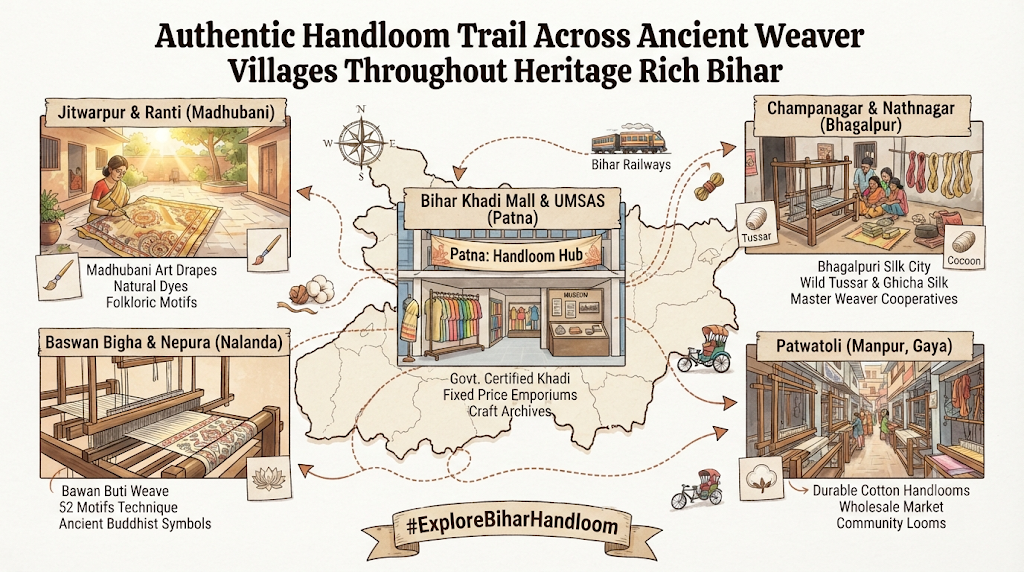
The ideal textile travel circuit begins in Patna for curated state emporiums, heads south to Nalanda and Gaya for Buddhist-inspired cottons, sweeps east to Bhagalpur for wild Tussar silks, and concludes north in Madhubani and Muzaffarpur for folk-painted drapes and intricate embroidery.
| Key Attribute | Details for Textile Travelers |
|---|---|
| Primary Signature Crafts | Bhagalpuri Tussar Silk, Madhubani Painted Sarees, Bawan Buti, Sujani Embroidery, Manpur Cotton |
| Main Entry Hubs | Patna Airport (PAT), Darbhanga Airport (DBR), Patna Junction & Bhagalpur Junction Railways |
| Ideal Trip Duration | 3 to 5 Days for a complete multi-district textile circuit |
| Peak Shopping Season | October to March (Post-monsoon pleasant weather & Chhath/wedding festive collections) |
| Price Range | ₹500 for daily handloom cottons to ₹25,000+ for museum-grade hand-painted Tussar |
Best Places to Buy Traditional Clothes in Bihar
1. Champanagar and Nathnagar Weaver Clusters (Bhagalpur)
Known globally as the “Silk City of India,” Bhagalpur has nurtured sericulture along the banks of the Ganges for over two millennia. Walking through the narrow lanes of Champanagar and Nathnagar, you witness entire families turning rough cocoons into lustrous Ghicha, Matka, and Katan Tussar silks.
Unlike showroom retail, buying directly from these master weaver cooperatives lets you inspect the raw, earthy slub of genuine wild silk before it ever reaches a city middleman. You can watch artisans dye yarns using natural pomegranate rind, turmeric, and madder root right beside their looms.
- Location: Champanagar & Nathnagar zones, Bhagalpur district (approx. 230 km east of Patna).
- Why it is worth visiting: Direct access to authentic GI-tagged Bhagalpuri Tussar silk and Manjusha art sarees at genuine weaver-gate prices. Ressa
- Best things to do: Watch cocoon reeling in family courtyards, commission custom-dyed Tussar yardage, and pick up Bhagalpuri silk-cotton blends for breathable everyday wear. Ressa
- Best time to visit: October to February, between 10:00 AM and 4:00 PM when natural daylight illuminates the true sheen of raw silk.
- Ideal for whom: Bridal shoppers, textile designers, slow-travel enthusiasts, and sustainable fashion buyers.
- Travel tip: Always check for the official Silk Mark tag and ask to see the reverse side of woven borders to distinguish true handloom work from power-loom synthetics. RootWell
Intricate handloom silk border craftsmanship.
2. Bihar Khadi Mall and Upendra Maharathi Shilp Anusandhan Sansthan (Patna)
Located right beside the historic Gandhi Maidan, Bihar Khadi Mall is India’s first dedicated multi-story mall exclusively celebrating handspun Khadi and regional village crafts. Just a short drive away on Bailey Road, the Upendra Maharathi Shilp Anusandhan Sansthan (UMSAS) operates both a craft museum and a direct artisan sales outlet.
Together, these two institutions eliminate the guesswork for travelers short on time. Every garment on the rack—from crisp Bhagalpuri linen kurtas to Tikuli-inspired sarees—is vetted by state craft boards, ensuring fair wages go straight back to rural clusters.
- Location: East Gandhi Maidan & Bailey Road, Central Patna (heart of the state capital). Upendra Maharathi Shilp Anusandhan Sansthan
- Why it is worth visiting: One-stop authenticated shopping under government oversight with fixed, transparent pricing and zero haggling. Upendra Maharathi Shilp Anusandhan Sansthan
- Best things to do: Browse three floors of Khadi apparel, explore the 100-year-old rare craft archives at UMSAS, and buy hand-stitched Khatwa appliqué dupattas. Ressa
- Best time to visit: November to March, ideally on weekday mornings around 11:00 AM to avoid weekend local crowds.
- Ideal for whom: First-time visitors to Bihar, corporate gift buyers, families, and travelers on tight schedules.
- Travel tip: Visit the Bihar Museum Shop on Jawaharlal Nehru Marg nearby for contemporary designer collaborations crafted by rural Bihari artisans.
3. Jitwarpur and Ranti Craft Villages (Madhubani)
In the heart of the Mithila region, the twin villages of Jitwarpur and Ranti function as open-air art studios where mud walls and fine Tussar fabrics share the same vivid visual language. Here, female master artists translate ancient Bharni (filled color) and Kachni (fine line) Madhubani painting traditions onto sarees, stoles, and men’s kurtas.
Sitting cross-legged on a verandah with a national-award-winning artist as she uses a bamboo twig to paint Kohbar marriage motifs onto raw silk is an unforgettable cultural immersion. Every brushstroke tells a story of nature, fertility, and Maithil folklore.
- Location: Jitwarpur & Ranti villages, Madhubani district (approx. 170 km northeast of Patna and 35 km from Darbhanga).
- Why it is worth visiting: Home to Padma Shri-awarded Mithila artists where you buy hand-painted GI-tagged garments straight from the creator’s easel. Ressa
- Best things to do: Commission a personalized Kohbar Madhubani saree, watch artists prepare natural dyes from soot and leaves, and purchase hand-painted cotton dress materials. Ressa
- Best time to visit: October to March, arriving by 9:30 AM when artists begin their morning painting sessions in soft courtyard light.
- Ideal for whom: Art collectors, solo cultural travelers, couples, and photographers.
- Travel tip: Carry sufficient cash in small denominations, as cellular data in interior village lanes can occasionally drop during UPI transfers.
4. Baswan Bigha and Nepura Weaver Hubs (Nalanda)
Tucked near the ancient ruins of Nalanda University, the villages of Baswan Bigha and Nepura guard one of India’s most poetic handloom secrets: the Bawan Buti weave. Awarded prestigious GI tag protection in June 2026, Bawan Buti literally translates to 52 small motifs woven directly into the fabric using an arduous extra-weft technique.
As weavers work their pit looms, Buddhist symbols—the Bodhi tree, lotus, conch, and wheel—emerge symmetrically across soft cotton and Nepura Tussar silk. A single six-yard saree requires up to 20 days of uninterrupted hand-shuttle coordination.
- Location: Baswan Bigha & Nepura villages, Nalanda district (approx. 85 km southeast of Patna, near Rajgir).
- Why it is worth visiting: Direct access to newly GI-certified Bawan Buti sarees and stoles before global commercial demand drives prices up. MadeByHer
- Best things to do: Inspect the mirrored motif reverse side on active pit looms, meet local weaver cooperatives, and buy Bawan Buti yardage for bespoke tailoring. MadeByHer
- Best time to visit: October to February, pairing a morning loom visit with an afternoon tour of the Nalanda Mahavihara ruins.
- Ideal for whom: Heritage connoisseurs, textile researchers, and travelers exploring the Buddhist Circuit.
- Travel tip: Flip the saree over before buying; authentic extra-weft Bawan Buti motifs appear crisp and legible on the back with zero loose hanging knots. MadeByHer
5. Patwatoli Handloom Cluster (Manpur, Gaya)
Across the Falgu River from the sacred pilgrimage town of Gaya lies Manpur’s Patwatoli, a legendary weaving settlement where rhythmic loom sounds echo from dawn until dusk. While Patwatoli is famous nationwide for producing engineering graduates from weaver households, its primary heartbeat remains durable, vibrant handloom cotton sarees, gamchas, and dhotis.
This is the ultimate destination for travelers seeking honest, breathable everyday Indian textiles without tourist markups. The sheer scale of community-run looms makes Patwatoli a powerhouse of grassroots craftsmanship.
- Location: Manpur block, Gaya district (approx. 105 km south of Patna and 15 km from Bodh Gaya).
- Why it is worth visiting: Unbeatable wholesale-level pricing on sturdy, pure cotton handlooms and traditional Bihari gamchas. Ressa
- Best things to do: Walk the bustling weaver alleys, pick up colorful Manpur cotton sarees for summer wear, and buy handwoven lungis and stoles. Ressa
- Best time to visit: November to February, ideally between 10:00 AM and 1:00 PM before afternoon breaks.
- Ideal for whom: Budget travelers, bulk souvenir shoppers, and pilgrims visiting Bodh Gaya.
- Travel tip: Combine this stop with a morning visit to Mahabodhi Temple in Bodh Gaya, hiring a local auto-rickshaw for a half-day loop.
6. Bhusura and Muzaffarpur Sujani Artisan Cooperatives (Muzaffarpur)
In the lush, lychee-orchard belt of North Bihar, rural women in Bhusura and surrounding Muzaffarpur villages keep alive the GI-tagged art of Sujani embroidery. Historically born from stitching worn-out saris into soft baby quilts, modern Sujani uses tiny, dense running stitches to narrate rural life, women’s empowerment, and folk celebrations on Tussar silk and fine cotton.
Unlike flashy machine embroidery, a Sujani drape feels sculptural and deeply personal—no two pieces ever tell the exact same visual story.
- Location: Bhusura village & Mahila Vikas Sahyog Samiti centers, Muzaffarpur district (approx. 75 km north of Patna).
- Why it is worth visiting: Support grassroots women-led cooperatives while acquiring museum-worthy Sujani embroidered sarees and jackets.
- Best things to do: Observe fine needlework sessions, purchase Sujani-on-Tussar fusion sarees, and browse hand-embroidered kurtis.
- Best time to visit: November to March (or May–June if you also want to taste fresh Shahi lychees).
- Ideal for whom: Ethical shoppers, lovers of intricate needlework, and slow-fashion advocates.
- Travel tip: Call ahead to the Mahila Vikas Sahyog Samiti office in Bhusura so master artisans can lay out their finest archived pieces for your visit.
Vibrant local street market scene in Patna.
Offbeat Exploration: Hidden Gems Tourists Miss
Saurath Sabha Heritage Groves (Madhubani)
Located just outside Madhubani town, Saurath is famous for its centuries-old banyan and mango groves where traditional Maithil marriage congregations (Sabha) historically took place. During festive seasons, local elders and artisans gather here wearing traditional Maithil Paag (headgear) and handwoven dhotis, offering a rare glimpse into authentic ceremonial attire in its living cultural habitat.
Hathua Market Tailoring Lanes (Patna)
While tourists flock to shiny malls, locals head to the historic Hathua Market near Bari Path in Patna. Tucked behind rows of traditional bangle shops are veteran master tailors who can transform raw Bhagalpuri silk or Bawan Buti yardage you bought earlier in the day into custom-fitted Nehru jackets and blouses within 24 hours.
Katoriya Tussar Cocoon Haats (Banka)
South of Bhagalpur lies Banka, the forested tribal belt where indigenous Santhal and Paharia communities harvest wild Tussar cocoons from Arjun and Asan trees. Visiting a weekly rural haat (market) in Katoriya lets you see the very beginning of Bihar’s silk supply chain—raw golden cocoons traded in woven bamboo baskets.
Detailed Practical Guidance for Travelers
| Destination | Standard Entry Fee | General Timings | Best Local Food Options Nearby | Recommended Nearby Attractions |
|---|---|---|---|---|
| Champanagar & Nathnagar (Bhagalpur) | Free (Village weaver clusters) | 9:30 AM – 6:00 PM | Chura-Dahi with Gur, fresh Litti-Chokha near Station Chowk | Vikramshila Ruins, Kuppaghat Ashram |
| Bihar Khadi Mall & UMSAS (Patna) | Free (UMSAS Museum ₹20) | 10:30 AM – 8:00 PM (Mall); 10:00 AM – 5:00 PM (UMSAS) | Sattu Paratha, Khaja at Mauryalok Complex, Chana Ghugni | Gandhi Maidan, Bihar Museum, Golghar |
| Jitwarpur & Ranti Villages (Madhubani) | Free (Artisan home studios) | 9:00 AM – 5:30 PM | Makhana Kheer, Tilkor Pakora, Bari-Bhat | Kapileshwar Sthan Temple, Rajnagar Palace Ruins |
| Baswan Bigha & Nepura (Nalanda) | Free (Cooperative workshops) | 9:30 AM – 5:00 PM | Silao Khaja (GI-tagged flaky sweet), Aloo Kachori | Nalanda University Ruins, Rajgir Vishwa Shanti Stupa |
| Patwatoli Manpur (Gaya) | Free (Loom lanes) | 9:00 AM – 6:00 PM | Tilkut (sesame-jaggery sweet), Anarsa, Kesaria Peda | Mahabodhi Temple (Bodh Gaya), Vishnupad Temple |
| Bhusura Cooperatives (Muzaffarpur) | Free (Prior call advised) | 10:00 AM – 5:00 PM | Malpua, Litti-Mutton, seasonal Shahi Lychee | Garib Sthan Mandir, Ramchandra Shahi Museum |
Logistics & On-Ground Navigation
Local Transport Options
- Indian Railways: The fastest and most economical backbone connecting Patna, Gaya, Nalanda, Bhagalpur, and Muzaffarpur. Book AC Chair Car or 3AC tickets in advance via IRCTC.
- App-Based Cabs & Intercity Rentals: Ola and Uber operate reliably within Patna and Gaya. For multi-village textile loops (like Jitwarpur–Ranti or Baswan Bigha–Nepura), hire a dedicated private sedan or SUV with a local driver for ₹2,200–₹3,000 per day.
- E-Rickshaws (Totos) & Auto-Rickshaws: Essential for navigating narrow weaver alleys in Champanagar and Patwatoli where four-wheelers cannot enter. Always agree on the fare before boarding.
Budget Planning
- Budget / Backpacking Tier (₹1,800 – ₹3,000 per day): Includes clean AC guesthouses or railway retiring rooms (₹900–₹1,400), intercity express trains, shared e-rickshaws, and hearty street-side Litti-Chokha and thali meals (₹400–₹600). (Excludes textile shopping).
- Mid-Range / Comfort Tier (₹5,500 – ₹9,000 per day): Includes 3-to-4-star business hotels in Patna, Bodh Gaya, or Bhagalpur (₹3,000–₹5,000), private chauffeur-driven AC cab for village hopping, and dining at heritage restaurants (₹1,200–₹1,800).
Safety and Inclusivity Tips
- For Families: Bihar’s craft clusters are exceptionally welcoming to families; weavers love explaining loom mechanics to curious children. Stick to daytime village visits between 9:00 AM and 5:00 PM.
- For Couples: Opt for established hotels in Patna (Fraser Road/Bailey Road) or Bodh Gaya as your base, and dress modestly in lightweight cottons when visiting rural artisan homes.
- General Safety: Keep valuables secure in crowded transit hubs like Patna Junction, carry a basic first-aid kit and bottled water for rural drives, and save your hotel’s offline Google Map pins.
Strategic Travel Planning Guardrails
Travel Planning Tips for Bihar
- Time Your Visit Around Festivals: Shopping right before Chhath Puja (October/November) or Durga Puja reveals the freshest handloom collections, though artisan looms slow down during actual festival days.
- Carry Hybrid Payment Options: While UPI (GPay/PhonePe) works smoothly in Patna malls and major cooperatives, rural weavers in Baswan Bigha or Jitwarpur frequently prefer cash for direct purchases.
- Verify GI & Handloom Marks: Look for the India Handloom Brand, Silk Mark, and GI tags on high-value Tussar and Bawan Buti sarees to guarantee authentic provenance.
- Pack a Spare Foldable Duffel: Handwoven Tussar silks and thick Khadi cottons are bulkier than synthetic fabrics; an extra soft-shell bag prevents creasing your treasures.
- Respect Artisan Photography Etiquette: Always ask permission before photographing weavers at their looms or recording patterns, as designs represent intellectual family heritage.
Common Mistakes to Avoid
- Rushing Multiple Districts in One Day: Distance in kilometers can be deceiving due to rural two-lane roads; never attempt Bhagalpur and Madhubani on the same day.
- Buying “Bhagalpuri Silk” at Tourist Traps: Avoid unverified roadside stalls near major monuments selling shiny polyester blends labeled as pure Tussar.
- Skipping Direct Weaver Cooperatives: Buying solely in city boutiques adds 40–60% retail markups and robs you of the storyteller experience.
- Ignoring Care Instructions: Pure Tussar and natural-dyed Madhubani textiles require dry cleaning or gentle cold-water shade drying—never harsh machine washing.
- Forgetting Men’s & Home Textiles: Do not focus exclusively on sarees; Bihar produces extraordinary Tussar Bandhgala jackets, Bawan Buti curtains, and Sujani cushion covers.
Suggested Itinerary Blueprints
- 1-Day Quick Dash (The Patna Heritage & Khadi Loop):
- Target Audience: Business travelers and weekend flyers landing in Patna.
- Route: Start at 10:30 AM at Bihar Khadi Mall (Gandhi Maidan) for curated handlooms → Lunch at Mauryalok Complex → Afternoon visit to Upendra Maharathi Shilp Anusandhan Sansthan and Bihar Museum Shop on Bailey Road → Evening custom tailoring drop-off at Hathua Market. Upendra Maharathi Shilp Anusandhan Sansthan
- 2-Day Deep-Dive (The Buddhist & Silk Circuit):
- Day 1 (Nalanda & Gaya): Depart Patna at 8:00 AM for Baswan Bigha and Nepura in Nalanda to explore Bawan Buti pit looms → Taste hot Silao Khaja → Drive to Patwatoli (Manpur) in Gaya for cotton handlooms → Overnight stay in Bodh Gaya.
- Day 2 (Bhagalpur Silk Trail): Catch an early morning train or drive east to Bhagalpur → Spend the afternoon touring Champanagar and Nathnagar silk workshops → Evening return train to Patna.
- Complete Weekend Travel Plan (The Grand Bihar Craft Odyssey):
- Friday (Patna Foundations): Arrive in Patna; explore Bihar Emporium (Mauryalok) and Bihar Khadi Mall to understand fabric textures and benchmark fair prices. Upendra Maharathi Shilp Anusandhan Sansthan
- Saturday (Mithila Art & Sujani): Drive north via Muzaffarpur (Bhusura) to see Sujani embroidery cooperatives → Continue to Madhubani for an immersive afternoon with master artists in Jitwarpur and Ranti → Overnight in Darbhanga or Madhubani. Ressa
- Sunday (Nalanda Weaves & Return): Morning drive south to Nepura (Nalanda) for Bawan Buti Tussar sarees → Sunset visit to Rajgir hills before returning to Patna Airport for your evening flight.
Common Tourist Mistakes to Avoid
- Geographic Blunders: Trying to combine North Bihar’s Mithila circuit (Madhubani/Muzaffarpur) with South Bihar’s Magadh circuit (Gaya/Nalanda) on the same day leads to exhausting 8-hour highway marathons.
- Commercial Traps: Spending your vacation inside generic chain stores along Boring Road or Fraser Road in Patna rather than stepping into living artisan neighborhoods where looms actually clatter. Justdial
- Neglecting Modern/Alternative Zones: Overlooking Patna’s emerging creative cafes and contemporary craft studios around Patliputra Colony and Bihar Museum, where young designers reinvent traditional Sikki and Bawan Buti motifs for modern wardrobes.
- Transport Overpayment: Accepting the first inflated quote from station-exit auto drivers; always cross-check fares on Ola/Uber in Patna/Gaya or negotiate flat half-day rates for e-rickshaws.
- Luxury Dining Bias: Eating exclusively inside hotel buffets deprives you of Bihar’s culinary soul—wood-fired Litti-Chokha dripping with desi ghee, flaky Silao Khaja, and smoky Champaran Ahuna mutton.
Frequently Asked Questions
1. What is the single most famous traditional fabric to buy in Bihar?
Bhagalpuri Tussar silk is Bihar’s most iconic export, celebrated globally for its rich golden sheen, breathable natural texture, and centuries-old wild silkworm heritage.
2. How can I tell if a Bhagalpuri silk saree is pure handloom or synthetic polyester?
Perform a visual and tactile check: genuine handloom Tussar features subtle, organic slubs (tiny thread irregularities) and a warm, matte-gold luster, whereas synthetic imitations feel overly slick, uniform, and plasticky. Always ask for the Silk Mark certification tag.
3. What makes the Bawan Buti saree from Nalanda so special?
Bawan Buti (meaning 52 motifs) uses a rare hand-inserted extra-weft technique to weave 52 symmetrical Buddhist and nature symbols—like the lotus and Bodhi tree—directly into the fabric, earning an official GI tag in June 2026.
4. Where is the best place in Patna to buy authentic Bihari clothes under one roof?
Bihar Khadi Mall near East Gandhi Maidan and the Upendra Maharathi Shilp Anusandhan Sansthan (UMSAS) outlet are the most reliable, government-backed destinations in Patna for fixed-price authentic handlooms.
Upendra Maharathi Shilp Anusandhan Sansthan
5. Are Madhubani sarees printed or hand-painted?
Authentic Madhubani sarees bought in Jitwarpur and Ranti are 100% hand-painted using bamboo twigs, nibs, and natural pigments. Digital prints exist in city markets at much lower prices, so inspect the fabric closely for subtle brushwork variations.
6. What is the average price range for traditional garments in Bihar?
Daily-wear Manpur cotton sarees and Khadi kurtas start around ₹500 to ₹1,500, pure Bhagalpuri Tussar sarees range from ₹3,500 to ₹9,000, and intricate hand-painted Madhubani or Bawan Buti Tussar drapes cost ₹8,000 to ₹25,000+.
7. Can men also find traditional Bihari clothing options?
Yes, Bihar offers exceptional menswear, including raw Bhagalpuri Tussar Bandhgala jackets, handspun Khadi kurtas, Madhubani hand-painted silk kurtas, traditional Maithil Paag headgear, and colorful Patwatoli cotton gamchas.
8. What is Sujani embroidery, and where does it originate?
Sujani is a GI-tagged running-stitch embroidery tradition originating in Muzaffarpur, where rural women artisans stitch intricate village narratives, flora, and social themes onto Tussar silk and cotton.
9. Do artisan villages in Bihar accept credit cards or digital payments?
While major showrooms in Patna accept cards and UPI, smaller weaver households in Bhagalpur, Nalanda, and Madhubani prefer cash or UPI—carry adequate cash as backup for weak rural mobile networks.
10. What is the best season to plan a textile shopping trip to Bihar?
October through March offers crisp, pleasant weather ideal for walking through weaver villages, coinciding with major festive releases around Chhath Puja and winter weddings.
11. How should I care for hand-painted Madhubani and Tussar silk garments?
Always dry clean pure Tussar and hand-painted silk items for the first few washes, store them wrapped in breathable white muslin cloth rather than plastic, and refold them every few months to prevent crease wear.
12. Is it safe to travel independently to weaver villages like Jitwarpur or Nepura?
Yes, Bihar’s craft villages are peaceful and hospitable during daytime hours; hiring a local cab with a knowledgeable driver makes navigating narrow rural lanes effortless and enriching.
Conclusion
Choosing to trace Bihar’s ancient handloom trail is a quiet rebellion against fast fashion and sterile tourism. Long after you return home, draping yourself in a hand-painted Madhubani Tussar saree or slipping into a crisp Bawan Buti cotton kurta brings back the warmth of a weaver’s courtyard smile, the scent of earth and natural dyes, and the pride of carrying living Indian history against your skin.
