Introduction
Mainstream Indian tourism routinely funnels travelers into overcrowded hill stations, sanitized beach resorts, and heavily curated commercial corridors. Bihar breaks away from that predictable formula entirely, welcoming travelers into raw, living history, ancient spiritual sanctuaries, and culinary traditions untouched by tourist-trap pretension.
Stepping into Patna, the ancient imperial capital of Pataliputra, means experiencing centuries of civilization layered into everyday life. From the sizzling cast-iron tawas in historic alleys to the serene flow of the Ganga at dawn, this city offers genuine cultural immersion for curious wanderers.
0
Authentic fire-roasted Bihari Litti Chokha.
Why Patna is a must-visit city
Patna anchors one of humanity’s most intellectually fertile landscapes, having served as the seat of the Mauryan and Gupta empires where pioneers like Chanakya and Aryabhata reshaped statecraft and mathematics. Geographically sprawled along the southern bank of the Ganges River, the city serves as the ultimate gateway to the Buddhist, Jain, and Sikh circuits of eastern India.
Modern connectivity makes traveling here seamless, with Jay Prakash Narayan International Airport (PAT) linking major Indian metros, Patna Junction (PNBE) offering extensive superfast rail connections, and four-lane expressways opening quick transit down toward Nalanda, Rajgir, and Bodh Gaya. Whether you are a solo backpacker tracking heritage trails, a culinary traveler craving authentic street food, or a family exploring sacred pilgrimages, Patna provides the infrastructure and heartfelt hospitality required for a rewarding expedition.
The travel circuit naturally integrates sacred riverfront ghats, imperial archaeological ruins, colonial granaries, world-class modern museums, and historic culinary lanes into an effortless loop.
| Metric / Dimension | Practical Regional Detail |
|---|---|
| Geographic Coordinates | 25.5941° N, 85.1376° E (Southern plains of River Ganga) |
| Primary Transit Hubs | Patna Airport (PAT), Patna Junction, Rajendra Nagar Terminal |
| Peak Season Window | October to March (Crisp mornings, mild daytime temperatures) |
| Signature Local Flavors | Sattu Litti Chokha, Khaja, Champaran Meat, Chandrakala |
| Dominant Languages | Hindi, Magahi, Bhojpuri, Maithili, English |
| Base Currency / Payment | Indian Rupee (INR); UPI apps widely accepted alongside cash |
Best Places or Experiences
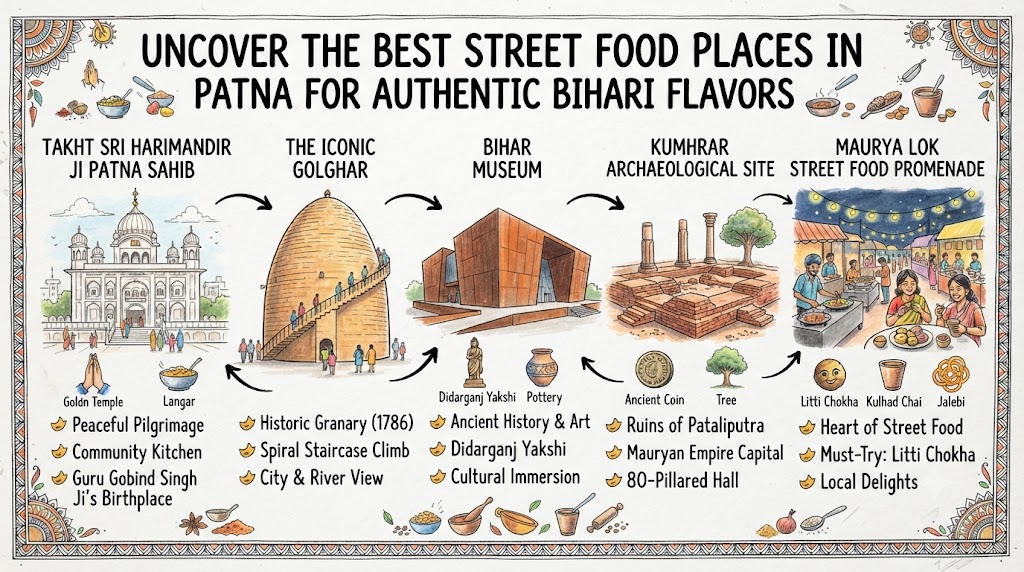
Takht Sri Harmandir Ji Patna Sahib
Standing in the heart of old Patna, Takht Sri Harmandir Ji marks the sacred birthplace of Guru Gobind Singh Ji, the tenth Sikh Guru. The majestic white-marble complex radiates peace amidst the vibrant lanes of Patna City, welcoming pilgrims and travelers of every faith into its sunlit courtyards. Inside the sanctum, devotees revere sacred relics including holy scriptures, historic weapons, and childhood artifacts of the Guru.
The spiritual cadence here peaks during morning Asa di Var and evening kirtans, accompanied by the gentle clatter of seva from the communal langar kitchen. The surrounding heritage neighborhoods trace ancient trading routes, where centuries of syncretic co-existence define daily community life.
Takht Sri Harmandir Ji Patna Sahib.
- Location: Patna City (Old Patna), approximately 12 km east of Patna Junction.
- Why it is worth visiting: It is one of the five sacred Takhts of Sikhism, combining profound spiritual significance with exquisite marble architecture.
- Best things to do: Participate in the voluntary langar community kitchen seva, view Guru Gobind Singh Ji’s preserved childhood relics, and absorb the soul-stirring evening Gurbani kirtan.
- Best time to visit: Early morning between 5:30 AM and 8:00 AM for sunrise prayers and uncrowded courtyards.
- Ideal for whom: Spiritual seekers, heritage lovers, architecture enthusiasts, and families.
- Travel tip: Dress modestly, ensure heads are covered before stepping through the gates, and use the designated free shoe-storage counters at the entrance.
The Iconic Golghar
Erected in 1786 by Captain John Garstin following the catastrophic famine of 1770, Golghar stands as an audacious engineering feat of the British colonial era. Built as a massive beehive-shaped granary with a capacity of 137,000 tons, the structure was built entirely without internal pillars to maximize storage space.
Two spiral staircases wrap around the outside of the dome, originally engineered so coolies could carry grain sacks up one side and descend the other. Reaching the panoramic summit rewards you with breathtaking views sweeping across the historic city skyline and the broad silver stretch of the Ganges.
Historic beehive granary at Golghar.
- Location: Near Gandhi Maidan, Patna Central, roughly 2.5 km north of Patna Junction.
- Why it is worth visiting: It offers an unusual pillarless architectural design and provides unmatched panoramic views of the River Ganga and urban Patna.
- Best things to do: Climb the external spiral staircase, test the unique acoustic echoes along the rounded perimeter walls, and stroll through the landscaped public garden.
- Best time to visit: Late afternoon around 4:30 PM to catch golden hour over the riverfront.
- Ideal for whom: Photographers, civil engineering enthusiasts, and history students.
- Travel tip: Wear sturdy walking shoes with good grip, as the curved spiral stone steps can feel steep during the climb.
Bihar Museum
Stretching across 13.9 acres along Bailey Road, the Bihar Museum is a world-class cultural institution designed by Tokyo-based Maki and Associates. Cloaked in weathered Corten steel that naturally patinates over time, the complex pays tribute to the region’s ancient industrial and agricultural metalworking heritage.
Inside, interactive galleries present thousands of years of regional civilization, from prehistoric paleolithic tools to intricate Buddhist and Jain bronzes. The crown jewel is the 3rd-century BCE polished sandstone Didarganj Yakshi, revered across the world as a pinnacle of ancient Indian sculptural mastery.
- Location: Jawaharlal Nehru Marg (Bailey Road), 3 km west of Patna Junction.
- Why it is worth visiting: It stands among the finest and most thoughtfully curated museum spaces in South Asia, housing original artifacts from ancient Magadha.
- Best things to do: Marvel at the mirror-finished Didarganj Yakshi, explore the experiential Children’s Discovery Gallery, and admire indigenous Madhubani murals in the folk-art wing.
- Best time to visit: Weekday mornings right at 10:30 AM opening to explore the sprawling galleries before school and tour groups arrive.
- Ideal for whom: Culture enthusiasts, global art historians, students, and traveling families.
- Travel tip: Plan for at least 3 to 4 hours inside, and rent the multilingual audio-guide headset at the reception desk for detailed artifact context.
Kumhrar Archaeological Site
Kumhrar preserves the excavated footprint of ancient Pataliputra, the imperial metropolis described with great wonder by the Greek ambassador Megasthenes. The archaeological park protects the remains of the Mauryan 80-Pillared Hypostyle Hall, constructed during the reigns of Chandragupta Maurya and Emperor Ashoka.
Walking among the deep brick trenches reveals timber foundation beams that survived millennia underground, proving the sophisticated water-resistant woodwork techniques of 300 BCE. Shaded by ancient trees, the site offers a contemplative pause from the lively bustle of the modern capital.
- Location: Kankarbagh Road, roughly 5 km east of Patna Junction.
- Why it is worth visiting: It is the only tangible archaeological site in Patna where visitors can walk through the physical capital ruins of the Mauryan Empire.
- Best things to do: Inspect the excavated Mauryan assembly hall foundations, examine polished stone pillar fragments in the on-site museum, and walk around the historic Arogya Vihar pond.
- Best time to visit: November through February, between 8:00 AM and 11:00 AM for comfortable walking temperatures.
- Ideal for whom: Archaeology lovers, Mauryan history scholars, and quiet retreat seekers.
- Travel tip: Hire an official Archaeological Survey of India (ASI) licensed guide at the ticketing counter to properly locate and interpret the scattered foundation markings.
Maurya Lok Street Food Promenade
Maurya Lok is the beating heart of Patna’s culinary and social life, functioning as a vibrant open-air promenade where students, professionals, and families gather every evening. Built around a broad commercial plaza, it hosts rows of celebrated vendors serving authentic regional snacks alongside beloved Indo-Chinese classics.
The air fills with the aroma of charcoal-roasted sattu, bubbling pans of spicy chana ghugni, and fresh sweets dipped in sugar syrup. This is the ultimate starting point for beginners to dive into Patna’s legendary street-food culture within an energetic, walkable setting.
- Location: Dak Bungalow Road, Fraser Road area, roughly 1.5 km from Patna Junction.
- Why it is worth visiting: It gathers Patna’s iconic street food stalls into a safe, clean, and pedestrian-friendly plaza.
- Best things to do: Feast on charcoal-roasted Litti Chokha drenched in pure desi ghee, sip warm kulhad chai, and sample piping-hot dry fruit Chandrakala.
- Best time to visit: Evenings between 6:00 PM and 9:30 PM when the plaza lights up and street stalls hit peak freshness.
- Ideal for whom: Street food aficionados, solo travelers, groups of friends, and night strollers.
- Travel tip: Pick stalls with high customer turnover where dishes are prepared fresh in front of you, and carry small-denomination cash or an active UPI app.
Patna Ghats at Sunset (NIT & Collectorate Ghats)
The ghats of Patna offer a tranquil look into everyday riverine life along the sacred Ganga. NIT Ghat, adjoining the National Institute of Technology campus, features wide paved walkways where cool river breezes provide sweet relief after warm afternoons.
Every Saturday and Sunday evening, priests conduct an elaborate Ganga Aarti complete with tiered brass lamps, conch shells, and rhythmic chants that reflect across the shimmering water. Small wooden country boats drift lazily along the bank, giving travelers a peaceful vantage point to watch the city lights turn on across the southern horizon.
- Location: Ashok Rajpath corridor along the southern riverfront, roughly 6 km northeast of Patna Junction.
- Why it is worth visiting: It showcases the authentic spiritual and communal riverfront life of Bihar, away from the commercial tourist crush seen in other river cities.
- Best things to do: Attend the weekend evening Maha Aarti at NIT Ghat, book a hand-rowed wooden boat ride at dusk, and sip ginger lemon tea on the river steps.
- Best time to visit: 5:00 PM to 7:00 PM to watch the changing colors of sunset give way to the evening aarti ceremony.
- Ideal for whom: Photographers, couples, spiritual travelers, and quiet writers.
- Travel tip: Confirm boat ride fares before boarding; a standard 30-minute private ride should cost between ₹200 and ₹300 total for a small group.
Offbeat Exploration: Hidden Gems Tourists Miss
Padri Ki Haveli (St. Mary’s Church)
Tucked away in the narrow alleys of Patna City stands Padri Ki Haveli, the oldest surviving Christian church in Bihar. Founded in 1713 and rebuilt in 1772 by the Venetian architect Tirreto, this neoclassical church features sweeping arches, stately columns, and a large cathedral bell cast in Venice. Mother Teresa lived and trained in this quiet compound when she first arrived in Patna in 1948, making it a peaceful sanctuary steeped in modern history.
Khuda Bakhsh Oriental Public Library
Opened to the public in 1891 by Khan Bahadur Khuda Bakhsh, this world-renowned institution along Ashok Rajpath houses one of the finest collections of Islamic manuscripts in existence. Scholars travel here from across the globe to view rare handwritten Arabic and Persian texts, Rajput miniature paintings, and a volume of the Quran written on paper made from palm leaves. Its quiet reading rooms provide an incredible look into regional literary patronage.
Sabhyata Dwar (Civilization Gate)
Standing 32 meters high on the banks of the Ganges near the Gyan Bhawan convention complex, Sabhyata Dwar is modern Patna’s monumental stone arch. Built with red and white sandstone inspired by Mauryan architectural traditions, the monument features inscribed teachings from Emperor Ashoka, Mahavira, Buddha, and Megasthenes. It remains blissfully uncrowded on weekday mornings, offering sweeping views of the river plains from its open plaza.
Detailed Practical Guidance for Travelers
| Destination | Standard Entry Fee | General Timings | Best Local Food Options Nearby | Recommended Nearby Attractions |
|---|---|---|---|---|
| Takht Sri Harmandir Ji | Free entry | 04:00 AM – 10:00 PM daily | Langar Prasad, Gurdwara lane Jalebi & Lassi | Padri Ki Haveli, Jalan Museum (Quila House) |
| Golghar | ₹15 for Indians, ₹100 for Foreigners | 09:30 AM – 05:30 PM (Closed Mondays) | Bhelpuri & roasted corn stalls outside gate | Gandhi Maidan, Patna Planetarium |
| Bihar Museum | ₹100 for Indians, ₹500 for Foreigners | 10:30 AM – 05:00 PM (Closed Mondays) | Potbelly Cafe (in-house Bihari cuisine) | Patna High Court, Eco Park (Rajdhani Vatika) |
| Kumhrar Excavations | ₹25 for Indians, ₹300 for Foreigners | 08:30 AM – 05:00 PM (All days) | Local Sattu Sharbat stalls near Kankarbagh | Agam Kuan (Ashoka’s Legend Well) |
| Maurya Lok Complex | Free public access | 10:00 AM – 10:00 PM (Stalls peak evening) | Bhojpuri Litti Stall, Kapil Dev’s Elevens | Fraser Road shopping district, Buddha Smriti Park |
| NIT Ghat Riverfront | Free public access | 05:00 AM – 09:00 PM daily | Steaming ginger chai, Jhalmuri vendors | Patna University heritage campus, Darbhanga House |
Logistics & On-Ground Navigation
Local Transport Options
- App-Based Cabs & Autos: Services like Ola and Uber operate throughout Patna, providing upfront pricing and reliable air-conditioned transfers between the airport, hotels, and major sights.
- Shared and Reserve E-Rickshaws: Battery-powered ‘Totos’ dominate inner corridors like Bailey Road, Boring Road, and Ashok Rajpath; reserve them for ₹80 to ₹150 for private short transfers or pay ₹15 per shared hop.
- Auto-Rickshaws (Tempos): Shared three-wheelers follow fixed routes connecting Patna Junction to Gandhi Maidan and Patna City for ₹15 to ₹30 per passenger.
- Pre-Booked Car Rentals: For day outings to Nalanda, Rajgir, or Vaishali, reserve an air-conditioned sedan through local agencies or hotel travel desks for approximately ₹2,500 to ₹3,500 per day including driver allowances.
Budget Planning
- Budget / Backpacker Tier: Expect to spend ₹1,200 to ₹2,000 per day. This covers a clean guesthouse or budget hotel room near Station Road (₹800 to ₹1,200), hearty street food meals and thalis (₹300 to ₹400), and transit via e-rickshaws and shared tempos (₹150 to ₹250).
- Mid-Range / Comfort Tier: Expect to spend ₹4,500 to ₹7,500 per day. This includes a comfortable 3- or 4-star business hotel in Patliputra Colony or Exhibition Road (₹3,000 to ₹5,500), dining at heritage restaurants and the Bihar Museum’s Potbelly cafe (₹1,000 to ₹1,500), and private app-cab travel (₹800 to ₹1,200).
Safety and Inclusivity Tips
- For Families: Patna is family-oriented; parks like Eco Park and the open courtyards of Bihar Museum provide safe, comfortable spaces for children and seniors with ramps and golf carts available.
- For Couples: Public spaces like Maurya Lok and riverside ghats during daylight hours are welcoming and safe; avoid poorly lit, deserted riverfront sections after 9:00 PM.
- General Health & Safety: Drink only sealed bottled or purified RO water, especially when exploring old street-food lanes, and carry pocket hand sanitizer for quick meals on the go.
Strategic Travel Planning Guardrails
Travel Planning Tips for Patna
- Target the Winter Window: Plan your trip between November and February when crisp morning air and comfortable 18°C afternoons make walking through heritage ruins effortless.
- Embrace Digital Payments: UPI via phone apps works at 95% of fruit carts, street food vendors, and auto drivers; keep ₹1,000 in ₹50 and ₹100 paper notes for deep alley stalls.
- Dress Modestly at Pilgrimage Sites: Wear breathable cotton clothing covering knees and shoulders when entering Takht Patna Sahib, temples, and historic mosques.
- Check Museum Calendar Closures: Remember that both the Bihar Museum and Patna Museum remain closed on Mondays; plan your itinerary to visit outdoor ruins or ghats on that day.
- Book Railway Retiring Rooms Early: If arriving on overnight express trains, the luxury executive retiring pods and rooms at Patna Junction book out weeks ahead via IRCTC.
Common Mistakes to Avoid
- Underestimating East-West Traffic: Rushing between western areas (like the Airport and Patliputra) and eastern Patna City during rush hours (9:30 AM–11:00 AM and 5:30 PM–8:00 PM) can trap you in slow traffic along Ashok Rajpath.
- Skipping the Langar Experience: Passing through Takht Sri Patna Sahib without tasting the simple, blessed community meal means missing the heart of the shrine’s hospitality.
- Relying Solely on Card Swipes: Smaller vendors, parking attendants, and wooden boatmen rarely carry POS card swipe machines, though they happily accept UPI QR codes.
- Overlooking Regional Bihari Thalis: Sticking exclusively to hotel buffet spreads causes travelers to miss out on authentic Ol ki Chutney, Dal Pithi, and seasonal Bihari seasonal dishes.
- Leaving Riverfronts Unplanned: Arriving at the ghats during mid-afternoon heat leads to washed-out views; always time your river visits for the golden hour just before dusk.
Suggested Itinerary Blueprints
1-Day Quick Dash (The Imperial Heritage Circuit)
Target Audience: Business travelers, quick layover wanderers, and weekend heritage seekers.
- 08:30 AM: Start with traditional chana kachori and jalebi on Fraser Road, then head directly to Golghar to climb the outer ramp for city views.
- 10:30 AM: Spend a focused 3-hour morning exploring the masterworks and the Didarganj Yakshi at the world-class Bihar Museum.
- 01:30 PM: Enjoy a traditional Maithili and Bhojpuri lunch platter at The Potbelly Cafe inside the museum complex.
- 03:30 PM: Drive east through the historic quarter to pay homage at Takht Sri Harmandir Ji Patna Sahib.
- 06:30 PM: Wrap up your evening with fresh ghee-dunked Litti Chokha and sweet Chandrakala amidst the buzzing stalls of Maurya Lok.
2-Day Deep-Dive (From Mauryan Glory to River Sacredness)
Target Audience: Culture enthusiasts, foodies, and photography travelers.
- Day 1 (Imperial Roots & Cultural Centers):
- Morning: Explore the Mauryan pillar foundations and tranquil grounds at Kumhrar Excavations, followed by an authentic sattu drink nearby.
- Mid-Day: Immerse yourself in the rare manuscripts and Mughal miniatures at the Khuda Bakhsh Oriental Library.
- Afternoon: Take an architectural tour of the British-era Patna High Court and colonial buildings along Bailey Road.
- Evening: Enjoy a scenic sunset stroll along the promenades of NIT Ghat, staying for the weekend evening Ganga Aarti ceremony.
- Day 2 (Masterpiece Art & Culinary Legacy):
- Morning: Dedicate a full morning to the immersive galleries and courtyards of the Bihar Museum.
- Lunch: Taste authentic rustic Champaran Handi Ahuna mutton or slow-cooked paneer in Old Patna.
- Afternoon: Visit the historic stone arch at Sabhyata Dwar followed by a stop at the serene Buddha Smriti Park.
- Night: Embark on an evening street-food walk through Maurya Lok, sampling regional sweets and steaming hot kulhad tea.
Complete Weekend Travel Plan (The Grand Patna Heritage Loop)
Target Audience: Slow travelers, families, and long-weekend explorers.
- Friday Evening: Arrive in Patna, check into your hotel near Patliputra Colony or Exhibition Road, and head out for fresh litti and evening chaat at Maurya Lok.
- Saturday (Spiritual Reverence & Colonial Curiosities):
- Early Morning: Witness morning prayers and enjoy peaceful community langar at Takht Sri Harmandir Ji Patna Sahib.
- Late Morning: Wander through the historic alleys to visit the Venetian-designed Padri Ki Haveli.
- Afternoon: Explore the 18th-century architecture of Golghar and relax under the trees at Gandhi Maidan.
- Sunset: Hire a private wooden boat at Collectorate Ghat for views of the Ganga riverfront at dusk.
- Sunday (Ancient Empires & Living Art):
- Morning: Spend 3 hours unearthing regional masterworks at the Bihar Museum.
- Lunch: Sample authentic regional cuisine featuring litti, sattu, and Ol parathas.
- Afternoon: Walk the ancient imperial grounds of Kumhrar Archaeological Site.
- Evening: Browse local government emporiums (like Upendra Maharathi Shilp Anusandhan Sansthan) for authentic Madhubani hand-painted silks and stone crafts before departing.
Common Tourist Mistakes to Avoid
- Geographic Blunders: Group your destinations logically by zone. Do not attempt to visit western sights (like the Bihar Museum and Airport) and eastern heritage points (like Patna Sahib and Kumhrar) within the same 2-hour window, as cross-city transit along narrow heritage arteries requires patience.
- Commercial Traps: Avoid spending your evenings in generic air-conditioned shopping malls along Boring Road. Instead, head to atmospheric community hubs like Maurya Lok, Gandhi Maidan, and the riverfront ghats where genuine Bihari life thrives.
- Neglecting Modern/Alternative Zones: Patna is not just ancient monuments. Explore the leafy residential avenues of Patliputra Colony, discover independent art galleries, and visit youth-driven literary cafes that highlight the modern energy of Bihar’s capital.
- Transport Overpayment: Unmetered auto drivers waiting outside Patna Junction often quote elevated flat fares to new visitors. Always check rideshare apps on your phone first to verify benchmark rates, or use official prepaid auto booths outside railway exits.
- Luxury Dining Bias: Sticking exclusively to generic multi-cuisine hotel dining rooms deprives you of the soul of the region. Step out to try piping hot litti directly from the vendor’s charcoal hearth and taste fresh chana ghugni from busy local market stands.
Frequently Asked Questions
1. Is Patna safe for solo travelers and women walking around the city?
Patna is generally welcoming and respectful toward solo travelers, with bustling streets well into the evening. Keep your travels to well-lit areas like Boring Road, Bailey Road, and central ghats after 9:00 PM, and rely on app-based cabs for late-night airport or station transfers.
2. What dishes represent the most authentic street food in Patna?
Authentic culinary highlights include charcoal-roasted Litti Chokha served with spicy brinjal and mashed potato chokha, rich Champaran meat cooked in sealed clay handis, savory Dal Pithi, spicy Ghugni-Kachori, and traditional sweets like Chandrakala and Khaja.
3. What is the most convenient way to travel from Patna to Nalanda and Rajgir?
The most practical option is booking a private air-conditioned cab for a day trip, which takes roughly 2.5 to 3 hours each way via the Patna-Bakhtiyarpur 4-lane highway. Regular express passenger trains also connect Patna Junction directly to Rajgir station every morning.
4. How many days are ideal for a complete trip exploring Patna?
Two full days allow you to comfortably visit key landmarks including the Bihar Museum, Golghar, Patna Sahib, Kumhrar, and the riverfront ghats without rushing. Adding a third or fourth day lets you easily take day trips out to the UNESCO ruins of Nalanda and the hills of Rajgir.
5. How does the Bihar Museum differ from the old Patna Museum?
The newer Bihar Museum on Bailey Road is an expansive, world-class experiential museum focused on regional history from prehistory up through 1764, housing the Didarganj Yakshi. The historic Patna Museum on Museum Road features British colonial-era collections, natural history displays, and a famous 200-million-year-old fossilized tree trunk.
6. Can non-Sikh visitors enter and eat at Takht Sri Harmandir Ji Patna Sahib?
Yes, visitors of every background and faith are warmly welcomed. You can pay your respects in the sanctum and sit in the communal langar hall for meals; just remember to cover your head with a scarf or rumāl and remove your shoes at the free entrance counters.
7. Is street food in Patna hygienic for sensitive traveler stomachs?
Street food is generally safe when you select popular stalls with high customer turnover where food is cooked fresh over open flames. Enjoy freshly roasted litti straight from the coals, drink packaged or purified water, and skip raw pre-cut fruits exposed to open air.
8. What unique souvenirs should travelers buy before leaving Patna?
Pick up genuine hand-painted Madhubani artworks on handmade paper or silk, fine Sikki grass woven baskets, brass home decor, and boxes of fresh Khaja from sweet shops along your route.
9. Are photography and videography permitted inside the major monuments?
Personal smartphone photography is allowed at most outdoor sites including Golghar grounds and Kumhrar. The Bihar Museum allows non-flash smartphone photography inside its main galleries, though tripods, professional camera rigs, and commercial video shoots require prior written permits and fees.
10. What is the standard language spoken across Patna markets?
Hindi is the universal language for daily business and navigation across the city. Locals also speak dialects such as Magahi and Bhojpuri at home, while English is widely understood in hotels, cafes, and major transit hubs.
11. What is the best way to catch a boat ride on the River Ganges?
Head to NIT Ghat or Gandhi Ghat between 4:30 PM and 6:00 PM when licensed wooden boatmen offer rides along the riverbanks. Always negotiate the total boat price upfront before boarding, and ensure life jackets are available on board.
12. When is the best time of year to visit Patna for cultural festivities?
The most culturally vibrant time is during October and November during the grand celebrations of Chhath Puja, when the city’s river ghats illuminate with thousands of lamps and offerings. The winter months of December and January also bring pleasant, cool weather perfect for sightseeing.
Conclusion
Traveling to Patna offers an authentic journey into the deep roots of Indian civilization, far removed from standard tourist itineraries. Walking past ancient brick foundations where emperors once stood, smelling roasting sattu along evening promenades, and hearing prayers carry across the wide waters of the Ganga leaves a lasting impression on curious travelers. When you look beyond predictable destinations, Bihar rewards you with living history, generous hospitality, and memories that stay with you long after the journey ends.
