Introduction
Mainstream tourist corridors across India often trap travelers inside commercialized plazas, manicured heritage enclaves, and congested selfie points that sanitize centuries of drama. Bihar strikes back with raw, unvarnished antiquity. Here, history is not a roped-off museum display; it is the very earth beneath your boots, weathered by monastic chants, imperial decrees, and philosophical revolutions that shaped the Asian continent.
When you walk across the sun-baked, burnt-brick foundations of ancient universities or stand in the cool acoustic silence of granite caves cut three centuries before the common era, you touch living heritage. This is the birthplace of world-spanning empires and dharmic faiths, offering travelers an authentic cultural odyssey far removed from packaged tourism tropes.
Why Bihar is a must-visit city
To understand classical Asia, one must explore Bihar. Geographically anchored by the fertile plains of the mighty Ganges and bounded by craggy mineral-rich ranges to the south, this land served as the core of Magadha, the Mauryan Empire, and the Gupta Golden Age. It was here that Gautama Buddha achieved enlightenment, where Mahavira revitalized Jain philosophy, and where Chanakya laid down realpolitik in the Arthashastra.
Today, visiting these profound heritage landscapes is remarkably straightforward. An extensive highway network, high-speed rail lines connecting Patna, Gaya, and Rajgir, and modern hospitality properties operated by both state tourism boards and international chains welcome travelers of every budget.
The premier historical circuit links the ancient capital of Pataliputra (modern Patna) southward through the monastic hubs of Nalanda and Rajgir, down to the spiritual epicenter of Bodh Gaya, and westward toward Sasaram and Vaishali.
| Journey Metric | Operational Reality |
|---|---|
| Primary Entry Gateways | Jay Prakash Narayan Airport (Patna), Gaya International Airport |
| Peak Historical Travel Season | October to March (Crisp 12°C to 25°C daytime weather) |
| Circuit Travel Style | Rail hubs combined with private highway cabs |
| Core Archaeological Themes | Mauryan stone carving, Gupta monastic architecture, Suri dynasty engineering |
| Ideal Exploration Window | 5 to 7 days for an unhurried, multi-district historical immersion |
The ancient monastic ruins of Nalanda Mahavihara.
Best Places or Experiences
1. Nalanda Mahavihara Ruins
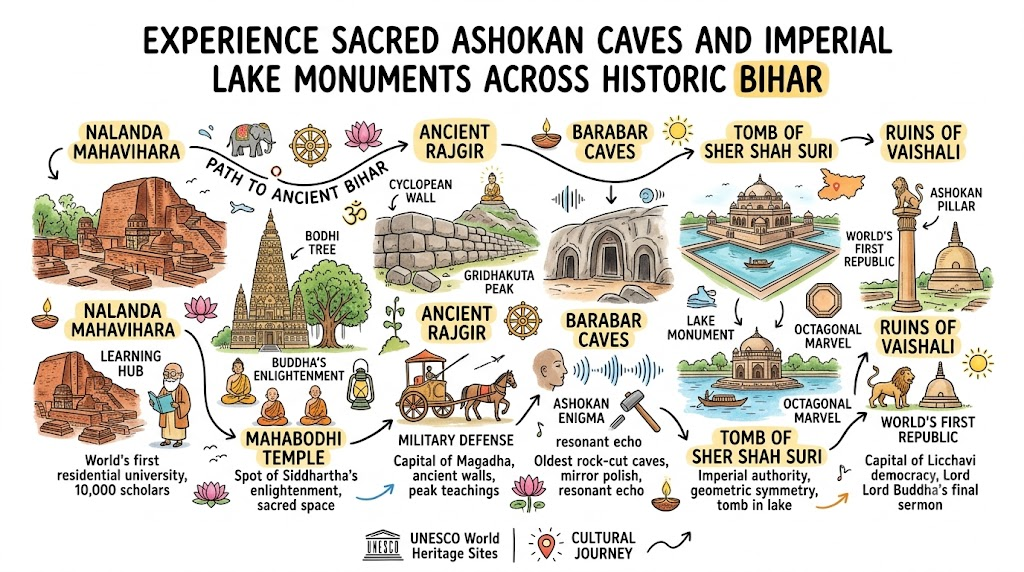
Established in the 5th century CE under the Gupta emperors, Nalanda stood for over seven centuries as the intellectual capital of the ancient world. Over ten thousand residential scholars and two thousand master teachers gathered here from Korea, Japan, China, Tibet, and Central Asia to study philosophy, logic, astronomy, medicine, and metaphysics under rigorous academic debate.
The sprawling excavated complex reveals astonishing architectural mastery: interconnected brick monasteries, thermal water systems, personal student quarters with stone beds, and vast lecture amphitheaters. The monumental Temple No. 3 towers over the site, featuring concentric layers of construction and delicate stucco bas-relief panels that miraculously survived the destructive 12th-century sack of its legendary multi-story libraries.
- Location: Nalanda District; approximately 85 km southeast of Patna Junction.
- Why it is worth visiting: The world’s first residential international university and a premier UNESCO World Heritage Site.
- Best things to do: Trace the ancient drainage and heating systems in Monastery 1, study the stucco Buddha carvings on Temple 3, and visit the adjacent Archaeological Museum housing retrieved bronze deities.
- Best time to visit: November to February, arriving right at 9:00 AM before afternoon tour buses arrive.
- Ideal for whom: History scholars, architecture lovers, and solo heritage travelers.
- Travel tip: Hire an ASI-certified guide at the main gate ticket desk to decode the structural phases across the seven monastery levels.
2. Mahabodhi Temple Complex
The Mahabodhi Temple in Bodh Gaya represents the physical dawn of Buddhist philosophy. Dating back architecturally to the late Gupta and Pala eras, the grand 55-meter central stone pyramidal shikhara marks the exact geographical spot where Siddhartha Gautama attained enlightenment beneath the sacred pipal tree circa 500 BCE.
Surrounding the central tower are exquisitely carved Ashokan stone railings and votive stupas placed across centuries by visiting kings from Sri Lanka, Burma, and China. Walking through the inner cloister as evening falls, filled with the resonant hum of monastic chanting and butter lamps glowing against polished black granite, connects you directly to two and a half millennia of spiritual continuity.
- Location: Bodh Gaya, Gaya District; 115 km south of Patna, 14 km from Gaya Railway Junction.
- Why it is worth visiting: The supreme holy seat of Buddhism featuring original 3rd-century BCE stone relics and the sacred Bodhi Tree.
- Best things to do: Sit quietly beside the Diamond Throne (Vajrasana), examine the sandstone railing bas-reliefs, and attend the dawn meditation chanting.
- Best time to visit: 5:00 AM to 7:30 AM for sublime morning light and peaceful meditation.
- Ideal for whom: Spiritual pilgrims, heritage photographers, and cultural historians.
- Travel tip: Mobile phones are completely prohibited inside the inner complex; leave your phone in the secure gate lockers and purchase a dedicated digital camera pass.
The historic Mahabodhi Temple spire at Bodh Gaya.
3. Ancient Rajgir: Gridhakuta Peak and Cyclopean Wall
Nestled inside a fortress-like valley surrounded by five craggy hills, Rajgir (ancient Rajagriha) served as the impregnable first capital of the Magadha kingdom. On Gridhakuta (Vulture’s Peak), the Buddha delivered his most famous second turning discourses, including the Heart Sutra, to gathered assemblies.
The surrounding hills are girdled by the staggering Cyclopean Wall, a 40-kilometer defensive stone barrier constructed with unworked, massive limestone boulders fitted without mortar during the pre-Mauryan era (6th century BCE). Walking the ridges above the valley reveals stone chariot ruts carved deeply into the exposed bedrock along the ancient military road of Bimbisara.
- Location: Rajgir, Nalanda District; 100 km south of Patna.
- Why it is worth visiting: One of the oldest surviving cyclopean stone defensive engineering works in Asia.
- Best things to do: Hike the ancient stone path up to Gridhakuta Peak, photograph the Cyclopean Wall ridges along the valley pass, and inspect the ancient prison cell of King Bimbisara.
- Best time to visit: Early morning between 6:00 AM and 9:00 AM during winter.
- Ideal for whom: Trekking enthusiasts, military history buffs, and ancient geopolitical researchers.
- Travel tip: Skip the crowded aerial chairlift line by ascending the well-paved heritage walking trail in the cool morning air.
4. Barabar Caves: The Ashokan Rock-Cut Enigma
Carved directly into monolithic granite outcrops during the reign of Emperor Ashoka and his grandson Dasharatha in the 3rd century BCE, the Barabar Caves are the oldest surviving rock-cut chambers in India. Built for the ascetic monks of the ancient Ajivika sect, these subterranean vaults represent an unfathomable engineering achievement.
The outer facades mimic wooden Mauryan barrel vaults with incredible accuracy, while the cavernous inner chambers are lined with the legendary Mauryan polish—granite buffed to a glass-like sheen that creates a cavernous acoustic reverberation lasting several seconds. Entering the pitch-black sanctum of the Lomas Rishi Cave feels like stepping into a mathematical sonic resonator designed for deep vibrational contemplation.
- Location: Jehanabad District; approximately 70 km south of Patna and 35 km north of Gaya.
- Why it is worth visiting: The prototype of all Indian rock-cut cave architecture with mirror-polished granite interiors.
- Best things to do: Test the extraordinary sonic echo inside the Karan Chaupar cave, admire the carved elephant frieze over Lomas Rishi cave, and climb the monolithic ridge for panoramic vistas.
- Best time to visit: October to February, ideally between 10:00 AM and 2:00 PM for bright overhead sun entering cave portals.
- Ideal for whom: Acoustic researchers, archaeological purists, and adventurous travelers.
- Travel tip: Carry a powerful handheld torch, as there is no artificial lighting inside the deep rock chambers.
The Mauryan stone entrance of Barabar Caves.
5. Tomb of Sher Shah Suri
Rising 122 feet from the center of an expansive, square artificial lake, the grand sandstone mausoleum of Emperor Sher Shah Suri is a triumph of late Indo-Islamic architecture. Suri, who toppled Humayun to establish the Sur Empire and founded the Grand Trunk Road and Rupee currency, planned this monumental tomb as a display of imperial authority and geometric symmetry.
Constructed from fine Chunar sandstone, the three-tiered octagonal structure rests on a broad stepped plinth accessed by a single stone causeway bridge. The balance of its massive central dome, delicate arched pavilions (chattris), and still perimeter waters creates a majestic reflection that rivals any monument in northern India.
- Location: Sasaram, Rohtas District; 155 km southwest of Patna via NH19.
- Why it is worth visiting: An architectural bridge between the Sultanate style and high Mughal monuments like the Taj Mahal.
- Best things to do: Walk the perimeter stone embankment for reflection photography, inspect the calligraphic inscriptions inside the dome, and explore the nearby incomplete tomb of his son Islam Shah.
- Best time to visit: Golden hour between 4:00 PM and 5:30 PM when the sandstone glows deep ochre.
- Ideal for whom: Islamic architectural historians, fine-art photographers, and culture travelers.
- Travel tip: Arrive via the Sasaram Junction rail stop on the Grand Chord line to avoid highway traffic snarls.
The octagonal water tomb of Sher Shah Suri at Sasaram.
6. Archaeological Ruins of Vaishali
Vaishali holds a seminal place in global democratic history as the capital of the Licchavi republic—the world’s earliest known participatory democracy where elected representatives governed through popular assembly. It was also where Lord Buddha delivered his final sermon, renouncing his earthly life, and where the Second Buddhist Council convened in 383 BCE.
The archaeological site features a remarkably preserved monolithic Ashokan Pillar, crowned with a life-sized seated lion facing north toward the Buddha’s final journey to Kushinagar. Adjacent lies the ancient brick stupa where the Licchavis originally enshrined their eighth share of the Buddha’s cremated relics, discovered intact in modern excavations.
- Location: Vaishali District; 55 km north of Patna across the Mahatma Gandhi Setu.
- Why it is worth visiting: The world’s first republic and one of the best-preserved intact Ashokan pillars in situ.
- Best things to do: Examine the polish and carved lion atop the Ashokan pillar, circumambulate the Relic Stupa, and visit the serene Japanese Peace Pagoda nearby.
- Best time to visit: December to February during the calm morning hours.
- Ideal for whom: Political history enthusiasts, Buddhist pilgrims, and peace seekers.
- Travel tip: Combine your visit with a stop at the nearby Vaishali Archaeological Museum to view antique terracotta coins and seals from the ancient senate.
Offbeat Exploration: Hidden Gems Tourists Miss
Telhara Monastic Excavations, Nalanda District
While millions visit Nalanda, few venture 30 kilometers west to the recently excavated university site of Telhara. Mentioned by Chinese traveler Xuanzang, Telhara predates Nalanda and has yielded three-story monastery foundations, grand stone pillars, and intact terracotta sealing tablets hidden under peaceful agricultural fields.
Rohtasgarh Fort, Kaimur Plateau
Perched 1,500 feet atop the steep scarps of the Kaimur hills near the Son River, this colossal fort boasts a 45-kilometer perimeter wall. Controlled successively by tribal kings, Sher Shah Suri, and Raja Man Singh, the citadel houses abandoned palaces, hanging balconies, and stone stepwells blanketed in wild forest overgrowth.
Mundeshwari Devi Temple, Kaimur
Recognized by archaeological authorities as the oldest continuously functioning Hindu temple in India, this octagonal stone shrine dates back to 108 CE under the Kushan or Gupta realm. The intricate Nagara carvings on its pillars and the ongoing rituals offer a rare living connection to ancient sacred worship.
Detailed Practical Guidance for Travelers
| Destination | Standard Entry Fee | General Timings | Best Local Food Options Nearby | Recommended Nearby Attractions |
|---|---|---|---|---|
| Nalanda Mahavihara | ₹40 (Indian), ₹600 (Foreigner) | 9:00 AM – 5:00 PM | Local Tilkut, Thali at Highway Dhabas | Hiuen Tsang Memorial, Kundalpur |
| Mahabodhi Temple | Free (Camera: ₹100) | 5:00 AM – 9:00 PM | Tibetan Thukpa, Bhutanese butter tea | Great Buddha Statue, Dungeshwari Caves |
| Gridhakuta & Rajgir | Free (Ropeway: ₹100) | 6:00 AM – 5:30 PM | Crispy Rajgir Silao Khaja | Venuvana Bamboo Grove, Tapodharma Hot Springs |
| Barabar Caves | Free (Nominal parking) | Sunrise to Sunset | Simple village tea stalls and Sattu drink | Nagarjuni Caves, Kauva Dol Buddha |
| Sher Shah Suri Tomb | ₹25 (Indian), ₹300 (Foreigner) | 6:00 AM – 6:00 PM | Sattu Paratha, Bihari Kebab stalls | Rohtasgarh Fort, Manjhar Kund Waterfall |
| Vaishali Ruins | ₹25 (Indian), ₹300 (Foreigner) | 8:00 AM – 5:00 PM | Fresh roasted Makhana, Seasonal Bananas | Kolhua Lion Pillar, World Peace Pagoda |
Logistics & On-Ground Navigation
Local Transport Options
- Railways: Bihar’s railway network connects major archaeological destinations. High-speed express trains run between Patna Junction and Gaya Junction every few hours, while local passenger trains connect to Rajgir and Sasaram.
- Hired Private Sedans: Booking a private taxi for 3–4 consecutive days from Patna remains the most practical and flexible method for reaching isolated rural ruins like Barabar and Telhara.
- Auto-Rickshaws & E-Rickshaws: Green battery e-rickshaws dominate historical hubs like Bodh Gaya and Rajgir, providing cheap, pollution-free transport between nearby monuments.
Budget Planning
- Backpacker / Student Tier: ₹1,200 – ₹1,800 per day. Covers clean heritage monastery guesthouses, local passenger trains, e-rickshaws, and rustic dhaba meals.
- Mid-Range / Comfort Tier: ₹3,500 – ₹6,500 per day. Covers 3-star heritage hotels, dedicated AC taxi rental with driver, guided ASI walking tours, and multi-cuisine restaurant dining.
Safety and Inclusivity Tips
- Families: Most sites feature wide lawns, but stone steps at Rajgir and Barabar require sturdy footwear; bring insulated water bottles and umbrella sunshades for kids.
- Couples: Bodh Gaya and Rajgir are remarkably peaceful and welcoming; modest, shoulder-and-knee covering attire is recommended around monastic sites.
- General Safety: Stick to main state highways before 9:00 PM and avoid driving through unlit interior country roads late at night.
Local Travel Secret: When visiting Rajgir, stop at the roadside village of Silao to buy authentic, fresh Khaja—a delicate, multi-layered sweet pastry granted an official GI tag that has been prepared in the region for over two millennia.
Strategic Travel Planning Guardrails
Travel Planning Tips for Bihar
- Book Peak Winter Stays 60 Days Ahead: Bodh Gaya receives hundreds of thousands of international Buddhist pilgrims between November and January; hotels fill up quickly.
- Keep Small Cash Notes Handy: While mobile UPI is ubiquitous in cities, cellular reception can drop near rocky locations like Barabar Caves, where ticket vendors and local guides prefer cash.
- Procure ASI Photography Tokens: Heritage sites require separate ticket counter fees for DSLRs; purchase camera permits at the main gate to avoid equipment confiscation inside.
- Layer for Temperature Swings: Winter mornings can hover around 9°C, warming to a sunny 24°C by midday; pack packable thermal jackets and scarves.
- Engage ASI Authorized Guides Only: Insist on verifying official badge credentials issued by the Archaeological Survey of India to avoid misleading local mythologies.
Common Mistakes to Avoid
- Underestimating Inter-Site Travel: Do not attempt to cover Vaishali, Nalanda, and Sasaram in a single weekend; driving between north and south Bihar involves crossing major river choke points.
- Rushing Bodh Gaya in Two Hours: This site requires slow contemplation; allocate at least an entire afternoon and evening to absorb its atmosphere.
- Ignoring Local Food Traditions: Do not stick solely to hotel dining rooms; missing roadside wood-fired Litti Chokha seasoned with pungent mustard oil deprives you of Bihar’s core culinary identity.
- Expecting Constant English Signage: While primary monuments feature multilingual ASI boards, deep rural trails require basic conversational Hindi or an accompanied local driver.
- Overlooking Museum Closing Days: Keep in mind that regional archaeological museums (including Nalanda and Patna Museum) remain closed to visitors on Mondays.
Suggested Itinerary Blueprints
1. Day Quick Dash (The Pataliputra Imperial Corridor)
Targeted at travelers on a rapid business layover or short historical weekend in the state capital.
- 08:30 AM – 10:30 AM: Visit the ancient Mauryan excavations at Kumhrar, viewing the surviving sandstone pillars of Emperor Ashoka’s 80-pillared assembly hall.
- 11:00 AM – 02:00 PM: Comprehensive tour of the sprawling Bihar Museum, admiring the polished Mauryan Didarganj Yakshi and ancient bronze galleries.
- 02:30 PM – 04:00 PM: Lunch featuring authentic Champaran meat or Litti Chokha near Bailey Road.
- 04:30 PM – 06:00 PM: Sunset walk along the historic Ganga Ghats and Patna Marine Drive to view the sacred river that carried the fleets of the Magadha kings.
2. Day Deep-Dive (Monastic Heartland Route)
A curated two-day immersion into ancient universities, kings, and enlightenment.
- Day 1 (Rajgir & Nalanda): Early morning drive from Patna to Nalanda (2 hours). Spend 3 hours exploring the ruins of Nalanda Mahavihara and the Xuanzang Memorial Hall. Continue to Rajgir for lunch, then spend the afternoon ascending Gridhakuta Peak and walking the ancient Cyclopean Wall before an overnight stay in Rajgir.
- Day 2 (Bodh Gaya): Morning 2-hour transfer to Bodh Gaya. Dedicate the day to circumambulating the Mahabodhi Temple, admiring the Great Buddha Statue, and visiting international Buddhist monasteries built in Japanese, Thai, and Bhutanese architectural styles.
3. Complete Weekend Travel Plan (Grand Historical Loop)
An ambitious Friday-to-Sunday loop balancing imperial architecture, early republics, and philosophy.
- Friday: Depart Patna early morning north to Vaishali. Explore the Ashokan Lion Pillar, Relic Stupa, and the coronation pond of ancient Licchavi senators. Return south across the Ganges for an evening meal in Patna.
- Saturday: Drive south through Jehanabad to explore the mirror-polished Barabar Caves. Continue south to Bodh Gaya for an evocative evening meditation at the sacred Bodhi Tree.
- Sunday: Early morning drive west along NH19 to Sasaram to view the grand lake mausoleum of Sher Shah Suri. Conclude your journey by catching an evening express train back to Patna or onward to Varanasi.
Common Tourist Mistakes to Avoid
Geographic Blunders
Attempting to cross from Sasaram in the southwest to Bhagalpur in the east in one day is a recipe for travel exhaustion. The two sites sit over 350 km apart across varying road conditions. Focus your trip on a single unified geographic axis.
Commercial Traps
Spending valuable downtime roaming indoor retail malls in modern Patna disconnects you from the region’s living craft heritage. Instead, seek out certified cooperative weavers in Madhubani stalls or the Upendra Maharathi Shilp Anusandhan Sansthan to purchase authentic stone carvings, Sikki grass crafts, and hand-painted folk art directly from master artisans.
Neglecting Modern/Alternative Zones
Do not bypass the new cultural developments in the capital. The newly established Bihar Museum in Patna is widely regarded as one of South Asia’s finest contemporary cultural spaces, offering brilliant architectural presentation and world-class curation that sets the baseline for everything you will see on the ground.
Transport Overpayment
Avoid booking private street cabs without agreeing on explicit per-kilometer rates and fuel inclusion up front. For airport and train station transfers, rely on regulated app platforms like Ola and Uber, or pre-book through your hotel desk to prevent inflated tourist surcharges.
Luxury Dining Bias
Confining your meals to sterile hotel multi-cuisine buffets prevents you from experiencing true regional cooking. Venture into clean, popular local eateries to taste authentic Litti Chokha, slow-cooked Ahuna mutton simmered in sealed earthenware pots, fragrant Katarni rice, and delicate sweets like Tilkut and Anarsa.
Frequently Asked Questions
1. What makes Bihar the most important region for ancient history lovers in India?
Bihar was the epicenter of India’s classical golden age, functioning as the political seat of the Mauryan and Gupta empires and the birthplace of Buddhism and Jainism. Here, travelers encounter physical monuments dating from the 3rd century BCE to the 12th century CE, including the world’s first residential international university at Nalanda and the oldest functioning stone temple at Mundeshwari.
2. How do I travel between Patna, Nalanda, and Bodh Gaya efficiently?
The most efficient travel method is hiring a private AC cab from Patna for a multi-day journey, allowing flexible stops at rural roadside sites. Alternatively, express trains run frequently from Patna Junction to Gaya Junction, where local electric rickshaws and private taxis connect passengers onward to Bodh Gaya and Rajgir.
3. Are the Barabar Caves accessible for elderly travelers or small children?
The Barabar Caves require ascending several flights of uneven granite rock stairs cut into the hill ridge, which can be taxing for travelers with limited mobility. Visitors must exercise caution on the smooth, polished stone thresholds, and carrying a walking stick along with drinking water is strongly recommended.
4. What are the strict camera and mobile phone rules at Bodh Gaya?
Due to security protocols, mobile phones and smart watches are strictly prohibited inside the main Mahabodhi Temple complex and must be checked into the complimentary security lockers at the entrance. Dedicated DSLRs and video cameras are permitted inside only after paying a nominal camera pass fee at the ticket counter.
5. Is it safe to travel through the historical interior circuits of Bihar?
Yes, the historical tourism circuits across Patna, Nalanda, Rajgir, Bodh Gaya, and Vaishali are safe, well-policed, and frequently traversed by domestic and international travelers. As with any rural travel, plan road trips during daylight hours, use registered taxi services, and keep your hotel informed of your daily itinerary.
6. What is the historical significance of the Cyclopean Wall in Rajgir?
Dating back to the 6th century BCE, the Cyclopean Wall of Rajgir is a 40-kilometer defensive stone fortification constructed from massive, unhewn limestone blocks fitted without mortar. It was built by ancient Magadha rulers to enclose their capital within surrounding hills, making it one of the oldest surviving masonry structures in the Indian subcontinent.
7. Can I find certified English-speaking guides at the archaeological sites?
Yes, authorized Archaeological Survey of India (ASI) guides are available for hire at the ticket complexes of Nalanda, Mahabodhi Temple, and Vaishali. Always check for their government-issued identity cards at the ticket desk to ensure accurate, historically grounded explanations rather than sensationalized local folk tales.
8. What authentic local souvenirs should a cultural traveler buy in Bihar?
Travelers should look for authentic hand-painted Madhubani (Mithila) paintings on handmade paper or silk, golden Sikki grass woven containers, handloom Bhagalpuri Tussar silk sarees, and carved black stone statuettes crafted by local artisans near the historic quarries of Gaya.
9. Why is the Tomb of Sher Shah Suri in Sasaram architecturally unique?
The tomb is an architectural marvel that sits directly in the center of an expansive artificial square lake, accessible via a single stone bridge causeway. Its three-tiered octagonal design, majestic 122-foot dome, and delicate corner kiosks represent the peak transition between Delhi Sultanate architecture and the later Mughal imperial style.
10. How does the ancient university of Nalanda compare to European historical universities?
Established in the early 5th century CE, Nalanda operated as a residential university more than six hundred years before the founding of the University of Bologna or Oxford. It accommodated over 10,000 scholars and featured a rigorous entrance exam, an organized nine-story library, and fully subsidized housing, meals, and education funded by royal land endowments.
11. What traditional culinary dishes should every historical traveler taste in Bihar?
Visitors should taste wood-fire roasted Litti Chokha brushed with desi ghee, succulent Champaran Ahuna meat cooked in sealed earthen pots, sweet multi-layered Silao Khaja, roasted cumin-infused Sattu drinks, and winter jaggery Tilkut made from pounded sesame seeds.
12. When is the best time of year to undertake this history-focused tour?
The optimal travel window spans from late October through mid-March, when clear blue skies and daytime temperatures between 12°C and 25°C make exploring sprawling open-air ruins enjoyable. The summer months from April to June bring extreme heat that can make outdoor stone monuments uncomfortable to navigate during midday.
Conclusion
A journey through Bihar’s ancient heartland is far more than a leisure holiday; it is an intellectual pilgrimage across the bedrock of Indian civilization. Standing amidst the crimson brick courtyards of Nalanda, gazing up at the quiet spires of Bodh Gaya, or testing the ancient echoes inside the mirror-polished Barabar Caves reminds us that great ideas outlive empires. Step away from over-commercialized tourist trails, pack your field notebook, and let the timeless horizons of Bihar awaken your sense of wonder.
