Introduction
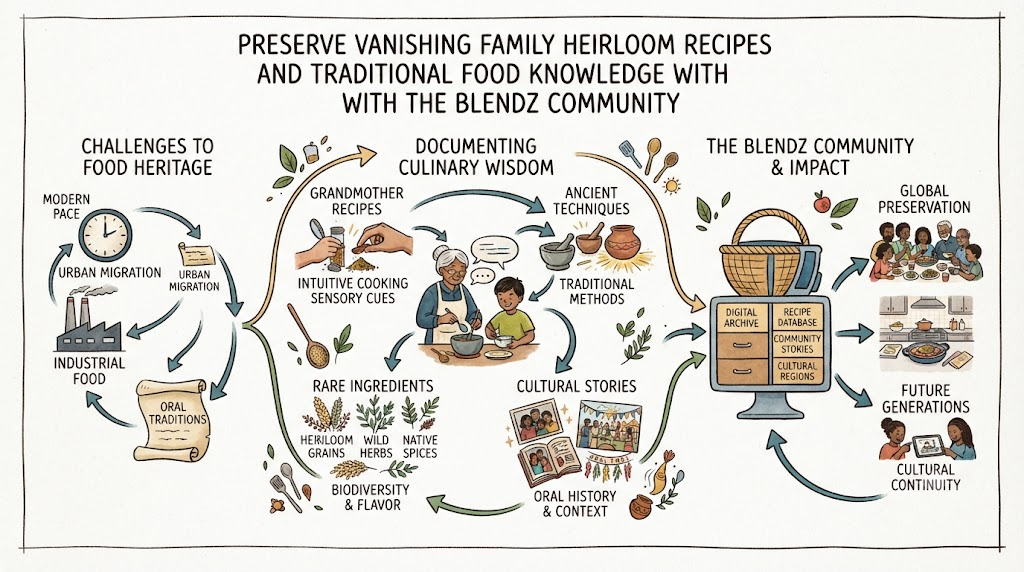
Across the globe, thousands of traditional food recipes and ancestral culinary techniques are quietly fading from daily kitchen life due to fast-paced modern living, industrial food systems, and shifting agricultural patterns. When a dish disappears, we do not merely lose a sequence of kitchen instructions; we forfeit cultural heritage, regional biodiversity, precious family memories, and profound community connections. Documenting grandmother recipes, heritage ingredients, and generational cooking methods protects the essential link between our ancestors and our future. Culinary traditions carry living history inside every earthen pot, fermented jar, and hand-ground spice blend. Exploring the deep repository at Blendz reminds us that keeping these fragile culinary identities alive is an urgent, shared cultural responsibility for home cooks, researchers, and families everywhere.
What is Blendz
Blendz serves as a global food heritage archive and educational platform dedicated to rediscovering, cataloging, and safeguarding the world’s most vulnerable culinary practices before they vanish entirely. The platform functions as an open digital sanctuary where food historians, home cooks, regional travelers, and cultural researchers come together to chronicle forgotten recipes, heritage cooking methods, and indigenous kitchen lore. By organizing culinary knowledge systematically across regions and generations, the archive bridges the gap between historical field documentation and everyday home cooking, transforming scattered kitchen memories into a structured, accessible educational resource for posterity.
Why Blendz
As modern culinary globalization homogenizes flavors across continents, Blendz provides a dedicated, structured haven for documenting rare ingredients, ancient recipes, grandmother cooking traditions, and vibrant festival food recipes from every corner of the planet. Visitors can seamlessly explore verified regional food stories, discover forgotten village staples, and actively contribute their own family culinary records to ensure valuable local heritage is never lost to time. The archive treats every recipe as an essential historical artifact, honoring the intricate cultural narratives, localized naming conventions, and ancestral cooking techniques that define the rich tapestry of our shared human history.
What Are Lost Recipes?
Lost recipes are traditional dishes, preparation techniques, or heritage food formulations that were once central to daily life but have gradually fallen out of active household and commercial circulation. These culinary practices typically fade when time-consuming preparation steps clash with modern convenience, when native micro-regional ingredients become commercially extinct, or when oral traditions fail to reach younger generations. For instance, labor-intensive dishes like indigenous multi-millet sourdough breads, complex pit-roasted village stews, and hand-rolled heritage pasta shapes like Sardinian su filindeu risk complete disappearance as mechanized alternatives take over kitchen spaces.
Why Traditional Recipes Matter
Traditional recipes serve as irreplaceable cultural anchors, carrying ancestral knowledge, ecological wisdom, communal identity, and deep familial bonds across generations. A heritage recipe preserves far more than a list of raw ingredients; it encapsulates local climate adaptations, historical trade interactions, seasonal harvest rhythms, and restorative nutritional practices developed over centuries. When we prepare authentic grandmother recipes, we participate in an unbroken lineage of living history, honoring the resourcefulness, resilience, and seasonal reverence of the domestic cooks who sustained communities through periods of abundance and extreme scarcity alike.
Grandmother Recipes and Oral Food Traditions
Grandmother recipes form the emotional heartbeat of global culinary history, relying almost entirely on tactile oral transmission rather than written, measured cooking manuals. In a typical home kitchen, an elder does not measure salt in grams or monitor cooking times with digital timers; instead, they gauge readiness by the sound of a crackling seed, the aromatic release of toasted spices, the elasticity of hand-kneaded dough, or the visual hue of simmering reduction. Capturing these unwritten sensory benchmarks requires patient observation, continuous dialogue, and detailed note-taking to translate instinctive domestic brilliance into clear, preserved culinary records that future generations can faithfully recreate.
Ancient Recipes and Traditional Cooking Methods
Ancient recipes reflect sophisticated historical food technologies that maximized nutritional availability, enhanced digestibility, and preserved perishable harvests long before artificial refrigeration existed. Vital traditional techniques such as wild fermentation, sun-drying, wood-smoking, underground pit-roasting, stone-grinding, salt-pickling, and prolonged earthen slow-cooking fundamentally alter food chemistry and produce unparalleled depth of flavor. Preserving the exact operational methodology is just as critical as documenting the ingredients themselves, because modern shortcuts like chemical additives or intense commercial heat completely strip these heritage dishes of their authentic texture, probiotic vitality, and historical soul.
Rare Ingredients and Food Heritage
The steady decline of agricultural biodiversity directly threatens traditional food recipes, as uniform industrial monocultures replace native grains, wild herbs, heirloom fruits, and regional heirloom vegetables. When indigenous ingredients like nutrient-dense wild millets, forest-foraged greens, sun-cured mountain peppers, or traditional fermentation starters disappear from local fields, the complex traditional dishes built entirely around their distinctive flavor profiles inevitably vanish as well. Protecting rare botanical varieties and traditional livestock breeds goes hand in hand with preserving culinary history, ensuring that the authentic biological building blocks of heritage cuisine remain accessible to future cooks.
| Ingredient Category | Historical Example | Cultural Origin | Primary Culinary Function | Threat to Survival |
| Heirloom Grains | Emmer & Einkorn Wheat | Fertile Crescent / Mediterranean | Ancient sourdough flatbreads and dense porridges | Commercial replacement by modern dwarf wheat |
| Indigenous Millets | Kodo & Foxtail Millet | South Asia / Sub-Saharan Africa | Slow-cooked savory gruels and fermented rice staples | Industrial shift toward polished white rice and corn |
| Wild Botanicals | Epazote & Hoja Santa | Mesoamerica | Flavoring bean stews and wrapping herbal tamales | Habitat destruction and reduced foraging knowledge |
| Fermented Starters | Nuruk & Ragi Starters | East & Southeast Asia | Inoculating wild grain ferments and heritage beverages | Modern standardized industrial yeast packets |
Festival Food Recipes
Festival food recipes celebrate profound cultural, spiritual, and seasonal milestones, serving as culinary markers for bountiful agricultural harvests, religious observances, and extended family reunions. Dishes like golden South Indian Pongal, intricately molded East Asian mooncakes, hand-pounded Japanese ceremonial mochi, and layered Mediterranean festival baklava embody symbolic blessings of prosperity, gratitude, and communal unity. Documenting these ceremonial specialties alongside their complete cultural context ensures that future generations understand not just the precise technique for making the dish, but the vital spiritual and communal reasons why the recipe exists in human history.
Traditional Recipes From Around the World
India
Indian culinary heritage encompasses an extraordinary mosaic of micro-regional traditions, where ancient culinary systems transform regional millets, sun-dried wild berries, cold-pressed seed oils, and Ayurvedic spice formulations into deeply restorative daily meals. From slow-simmered Rajasthani ker sangri harvested from desert trees to fermented black rice preparations of the Northeast, these complex traditional recipes honor hyper-local biodiversity, seasonal climate variations, and sophisticated, multi-layered tempering techniques passed down through domestic lineages.
Japan
Traditional Japanese cuisine, codified in the foundational philosophy of washoku, centers on absolute seasonal harmony, meticulous knife technique, and the artful mastery of natural fermentation methods. Beyond modern urban dining, rural Japanese culinary heritage preserves ancient techniques like long-cured nukazuke rice-bran pickling, earthen-pot nabemono winter stews, and regional sansai mountain-vegetable preparations that balance the palate while highlighting the unadorned, pure essence of pristine local ingredients.
Mexico
Mexican culinary history represents a vibrant synthesis of ancient Mesoamerican botanical wisdom and regional cooking practices, anchored by the foundational tradition of grain nixtamalization. Authentic heritage dishes, from complex multi-day Oaxacan celebratory moles and hand-patted heirloom corn tortillas to slow-cooked clay-pot bean preparations, demonstrate how ancient stone-grinding and wild chili-smoking techniques elevate humble harvest staples into deeply sophisticated culinary monuments.
Ethiopia
Ethiopian food heritage centers on communal solidarity and ancient grain cultivation, exemplified by the daily preparation of naturally fermented, bubbly injera made from iron-rich teff flour. Traditional slow-simmered dishes such as aromatic doro wat and diverse legume-based shiro preparations rely on intricately roasted berbere spice blends and seasoned niter kibbeh clarified butter, showcasing an ancient, unbroken culinary tradition centered around shared platters and hospitality.
Italy
Italian traditional cuisine is built entirely upon fierce regional pride, hyper-local microclimates, and absolute reverence for simple, unadulterated seasonal agricultural harvests. Long before standardized restaurant menus, rural Italian food traditions flourished through domestic preservation arts, hand-shaped regional pastas, slow-braised mountain ragùs, and resourceful cucina povera dishes that magically coaxed extraordinary depth of flavor from stale rustic bread, wild foraged field greens, and locally pressed olive oils.
What, Why, and How Section
Preserving culinary heritage requires a systematic understanding of the historical value of food, the cultural necessity of saving fragile cooking traditions, and the actionable protocols needed to record them accurately. Documenting a recipe bridges the gap between historical field ethnography and everyday domestic practice, transforming transient kitchen moments into structured cultural archives.
| Core Dimension | Essential Definition | Critical Importance | Practical Action Steps |
| What It Means | The intentional documentation of heirloom recipes, rare ingredients, native agricultural varieties, and ancestral preparation methods. | Halts the silent extinction of traditional culinary wisdom, culinary biodiversity, and regional food culture. | Record oral instructions, document regional names, measure hand pinches, and photograph raw ingredients. |
| Why It Matters | Reconnects contemporary society to historical roots, sustains family identity, and preserves ecological knowledge. | Protects nutritional diversity, prevents industrial food homogenization, and honors domestic kitchen labor. | Share archived recipes with younger relatives, cook traditional dishes at home, and support heritage growers. |
| How to Execute | Active interviewing of community elders, field recording of techniques, and faithful preservation of variations. | Transforms unwritten, fragile sensory instincts into permanent, reproducible cultural blueprints. | Create digital family food archives, support localized seed banks, and contribute to public food repositories. |
Real-Life Scenarios and Field Experiences
- A home cook sits beside their elderly grandmother to document a century-old holiday pastry, discovering that standard measuring cups fail to capture the ancestral technique of measuring liquid by the curvature of an antique ceramic teacup.
- A regional food researcher visits an isolated mountain village and records a dying technique for fermenting wild mountain greens in hand-sealed clay urns, preserving a crucial probiotic culinary process that had never been documented in print.
- A family gathers across three generations to film, transcribe, and standardize their great-uncle’s complex, wood-fired festival stew recipe, ensuring that subtle cues like the aromatic change in roasting spices are preserved for distant descendants.
Common Mistakes to Avoid
- Recording only the bare ingredient list while completely omitting the specific, non-negotiable cooking techniques, heat sources, and timing cues.
- Modernizing traditional dishes prematurely with processed commercial shortcuts or artificial flavoring pastes without documenting the authentic, foundational baseline method.
- Erasing micro-regional recipe variations in an ill-advised attempt to standardize a dish into a single, uniform regional preparation.
- Substituting rare, indigenous herbs or heirloom grains with generic supermarket staples without noting the original botanical profile and flavor contribution.
- Failing to document the historical, social, and emotional stories that explain why, when, and for whom the dish was traditionally prepared.
- Overlooking localized dialect names, traditional kitchen tool terminology, and regional ingredient titles during transcription.
How to Preserve a Family Recipe
- Interview the Elders: Schedule focused cooking sessions with family elders to capture oral stories, historical memories, and personal tips connected to the dish.
- Observe and Measure: Stand alongside the cook to discreetly weigh and measure every handful, pinch, and splash of ingredient before it goes into the pan.
- Document Sensory Benchmarks: Note explicit physical indicators, such as oil separation, fragrance release, color shifts, bubbling sounds, and dough textures.
- Photograph Key Stages: Capture clear visual records of raw local ingredients, intermediate cooking phases, traditional utensils, and the final plated presentation.
- Preserve Exact Terminology: Record the precise regional names of ingredients and tools in their original language or local dialect.
- Cook and Validate: Recreate the dish independently using your written field notes to identify missing instructions and confirm authentic flavor replication.
How to Document Traditional Food Responsibly
Responsible culinary documentation demands profound cultural sensitivity, meticulous historical accuracy, and genuine respect for the domestic communities that nurtured these traditions through hardship. Researchers and writers must always seek explicit permission from recipe holders, give clear credit to the families or indigenous communities who originated the knowledge, and avoid claiming proprietary ownership over collective heritage. Furthermore, documentarians should carefully distinguish between cherished family kitchen lore and peer-reviewed historical facts, ensuring that traditional foodways are celebrated with scholarly integrity, empathy, and unconditional authenticity.
Frequently Asked Questions
1. What is the difference between a traditional recipe and a lost recipe?
A traditional recipe remains in active, continuous preparation across families and communities, passing down through living cultural customs. A lost recipe, however, has largely disappeared from modern kitchens due to forgotten techniques, unavailable rare ingredients, or interrupted generational transmission, requiring deliberate historical and archival effort to recover and restore to the table.
2. Why are grandmother recipes often difficult to write down accurately?
Grandmother recipes rely primarily on intuitive sensory benchmarks—such as touch, aroma, visual cues, and crackling sounds—rather than rigid written measurements. Translating casual palm measurements, fluid cup estimates, and instinctive timing into precise, reproducible grams and minutes requires patient observation, repeated kitchen testing, and careful structural documentation.
3. How do industrial agricultural systems contribute to the loss of traditional recipes?
Modern industrial agriculture prioritizes high-yield, shelf-stable monoculture crops over delicate, diverse heirloom varieties. As native millets, wild forest herbs, regional root vegetables, and heritage fruit species vanish from local markets, home cooks can no longer source the foundational botanical components necessary to prepare authentic heritage dishes faithfully.
4. Can a traditional recipe be preserved if an original ingredient is extinct?
Yes, a traditional recipe can still be preserved by thoroughly documenting its historical preparation, cultural role, and original ingredient profile. Culinary researchers record the extinct botanical notes and recommend the closest authentic ecological substitutes, ensuring the fundamental cooking methodology and cultural memory endure despite modern environmental changes.
5. What role does wild fermentation play in ancient cooking traditions?
Wild fermentation served as an indispensable ancient preservation technology, enhancing micronutrient bioavailability, promoting gut health, and deepening complex umami flavors before modern refrigeration. Fermenting grains, dairy, legumes, and seasonal vegetables allowed ancient communities to safely store seasonal harvest surpluses and survive lean winter periods.
6. Why is it important to document the cultural stories behind festival foods?
Festival foods are deeply intertwined with spiritual celebrations, seasonal harvest cycles, and family gatherings. Documenting the underlying cultural stories explains why specific symbolic ingredients and elaborate preparation methods were chosen, ensuring future generations appreciate the profound emotional and social values baked into every ceremonial dish.
7. How can home cooks start archiving their own family recipes today?
Home cooks can start immediately by cooking alongside elderly family members, carefully weighing casual handfuls of ingredients, and recording the session on audio or video. Writing down specific sensory cues, photographing raw materials, and preserving native terminology transforms fragile kitchen memories into an enduring family culinary heirloom.
8. What is the biggest mistake people make when recording traditional food?
The most common mistake is recording only the bare ingredient list while completely ignoring the critical cooking techniques, heat variations, and cultural context. Without documenting how an ingredient is toasted, ground, or simmered, future cooks cannot authentically reproduce the true texture, aroma, and soul of the heritage dish.
9. How do cooking vessels and traditional utensils affect heritage flavors?
Traditional cooking vessels—such as seasoned unglazed clay pots, heavy cast-iron pans, soapstone basins, and copper kettles—regulate heat retention and interact chemically with food. These traditional materials impart distinctive mineral notes, delicate smokiness, and tender textures that modern non-stick cookware simply cannot duplicate in home kitchens.
10. Why should we preserve regional variations of the same traditional dish?
Regional variations reflect micro-climates, localized agriculture, historical trade routes, and unique family adaptations. Documenting these subtle differences prevents the artificial homogenization of food culture, honoring the brilliant diversity with which different neighboring communities adapted shared culinary foundations to their immediate natural surroundings.
11. Is it acceptable to adapt traditional recipes for modern dietary restrictions?
Adapting traditional recipes for modern dietary needs is acceptable, provided the original, unadulterated recipe and historical context are faithfully recorded first. Documenting the authentic baseline ensures the foundational culinary heritage remains completely intact, even as modern cooks experiment with alternative dietary substitutions in their own kitchens.
12. Where can food enthusiasts find and contribute verified lost recipes?
Food enthusiasts can discover and share verified lost recipes through dedicated digital food archives, regional historical societies, community cultural projects, and specialized platforms like Blendz. Engaging with global culinary repositories allows home cooks, researchers, and families to actively safeguard delicate generational food knowledge for the entire world.
Conclusion
Preserving lost recipes, rare ingredients, and ancestral cooking techniques is an urgent act of cultural stewardship that keeps the living memory of human civilization vibrant and nourishing. Every hand-ground spice blend, slow-fermented dough, and heirloom holiday dish carries the resilience, wisdom, and love of the generations who walked before us. By taking the time to interview our elders, record precise sensory cues, and honor micro-regional culinary diversity, we safeguard our shared cultural identity against the tide of industrial homogenization. Exploring dedicated archives like Blendz empowers home cooks, cultural researchers, and curious food lovers everywhere to rediscover forgotten culinary roots, master historical methods, and pass these priceless gastronomic treasures forward to enrich future tables across the world.
