Introduction
While standard travel itineraries herd crowds toward identical commercialized hill stations and concrete tourist hubs, Bihar offers an untouched alternative steeped in raw spirit, layered history, and unfiltered light. Here, photography is not merely about framed vistas—it is a deeply personal exercise in documenting living heritage, sacred water bodies, ancient terracotta ruins, and mist-shrouded valley ridges.
Standing along the banks of the Ganges at dawn or catching the golden sun reflecting off thousand-year-old brickwork connects your lens directly to an authentic visual narrative. Framing frames in Bihar allows photographers to escape commercial noise and capture timeless human stories set against majestic historical backdrops.
Why Bihar is a must-visit city
Bihar forms a foundational chapter in global spiritual, intellectual, and political history. As the cradle of Buddhism and Jainism and the heartland of the ancient Mauryan and Gupta Empires, this state possesses unmatched cultural weight. Modern infrastructure makes exploring easy, featuring expanding four-lane expressways connecting Patna to regional heritage hubs, high-speed rail connectivity via major junctions, and well-appointed hospitality options for every budget tier.
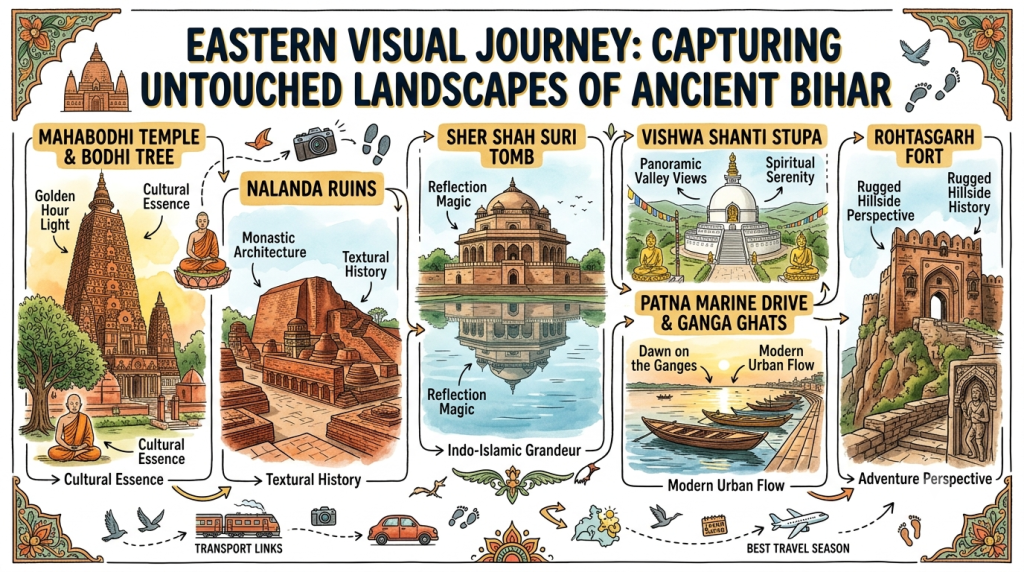
The primary photography circuit seamlessly connects urban riverfronts, peaceful monastic ruins, eco-rich forested hills, and grand water fortresses. Photographers can easily craft diverse visual themes ranging from dramatic architectural geometry to intimate street portraits bathed in soft natural light.
| Key Travel Fact | Details |
|---|---|
| Primary Gateways | Jay Prakash Narayan Airport (Patna), Gaya International Airport |
| Best Travel Season | October to March (Crisp morning air, minimal haze) |
| Top Photography Themes | Heritage Architecture, Sacred Landscapes, Street & Culture |
| Transport Connectivity | Direct Vande Bharat express trains, broad NH road network |
| Ideal Trip Duration | 4 to 6 Days for a complete multi-zone photography circuit |
Mahabodhi Temple towering in early light.
Best Places or Experiences
1. Mahabodhi Temple Complex, Bodh Gaya
Dawn at the UNESCO World Heritage Mahabodhi Temple is a deeply atmospheric sensory experience for any visual storyteller. Before general tourist crowds arrive, chanting monks clad in saffron and maroon robes circumambulate the ancient 55-meter stone pyramid structure.
Golden rays filtering through the historic Bodhi Tree cast intricate, dappled shadow patterns across ancient carved stone railings. The quiet environment allows photographers to capture delicate architectural details, grand geometric scale, and profound devotional moments in natural light.
- Location: Bodh Gaya, Gaya District; 115 km south of Patna, 15 km from Gaya Junction.
- Why it is worth visiting: Iconic ancient brick architecture illuminated by low-angle golden hour light.
- Best things to do: Capture light filtering through the Bodhi Tree, photograph monks in peaceful meditation, and frame architectural reflections in the Lotus Pond.
- Best time to visit: 5:00 AM opening time to experience quiet morning light and devotional rituals.
- Ideal for whom: Culture documentarians, architecture photographers, and visual storytellers.
- Travel tip: Mobile phones are restricted inside the main temple premises; secure a dedicated camera permit at the entrance ticket counter.
2. Ruins of Nalanda Mahavihara
The vast red-brick ruins of ancient Nalanda University stretch across manicured green lawns, offering brilliant textural compositions for architectural photography. As the sun clears the horizon, the grand stupa of Temple No. 3 glows with an intense crimson warmth.
Low sun angles highlight intricate stucco bas-relief sculptures carved into ancient brick walls. Long shadows cast across ruined monastic corridors add dramatic depth, lead lines, and narrative scale to wide-angle landscape shots.
- Location: Nalanda District; 85 km southeast of Patna, 15 km from Rajgir.
- Why it is worth visiting: Expansive archaeological vistas boasting rich brickwork and dramatic shadow play.
- Best things to do: Shoot low-angle perspectives of Temple No. 3, frame long shadow corridors of ancient monasteries, and capture detailed carved brick motifs.
- Best time to visit: 9:00 AM complex opening for sharp textures or late afternoon golden hour.
- Ideal for whom: Architectural photographers, history buffs, and landscape creators.
- Travel tip: Walk to the far western boundary ridge for an elevated perspective that captures the full structural layout of the excavated complex.
Ancient brick masonry of Nalanda Mahavihara.
3. Tomb of Sher Shah Suri, Sasaram
Rising dramatically from the center of a large square artificial lake, this masterpiece of Indo-Islamic architecture is a fine-art photographer’s dream. The calm water surface often provides a flawless mirror reflection of the grand 122-foot sandstone dome.
During winter mornings, low-hanging mist hovers across the lake surface, isolating the grand mausoleum against a soft, glowing sky. The red sandstone construct absorbs light, shifting from cool morning blues to warm golden afternoon tones.
- Location: Sasaram, Rohtas District; 150 km southwest of Patna via NH19.
- Why it is worth visiting: Extraordinary reflection shots of an octagonal mausoleum floating on quiet water.
- Best things to do: Frame symmetrical reflections from the entrance causeway, capture flying migratory birds over the lake, and photograph intricate domed kiosks.
- Best time to visit: 6:00 AM to 7:30 AM for still waters and crisp reflection lines.
- Ideal for whom: Fine-art landscape creators, architectural photographers, and heritage travelers.
- Travel tip: Stand precisely at the center of the main access causeway with a wide-angle lens for perfect structural symmetry.
Flawless mirror reflection of Sher Shah Suri Tomb.
4. Vishwa Shanti Stupa & Ratnagiri Hill, Rajgir
Perched atop Ratnagiri Hill, the stark white dome of the Vishwa Shanti Stupa captures early rays of light breaking over the Rajgir valley. The panoramic views from this vantage point extend across five forested hills shrouded in morning fog.
The architectural symmetry of the stupa, framed by golden Buddha statues and prayer flags, creates a clean, peaceful composition. Shooting from the base stairs looking upward yields heroic perspectives set against vibrant blue skies.
- Location: Rajgir, Nalanda District; 100 km south of Patna.
- Why it is worth visiting: Sweeping 360-degree hilltop views of mist-covered valleys and sparkling stupa architecture.
- Best things to do: Ride the scenic aerial ropeway, photograph golden Buddha statues in clear light, and capture wide valley landscapes.
- Best time to visit: 6:00 AM to 8:00 AM for clear air and minimal crowd interference.
- Ideal for whom: Landscape lovers, solo travelers, and drone/panoramic enthusiasts.
- Travel tip: Take the early morning hiking trail if you want to reach the summit before the chairlift ropeway starts operating.
Vishwa Shanti Stupa standing proud atop Ratnagiri Hill.
5. Patna Marine Drive & Ganga Ghats
The morning sun rising over the Ganges in Patna offers a striking combination of traditional riverbank culture and modern urban engineering. Early hours at Sabzibagh Ghat and JP Ganga Path present calm reflections of wooden boats against glowing skies.
As mist hovers above the broad expanse of the sacred river, local fishermen and river life create evocative silhouette opportunities. The clean lines of the elevated highway contrast beautifully against the fluid motion of the river below.
- Location: Patna Metropolitan District, along the northern bypass edge; 5 km from Patna Junction.
- Why it is worth visiting: Unmatched wide-angle views of the Ganges during peak golden hour.
- Best things to do: Capture long-exposure water movements, shoot silhouetted riverboats, and frame modern bridge architecture against dawn skies.
- Best time to visit: 5:15 AM to 6:30 AM for optimal soft lighting and atmospheric river mist.
- Ideal for whom: Street photographers, urban landscape enthusiasts, and early morning travelers.
- Travel tip: Arrive 20 minutes before sunrise to set up your tripod along the concrete promenade before local pedestrian traffic builds.
6. Rohtasgarh Fort, Rohtas
Perched atop a plateau in the Kaimur hills, the rugged stone ruins of Rohtasgarh Fort offer dramatic, wild photography perspectives. Overlooking the Son River valley, this massive hilltop fortress features weathered archways, carved balconies, and overgrown courtyards.
The misty morning light filtering through ancient stone windows creates an moody, mysterious visual atmosphere. The sheer cliff edges surrounding the fort provide spectacular panoramic viewpoints across dense green forests.
- Location: Rohtas District; 180 km southwest of Patna, 40 km from Sasaram.
- Why it is worth visiting: Dramatic cliffside fortress ruins surrounded by untouched forest wilderness.
- Best things to do: Photograph moody archways in morning light, frame cliff-edge valley views, and capture stone carvings inside the Maan Singh Palace.
- Best time to visit: October to February, early morning to mid-afternoon.
- Ideal for whom: Adventure photographers, heritage explorers, and trek enthusiasts.
- Travel tip: Hire a knowledgeable local guide in Akbarpur before ascending the plateau for navigation and safety.
Offbeat Exploration: Hidden Gems Tourists Miss
Ghora Katora Lake, Rajgir
Surrounded by three steep green hills, this eco-friendly natural lake bans motor vehicles, preserving pristine air and quiet silence. Arriving by electric rickshaw at first light reveals a calm water surface reflecting a large submerged pink granite Buddha statue. The morning light breaking over the ridge creates a misty aesthetic ideal for fine-art landscape shots.
Barabar Caves, Jehanabad
As the oldest surviving rock-cut caves in India, dating back to the Mauryan Empire, the Barabar structures feature mirror-polished granite interiors. Early sunbeams penetrate the narrow entrance archways, striking the polished stone surfaces to create sharp light contrast. The surrounding granite hill terrain offers panoramic elevated views across rural fields.
Telhar Kund Waterfall, Kaimur
Located deep within the forested Kaimur plateau, Telhar Kund drops into a deep green pool surrounded by steep rock faces. Visiting after the monsoon season allows photographers to capture lush foliage, rushing water movements, and dramatic canyon depth from an elevated viewing platform.
Detailed Practical Guidance for Travelers
| Destination | Standard Entry Fee | General Timings | Best Local Food Options Nearby | Recommended Nearby Attractions |
|---|---|---|---|---|
| Mahabodhi Temple | Free (Camera: ₹100) | 5:00 AM – 9:00 PM | Tibetan Thukpa, Monks Cafe bakery | Great Buddha Statue, Thai Monastery |
| Nalanda Ruins | ₹40 (Indian), ₹600 (Foreigner) | 9:00 AM – 5:00 PM | Tilkut, Local Thali | Nalanda Archaeological Museum |
| Sher Shah Suri Tomb | ₹25 (Indian), ₹300 (Foreigner) | 6:00 AM – 6:00 PM | Sattu Paratha, Local Sweets | Rohtasgarh Fort, Camphire Park |
| Vishwa Shanti Stupa | Free (Ropeway: ₹100) | 6:00 AM – 6:00 PM | Fresh Guava, Rajgir Khaja | Griddhakuta Hill, Ghora Katora Lake |
| Patna Marine Drive | Free | Open 24 Hours | Litti Chokha at local stalls, Kulhad Chai | Bihar Museum, Mahavir Mandir |
| Rohtasgarh Fort | Free | 6:00 AM – 5:00 PM | Local home-style meals in Akbarpur | Tutla Bhawani Waterfall, Rohtas Plateau |
Logistics & On-Ground Navigation
Local Transport Options
- Railways: Extensive train network linking Patna Junction, Gaya Junction, and Rajgir; ideal for budget inter-district transfers.
- Auto-Rickshaws & E-Rickshaws: Abundant for short intra-city travel; e-rickshaws dominate small heritage towns like Bodh Gaya and Rajgir.
- Car Rentals: Hiring a private vehicle with a driver is the most efficient option for early morning photography shoots across multiple locations.
Budget Planning
- Backpacker / Budget Tier: ₹1,200 – ₹1,800 per day (Includes budget guesthouses, public transport, and street-side dining).
- Mid-Range / Comfort Tier: ₹3,500 – ₹6,000 per day (Includes 3-star boutique hotels, private AC sedan rental, and sit-down dining).
Safety and Inclusivity Tips
- Families: Well-paved walkways at main heritage monuments accommodate strollers easily; carry bottled water during day outings.
- Couples: Bodh Gaya and Rajgir offer serene, peaceful environments; maintain respectful decorum near religious sites.
- General Safety: Rural roads can be foggy during winter dawns; hire experienced drivers for early morning departures.
Strategic Travel Planning Guardrails
Travel Planning Tips for Bihar
- Pre-Book Winter Accommodations: Bodh Gaya experiences peak international pilgrim season between November and February; secure rooms early.
- Carry Liquid Cash: While UPI payments are widely accepted in cities, small rural vendors near offbeat spots prefer cash transactions.
- Dress in Respectful Layers: Early mornings can be cold (8°C–12°C in winter), requiring light jackets that can be shed as the sun warms up.
- Respect Sacred Etiquette: Remove footwear before entering temple outer courtyards, and walk clockwise around stupas.
- Plan Around Golden Hour: Summer dawns occur as early as 5:00 AM, while winter sunrises shift to 6:30 AM.
Common Mistakes to Avoid
- Overpacking Daily Routes: Avoid trying to cover Patna, Rajgir, and Sasaram in a single day due to inter-district driving times.
- Skipping Regional Cuisine: Do not stick solely to hotel buffets; miss out on freshly prepared local snacks like Khaja and Sattu drinks at your peril.
- Assuming Public Transport Runs Early: Do not rely on local buses for 5:00 AM photography shoots; pre-arrange private cabs.
- Ignoring Camera Permits: Forgetting to buy official camera tickets at heritage gates leads to unnecessary delays during prime lighting windows.
- Rushing Bodh Gaya: Allocate at least one full morning to soak in the ambient quietude rather than snapping quick photos and leaving.
Suggested Itinerary Blueprints
1. Day Quick Dash (Patna Urban Heritage Express)
Designed for travelers with limited time, focusing on capital city riverfronts, architecture, and cultural museums.
- 05:15 AM – 07:00 AM: Sunrise shooting along the Ganges at Patna Marine Drive and Sabzibagh Ghat.
- 07:30 AM – 09:00 AM: Breakfast featuring authentic piping-hot Litti Chokha at a local city eatery.
- 09:30 AM – 12:30 PM: Indoor gallery exploration and architectural shooting at the world-class Bihar Museum.
- 02:00 PM – 05:30 PM: Sunset framing from the historic Golghar structure overlooking the city skyline.
2. Day Deep-Dive (Heritage Golden Triangle Circuit)
A balanced two-day loop covering ancient monastic centers, scenic hills, and spiritual sites.
- Day 1: Morning arrival in Rajgir; take the early ropeway up Ratnagiri Hill for photos at Vishwa Shanti Stupa. Spend the afternoon exploring Ghora Katora Lake and ancient stone walls.
- Day 2: Sunrise photography at the ruined brick monasteries of Nalanda. Afternoon transfer to Bodh Gaya to document evening prayers around the Mahabodhi Temple.
3. Complete Weekend Travel Plan (Grand Photography Loop)
A comprehensive three-day trip across scenic, architectural, and heritage locations.
- Friday: Arrive in Patna; evening stroll along Ganga Path to map out early morning camera angles.
- Saturday: Drive south to Sasaram for sunrise at Sher Shah Suri’s Tomb. Afternoon drive to Bodh Gaya for golden hour photos at the Great Buddha Statue.
- Sunday: Early sunrise session inside the Mahabodhi Temple Complex. Afternoon stop at the ancient rock-cut Barabar Caves before returning to Patna for departures.
Common Tourist Mistakes to Avoid
Geographic Blunders
Attempting to map Sasaram and Bhagalpur into the same morning itinerary creates an exhausting 300 km transit across opposite sides of the state. Group your trip logically into Northern, Central, and Southern sectors.
Commercial Traps
Spending precious morning hours inside modern shopping centers in Patna deprives travelers of atmospheric street lighting, bustling morning markets, and quiet riverfront moments.
Neglecting Modern/Alternative Zones
Focusing exclusively on ancient ruins causes tourists to miss vibrant contemporary spots like Patna’s expanded art corridors, landscaped river promenades, and boutique cafes.
Transport Overpayment
Always use app-based cab booking tools or cross-check prevailing auto rates with hotel concierges to avoid inflated tourist fares when booking early morning transfers.
Luxury Dining Bias
Relying solely on hotel dining rooms isolates you from iconic local flavors. Freshly fried Khaja in Rajgir or warm Tilkut in Gaya represent the true culinary heart of the region.
Frequently Asked Questions
1. What is the absolute best season for photography in Bihar?
The winter months between October and March offer crisp air, clear skies, comfortable daytime temperatures, and soft light ideal for outdoor shoots.
2. Are tripods allowed inside the Mahabodhi Temple complex in Bodh Gaya?
Standard tripods require special clearance or a paid camera pass at the main gate. Compact monopods or handheld camera setups are easier to bring inside.
3. How do I reach Ratnagiri Hill in Rajgir for early morning light?
You can hire an e-rickshaw early in the morning to reach the base gate, then take the walking trail or wait for the aerial chairlift ropeway to open.
4. Is it safe for solo female photographers to shoot at early dawn?
Major travel hubs like Bodh Gaya, Rajgir, and central Patna riverfronts are generally safe and active at dawn. Pre-arranging transport via your hotel is recommended for remote sites.
5. What wide-angle lens works best for capturing the ruins at Nalanda?
A 16-35mm lens on a full-frame camera body allows you to capture the grand scale of Temple No. 3 while remaining close to structural foundations.
6. Do I need permission to fly a photography drone over Bihar heritage sites?
Yes, flying drones over protected ASI monuments like Nalanda, Mahabodhi, and Sher Shah Suri Tomb is strictly prohibited without explicit clearance from authorities.
7. How much time should I allocate for a photography shoot at Sher Shah Suri Tomb?
Plan for at least 90 minutes. This allows you to walk around the perimeter lake, find symmetrical angles along the causeway, and capture light shifts on the sandstone.
8. Are mobile phone cameras permitted inside all major monuments?
Mobile cameras are allowed at most sites for a nominal fee, though Bodh Gaya enforces a strict policy where all mobile devices must be deposited in lockers before entry.
9. What is the best sunrise spot along the Ganges in Patna?
JP Ganga Path (Patna Marine Drive) and Kali Ghat offer clear eastern exposures across the open river with minimal visual obstruction.
10. Is local street food safe to eat after an early morning shoot?
Yes, eating freshly cooked, piping-hot street food like Litti Chokha or Jalebi from busy stalls with high customer turnover is safe and delicious.
11. How can I capture misty morning photos without damaging my camera gear?
Keep a clean microfiber cloth in your pocket to wipe condensation off your front lens element, and allow your camera gear to adjust gradually to outdoor humidity.
12. Can I hire local photography guides in Bodh Gaya or Rajgir?
Yes, licensed tourism guides are available at monument entrances who can direct you to exact visual vantage points and share deep historical insights.
Conclusion
Choosing a photography journey through Bihar offers something rare in modern travel: the chance to capture genuinely undisturbed heritage. As golden light breaks over ancient stupas, sacred rivers, and quiet hills, your camera captures not just scenery, but centuries of living history. Step off the worn tourist path, explore with an open lens, and witness the timeless magic of this vibrant state unfold around you.
