Introduction
When most travelers map out their holiday escapes, they fall into the same predictable patterns, booking tickets to overcrowded mountain resorts or hyper-commercialized coastal towns where the authentic soul of the destination has long been replaced by tourist traps. If you are tired of identical-looking cafes and souvenir shops that sell the exact same trinkets across state lines, it is time to pivot toward something with deep roots, undeniable authenticity, and a powerful cultural connection. Patna, the ancient seat of empires once known as Pataliputra, offers an raw, unfiltered immersion into India’s historical spine.
At the epicentre of this urban heritage stands Golghar, a massive beehive-shaped granary built by the British in 1786. While this architectural oddity serves as a fantastic starting point, the real magic lies in the fascinating cultural matrix that surrounds it. Choosing to explore the historic circuit around Golghar means stepping away from superficial sightseeing and diving deep into centuries of Buddhist, sikh, and Mauryan history that shaped the entire subcontinent.
Why Patna is a must visit city
Patna carries a monumental historical and cultural weight that few living cities on Earth can match. Strategically positioned along the southern bank of the holy river Ganges, this region has served as a cradle for major world religions, the nerve center of the mighty Mauryan and Gupta Empires, and a vital trading hub for millennia. From the spiritual steps of Lord Buddha and Lord Mahavira to the birthplace of Guru Gobind Singh Ji, the macro-level history of Patna reads like an epic saga of human civilization.
For modern travelers, the practical accessibility of Patna makes it an incredibly smooth destination to navigate. The city is seamlessly connected via the Patna Junction Railway Station, a massive central hub, and the Jay Prakash Narayan International Airport, which offers daily flights to all major Indian metropolises. Well-maintained national highways link Patna directly to nearby historic epicenters like Nalanda, Rajgir, and Vaishali. The hospitality landscape has also evolved dramatically, catering comfortably to backpackers looking for budget hostels, families seeking reliable mid-range hotels, and heritage enthusiasts checking into premium luxury stays.
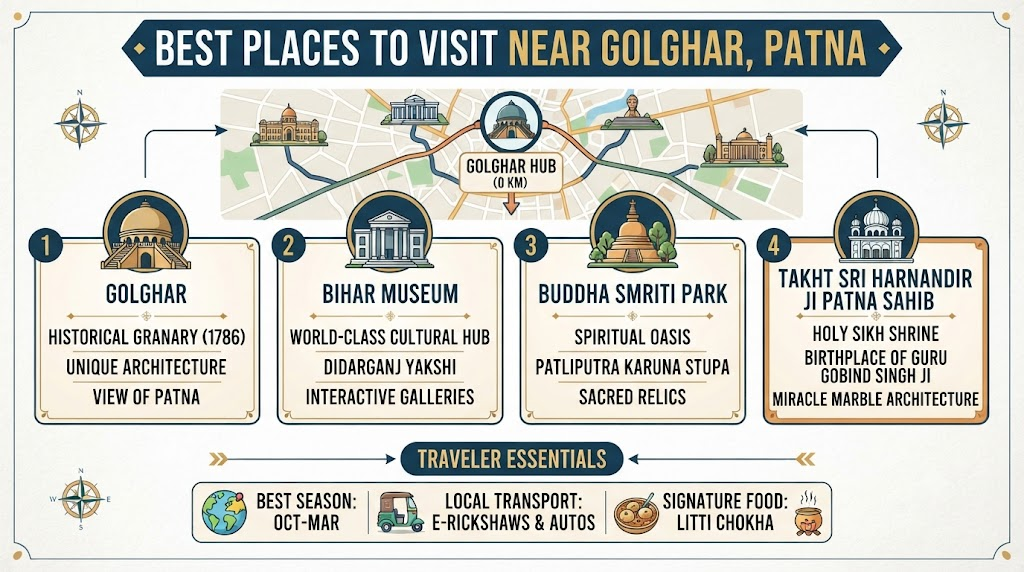
The local travel circuit naturally unfurls from the central landmark of Golghar, tracing a route that spans from world-class modern museums and tranquil spiritual parks to bustling ancient ghats and sacred shrines.
| Metric / Feature | Details for Travelers |
|---|---|
| Primary Hub Landmark | Golghar, Ashok Rajpath, Patna |
| Best Travel Season | October to March (Pleasant, cool weather) |
| Nearest Airport | Jay Prakash Narayan International Airport (PAT) |
| Nearest Railway Station | Patna Junction (PNBE) |
| Signature Local Street Cuisine | Litti Chokha, Chana Ghugni, Anarsa, Malpua |
| Key Architectural Styles | British Colonial, Mauryan, Indo-Saracenic, Modernist |
Best Places or Experiences
Golghar
The very landmark that anchors this guide, Golghar is an engineering marvel born out of the tragic Great Bengal Famine of 1770. Captain John Garstin designed this colossal, pillarless dome to store over 137,000 tons of grain for the British army. Its unique, bulbous design stands as a testament to late 18th-century architectural experimentation, featuring twin spiral staircases that wrap around the exterior, designed specifically for laborers to carry grain sacks up one side and cascade down the other.
Patna
The iconic beehive-shaped granary of Golghar.
Walking around its massive base gives you a true sense of scale. The structure is completely hollow from the inside and relies entirely on its sweeping brick-and-mortar curvature to support its weight, resulting in an incredible acoustic echo chamber.
- Location: Opposite Government Girls High School, Ashok Rajpath Road, Patna (0 km from hub)
- Why it is worth visiting: It is a unique piece of British colonial engineering with a completely pillarless interior dome design.
- Best things to do: Walk the manicured perimeter gardens, appreciate the massive brickwork architecture from the base, and enjoy the evening laser and sound show when operational.
- Best time to visit: Late afternoon (4:00 PM to 5:30 PM) to catch the soft golden light reflecting off the brick architecture.
- Ideal for whom: History buffs, architecture students, and families looking for an open, breezy heritage site.
- Travel tip: Access to the very top via the spiral stairs is sometimes restricted for structural safety; always check with the on-site guards before attempting to climb. MakeMyTrip
Bihar Museum
Spanning over a magnificent 13.5 acres, the Bihar Museum is a world-class, state-of-the-art cultural institution that redefines how history is experienced in India. Designed by the renowned Japanese architectural firm Maki and Associates, the building itself is a spectacular masterpiece of weathering steel and clean, minimalist lines. Inside, the galleries are organized with breathtaking curation, taking visitors on a chronological journey from prehistoric times through the golden age of Magadha to contemporary regional art.
The crowning jewel of the museum is the iconic Didarganj Yakshi, a flawless sandstone sculpture dating back to the 3rd century BCE, famed for its mesmerizing mirror-like Mauryan polish. The museum successfully bridges antiquity with interactive multimedia touchscreens, immersive audio guides, and dedicated children’s experiential galleries.
- Location: Bailey Road, Patna (Approx. 2.5 km from Golghar)
- Why it is worth visiting: It is one of the largest and most technologically advanced museums in South Asia, housing the legendary Didarganj Yakshi.
- Best things to do: View the ancient Mauryan stone sculptures, explore the interactive children’s history gallery, and enjoy a quiet moment in the outdoor sunken courtyards.
- Best time to visit: Morning hours right at opening (10:30 AM) to comfortably explore the massive galleries before afternoon crowds arrive.
- Ideal for whom: Art lovers, deep-dive historians, global travelers, and families with curious children.
- Travel tip: The museum is massive and requires at least 3 hours to see properly; wear exceptionally comfortable walking shoes and consider renting the high-quality audio guide.
Buddha Smriti Park
Inaugurated to commemorate the 2554th birth anniversary of Lord Buddha, Buddha Smriti Park is a 22-acre urban oasis of absolute serenity dropped directly into the chaotic heart of downtown Patna. The park was constructed using materials retrieved from historical Buddhist sites and features the magnificent Patliputra Karuna Stupa, a towering 200-foot structure that anchors the landscape. Inside the stupa, a glass structures preserves sacred relics of Buddha contributed by various Buddhist nations.
The peaceful Patliputra Karuna Stupa.
The park is beautifully landscaped with native trees under which Buddha is said to have meditated, including saplings directly cloned from the original Bodhi trees. The soothing sound of trickling water fountains and open-air meditation spaces make it an incredible spot to decompress after a day of hectic urban exploration.
- Location: Frazer Road, near Patna Junction (Approx. 2.2 km from Golghar)
- Why it is worth visiting: It features a monumental stupa housing authentic sacred relics of Lord Buddha and an interactive meditation center.
- Best things to do: Explore the underground museum showcasing life-size dioramas of Buddha’s journey, meditate in the designated quiet zones, and watch the synchronized musical fountain show in the evening.
- Best time to visit: Late evening (5:00 PM to 7:00 PM) when the entire stupa is beautifully illuminated with color-changing lights.
- Ideal for whom: Spiritual seekers, couples looking for a quiet walk, and travelers wanting to escape the city noise.
- Travel tip: Shoes must be removed before entering the inner stupa area; carry a pair of clean socks if you dislike walking barefoot on stone pathways.
Takht Sri Harmandir Ji Patna Sahib
Tucked away in the vibrant, atmospheric lanes of old Patna, Takht Sri Harmandir Ji Patna Sahib is one of the five holiest seats of authority in Sikhism (Panj Takht). Built out of gleaming white marble with majestic golden domes, this spectacular shrine marks the exact birthplace of the tenth Sikh Guru, Guru Gobind Singh Ji, who was born here in 1666. The current structure was originally initiated by the great Maharaja Ranjit Singh, who contributed exquisite marble work and gold leaf plating.
The holy Takht Sri Patna Sahib Gurudwara.
Stepping through the grand archways into the main courtyard instantly transports you into a world of profound devotion. The continuous, melodic chanting of Gurbani Kirtan echoes through the marble corridors while the selfless volunteers operate the Langar (community kitchen), serving hot, delicious meals to tens of thousands of visitors daily, regardless of caste, creed, or background.
- Location: Patna City area (Approx. 9.5 km east of Golghar)
- Why it is worth visiting: It is an incredibly sacred spiritual site with stunning white marble architecture and a deeply moving community spirit.
- Best things to do: Pay respects in the main inner sanctum, view the historical relics belonging to Guru Gobind Singh Ji kept in the museum, and partake in the holy Langar meal.
- Best time to visit: Early morning (5:00 AM to 7:00 AM) for the serene morning prayers or during major festival days for a high-energy cultural experience.
- Ideal for whom: Spiritual pilgrims, cultural explorers, photographers, and families.
- Travel tip: Ensure your head is fully covered with a scarf or bandana before entering the complex, and deposit your footwear at the designated free counter outside.
Offbeat Exploration: Hidden Gems Tourists Miss
Khuda Bakhsh Oriental Public Library
Located just a short walk down the road from Golghar, this unassuming national treasure holds one of the most priceless collections of rare Islamic manuscripts, Rajput paintings, and historical texts in the entire world. Established in 1891, it houses unique treasures like a tiny, exquisite Quran hand-written on palm leaves and the original military dispatches of Emperor Shah Jahan. It is a quiet, atmospheric sanctuary that most casual tourists walk right past without realizing the historical weight contained inside its walls.
Gandhi Ghat & The Evening Ganga Aarti
While everyone flocks to the ghats of Varanasi, Patna offers its own deeply authentic and far less commercialized evening Ganga Aarti at Gandhi Ghat. As dusk falls over the massive river Ganges, local priests dressed in traditional attire perform rhythmic rituals with towering multi-tiered brass lamps. The sound of blowing conch shells and synchronized bells creates an incredibly electric, spiritual atmosphere without the crushing, pushy tourist crowds found in other holy cities.
Sabhyata Dwar (Civilization Gate)
Positioned gracefully on the banks of the Ganges just behind Gandhi Maidan, this soaring 32-meter-tall sandstone arch is newer than Patna’s ancient relics but carries immense symbolic power. Built to surpass the height of Mumbai’s Gateway of India, its red and white sandstone structures are inscribed with the timeless philosophies of Emperor Ashoka, Lord Buddha, and Lord Mahavira. It is a stunning, quiet viewpoint to watch the massive river flow by as the sun dips below the horizon.
Detailed Practical Guidance for Travelers
| Destination | Standard Entry Fee | General Timings | Best Local Food Options Nearby | Recommended Nearby Attractions |
|---|---|---|---|---|
| Golghar | Free Admission | 9:30 AM – 6:00 PM | Bansi Vihar (South Indian & Sweets) | Gandhi Sangrahalaya, Shrikrishna Science Centre |
| Bihar Museum | ₹100 for Adults | 10:30 AM – 5:00 PM (Closed Mondays) | Museum Cafe (Regional Bhojpuri Platter) | Indira Gandhi Planetarium, Eco Park |
| Buddha Smriti Park | ₹20 for Park Entry | 9:00 AM – 7:00 PM (Closed Mondays) | Maurya Lok Food Stalls (Street Snacks) | Mahavir Mandir, Patna Junction |
| Patna Sahib Gurudwara | Free Admission | Open 24 Hours | Local Halwai shops (Hot Jalebis & Samosas) | Jalan Museum (Qila House), Mangal Talao |
| Khuda Bakhsh Library | Free Admission | 9:30 AM – 5:00 PM (Closed Fridays) | Ashok Rajpath Street Food vendors | Patna Market (Traditional shopping) |
Logistics & On-Ground Navigation
Local Transport Options
- Auto-Rickshaws (Shared & Private): The absolute lifeline of Patna’s transit system. Shared autos run continuously along the main Ashok Rajpath artery, costing a mere ₹10 to ₹30 per stretch. Private rides must be negotiated beforehand.
- E-Rickshaws: Excellent for short-distance hops between closely clustered landmarks like moving from Golghar to Gandhi Maidan. They are eco-friendly, cheap, and easily accessible.
- App-Based Cabs (Ola/Uber): Highly recommended for longer transits, such as traveling from your hotel in western Patna out to Patna Sahib Gurudwara in the far east. It eliminates fare haggling completely.
- Car Rentals: Ideal if you are traveling with elderly family members or plan to club city sights with a day trip to Vaishali or Nalanda.
Budget Planning
- Budget / Backpacking Tier (₹1,200 – ₹1,800 per day): Stay in budget guesthouses or homestays near Patna Junction, rely exclusively on shared auto-rickshaws, dine at iconic local street food stalls, and focus on low-cost heritage entry tickets.
- Mid-Range / Comfort Tier (₹3,500 – ₹6,000 per day): Stay in reliable 3-star business hotels or boutique stays on Exhibition Road, utilize private app-based cabs for daily transit, dine at sit-down air-conditioned regional restaurants, and opt for premium museum entry packages.
Safety and Inclusivity Tips
- For Families: Stick to well-policed, organized spaces like the Bihar Museum and Buddha Smriti Park during the core daytime hours. Patna’s parks are incredibly family-friendly and welcoming.
- For Couples: Buddha Smriti Park and Eco Park offer beautiful, respectable walkways. Avoid late-night isolated strolls along unlit stretches of the outer river ghats.
- General Safety: Patna is a busy, bustling capital city. Keep your personal belongings secure in crowded market areas like Patna Market or Patna City lanes, and avoid traveling to remote outer city limits after 10:00 PM.
Strategic Travel Planning Guardrails
Travel Planning Tips for Patna
- Digital vs. Cash Preferences: While high-end museums and restaurants seamlessly accept UPI payments and credit cards, carry loose cash (₹100 and ₹50 notes) for auto-rickshaws and street food vendors.
- Physical Preparation: Be prepared to walk significantly inside complex structures like the Bihar Museum and park grounds. Wear breathable fabrics and always carry a reusable water bottle.
- Local Etiquette: Dress modestly when entering religious spaces like Patan Devi or Patna Sahib. Remove your shoes and obey all photography restriction signs inside holy sanctums.
- Booking Seasons: If your trip coincides with the massive Chhath Puja festival (usually October/November), book your accommodation months in advance as the city swells with returning diaspora.
Common Mistakes to Avoid
- Over-packing your itinerary: Do not try to jam the Bihar Museum, Patna Museum, and Patna Sahib into a single afternoon; you will spend all your time stuck in traffic.
- Assuming uniform transport pricing: Never hop into an unmetered local auto without firmly agreeing on the final destination price first.
- Skipping the street food: Avoiding street vendors out of hyper-caution means missing out on legendary local treats like authentic, smoky Litti Chokha.
- Ignoring museum timetables: Do not schedule your visits to the Bihar Museum or Buddha Smriti Park on a Monday, as they remain completely closed to the public.
- Overpaying for heritage entry: Always look for the official government ticket counters or QR codes at monuments instead of listening to unauthorized local guides outside.
Suggested Itinerary Blueprints
1. Day Quick Dash (The Heritage Core)
- Target Audience: Business travelers or tourists with just 12 hours to spare.
- Morning (8:30 AM): Start at Golghar for a quick architectural look and photos, followed by breakfast at a nearby café.
- Mid-Day (11:00 AM): Head straight to the Bihar Museum to spend 3 hours exploring the core historical galleries. Thrillophilia
- Evening (4:30 PM): Catch the serene evening sunset and spiritual vibes at Buddha Smriti Park before catching your train or flight. MakeMyTrip
2. Day Deep-Dive (The Culture & Spirit Split)
- Day 1 (The Imperial Journey): Start your morning at Golghar, walk down to the Khuda Bakhsh Library, spend your afternoon absorbing the Bihar Museum, and conclude with the golden hour at Sabhyata Dwar.
- Day 2 (The Spiritual Path): Start early morning at the iconic Mahavir Mandir near the station, drive east to Takht Sri Patna Sahib for Gurbani and Langar, explore the rare antiques at Jalan Museum, and finish your trip with the evening Ganga Aarti at Gandhi Ghat.
3. Complete Weekend Travel Plan (The Greater Patna Loop)
- Friday: Arrive in the city, check into your hotel, and spend a relaxed evening exploring the bustling shopping zones and street food stalls of Maurya Lok Complex.
- Saturday: Dedicate your entire day to Patna’s core heritage monuments: Golghar, Bihar Museum, and an illuminated evening stroll through Buddha Smriti Park. MakeMyTrip
- Sunday: Take an early morning excursion out to the historical ruins of Kumhrar (the ancient Mauryan pillared hall), proceed to Patna Sahib Gurudwara for a deep cultural immersion, and close your weekend with a sunset boat ride on the Ganges from Gandhi Ghat.
Common Tourist Mistakes to Avoid
- Geographic Blunders: Trying to combine the far-eastern Patna City zone (Patna Sahib Gurudwara) with the far-western expansions (Patna Zoo/Eco Park) in the exact same afternoon. Patna stretches linearly along the river; split your days geographically into East and West to avoid grueling traffic standstills.
- Commercial Traps: Spending your precious vacation hours wandering around modernized shopping malls that look exactly like the ones in Delhi or Bangalore, rather than exploring the raw, historic charm of local wholesale hubs like Khaitan Market.
- Neglecting Modern/Alternative Zones: Forgetting to step into the quieter, artistic residential neighborhoods or the growing cafe culture around Patliputra Colony and Boring Road, which showcase the trendy, modern face of Bihar’s youth.
- Transport Overpayment: Accepting the first outrageous price quoted by an aggressive taxi driver outside the station. Always cross-reference the estimated rate on apps like Uber or Ola before agreeing to a manual ride.
- Luxury Dining Bias: Eating all your meals inside enclosed luxury hotel buffets. Missing out on the piping hot, ghee-laden street-side Litti Chokha prepared over open charcoal fires deprives your palate of the true culinary soul of this region.
Frequently Asked Questions
1. Is Golghar open for tourists to climb to the top right now? Structural entry to the very top stairs of Golghar is occasionally restricted by the Archaeological Survey of India to protect the aging brickwork. However, the entire perimeter gardens, light shows, and base architecture remain completely open for public exploration.
MakeMyTrip
2. How far is the Bihar Museum from Golghar, and what is the best way to travel between them? The Bihar Museum is located approximately 2.5 kilometers away from Golghar down Bailey Road. The easiest, most efficient way to travel between them is to hail a local e-rickshaw or book a quick app-based cab, taking roughly 10 minutes depending on city traffic.
3. Can people of all religions eat the Langar at Takht Sri Patna Sahib? Absolutely. The Langar (community kitchen) at the Gurudwara is completely inclusive and welcomes every single human being, regardless of religion, background, or social status. The food is entirely vegetarian, delicious, and served with immense respect.
4. What is the ticket price for adults at the Bihar Museum? The standard entry fee for an adult Indian citizen at the Bihar Museum is ₹100. There are separate, nominal fees if you wish to carry a professional camera or opt for foreign language audio guides.
5. Is Patna safe for solo female travelers during the evening hours? Patna is generally safe and welcoming, but like any major capital city, standard safety precautions apply. It is recommended for solo female travelers to stay in bustling, well-lit central commercial areas after dark and utilize verified app-based cabs for late-night transport.
6. Which local street food near Golghar is an absolute must-try? You absolutely cannot leave Patna without trying Litti Chokha—roasted wheat balls stuffed with spiced gram flour (sattu) dipped heavily in pure ghee, served with mashed vegetables. Chana Ghugni and sweet Malpua are also local culinary legends.
7. Are Buddha Smriti Park and the Bihar Museum open on Mondays? No, both Buddha Smriti Park and the Bihar Museum remain completely closed to the general public on Mondays for routine weekly maintenance and cleaning. Plan your itinerary accordingly to avoid arriving at closed gates.
8. Can I take professional photographs inside the Khuda Bakhsh Oriental Library? General photography of the building exterior is permitted, but taking photos or using flash on the ancient, fragile historical manuscripts inside the reading rooms is strictly prohibited to preserve the delicate historical documents.
9. What is the best season to plan a holiday trip to Patna? The absolute best time to visit Patna is during the winter season, stretching from October to March. The weather during these months is beautifully cool, pleasant, and perfect for long days of outdoor sightseeing without intense heat.
10. How much time should I ideally dedicate to exploring Buddha Smriti Park? You should ideally budget around 1.5 to 2 hours. This gives you ample time to tour the underground museum galleries, walk through the serene relic stupa, and sit quietly in the meditation gardens.
11. Is there a reliable parking space available near Golghar for private vehicles? Yes, there are designated roadside parking zones and public parking spaces managed around the perimeter of Gandhi Maidan and adjacent government facilities right next to Golghar.
12. Are there any dress codes to keep in mind when visiting the tourist sites near Golghar? While modern museums and parks have no strict dress codes, religious landmarks like the Patna Sahib Gurudwara require visitors to dress modestly (covering shoulders and knees) and keep their heads fully covered with a clean scarf or handkerchief inside the complex.
Conclusion
Choosing a travel destination is ultimately a choice about how you want to spend your time—do you want to skim the surface of a place designed entirely for tourists, or do you want to touch the living pulse of history? Venturing beyond the monumental dome of Golghar into the vibrant cultural landscape of Patna rewards you with something completely unforgettable. It is the intellectual thrill of standing before 2,500-year-old Mauryan stone carvings, the spiritual calm of meditating beside sacred Buddhist relics, and the pure, human warmth of sharing a communal meal inside a gleaming white marble Gurudwara. This journey leaves you with a profound sense of perspective and a deep, authentic connection to the cultural foundation of India that an ordinary, commercial vacation simply cannot replicate.
