Introduction
When planning a getaway, most travelers instinctively look toward the heavily commercialized hubs of Rajasthan or the packed beach sides of Goa. But if you are tired of curated, overcrowded tourist traps and crave raw authenticity, profound historical depth, and an unhurried cultural pulse, it is time to turn your gaze to Patna. As one of the oldest continuously inhabited cities on the planet, Patna does not merely display history; it cradles the very foundations of ancient global civilization.
Walking through its vibrant streets means stepping directly onto layers of soil that once shaped empires. From the golden eras of Magadha and the Maurya Empire to its pivotal position as the powerhouse called Pataliputra, this city has quietly anchored the historical narrative of the Indian subcontinent. Here, you will trade superficial tourist gimmicks for real, deep-rooted storytelling that echoes through millennia-old monuments and sacred spaces.
Why Patna is a Must Visit City
To truly understand the story of India, you must understand Patna. Geographically positioned on the fertile southern bank of the holy Ganges River, this city served as the epicenter for legendary rulers like Ashoka the Great and Chandragupta Maurya. It was the fertile ground from which major world philosophies like Buddhism and Jainism flourished and spread across Asia. For any traveler archetype—whether a solo backpacker tracking ancient footprints, a family looking for educational depth, or a spiritual seeker—Patna offers a rare macro-level view of antiquity.
Modern Patna blends this staggering weight of the past with highly accessible infrastructure. The city is exceptionally well-connected by the Patna Junction railway station (one of India’s busiest railway hubs) and the Lok Nayak Jayaprakash Airport. High-quality national highways seamlessly link it to regional international hubs like Bodh Gaya, Nalanda, and Vaishali, making it the perfect anchor point for the larger, world-renowned Buddhist and heritage circuits of Bihar.
| Quick Fact | Details & Specifications |
|---|---|
| Ideal Trip Duration | 2 to 3 Days for the core city circuit |
| Best Travel Season | October to March (Pleasant, cool weather) |
| Must-Try Local Food | Litti Chokha, Khaja, Anarsa, Malpua |
| Nearest Transport Hubs | Patna Junction (Rail), Patliputra Junction (Rail), LNJP Airport Patna |
| Primary Languages | Hindi, Magahi, Maithili, Bhojpuri, English |
Best Places or Experiences
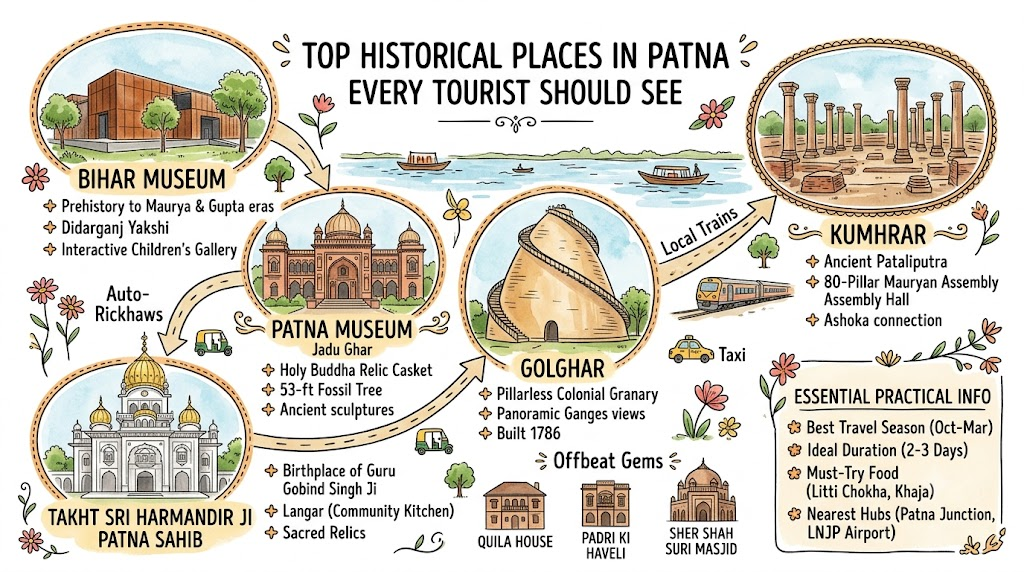
Takht Sri Harmandir Ji Patna Sahib
This majestic white-marble shrine stands as one of the most sacred seats of power in Sikhism, marking the exact birthplace of Guru Gobind Singh Ji, the tenth Sikh Guru. The architecture is a breathtaking display of traditional artistic design, featuring gold-leafed domes, intricately carved balustrades, and a serene inner courtyard that instantly isolates you from the chaotic hum of old Patna. Walking through its gates, you are greeted by the soothing, continuous chanting of Gurbani and the rich, earthy aroma of pure desi ghee from the community kitchen.
Inside the complex, a preserved museum houses invaluable historical relics, including the childhood shoes, weapons, and a cradle belonging to Guru Gobind Singh Ji. The spiritual energy here is tangible, culminating in the daily practice of Langar, where thousands of people from all walks of life sit together on the floor to share a free, delicious, hot meal prepared entirely by volunteer service.
Takht Sri Harmandir Ji Patna Sahib.
- Location: Patna City (Old Patna zone), roughly 11 km east of the Patna Junction railway station.
- Why it is worth visiting: It is one of the five holy temporal seats (Takhts) of Sikhism, offering unmatched spiritual peace and deep historical insight.
- Best things to do: Participate in the volunteer service at the Langar kitchen, view the ancient relics in the inner museum, and sit by the courtyard during evening prayers.
- Best time to visit: Early morning around 5:00 AM for the peaceful morning prayers, or during the birth anniversary celebrations of Guru Gobind Singh Ji (Prakash Parv).
- Ideal for whom: Spiritual seekers, history enthusiasts, culture lovers, and families.
- Travel tip: Ensure your head is fully covered with a scarf or handkerchief before entering the premises, and leave your footwear at the designated free counter outside.
Golghar
Constructed in 1786 by Captain John Garstin, this massive, beehive-shaped structure is a staggering engineering marvel born out of tragedy. Following the devastating Bengal Famine of 1770, the British administration built this pillarless granary to store over 137,000 tons of grain for the army. The sheer architectural brilliance lies in its dome design, which stands completely un-supported by internal pillars, relying instead on a thick, continuous masonry shell.
Two spiral staircases wrap elegantly around the exterior of the structure, designed specifically so that laborers could carry heavy grain sacks up one side, dump them through the hole at the absolute apex, and descend down the opposite staircase. The top of the dome provides a spectacular panoramic view of the wide Ganges River flowing quietly alongside the expanding skyline of Patna.
- Location: Near Gandhi Maidan, just 3 km north of Patna Junction.
- Why it is worth visiting: A unique example of pillarless colonial architecture that offers the finest vantage point of Patna and the Ganges.
- Best things to do: Walk the architectural base to check the acoustics, view the structure during the evening laser light show, and take photos from the landscaped lawns.
- Best time to visit: Late afternoon around 4:30 PM when the sun drops lower, keeping the brickwork cool and offering a beautiful sunset hue.
- Ideal for whom: Architecture geeks, history buffs, photographers, and casual strollers.
- Travel tip: The internal chamber has an incredible acoustic echo effect; while structural climbing on the stairs is occasionally restricted for safety maintenance, the base park is fully open.
The Bihar Museum
Spanning across several acres of world-class, ultra-modern design, the Bihar Museum is a magnificent, state-of-the-art space that rivals major international exhibition centers. Designed by a renowned Japanese architectural firm, the structure utilizes weathering steel and clean concrete lines to reflect a seamless harmony between regional heritage and future-forward design. The galleries inside are laid out chronologically, guiding you on an immersive journey from prehistory right through to the golden age of the Maurya and Gupta dynasties.
The absolute crown jewel of the museum is the world-famous Didarganj Yakshi statue, a sandstone masterpiece carved in the 3rd century BCE that boasts an unbelievable, mirror-like Mauryan polish that has survived for millennia. From ancient coins and stunning bronze idols to massive contemporary tribal art installations, the museum beautifully displays the sheer artistic brilliance of ancient Magadha.
The contemporary design of Bihar Museum.
- Location: Bailey Road, roughly 4.5 km west of Patna Junction.
- Why it is worth visiting: It is arguably one of India’s finest, most advanced museums, holding world-class ancient antiquities with interactive digital displays.
- Best things to do: Stand in awe before the pristine Didarganj Yakshi, explore the dedicated Children’s Gallery with interactive historical games, and have a meal at the internal heritage cafe.
- Best time to visit: Plan to arrive right at 10:30 AM when it opens to explore the galleries before the afternoon crowds arrive.
- Ideal for whom: Art lovers, history scholars, families with curious kids, and international tourists.
- Travel tip: Allocate a solid 3 to 4 hours here because the campus is massive; hiring an official audio guide at the counter adds immense value to the experience.
Patna Museum
Known affectionately by locals as the Jadu Ghar (House of Wonders), this beautiful building constructed in 1917 is a striking example of Indo-Saracenic architecture. The building itself features elegant Mughal-style domes, wide overhanging eaves, and classic British archways, making it an architectural gem in its own right. The museum houses an incredible collection of over 50,000 rare artifacts, including archaeological treasures uncovered during excavations across Bihar.
Among its most sacred possessions is a holy relic casket containing the actual, physical cremated remains of Gautama Buddha, recovered from a stupa in Vaishali. The museum also proudly displays a stunning 53-foot-long fossilized tree trunk that dates back millions of years, alongside an impressive collection of colonial-era paintings, ancient weapons, and intricate terracotta figurines.
- Location: Near Lodipur, on Buddha Marg, approximately 2 km from Patna Junction.
- Why it is worth visiting: A treasure trove of ancient Indian history housed within a stunning centenary colonial building.
- Best things to do: View the highly sacred Buddha relic vault, examine the ancient Mauryan sandstone sculptures, and photograph the beautiful gardens surrounding the building.
- Best time to visit: Mid-day between 11:00 AM and 2:00 PM, providing an educational and cool indoor retreat from the outside heat.
- Ideal for whom: Academics, archaeology enthusiasts, senior travelers, and backpackers.
- Travel tip: A separate ticket is required to enter the highly secured Buddha Relic Gallery; keep bags and larger camera gear inside the secure locker facility at the entrance.
Kumhrar
Kumhrar houses the prized archaeological ruins of ancient Pataliputra, the glorious capital city of the Maurya Empire. Wandering through this quiet, grassy park reveals the excavated remains of a legendary 80-pillar assembly hall that dates all the way back to 300 BCE. Historians and early Chinese travelers like Faxian once described this monumental hall as a palace of unmatched architectural beauty, noting it seemed too grand to have been built by human hands.
Though time and the changing path of the nearby river have left most of the wooden elements buried beneath protective layers of soil and water, the site remains an incredibly evocative space. A small, well-curated on-site museum displays stone fragments, delicate terracotta seals, ancient coins, and medical scripts from the historic monastery-hospital that once thrived on these very grounds.
- Location: Kankarbagh Road, roughly 5 km east of Patna Junction.
- Why it is worth visiting: It is the tangible birthplace of the Mauryan empire’s political power, directly connecting you to the era of Emperor Ashoka.
- Best things to do: Walk through the peaceful excavation pits, look over the polished sandstone pillar remnants, and read the informative charts in the local exhibition room.
- Best time to visit: Early morning between 7:00 AM and 9:00 AM when the park is incredibly quiet and perfect for contemplative walks.
- Ideal for whom: True history purists, archaeological buffs, and travelers seeking a quiet getaway from the city center.
- Travel tip: Read up briefly on Mauryan history before visiting; the site requires a bit of imagination to visualize the grand palaces that once stood over these foundation stones.
Offbeat Exploration: Hidden Gems Tourists Miss
The Quila House (Jalan Museum)
Perched quietly on the banks of the Ganges in old Patna City, this private museum is built directly over the foundations of Sher Shah Suri’s historic 16th-century fort. Owned privately by the Jalan family, it houses an unbelievable collection of rare antiquities, including silver dinner services belonging to George III, delicate jade carvings from the Chinese Qing Dynasty, and Marie Antoinette’s personal porcelain. It is a spectacular secret space, but access requires securing prior permission directly from the owners.
Padri Ki Haveli
Formally known as the Church of St. Mary, this is the oldest surviving Christian church in Bihar, built originally in 1713 and redesigned beautifully in 1772 by the Venetian architect Padre Joseph. The structure features grand Roman pillars, high ceilings, and an imposing historic cathedral bell that has witnessed centuries of changing regimes. It is a remarkably tranquil oasis hidden right within the bustling, narrow lanes of the historic Patna City market zone.
Sher Shah Suri Masjid
Built in 1545 by the Afghan emperor Sher Shah Suri to celebrate his reign, this mosque is a masterpiece of classic Afghan architecture. Located in the heart of old Patna, it features a massive central dome surrounded by four smaller domes, displaying a unique aesthetic that sits in stark contrast to traditional Mughal designs. It remains a largely overlooked historical monument where you can sit quietly and appreciate ancient stonework without encountering any tourist crowds.
Detailed Practical Guidance for Travelers
| Destination | Standard Entry Fee | General Timings | Best Local Food Options Nearby | Recommended Nearby Attractions |
|---|---|---|---|---|
| Takht Patna Sahib | Free Admission | 4:00 AM – 10:00 PM | Hot Langar Prasada, Local Jalebis in Patna City | Mangal Talao, Padri Ki Haveli |
| Golghar | ₹20 (Park Entry) | 10:00 AM – 6:00 PM | Litti Chokha stalls outside Gandhi Maidan | Gandhi Maidan, Patna Market |
| The Bihar Museum | ₹100 (Indians) / ₹500 (Foreigners) | 10:30 AM – 5:00 PM (Closed Mondays) | Heritage Cafe inside, Eco Park eateries | Patna Zoo, Indira Gandhi Science Complex |
| Patna Museum | ₹50 (Indians) / ₹250 (Foreigners) | 10:30 AM – 4:30 PM (Closed Mondays) | Maurya Lok Shopping Complex eateries | Buddha Smriti Park, GPO Building |
| Kumhrar | ₹25 (Indians) / ₹300 (Foreigners) | 9:00 AM – 5:00 PM | Local street food on Kankarbagh Main Road | Agam Kuan (Ancient Holy Well) |
Logistics & On-Ground Navigation
Local Transport Options
- Railways: Patna is exceptionally well-connected with intra-city stations like Patna Junction, Patliputra, and Rajendra Nagar Terminal, making it easy to hop on local trains for day trips to nearby heritage sites.
- Auto-Rickshaws: These form the absolute backbone of Patna’s transit system. Shared autos run along fixed routes (like Patna Junction to Patna City) and are incredibly cheap, while private autos can be easily hired for customized day trips.
- E-Rickshaws: Ideal for negotiating the narrow, historic lanes of old Patna or navigating short distances around Gandhi Maidan and Bailey Road at minimal cost.
- Car Rentals & App Cabs: Services like Ola and Uber operate smoothly throughout Patna, providing an excellent, air-conditioned option for navigating the city comfortably during the warmer months.
Budget Planning
- Budget/Backpacker Tier: ₹1,200 to ₹1,800 per day. This easily covers a clean bed in a budget guesthouse, traveling via shared auto-rickshaws, enjoying local street food like litti chokha, and entry tickets for public monuments.
- Mid-Range/Comfort Tier: ₹3,500 to ₹6,000 per day. This covers a comfortable 3-star or 4-star hotel stay, booking private app-based cabs for day trips, dining at heritage restaurants, and hiring local guides at historical sites.
Safety and Inclusivity Tips
- For Families: Patna is an incredibly warm, family-oriented destination. Stick to well-traveled spaces like the Bihar Museum and Buddha Smriti Park during evening hours; these spots offer beautifully landscaped, highly secure areas for children and seniors.
- For Couples: Prefer mainstream modern spaces like Eco Park, the Marine Drive stretch along the Ganga, or clean cafes in the Maurya Lok area for relaxed evening hangouts.
- General Safety: Patna is generally quite safe, but it is wise to avoid wandering down unlit lanes in old Patna City late at night. Always cross-reference auto fares with locals or app pricing to ensure smooth, hassle-free travel.
Strategic Travel Planning Guardrails
Travel Planning Tips for Patna
- Advance Museum Booking: The Bihar Museum is exceptionally popular; try to book your tickets online over the weekend to bypass the long ticket-counter queues.
- Keep Liquid Cash Ready: While digital UPI payments are widely accepted across most shops, keeping small cash notes handy is incredibly helpful for shared auto rides and street food vendors.
- Dress Modestly: When visiting active religious sites like Takht Patna Sahib or historic mosques, dress respectfully with clothing that covers your shoulders and knees.
- Prepare for Foot Travel: Exploring ancient ruins like Kumhrar or walking through the expansive Bihar Museum involves a lot of walking, so ensure you wear broken-in, comfortable walking shoes.
- Stay Hydrated: Carry a reusable water bottle along on your daytime tours, as exploring wide outdoor heritage complexes can quickly wear you out.
Common Mistakes to Avoid
- Over-packing Itineraries: Do not try to club the distant ruins of old Patna City and the modern museums of West Patna into a single morning; give yourself time to soak in each space.
- Ignoring the Old City Area: Many tourists stick entirely to modern western Patna, missing out on the rich, atmospheric lanes of Patna City where the town’s historic soul truly lives.
- Assuming Touts represent Fixed Fares: Avoid accepting flat rates from un-metered transport drivers parked right outside the railway station; use app-based aggregators to check standard current rates.
- Skipping the Regional Cuisine: Do not limit your meals to generic hotel buffets; you will miss out on the incredible flavours of fresh litti chokha, authentic dal peetha, and hot malpua.
- Assuming Monday Openings: Avoid planning museum visits on a Monday, as major landmarks like the Bihar Museum and Patna Museum remain completely closed for weekly maintenance.
Suggested Itinerary Blueprints
1-Day Quick Dash (The Heritage Highlights Route)
Designed for business travelers or short-stay tourists wanting to see the absolute essentials:
- 09:30 AM: Start your day early at the magnificent Bihar Museum to witness the ancient Mauryan sculptures.
- 01:30 PM: Enjoy a traditional lunch of Litti Chokha at a highly-rated eatery near Maurya Lok.
- 03:00 PM: Head over to Golghar to admire its unique architecture and stroll through the surrounding park.
- 05:00 PM: Wrap up your evening with a peaceful walk through the beautifully lit Buddha Smriti Park right near the city center.
2-Day Deep-Dive (The Empires & Epics Circuit)
Perfect for a classic weekend escape packed with historical exploration:
- Day 1: Dedicate your entire morning to exploring the expansive galleries of the Bihar Museum. After a relaxed lunch, head to the historic Patna Museum to view the sacred Buddha relics. End your evening enjoying the sunset breeze at the Patna Marine Drive along the Ganges.
- Day 2: Dive straight into the ancient spiritual roots of the city by heading east to Takht Sri Patna Sahib. Spend your afternoon exploring the historic Padri Ki Haveli and the Afghan architecture of Sher Shah Suri Masjid. Wrap up your day exploring the ancient Mauryan palace ruins at Kumhrar.
Complete Weekend Travel Plan (The Ultimate Pataliputra Loop)
A comprehensive Friday-to-Sunday plan that blends history, culture, and local food:
- Friday: Arrive in Patna and check into your hotel. Spend your late afternoon visiting the centrally located Buddha Smriti Park and its meditation domes, followed by an evening shopping for authentic Madhubani paintings at the Maurya Lok complex.
- Saturday: Embark on an early morning architectural tour of Golghar, followed by an extensive exploration of the Bihar Museum. In the evening, head down to the Gandhi Ghat to witness the mesmerizing Ganga Aarti, where priests perform rhythmic prayers with massive brass lamps along the river.
- Sunday: Dedicate your Sunday morning to the spiritual atmosphere of Takht Patna Sahib and partake in the community Langar. Spend your afternoon discovering the hidden relics at the Quila House or exploring the historic ruins at Kumhrar, wrapping up your tour with a traditional sweets-tasting session in the old city.
Common Tourist Mistakes to Avoid
- Geographic Blunders: Trying to explore the Mauryan ruins of Kumhrar and the modern galleries of the Bihar Museum within a tight two-hour window is a mistake. They sit on opposite sides of the city, and daytime traffic can easily eat up your exploration time.
- Commercial Traps: Spending your limited vacation time hanging around modernized shopping malls rather than exploring the old, historic market lanes of Patna City will leave you with a generic experience.
- Neglecting Modern/Alternative Zones: Skipping the beautiful modern expansions along the riverfront or the quiet, tree-lined walking tracks of Eco Park means missing out on how contemporary Patna relaxes.
- Transport Overpayment: Accepting flat transport rates without cross-referencing live prices on ride-sharing apps like Ola or Uber will almost certainly lead to overpaying for short city rides.
- Luxury Dining Bias: Sticking exclusively to high-end multi-cuisine hotel restaurants means you miss out on the incredible, authentic flavors of street-side vendors who have spent generations perfecting regional delicacies.
Frequently Asked Questions
1. Is Patna safe for solo female travelers?
Yes, Patna is generally welcoming and safe for solo female travelers. Like any busy historic city, it is smart to stick to well-frequented public spaces during evening hours, use registered app-based cabs for transport, and dress modestly when visiting traditional neighborhoods.
2. What is the absolute best time of year to visit Patna?
The optimal window is between October and March. During these months, the weather is pleasant and cool, making it incredibly comfortable to explore expansive outdoor archaeological ruins and museum complexes without dealing with the intense summer heat.
3. How far is the ancient Nalanda University from Patna?
Nalanda sits roughly 90 km southeast of Patna. It makes for an exceptional day trip, easily reachable via a smooth 2.5-hour drive along well-maintained national highways or via regular regional trains.
4. Can we see the actual relics of Lord Buddha in Patna?
Yes, the authentic cremated remains of Lord Buddha, excavated from a historic stupa in Vaishali, are safely preserved within a specialized, highly secure gallery inside the Patna Museum.
5. Are photography and videography allowed inside the Bihar Museum?
Smart-phone photography is generally permitted across most galleries for personal use, though using professional DSLR cameras or tripods requires paying an additional commercial fee at the main ticket counter.
6. What are the key items one should buy when shopping in Patna?
You should look for genuine, hand-painted Madhubani artworks, intricate tussar silk sarees, unique hand-woven Tikuli art pieces, and delicious local sweets like dry Khaja from nearby vendors.
7. How much time does it take to thoroughly explore the Bihar Museum?
Because the museum campus is massive and filled with interactive exhibits, you should plan to spend at least 3 to 4 hours to truly appreciate the galleries without rushing.
8. Is Patna a good destination to visit with young children?
Absolutely. Modern spaces like the Bihar Museum feature fantastic interactive children’s galleries, while spots like the Patna Zoo, Buddha Smriti Park, and Eco Park offer plenty of open green spaces for kids to enjoy.
9. What is the significance of the Ganga Aarti in Patna?
The Ganga Aarti is a beautiful spiritual ceremony held every evening at Gandhi Ghat, where priests perform rhythmic prayers with large brass lamps, offering a deeply moving cultural experience similar to the aartis in Varanasi.
10. Do I need to hire an official tour guide when visiting Kumhrar?
While you can explore the park independently, hiring an official guide or spending time reading the detailed informational plaques on-site is highly recommended to help you visualize the ancient palaces that once stood there.
11. Is public transit readily available from Patna Airport to the city center?
Yes, you can easily find pre-paid taxi counters, app-based cabs like Ola and Uber, and auto-rickshaws right outside the terminal gates to take you comfortably to any part of the city.
12. Can non-Sikh tourists participate in the Langar at Takht Patna Sahib?
Absolutely. The community kitchen welcomes everyone with open arms, regardless of caste, creed, religion, or nationality, requiring only that visitors cover their heads and maintain the sanctity of the space.
Conclusion
Choosing a journey through Patna over a standard, cookie-cutter vacation is a deeply rewarding intellectual and cultural choice. This is a destination that doesn’t just entertain you; it broadens your perspective, grounding you in the realization that you are walking through the very cradle of ancient philosophy and empire. As you watch the golden sun drop below the horizon of the eternal Ganges, you carry home more than just digital photographs—you leave with a profound, firsthand connection to the living story of human civilization.
