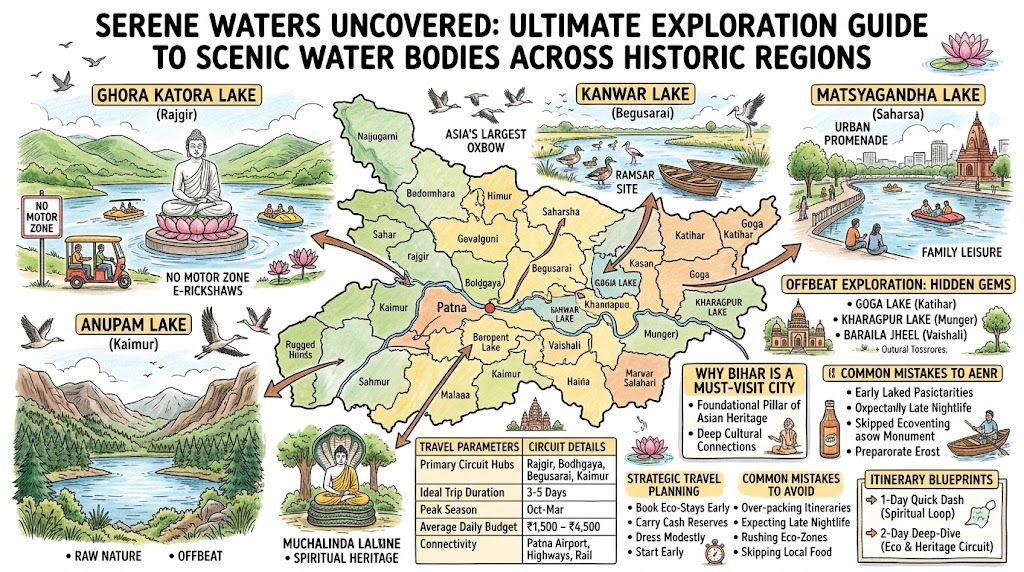
Introduction
When travelers dream of escaping urban chaos, popular hill stations and commercialized coastal towns often top the list. Yet, these crowded spots frequently offer long traffic jams instead of peaceful solitude.
Bihar presents a refreshing alternative for mindful travelers seeking quiet water reflections and deep cultural connections. Untouched by aggressive commercialization, the state’s serene lakes offer tranquil evenings framed by ancient history, rolling green hills, and vibrant bird sanctuaries.
Why Bihar is a must-visit city
Bihar is not merely a geographic location on India’s map; it is a foundational pillar of Asian heritage, spirituality, and ancient statecraft. From hosting Asia’s largest oxbow lake to sacred water reservoirs nestled among ancient hills, the region offers an extraordinary natural canvas. Modern expressways, smooth rail networks, and enhanced regional airport connectivity now make these serene waters accessible to backpackers, families, and road-trippers alike.
Navigating Bihar’s water circuit provides a unique blend of eco-tourism, spiritual reflection, and rural exploration. The northern plains feature sprawling wetlands fed by Himalayan tributaries, while the southern plateau boasts emerald lakes encircled by rocky outcrops.
| Travel Parameter | Circuit Summary & Details |
| Primary Circuit Hubs | Rajgir, Bodhgaya, Begusarai, Kaimur, and Saharsa |
| Ideal Trip Duration | 3 to 5 Days for a relaxed lake-side getaway |
| Peak Season | October to March (mild weather and migratory birds) |
| Average Daily Budget | ₹1,500 – ₹4,500 per person (Budget to Mid-range) |
| Connectivity | Connected via Patna Airport and major ECR/National Highways |
Best Places or Experiences
Ghora Katora Lake (Rajgir)
Nestled inside a horse-shoe-shaped valley of five hills, Ghora Katora Lake is an eco-conscious paradise. Local folklore suggests that ancient royal horses once quenched their thirst at this pristine natural basin. A massive white marble Buddha statue seated atop a lotus pedestal sits peacefully in the center of the lake.
The entire perimeter is designated as a motor-free eco-zone, preserving silence and air quality. Visiting during golden hour allows you to witness the sun dipping behind the Rajgir hills as light bounces off the lake’s smooth surface.
- Location: Rajgir, Nalanda district (approx. 100 km from Patna capital hub).
- Why it is worth visiting: Pristine horse-shoe valley lake featuring a majestic central Buddha statue in a zero-emission zone.
- Best things to do: Enjoy pedal boating near the Buddha statue, ride an electric rickshaw through forest tracks, and photograph sunset reflections.
- Best time to visit: November to February; late afternoon (3:30 PM to 5:30 PM) for sunset.
- Ideal for whom: Couples seeking peaceful evenings, nature photographers, and family vacationers.
- Travel tip: Private petrol/diesel vehicles are strictly stopped 5 km away; hire an eco-friendly e-rickshaw or horse cart to reach the shore.
Kanwar Lake (Begusarai)
Kanwar Lake (Kawar Taal) is Asia’s largest freshwater oxbow lake and Bihar’s first designated Ramsar Site. Formed by the historic meandering of the Gandak River, this vast wetland ecosystem acts as a vital haven for biodiversity.
During winter, over 60 species of migratory birds from Central Asia and Siberia make Kanwar Lake their temporary home. Rowing gently through its lily-carpeted waters as thousands of birds take flight offers an unforgettable wilderness experience.
- Location: Manjhaul village, Begusarai district (approx. 125 km from Patna).
- Why it is worth visiting: Asia’s largest oxbow lake and a Ramsar site teeming with rare winter avian visitors.
- Best things to do: Take guided wooden boat tours for birdwatching, explore local fishing hamlets, and take sunrise landscape photos.
- Best time to visit: November to January for migratory bird season; early morning (6:00 AM to 9:00 AM).
- Ideal for whom: Ornithologists, wildlife enthusiasts, and solo eco-travelers.
- Travel tip: Rent a wooden boat through local fishermen at Manjhaul village early in the morning for authentic bird-sighting routes.
Muchalinda Lake (Bodhgaya)
Located within the sacred Mahabodhi Temple complex precinct, Muchalinda Lake carries profound spiritual history. Legend states that during the sixth week after Gautama Buddha attained enlightenment, a storm hit the area. The Serpent King Muchalinda emerged from the lake depths to protect Buddha from the elements with his hood.
The lake’s calm emerald waters feature a statue illustrating Muchalinda sheltering the Buddha. Surrounded by manicured lawns and ancient trees, it offers a serene spot for evening meditation.
- Location: Bodhgaya, Gaya district (approx. 115 km south of Patna).
- Why it is worth visiting: A sacred Buddhist heritage site with deep spiritual roots and peaceful surroundings.
- Best things to do: Meditate along the stone banks, feed the sacred lake fish, and take evening walks around Mahabodhi Temple.
- Best time to visit: October to March; 4:00 PM to 6:30 PM to experience evening prayers.
- Ideal for whom: Spiritual seekers, solitude hunters, and heritage travelers.
- Travel tip: Respect temple silence rules and keep electronic devices switched off or on silent while near the meditation zones.
Anupam Lake (Kaimur)
Tucked away near the Kaimur Wildlife Sanctuary, Anupam Lake is a hidden natural jewel. Framed by dense forest canopies and rugged hills, its mirror-like waters offer pristine reflections of the surrounding landscape.
Because it remains off the typical commercial tourist trail, Anupam Lake offers complete tranquility. The sounds of rustling leaves, water ripples, and distant bird calls create an ideal atmosphere for evening relaxation.
- Location: Kaimur district (approx. 190 km southwest of Patna).
- Why it is worth visiting: Raw, untouched natural beauty tucked against forested hills and wilderness zones.
- Best things to do: Enjoy scenic lakeshore picnics, take forest landscape photos, and spot resident woodland birds.
- Best time to visit: October to February; mid-afternoon to sunset.
- Ideal for whom: Offbeat adventurers, road-trippers, and landscape photographers.
- Travel tip: Pack your own water and snacks, as commercial stalls around the lake perimeter are minimal.
Matsyagandha Lake (Saharsa)
Created as a civic water reservoir and urban oasis, Matsyagandha Lake has blossomed into Saharsa’s favorite leisure spot. The lake features a famous Lord Shiva temple (Rakta Kali Complex nearby) and manicured green pathways along its banks.
In the evening, soft lighting along the promenade makes it a popular destination for families and locals. The calm waters reflect the sky’s changing colors as sunset transitions into dusk.
- Location: Sattar Kataiya block, Saharsa district (approx. 220 km northeast of Patna).
- Why it is worth visiting: A pleasant urban lake offering serene walkways, boating facilities, and cultural charm.
- Best things to do: Go pedal boating, stroll along the promenade at sunset, and visit nearby regional temples.
- Best time to visit: October to March; 4:30 PM to 7:00 PM.
- Ideal for whom: Families, local wanderers, and casual evening strollers.
- Travel tip: Visit on weekdays to avoid weekend crowds and enjoy quiet pedal-boating sessions.
Offbeat Exploration: Hidden Gems Tourists Miss
Goga Lake (Katihar)
Goga Lake (Ghogha Chap) spreads across nearly 5 square kilometers in Katihar district. During the monsoons, it swells by merging with nearby water bodies to create a vast, sea-like expanse. It remains a peaceful sanctuary where rare aquatic species and migratory waterfowl gather, far away from urban crowds.
Kharagpur Lake (Munger Boundary)
Nestled near the hills between Munger and Jamui districts, Kharagpur Lake was originally formed by a historic dam built by the Maharaja of Darbhanga. Enclosed by forest-covered peaks, its deep blue waters offer spectacular views and quiet fishing spots during late afternoons.
Baraila Jheel (Vaishali)
Baraila Lake is a freshwater wetland sanctuary located in Vaishali district. Rich in aquatic biodiversity, this peaceful body of water attracts waterbirds while remaining blissfully quiet, making it an ideal escape for bird lovers and solitude seekers.
Detailed Practical Guidance for Travelers
| Destination | Standard Entry Fee | General Timings | Best Local Food Options Nearby | Recommended Nearby Attractions |
| Ghora Katora Lake | ₹20 per person (E-rickshaw extra) | 6:00 AM – 5:00 PM | Khaja sweets, Litti Chokha stalls | Vishwa Shanti Stupa, Gridhakuta Hill |
| Kanwar Lake | Free entry (Boat hire ₹200–₹400) | 6:00 AM – 6:00 PM | Fish curry with rice, Sattu drink | Naulakha Temple Begusarai |
| Muchalinda Lake | Free (Part of Mahabodhi Temple) | 5:00 AM – 9:00 PM | Monastic tea cafes, Tilkut sweets | Mahabodhi Temple, Great Buddha Statue |
| Anupam Lake | Free entry | 7:00 AM – 5:00 PM | Local roadside Dhaba Thalis | Telhar Kund Waterfall, Kaimur Fort |
| Matsyagandha Lake | Free entry (Boating fee extra) | 6:00 AM – 7:30 PM | Makhana snacks, Chana Ghugni | Matsyagandha Temple Complex |
Logistics & On-Ground Navigation
Local Transport Options
- Railways: Patna Junction, Gaya Junction, Rajgir, and Begusarai connect seamlessly via express trains to major Indian metros.
- E-Rickshaws & Auto-Rickshaws: Excellent for short-distance commutes in Rajgir, Bodhgaya, and Saharsa. E-rickshaws dominate eco-sensitive zones.
- Car Rentals: Hiring a private cab from Patna or Gaya offers maximum flexibility for visiting remote spots like Kaimur or Kanwar Lake.
Budget Planning
- Backpacker Tier (₹1,200 – ₹1,800/day): Stay in homestays or budget lodges, use public buses and shared auto-rickshaws, and dine at local eateries.
- Comfort Tier (₹3,500 – ₹6,000/day): Stay in mid-range boutique hotels, hire private AC sedan rentals, and enjoy full boat charters.
Safety and Inclusivity Tips
- Family Safety: Lake promenades at Ghora Katora and Bodhgaya are child-friendly with dedicated paved walking paths.
- Couple Privacy: Stick to well-monitored tourist zones; avoid isolated lakeside forest stretches after dark.
- General Safety: Wear life jackets during boating, carry flashlights for sunset walks, and keep digital copies of valid IDs.
Strategic Travel Planning Guardrails
Travel Planning Tips for Bihar
- Book Eco-Stays Early: Accommodation in Rajgir and Bodhgaya fills up quickly during the peak winter season (November to February).
- Carry Cash Reserves: Rural areas around Kanwar Lake and Kaimur have limited UPI connectivity; keep small cash bills handy.
- Dress Modestly: Respect local traditions when visiting lakes connected to temples or sacred sites.
- Layer Your Clothing: Winter evenings near water bodies can get surprisingly chilly; pack light jackets or shawls.
- Start Early: Visit bird sanctuaries like Kanwar Lake at dawn, when avian activity peaks.
Common Mistakes to Avoid
- Over-packing Itineraries: Trying to visit Kaimur (South-West) and Begusarai (North-Central) on the same day causes travel fatigue.
- Expecting Late Nightlife: Rural lakeside areas quiet down early; plan to conclude evening visits by 7:30 PM.
- Rushing Eco-Zones: Avoid using loud horns or playing music near bird sanctuaries and protected lake habitats.
- Skipping Local Food: Missing out on regional specialties like Litti Chokha, Makhana Kheer, or fresh Khaja deprives you of local flavor.
- Ignoring Local Guides: Skipping local boatmen means missing out on expert insights into bird nesting spots and regional folklore.
Suggested Itinerary Blueprints
1-Day Quick Dash (The Spiritual Heritage Loop)
- Target Audience: Fast-paced travelers based in Patna or Gaya.
- Route: Morning start at Muchalinda Lake (Bodhgaya) -> Afternoon drive to Rajgir -> Sunset pedal boating at Ghora Katora Lake -> Return by evening.
2-Day Deep-Dive (Eco-Nature & Heritage Circuit)
- Day 1: Arrive in Rajgir -> Explore Ghora Katora Lake eco-reserve -> Sunset at Venu Van pond -> Night stay in Rajgir.
- Day 2: Early drive to Begusarai -> Morning boat safari across Kanwar Lake Ramsar Site -> Return journey.
Complete Weekend Travel Plan (Wild Lakes & Waterfalls Loop)
- Friday: Reach Gaya/Bodhgaya -> Check-in -> Evening walk around Muchalinda Lake.
- Saturday: Road trip to Kaimur -> Afternoon visit to Anupam Lake -> Sunset view over Telhar Kund.
- Sunday: Morning eco-walk -> Local market shopping for handloom & crafts -> Departure.
Common Tourist Mistakes to Avoid
- Geographic Blunders: Combining northern wetland circuits (Begusarai, Katihar) with southern hill circuits (Kaimur, Bodhgaya) on a tight single-day itinerary.
- Commercial Traps: Spending precious evening hours in modern shopping centers instead of relaxing along natural lake shores.
- Neglecting Alternative Zones: Sticking strictly to main temple sites while skipping quiet eco-parks and lakeside walking paths nearby.
- Transport Overpayment: Failing to negotiate fixed rates with auto-rickshaws or omitting ride-hailing apps in major hubs.
- Luxury Dining Bias: Preferring hotel buffets over authentic street food vendors selling fresh Sattu Sharbat and local sweets.
Frequently Asked Questions
1. Which is the largest natural lake destination in Bihar for travel?
Kanwar Lake in Begusarai district is Asia’s largest freshwater oxbow lake and a premier wetland sanctuary.
2. Is boating allowed at Ghora Katora Lake in Rajgir?
Yes, pedal boating is widely popular at Ghora Katora Lake, allowing visitors to circle the iconic central Buddha statue safely.
3. What is the best season to spot migratory birds at Bihar lakes?
The winter months from November to February offer prime birdwatching opportunities, especially at Kanwar Lake and Goga Lake.
4. Are motor vehicles allowed inside the Ghora Katora Lake area?
No, motor vehicles are restricted 5 km before the lake to protect the environment. Visitors must walk, ride bicycles, or take electric rickshaws.
5. How far is Muchalinda Lake from the main Mahabodhi Temple?
Muchalinda Lake is located inside the Mahabodhi Temple complex in Bodhgaya, just a short walk from the main stupa.
6. Are these lake destinations safe for female solo travelers?
Yes, popular lake destinations like Rajgir and Bodhgaya are well-patrolled and safe, provided standard safety precautions are taken.
7. Can we find luxury accommodations near these lakes?
Bodhgaya and Rajgir offer 4-star hotels and heritage resorts, while spots like Kanwar Lake offer comfortable eco-lodges and guest houses.
8. What is the entry fee for visiting Kanwar Bird Sanctuary Lake?
Entry to the general wetland area is free, though hiring private wooden boats from local guides incurs a nominal fee.
9. Are there food stalls near Anupam Lake in Kaimur?
Food stalls directly along Anupam Lake are limited, so visitors should carry light snacks and water from nearby towns.
10. How do I travel from Patna to Ghora Katora Lake?
You can take a 2.5-hour drive via the Bakhtiyarpur-Rajgir Expressway or hop on a direct passenger train from Patna Junction to Rajgir.
11. Is photography permitted near Muchalinda Lake?
Yes, photography is permitted, though visitors must purchase a camera ticket at the main Mahabodhi Temple entrance gate.
12. What makes Matsyagandha Lake in Saharsa unique?
Matsyagandha Lake is an urban water body featuring a temple complex, landscaped gardens, and calm evening boating options.
Conclusion
Trading crowded commercial hill stations for Bihar’s peaceful lakes reveals a world of calm reflections, historic landscapes, and rich regional heritage. Whether you are floating past the central Buddha statue at Ghora Katora or watching migratory birds over Kanwar Lake, these water bodies offer genuine rejuvenation. Step off the beaten path, embrace the slow travel movement, and let Bihar’s quiet waters redefine your idea of a peaceful evening.
