Introduction
While overcrowded hill stations and commercialized resort corridors funnel travelers into predictable, bumper-to-bumper tourist traps, Bihar welcomes the mindful explorer with profound historical weight and raw authenticity. This is a land where ancient monastic ruins rise quietly above rural plains and vibrant spiritual traditions unfold at their own unhurried tempo.
Traveling here without a private vehicle is not a compromise—it is the definitive way to connect with the state’s living pulse. Relying on passenger rail networks, shared tempos, and battery-powered e-rickshaws strips away tourist insulation, letting you experience storied landscapes from ground level.
Why Bihar is a must-visit city
Bihar is an essential chapter in the world’s spiritual and intellectual history, serving as the cradle where both Buddhism and Jainism flourished and where India’s first great empires took root. The modern state balances this timeless legacy with exceptional public transport infrastructure, making private vehicular hire completely optional for independent travelers.
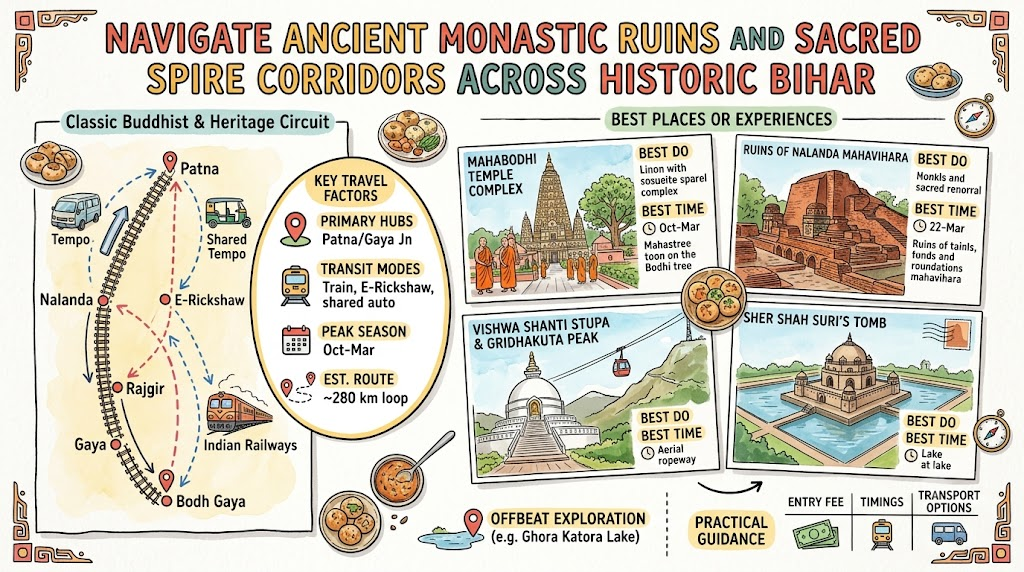
Broad-gauge Indian Railways lines, rapid intercity MEMU shuttles, state transport buses, and a pervasive web of cheap e-rickshaws seamlessly knit together the primary heritage zones. The classic Buddhist and Heritage Circuit—anchored by Patna, Nalanda, Rajgir, Gaya, and Bodh Gaya—offers unmatched ease of access directly from railway station platforms.
| Key Travel Factor | Indicator Details |
|---|---|
| Primary Transit Hubs | Patna Junction, Gaya Junction, Rajgir Railway Station |
| Transit Modes | Indian Railways Express & Passenger Trains, E-Rickshaws, Shared Autos |
| Peak Visiting Season | October to March (Crisp mornings, pleasant daytime temperatures) |
| Circuit Geography | South-Central Magadh Heritage Plains & Gangetic Basin |
| Estimated Route Length | ~280 km loop easily broken into modular day-hops by train |
Mahabodhi Temple spires in Bodh Gaya.
Best Places or Experiences
1. Mahabodhi Temple Complex, Bodh Gaya
The Mahabodhi Temple marks the very ground where Siddhartha Gautama attained enlightenment beneath the sacred Bodhi Tree over 2,500 years ago. The central grand spire towers 55 meters above manicured stone plazas, showcasing intricate Gupta-era brickwork and delicate stone carvings preserved across millennia. Monks draped in saffron, crimson, and golden silk chant in rhythmic waves as incense floats past ancient votive stupas.
Arriving on foot through the temple gates at dawn offers a tranquil atmosphere devoid of automotive noise. The surrounding village is dense and walkable, filled with international monasteries built in classic Burmese, Thai, Bhutanese, and Japanese architectural styles that can all be explored by pedal or battery rickshaw.
- Location: Bodh Gaya, Gaya District; 16 km south of Gaya Junction railway station.
- Why it is worth visiting: A UNESCO World Heritage Site preserving the epicenter of world Buddhist philosophy.
- Best things to do: Sit quietly in meditation beside the diamond throne (Vajrasana), photograph ancient carved stone balustrades during morning light, and explore the nearby Thai and Bhutanese monasteries.
- Best time to visit: November to February; visit between 5:30 AM and 7:00 AM to witness evocative morning monastic chanting.
- Ideal for whom: Spiritual seekers, solo backpackers, architectural scholars, and culture enthusiasts.
- Travel tip: Mobile phones are completely prohibited inside the inner complex; deposit them at the secure counter or bring a standalone camera with an official entry permit.
2. Ruins of Nalanda Mahavihara
Nalanda was the ancient world’s premier residential university, hosting over 10,000 scholars and 2,000 teachers from across Asia between the 5th and 12th centuries CE. Walking along the red-brick monastic corridors reveals ancient dormitory cells, meditation chambers, communal wells, and tiered lecture auditoriums.
The towering monumental mass of Temple Site No. 3 rises majestically above the excavated foundations, flanked by votive stupas adorned with stucco imagery of the Buddha. Because the entire excavation zone is strictly pedestrianized, travelers can absorb the site’s immense architectural scale on foot without traffic fumes.
- Location: Nalanda District; 12 km north of Rajgir town and directly accessible from Nalanda Railway Station.
- Why it is worth visiting: The world’s earliest residential learning center, designated as a UNESCO World Heritage marvel.
- Best things to do: Examine the stucco panels on Temple No. 3, walk down the main monastic avenue, and view recovered stone sculptures in the adjacent ASI Archaeological Museum.
- Best time to visit: October to March; early morning hours (9:00 AM to 11:00 AM) ensure comfortable walking across open brick courtyards.
- Ideal for whom: History lovers, archaeology enthusiasts, students, and walking tour travelers.
- Travel tip: Hire an authorized ASI guide at the entry gate to bring the floor layouts, drainage systems, and historical stratigraphy to life.
Monastic brick ruins of ancient Nalanda.
3. Vishwa Shanti Stupa & Gridhakuta Peak, Rajgir
Perched high atop Ratnagiri Hill, the stark white Vishwa Shanti Stupa (Peace Pagoda) shines against the lush, rocky ridges of the Rajgir valley. Built through Indo-Japanese collaboration, the massive dome features gilded statues depicting the four key stages of Buddha’s life. Nearby sits Gridhakuta, or Vulture’s Peak, where the Buddha delivered fundamental discourses including the Heart Sutra.
The ascent is made easy by a single-chair passenger aerial ropeway that glides silently above the green canopy, delivering panoramic views without needing a mountain road drive. The subsequent stone trail along the ridge allows for a scenic, breezy hike down to the valley floor.
- Location: Rajgir, Nalanda District; 4 km from Rajgir Railway Station.
- Why it is worth visiting: High-altitude panoramic valley views paired with a peaceful monument honoring non-violence.
- Best things to do: Ride the historic single-chair aerial ropeway to the hilltop, walk the stone trail out to Vulture’s Peak, and listen to the rhythmic taiko drum chanting in the Japanese temple.
- Best time to visit: October to February; late afternoon (3:00 PM to 5:00 PM) offers soft sunset lighting across the valley ridges.
- Ideal for whom: Scenic landscape photographers, pilgrims, hikers, and independent wanderers.
- Travel tip: Take the chairlift up to avoid the steep midday stair climb, then hike the gentle stone stairway back down to enjoy the scenery at your own pace.
Vishwa Shanti Stupa atop Ratnagiri Hill.
4. Sher Shah Suri’s Tomb, Sasaram
Rising dramatically from the center of a square artificial lake, the mausoleum of Afghan emperor Sher Shah Suri is a triumph of Indo-Islamic engineering. The massive 122-foot red sandstone dome rests on an octagonal stepped plinth, approached via a wide stone causeway that spans calm, reflective waters.
The site feels quiet and untouched compared to northern Mughal monuments, allowing visitors to appreciate its scale without bustling crowds. A brief walk or rickshaw ride through Sasaram town brings you to this floating fortress of stone, which served as a prototype for later Mughal imperial tombs.
- Location: Sasaram, Rohtas District; 2.5 km from Sasaram Junction on the Grand Chord railway line.
- Why it is worth visiting: An architectural marvel of medieval engineering featuring a massive dome floating on a serene lake.
- Best things to do: Walk the full perimeter path around the lake for water reflection photography, inspect the stone jali windows, and observe the interior acoustics under the main dome.
- Best time to visit: November to February; early morning (7:00 AM to 9:00 AM) provides glassy water surfaces for mirror reflections.
- Ideal for whom: Architecture purists, fine-art photographers, and solo train explorers.
- Travel tip: Board any early-morning express train from Gaya Junction to Sasaram; you can easily tour the tomb and catch an onward train by midday.
Floating tomb of Sher Shah Suri in Sasaram
5. Bihar Museum & Patna Riverfront Ghats
The capital city of Patna serves as the modern gateway to Bihar, where contemporary cultural spaces meet the timeless banks of the Ganges. The Bihar Museum is a world-class architectural space designed by Maki and Associates, featuring corten-steel walls, tranquil courtyards, and curated galleries showcasing treasures like the 3rd-century BCE Didarganj Yakshi.
MakeMyTrip
After exploring the museum galleries, hop on a shared auto or e-rickshaw to the historic river ghats along the Ganges. Walking the wide promenades at Gandhi Ghat or Kali Ghat connects you directly with boatmen, evening aarti ceremonies, and cooling river breezes.
- Location: Bailey Road and Ashok Rajpath, Patna; within 3 to 6 km of Patna Junction railway station.
- Why it is worth visiting: World-class modern exhibition curation contrasted with ancient living riverfront cultural traditions.
- Best things to do: Marvel at the Didarganj Yakshi in the Bihar Museum, take a sunset boat ride along the Ganges, and watch the evening river Ganga Aarti at Gandhi Ghat.
- Best time to visit: Year-round; allocate museum visits from 10:30 AM to 2:00 PM, heading to the river ghats by 5:00 PM.
- Ideal for whom: Art buffs, urban explorers, families, and street photographers.
- Travel tip: The Bihar Museum is closed on Mondays; budget a minimum of three hours to properly appreciate the historic galleries. MakeMyTrip
Offbeat Exploration: Hidden Gems Tourists Miss
Ghora Katora Lake, Rajgir
Tucked inside an eco-reserve encircled by three steep hills, Ghora Katora is an ecologically protected natural lake that strictly bans all combustion motor vehicles. Travelers arrive exclusively via rented bicycles, horse carriages (tongas), or electric rickshaws through a peaceful forest trail. In the center of the lake stands a pink sandstone statue of the Buddha rising out of the water, creating a quiet retreat for contemplation and birdwatching.
Dungeshwari (Mahakala) Caves, Gaya
Located roughly 12 km northeast of Bodh Gaya, these quiet rock-cut caves sit atop a rugged hill where Gautama practiced rigorous asceticism for six years prior to reaching Bodh Gaya. Shared autos take you to the base of the hill, from where a winding stone path leads past Tibetan prayer flags to small shrines housing an emaciated golden image of the Buddha. The viewpoint over the Phalgu river plains offers an expansive, peaceful panorama.
Barabar Caves, Makhdumpur (Jehanabad)
Dating back to the Mauryan Empire under Emperor Ashoka, the Barabar Caves are the oldest surviving rock-cut chambers in India. Carved directly out of massive solid granite outcrops, the interiors feature a mirror-like high polish (Mauryan polish) that creates incredible acoustic reverberation. Accessible via a short passenger train ride from Gaya to Bela or Makhdumpur station followed by a shared auto, this site is a true pilgrimage for archaeology enthusiasts.
Detailed Practical Guidance for Travelers
| Destination | Standard Entry Fee | General Timings | Best Local Food Options Nearby | Recommended Nearby Attractions |
|---|---|---|---|---|
| Mahabodhi Temple | Free (Camera pass: ₹100) | 5:00 AM – 9:00 PM | Tibetan Butter Tea, Thukpa at Root Institute Cafe | Great Buddha Statue, Sujata Kuti |
| Nalanda Ruins | ₹20 – ₹40 (Indian), ₹500 – ₹600 (Foreign) | 9:00 AM – 5:00 PM | Local Silao Khaja, Sattu Paratha at roadside dhabas | Nalanda ASI Museum, Xuanzang Memorial |
| Vishwa Shanti Stupa | Free (Ropeway: ~₹100) | 6:00 AM – 6:00 PM | Fresh roasted corn, sweet sugarcane juice | Vulture’s Peak, Bimbisara Jail, Hot Springs |
| Sher Shah Suri Tomb | ₹25 (Digital ₹20; Foreign ₹300) | 10:00 AM – 5:00 PM | Sattu Kachori, Rohtas Chhena Sweets | Hasan Shah Suri Tomb, Rohtasgarh Fort |
| Bihar Museum | ₹100 (Adult), ₹500 (Foreign) | 10:30 AM – 5:00 PM (Closed Mondays) | Museum Cafe Thali, Maurya Lok Litti Chokha | Patna Museum, Golghar, Gandhi Sangrahalaya |
Logistics & On-Ground Navigation
Local Transport Options
- Indian Railways Network: The backbone of car-free travel across Bihar. Express and local MEMU trains frequently link Patna Junction, Bakhtiyarpur, Bihar Sharif, Rajgir, Gaya Junction, and Sasaram with tickets starting under ₹50.
- Battery E-Rickshaws (Totos): The quiet heroes of short-distance connectivity. Available in abundance right outside every railway station, charging just ₹10 to ₹20 for shared hops across heritage towns.
- Shared Auto-Rickshaws (Tempos): The best option for bridging inter-town gaps, such as Gaya Junction to Bodh Gaya (16 km) or Rajgir town to Nalanda ruins (12 km), for ₹20 to ₹40 per seat.
- BSRTC State Buses: Modern, air-conditioned electric and ordinary buses operate frequent departures connecting Patna with Rajgir, Nalanda, and Gaya at very budget-friendly rates.
Budget Planning
- Backpacker / Budget Tier: ₹900 – ₹1,500 per day. Covers clean railway retiring rooms or monastery guesthouses, shared public transit, local street food, and monument entry tickets.
- Mid-Range / Comfort Tier: ₹2,800 – ₹4,500 per day. Covers comfortable boutique hotels or private rooms, reserved auto-rickshaws for full-day touring, museum passes, and sit-down dining.
Safety and Inclusivity Tips
- For Families: Stick to well-lit railway stations and opt for direct express trains during daytime hours; reserve entire e-rickshaws for hassle-free family transfers.
- For Couples: Town centers like Bodh Gaya and Rajgir are accustomed to international visitors and offer peaceful, welcoming settings. Dress modestly when visiting functioning monasteries.
- General Safety: Keep small cash denominations ready for transport, avoid walking unlit rural trails after 8:30 PM, and double-check return train schedules before heading out on day trips.
Strategic Travel Planning Guardrails
Travel Planning Tips for Bihar
- Time Your Visit for the Winter Window: Plan your trip between late October and early March to enjoy mild sun and cool walking weather.
- Embrace Train Apps for Live Tracking: Use apps like NTES or Where Is My Train to track real-time rail movements and platform numbers easily.
- Carry Small Cash Denominations: While QR-code UPI payments work in shops, shared tempo and e-rickshaw drivers strongly prefer ₹10, ₹20, and ₹50 notes.
- Respect Monastery Etiquette: Always remove footwear before entering temple halls, walk clockwise (pradakshina) around stupas, and ask permission before photographing monks.
- Pack a Light Shawl and Slip-On Shoes: You will frequently take off footwear at temples; slip-ons save time, while a light shawl protects against morning chill and sun.
Common Mistakes to Avoid
- Overpacking the Itinerary: Trying to see Patna, Nalanda, Rajgir, Gaya, and Sasaram in a two-day trip leads to exhaustion; pace your journey thoughtfully.
- Relying Exclusively on Private Cabs: Assuming you must hire an expensive tourist car causes you to miss the fun, affordable camaraderie of local train travel.
- Arriving Late at Monasteries: Many international monasteries in Bodh Gaya close their gates between 12:00 PM and 2:00 PM for lunch; plan your walks around these hours.
- Skipping Regional Cuisine: Eating generic fast food instead of authentic local street specialties robs you of true Bihari hospitality.
- Neglecting Evening Station Connectivity: Rural branch line trains taper off past 8:00 PM; always secure your return ride to your base hub before sunset.
Suggested Itinerary Blueprints
1. Day Quick Dash (The Nalanda & Rajgir Heritage Express)
Ideal for travelers short on time who want to experience ancient universities and sacred hills via public rail.
- 07:00 AM – 09:30 AM: Board the morning express or passenger train from Patna Junction directly to Rajgir.
- 09:45 AM – 01:00 PM: Take a ₹20 shared e-rickshaw to Ratnagiri Hill, ride the aerial chairlift to Vishwa Shanti Stupa, and visit Gridhakuta Peak.
- 01:00 PM – 02:30 PM: Enjoy a traditional lunch featuring authentic Silao Khaja and hot Sattu Parathas in Rajgir market.
- 02:30 PM – 05:00 PM: Hop on a northbound shared auto to the Nalanda Ruins (12 km) for a 2-hour walking tour of the ancient university. Patna Tourism
- 05:30 PM – 08:30 PM: Board the evening return train from Nalanda or Rajgir Station back to Patna Junction.
2. Day Deep-Dive (Bodh Gaya & Gaya Spiritual Immersion)
A rewarding 2-day exploration of Buddhist spirituality and ancient river heritage using trains and local tempos.
- Day 1: Arrive at Gaya Junction by morning train; hop on an easy shared tempo (₹30) directly to Bodh Gaya town. Spend the afternoon meditating at the Mahabodhi Temple, circumambulating the Bodhi Tree, and visiting the Great Buddha Statue. Spend the evening exploring the Bhutanese and Thai temples before sampling Tibetan thukpa.
- Day 2: Take a morning e-rickshaw across the river plains to the Dungeshwari Cave Temples for sweeping rural views. Return to Bodh Gaya to tour the archaeological museum and the Japanese Nippon Temple. Head back to Gaya Junction by late afternoon for onward rail connections.
3. Complete Weekend Travel Plan (The Grand Magadh Rail Loop)
A full 3-day circular car-free journey through Bihar’s most iconic historical sites.
- Friday: Arrive in Patna; spend the morning taking an e-rickshaw to the Bihar Museum, followed by an afternoon stroll along the riverfront at Gandhi Ghat.
- Saturday: Board an early train to Rajgir; explore Vishwa Shanti Stupa, take a carriage ride to eco-friendly Ghora Katora Lake, and spend the afternoon wandering the ruins of Nalanda. Take an evening shared tempo across to Gaya for an overnight stay.
- Sunday: Spend the dawn hours inside the quiet Mahabodhi Temple complex in Bodh Gaya. Board a short midday train from Gaya Junction to Sasaram to view the magnificent floating Tomb of Sher Shah Suri, catching a late evening train back to Patna.
Common Tourist Mistakes to Avoid
Geographic Blunders
Attempting to visit Sher Shah Suri’s Tomb in Sasaram and the ruins of Vikramshila in Bhagalpur on the same day is impossible without burning out. They sit on opposite ends of the state. Group your trip along logical rail corridors: the Patna-Gaya-Rajgir triangle or the Grand Chord rail line.
Commercial Traps
Spending precious sightseeing hours wandering modern shopping malls along Bailey Road in Patna wastes your trip. Instead, take an e-rickshaw down Ashok Rajpath to explore traditional bakeries, antique lanes, and the lively river ghats.
Neglecting Modern/Alternative Zones
Many travelers overlook Patna’s thriving artistic and green spaces in their rush to see ancient ruins. Take time to explore the landscaped courtyards of Buddha Smriti Park right opposite Patna Junction, or browse the handicrafts at the state-run Upendra Maharathi Shilp Anusandhan Sansthan.
Transport Overpayment
Never accept the first price quoted by private taxi touts outside arrival gates claiming public transit is unavailable. Walk directly to the prepaid auto booth or step 50 meters past the station gates to hail a meter auto, e-rickshaw, or app-based ride at standard local rates.
Luxury Dining Bias
Confining your meals to bland, multi-cuisine hotel restaurants cuts you off from authentic regional cuisine. Authentic street food cooked over open flames—like hot Litti Chokha dipped in pure desi ghee, flaky Khaja, or winter-fresh Tilkut—delivers the real flavor of Bihar at a fraction of the cost.
Frequently Asked Questions
1. Is it really easy to travel between Patna, Nalanda, and Bodh Gaya without a car?
Yes, traveling this classic circuit without a car is straightforward and reliable. Frequent express and passenger trains run daily between Patna, Rajgir, and Gaya. Once you step off the train, shared tempos and e-rickshaws wait outside the stations to take you directly to major heritage gates.
2. How do I get from Gaya Railway Station to Bodh Gaya using public transit?
Simply walk outside Gaya Junction to find the dedicated auto-rickshaw stand. Shared tempos run continuously to Bodh Gaya for around ₹30 per seat. Alternatively, you can hire a private battery rickshaw or auto for around ₹200 to ₹250 to take you directly to your hotel.
3. Are battery e-rickshaws available for full-day hiring in heritage towns like Rajgir?
Yes, e-rickshaw drivers in Rajgir and Bodh Gaya are happy to take day charters. You can easily hire an e-rickshaw for ₹600 to ₹900 to cover all major sites, including Ratnagiri Hill, Vulture’s Peak, and local hot springs, saving you from negotiating multiple individual rides.
4. What is the most convenient railway station for visiting Nalanda University ruins?
Nalanda has its own local railway passenger halt connected to Rajgir and Patna. However, Rajgir Junction (12 km away) and Bakhtiyarpur Junction (40 km away on the main mainline) offer far more frequent long-distance express train connections, with easy shared tempo connections right outside.
5. How much does an average budget trip to Bihar cost per day without a car?
A solo budget backpacker can travel comfortably on ₹1,000 to ₹1,500 per day. This budget easily covers comfortable guesthouse or monastery accommodations, regional train fares, shared e-rickshaws, hearty local meals like Litti Chokha, and entry tickets to archaeological sites.
6. Can solo female travelers safely navigate Bihar’s public transit network?
Yes, thousands of solo pilgrims and travelers navigate this popular heritage loop every year. Stick to day-time rail journeys, opt for busy station platforms, dress respectfully when visiting shrines, and base yourself in centrally located, reputable guesthouses in tourist towns like Bodh Gaya.
7. How do I reach the eco-friendly Ghora Katora Lake without personal transport?
Motor vehicles are completely prohibited near the lake. Take a shared tempo or e-rickshaw from Rajgir town to the forest entry checkpoint. From there, you can rent a bicycle, hire an electric cart, or take a traditional horse-drawn tonga down the scenic 6-km forest trail.
8. Are shared autos available for early morning visits to monuments?
In pilgrimage hubs like Bodh Gaya, e-rickshaws and tempos start buzzing well before dawn around 4:30 AM to transport morning worshipers to the Mahabodhi Temple. In smaller towns, simply ask your guesthouse host to arrange a local e-rickshaw the previous evening.
9. Can I visit the tomb of Sher Shah Suri in Sasaram as a day trip by train from Gaya?
Yes, it makes an easy and rewarding day trip. Several express trains connect Gaya Junction to Sasaram Junction along the Grand Chord line in under two hours. The tomb sits just 2.5 km from the station, easily reached by a ₹20 shared rickshaw ride.
10. What is the best way to travel from Patna airport to the main railway station?
BSRTC runs low-floor air-conditioned airport shuttle buses that link Patna Airport with Patna Junction. Alternatively, you can book an app-based cab or take a pre-paid auto from the counter outside the terminal arrivals exit for around ₹150 to ₹250.
11. Do local tempos and rickshaw drivers in Bihar accept digital payments?
While UPI QR codes are increasingly common at small street food stalls and urban stores, internet connectivity can be intermittent in rural pockets. It is always wise to keep plenty of loose cash notes like ₹10, ₹20, and ₹50 for seamless transport payments.
12. Is it possible to explore the Barabar Caves without booking a private vehicle?
Yes, adventurous travelers can take a morning MEMU passenger train from Gaya Junction to Makhdumpur Gaya station. From there, shared tempos run regularly toward the base of the Barabar Hills, where stone steps lead up to the historic rock-cut caves.
Conclusion
Choosing to explore Bihar without a car transforms a typical sightseeing trip into a deeply grounding personal journey. Stripping away the separation of private vehicles lets you experience the land just as travelers, scholars, and pilgrims have for centuries: arriving on foot, listening to the gentle rumble of the rails, and trading warm smiles with locals on shared rides. From the quiet red brick of ancient Nalanda to the peaceful shade of the Bodhi Tree, you will discover that Bihar’s greatest treasures reveal themselves most generously to those who slow down and travel light.
