Introduction
As organizations accelerate their digital transformation journeys, cloud infrastructure adoption has shifted from a competitive advantage to a fundamental operational necessity. However, this massive migration has exposed a critical challenge: rapidly escalating cloud expenditure that frequently outpaces projected budgets. Unlike traditional IT budgeting, which relies on predictable capital expenditures and long-term hardware lifecycles, cloud spending operates on a variable, pay-as-you-go consumption model. This paradigm shift means engineers can deploy expensive infrastructure with a few lines of code, often without immediate visibility into the financial ramifications. To bridge this gap between technology and finance, modern enterprises are turning to FinOps—a cultural and operational discipline that brings financial accountability to the variable spend model of the cloud. By creating a collaborative framework between engineering, finance, and business leadership, FinOps enables organizations to maximize the business value of their cloud investments while empowering technical teams to innovate efficiently. As a result, mastering cloud financial management has become an essential career accelerator for technology professionals seeking to drive strategic impact.
What Is FinOps?
FinOps, short for Cloud Financial Operations, is an evolving cloud financial management discipline and cultural practice that enables organizations to get maximum business value by driving cross-functional accountability. At its core, FinOps is not merely a cost-cutting exercise; rather, it is about making informed financial decisions that align cloud spending with strategic organizational goals. In a mature FinOps culture, cloud usage is tied directly to business metrics, transforming cloud cost from an opaque overhead expense into a clear driver of revenue and innovation. Engineering teams gain real-time visibility into the cost impact of their architectural decisions, enabling them to design cost-efficient systems without sacrificing performance or velocity. Simultaneously, finance professionals transition from reactive invoice auditing to proactive forecasting and unit economics analysis, while procurement teams leverage granular consumption data to negotiate favorable enterprise agreements. Technology leadership oversees this ecosystem by establishing clear governance frameworks and key performance indicators that ensure cross-functional alignment across all cloud operations.
The FinOps Lifecycle
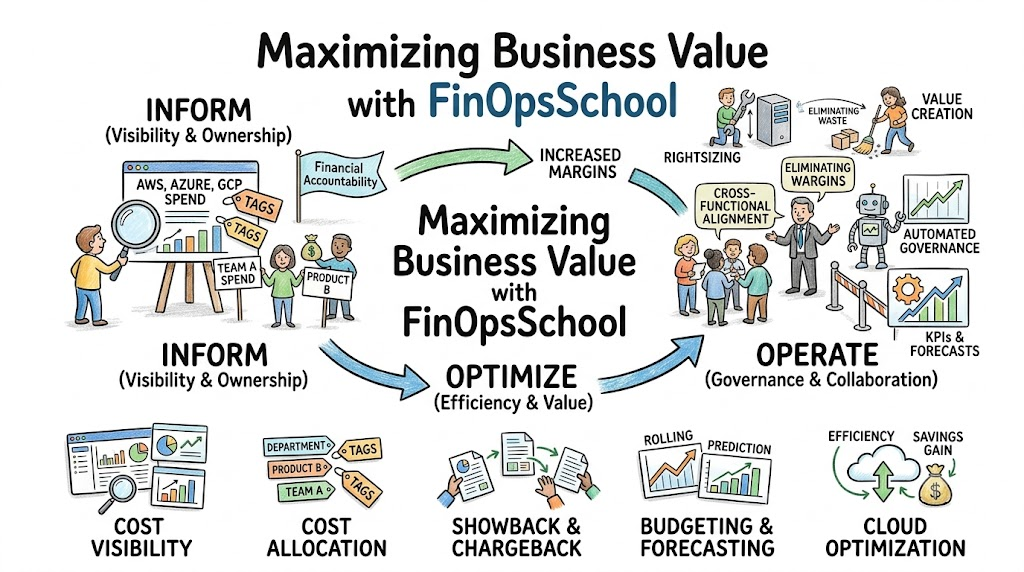
The FinOps discipline operates as a continuous, iterative lifecycle divided into three distinct phases: Inform, Optimize, and Operate. Organizations must continuously cycle through these phases to maintain financial control over dynamic cloud environments.
Inform
The Inform phase forms the foundation of the FinOps lifecycle by providing complete, real-time visibility into cloud expenditure and resource utilization. In this phase, organizations establish robust cost allocation frameworks using metadata, tags, and cloud account structures to map raw billing data directly to business units, applications, and engineering teams. With precise cost allocation in place, teams can establish accurate baselines, construct realistic forecasts, and implement automated anomaly detection systems that flag unexpected spending spikes before they impact monthly budgets. By democratizing cost visibility through tailored dashboards, the Inform phase empowers engineering and product teams to take direct ownership of their cloud consumption and understand the financial implications of their daily architectural choices.
Optimize
Once visibility is established, organizations enter the Optimize phase, which focuses on identifying and executing targeted cost reduction and efficiency strategies. This phase involves analyzing cloud usage telemetry to discover rightsizing opportunities, eliminating idle or orphaned resources, and transitioning static workloads to modern, cost-effective instance families. Technical teams evaluate architectural efficiencies such as container bin-packing, serverless adoption, and storage tiering policies to reduce waste without compromising application performance or availability SLAs. Concurrently, finance and central FinOps teams analyze historical usage patterns to acquire commitment-based discount instruments, such as Reserved Instances and Savings Plans, maximizing financial efficiency across stable baseline workloads.
Operate
The Operate phase converts financial insights and optimization strategies into continuous, embedded organizational processes. In this operational state, organizations enforce governance policies, deploy automated guardrails, and integrate cost management metrics directly into CI/CD pipelines and deployment workflows. Cross-functional teams conduct regular financial reviews to track performance against budgets, evaluate forecast accuracy, and monitor core efficiency metrics like cost per active user or transaction. By embedding financial metrics into daily operational standups and engineering reviews, the Operate phase fosters an enduring culture of financial accountability, ensuring that cloud cost optimization remains a continuous discipline rather than a sporadic, manual cleanup project.
Key FinOps Capabilities
Building a mature FinOps capability requires mastering several interconnected disciplines that bridge technical implementation and financial management.
Cost Visibility
Cost visibility is the cornerstone of effective cloud financial management, transforming complex cloud billing data into actionable business intelligence. Without clear visibility, engineering and finance teams operate in the dark, unable to pinpoint which applications, microservices, or deployment environments are driving cost increases. Modern cost visibility strategies utilize centralized dashboarding solutions that aggregate multi-cloud billing feeds, normalizes usage telemetry, and displays tailored metrics for different stakeholder groups. By providing engineers with near-real-time feedback on infrastructure spend and granting executives high-level views of organizational unit economics, cost visibility enables proactive governance and fosters a data-driven culture of accountability.
Cost Allocation
Cost allocation is the process of attributing cloud infrastructure costs to specific internal entities, such as business units, product teams, departments, or revenue-generating applications. Achieving precise cost allocation relies on establishing consistent metadata frameworks, utilizing tags, labels, account structures, projects, and subscriptions across all cloud platforms. When infrastructure resources are fully tagged, organizations can accurately assign direct costs and systematically divide shared infrastructure costs—such as core networking, security tools, and centralized Kubernetes clusters—among consuming teams. Proper cost allocation eliminates financial ambiguity, enabling business leaders to evaluate the true profitability and return on investment of individual digital products.
Showback and Chargeback
Showback and chargeback are financial governance mechanisms used to hold internal teams accountable for their cloud consumption. Showback acts as an informational tool, regularly providing engineering and business units with detailed reports showing their resource consumption and associated costs without actually transferring funds between internal accounts. Chargeback takes accountability a step further by directly billing internal department budgets for their exact cloud infrastructure usage. While showback builds early awareness and encourages voluntary optimization in developing FinOps cultures, chargeback creates direct financial responsibility, driving mature organizations to treat internal cloud consumption with the same financial rigor as external vendor contracts.
Budgeting and Forecasting
Budgeting and forecasting in dynamic cloud environments demand a fundamental shift from static annual predictions to agile, data-driven financial modeling. Cloud budgets must accommodate continuous software releases, variable user traffic, and evolving architectural footprints. Effective forecasting requires combining historical usage trends with forward-looking business inputs, such as projected user growth, upcoming marketing campaigns, seasonal traffic shifts, and planned product launches. By continually reconciling actual spend against projected baselines and leveraging automated threshold alerts, organizations can identify budget variances early in the billing cycle, allowing technical and financial leadership to make necessary operational adjustments before receiving an unexpected invoice.
What Does FinOps Training Teach?
Comprehensive FinOps training equips professionals with the multidisciplinary knowledge and practical skills required to manage, optimize, and govern cloud financial ecosystems. Learners gain a deep understanding of cloud billing structures, learning how to query, parse, and analyze massive billing datasets across major cloud service providers. Training curricula emphasize practical cost allocation methodologies, metadata enforcement strategies, and advanced forecasting models designed for dynamic IT environments. Participants also master technical optimization techniques—including rightsizing, commitment portfolio management, and Kubernetes cost management—while developing soft skills in stakeholder management, cross-functional communication, and establishing governance guardrails that drive organizational alignment.
Cloud Cost Optimization Strategies
Executing effective cloud cost optimization requires a balanced combination of technical architecture adjustments and strategic financial management across all infrastructure layers.
Rightsizing
Rightsizing is the continuous process of matching cloud resource configurations and performance characteristics to actual workload demand at the lowest possible cost. Engineers analyze historical performance metrics—such as CPU utilization, memory pressure, disk I/O, and network throughput—to identify overprovisioned compute instances and database nodes. By scaling down underutilized resources or transitioning workloads to modern, higher-efficiency instance families (such as ARM-based processors), organizations can achieve immediate cost reductions while maintaining required application performance thresholds and headroom for traffic spikes.
Eliminating Idle Resources
Eliminating idle resources targets completely unused cloud components that silently generate costs without delivering operational value. Common sources of cloud waste include orphaned virtual machine disks, unattached elastic IP addresses, stale storage snapshots, abandoned developer databases, and temporary test environments that were left running after project completion. Implementing automated detection scripts and scheduled shutdown policies for non-production environments ensures that non-essential resources are automatically deprovisioned during off-peak hours, eliminating unnecessary off-hours expenditure across engineering teams.
Storage Optimization
Storage optimization focuses on aligning data lifecycle management policies with actual data access patterns to minimize storage expenditure over time. Cloud providers offer multiple storage tiers ranging from high-performance, high-cost block storage to low-cost deep archive tiers. By implementing automated lifecycle policies, organizations can seamlessly transition infrequently accessed logs, historical backups, and compliance data from premium storage tiers to colder object storage tiers. Furthermore, enforcing aggressive snapshot retention schedules and enabling data compression or deduplication significantly lowers long-term data footprint costs without sacrificing data durability.
Commitment Optimization
Commitment optimization involves leveraging provider-specific discount mechanisms—such as AWS Savings Plans, Azure Reserved Instances, and GCP Committed Use Discounts—to secure lower pricing in exchange for committing to a baseline level of usage over a one- or three-year period. Managing a commitment portfolio requires rigorous analysis of baseline usage trends to balance financial savings against the risk of over-committing to obsolete architecture. FinOps teams utilize data-driven portfolio models to maintain a blended mix of flexible and instance-specific commitments, continuously tracking utilization rates to maximize discount coverage across dynamic enterprise workloads.
FinOps Across AWS, Azure and Google Cloud
Applying FinOps principles across major cloud service providers requires understanding the specific billing structures, native tools, and commitment mechanisms native to each vendor environment.
FinOps Across AWS, Azure and Google Cloud
| FinOps Area | AWS | Microsoft Azure | Google Cloud |
| Cost Analysis | AWS Cost Explorer & CUR | Azure Cost Analysis | GCP Cost Visualization & BigQuery |
| Budgeting | AWS Budgets | Azure Budgets | GCP Budgets & Alerts |
| Cost Allocation | Cost Allocation Tags & AWS Organizations | Resource Tags & Management Groups | Resource Labels & Projects |
| Commitment Options | Savings Plans & Reserved Instances | Azure Reservations & Savings Plans | Committed Use Discounts (CUDs) |
| Optimization | AWS Compute Optimizer | Azure Advisor | GCP Recommender |
FinOps and Kubernetes
Managing cloud costs in containerized environments presents unique challenges due to the abstraction layer Kubernetes introduces between applications and underlying cloud infrastructure. In a traditional virtual machine setup, resource allocation and cost attribution are straightforward; however, Kubernetes clusters pool compute and memory resources, sharing them across multiple microservices, namespaces, and engineering teams. Consequently, standard cloud billing statements only display the aggregate cost of worker nodes, obscuring the specific microservices or business units driving infrastructure spend.
Technical FinOps practices address Kubernetes cost complexity by analyzing container-level resource requests, limits, and real-time utilization. Unoptimized CPU and memory requests often cause cluster autoscalers to provision unnecessary worker nodes, leaving clusters underutilized despite high financial spend. By implementing pod rightsizing, adjusting horizontal and vertical autoscalers, and deploying specialized cost allocation tools, platform engineers can attribute cluster costs accurately to specific namespaces and workloads. Mastering Kubernetes cost efficiency is therefore a critical skill for DevOps and platform engineers seeking to maintain financial visibility across modern cloud-native architectures.
FinOps and Cloud Cost Optimization Are Not the Same Thing
While the terms are frequently used interchangeably, FinOps and cloud cost optimization represent distinct operational concepts within cloud management. Cloud cost optimization is a tactical, often reactive engineering effort aimed at reducing spending by turning off idle resources, rightsizing virtual machines, or purchasing discounted instances. In contrast, FinOps is an overarching, proactive cultural discipline that encompasses financial management, architectural governance, unit economics, organizational strategy, and cross-functional collaboration, driving business value rather than focusing solely on reducing total outlay.
For instance, a pure cost optimization effort might focus exclusively on cutting cloud infrastructure spend by 20% by downgrading database tiers, which could inadvertently degrade customer application performance and reduce revenue. A mature FinOps practice evaluates this trade-off by analyzing unit economics—such as the cost per active transaction—and may intentionally increase cloud spend if that expenditure directly yields proportional customer growth and top-line business profitability.
FinOps Training for Different Professional Roles
Adopting FinOps across an enterprise requires tailored skills and perspectives across distinct organizational functions.
- Cloud and DevOps Engineers: Learn to integrate cost feedback metrics into CI/CD pipelines, optimize infrastructure deployment scripts, and implement automated resource lifecycle management.
- Finance Professionals: Master modern cloud consumption models, variable forecasting techniques, unit economics calculations, and automated cost reconciliation against accounting ledgers.
- Cloud Architects: Gain capabilities in designing cost-efficient, multi-tenant cloud architectures, evaluating long-term financial implications of serverless versus containerized systems, and selecting optimal cloud vendor services.
- Procurement Teams: Develop skills to negotiate enterprise discount agreements, manage multi-provider commitment portfolios, and align vendor contract terms with dynamic engineering consumption needs.
- Managers and Technology Leaders: Acquire strategic oversight capabilities to establish organizational FinOps governance, align engineering velocity with financial targets, and track unit economics across product portfolios.
FinOps Certification vs. Practical Training
Navigating a career path in cloud financial management involves balancing formal industry certification with real-world hands-on expertise.
+-------------------------------------------------------------------+
|                   BALANCING FINOPS LEARNING                       |
+-------------------------------------------------------------------+
|  FINOPS CERTIFICATION             PRACTICAL TRAINING              |
|  - Validates core terminology     - Handles multi-cloud edge cases|
|  - Establishes industry standards - Queries raw billing datasets  |
|  - Demonstrates baseline competency- Implements custom automation |
+-------------------------------------------------------------------+
                                  |
                                  v
+-------------------------------------------------------------------+
|                     HIGH-PERFORMING FINOPS ROLE                   |
|       Blends foundational framework knowledge with executed       |
|            real-world infrastructure cost engineering             |
+-------------------------------------------------------------------+
FinOps certifications provide recognized proof of foundational knowledge, confirming a professional’s understanding of standardized frameworks, core terminology, and cross-functional operational phases. However, theoretical certification alone is insufficient to address complex enterprise cloud environments, which frequently feature messy billing data, unallocated shared resources, and legacy technical debt. Comprehensive professional development must pair certification preparation with practical, project-based training that simulates real-world infrastructure scenarios. Hands-on learning exposes professionals to raw billing data, custom querying languages, tagging remediation tools, and complex multi-cloud architectures. Ultimate career credibility stems from combining formal credentialing with demonstrated practical capabilities in executing actionable cost governance and architectural optimization.
FinOps Practitioner Training
FinOps Practitioner training serves as an essential entry point for professionals seeking foundational knowledge in cloud financial management principles, capabilities, and organizational workflows. This level of training focuses on establishing a baseline understanding of how engineering, finance, and business leadership collaborate within the FinOps lifecycle. Participants learn how to navigate cloud billing dashboards, interpret basic allocation reports, establish budget tracking mechanisms, and support organizational showback initiatives. Designed for business analysts, finance managers, junior cloud engineers, and IT project managers, practitioner training equips individuals with the fundamental skills required to participate effectively in cross-functional cloud cost governance initiatives.
FinOps Engineer Training
FinOps Engineer training delivers a deep technical curriculum designed specifically for hands-on IT professionals, DevOps specialists, platform engineers, and cloud architects. This advanced learning track explores the technical mechanics of cloud billing systems, teaching participants how to programmatically query raw billing datasets using SQL, Cloud Billing APIs, and automated data pipelines. Technical professionals master advanced cost allocation engineering, Infrastructure as Code guardrails, automated tagging enforcement policies, and container cost optimization strategies within Kubernetes ecosystems. By building skills in automated remediation scripts, dynamic dashboard construction, and anomaly detection pipelines, FinOps Engineers gain the capabilities necessary to architect self-healing, cost-aware cloud platforms.
FinOps in Kubernetes and Modern Cloud Environments
As enterprise cloud architectures evolve beyond traditional virtual machines toward complex containerized networks, serverless paradigms, and distributed data platforms, cloud financial management becomes increasingly intricate. In Kubernetes environments, managing compute and memory allocation across multi-tenant clusters requires continuous monitoring of pod requests versus actual consumption metrics. Beyond container management, modern FinOps practices must extend financial control to serverless architectures, managed database services, high-performance data lakes, and AI infrastructure. Uncapped serverless invocations, auto-scaling databases, and intensive GPU-driven AI model training can quickly create significant budget overruns if left unmonitored. Extending FinOps frameworks to cover these modern technology stacks ensures complete financial visibility across advanced digital platforms.
FinOps in Multi-Cloud Environments
Operating infrastructure across multiple cloud service providers introduces significant operational complexity, as AWS, Microsoft Azure, and Google Cloud utilize distinct billing terminology, discount models, and cost management tooling. Establishing an effective multi-cloud FinOps discipline requires aggregating disparate vendor billing feeds into a normalized, central data model to enable consistent cross-provider reporting and cost allocation. While individual cloud providers offer native tools for local optimization, enterprise FinOps teams must implement unified organizational standards for tagging, budgeting, and financial governance that operate seamlessly across all cloud platforms. Heterogeneous cloud management ensures business leaders receive a holistic view of overall enterprise cloud expenditure without sacrificing provider-specific optimization opportunities.
Choosing the Right FinOps Course
Selecting an effective training program requires evaluating educational frameworks against real-world technical demands and organizational objectives.
+-------------------------------------------------------------------+
|                    FINOPS COURSE EVALUATION                       |
+-------------------------------------------------------------------+
|  1. CURRICULUM DEPTH      -> Covers multi-cloud, K8s, & APIs      |
|  2. PRACTICAL LABS        -> Real billing datasets & live scripts |
|  3. ROLE ALIGNMENT        -> Tailored for engineering vs finance  |
|  4. CREDENTIAL VALUE      -> Prepares for industry certifications |
|  5. DELIVERY FLEXIBILITY  -> Instructor-led online or corporate   |
+-------------------------------------------------------------------+
When assessing educational options, professionals should prioritize courses that offer extensive hands-on exercises utilizing realistic cloud billing datasets rather than purely theoretical slide presentations. A robust curriculum should cover multi-cloud environments, container cost management, programmatic API access, automated governance, and practical commitment portfolio management strategies. Additionally, evaluate instructor industry experience, certification alignment, and the availability of interactive learning formats that support continuous skill development for both individual learners and corporate engineering teams.
FinOps Skills Comparison by Career Path
FinOps Skills Comparison by Career Path
| Career Path | Core FinOps Skills | Useful Learning Focus |
| FinOps Practitioner | Lifecycle phases, basic allocation, showback reporting, budget monitoring | FinOps frameworks, stakeholder communication, reporting tools |
| FinOps Engineer | Billing APIs, automated rightsizing, K8s cost allocation, IaC cost guardrails | Programmatic billing analysis, Python/SQL automation, container metrics |
| Finance Professional | Cloud consumption modeling, variable forecasting, unit economics, chargeback | Cloud pricing structures, commitment portfolio financial modeling |
| Cloud Engineer | Resource rightsizing, auto-scaling configuration, idle resource deprovisioning | Performance telemetry analysis, instance family optimization, serverless tuning |
| DevOps Professional | Tagging automation, CI/CD cost guardrails, continuous deployment efficiency | Policy-as-code enforcement, automated infrastructure lifecycle scripts |
| Technology Manager | Budget variance tracking, cross-functional alignment, governance enforcement | Team KPI tracking, organizational change management, forecasting frameworks |
| Procurement Specialist | Enterprise agreement negotiation, discount portfolio coverage, vendor management | Provider commitment terms, volume discount mechanics, enterprise contracts |
| Technology Leader | Cloud unit economics, strategic value alignment, governance frameworks | Executive dashboarding, cloud ROI modeling, organizational culture transformation |
FinOpsSchool: Practical Learning for FinOps Skills
FinOpsSchool provides practical, career-focused learning designed to help technology and finance professionals master cloud cost management across AWS, Microsoft Azure, and Google Cloud environments. The structured programs combine foundational frameworks with hands-on labs covering cloud billing datasets, tagging enforcement, cost allocation models, showback and chargeback workflows, and forecasting techniques. Through specialized tracks including FinOps Practitioner Training, FinOps Engineer Training, and Corporate FinOps Training, learners gain practical experience in execution strategies like resource rightsizing, commitment portfolio management, interactive dashboard creation, and automated anomaly detection. Designed for cloud engineers, DevOps teams, architects, and finance leaders, these courses focus on real-world multi-cloud application, helping teams turn cloud cost data into strategic business value.
Benefits of FinOps Certification Training
Structured certification training provides a guided learning path that systematically builds foundational knowledge across all cloud financial management domains. Pursuing formal certification helps professionals organize their study efforts, fill knowledge gaps in unfamiliar cloud provider ecosystems, and validate their technical and operational skills against established industry standards. Beyond personal skill acquisition, earning an industry-recognized credential enhances professional credibility, signals expertise to enterprise employers, and supports career progression into specialized cloud management roles. When combined with practical hands-on experience, certification equips professionals to drive impactful financial governance within their organizations.
Corporate FinOps Training
Corporate FinOps Training delivers customized, cross-functional learning programs designed to elevate an enterprise’s overall cloud financial maturity. Unlike individual learning courses, corporate programs focus on aligning an organization’s specific engineering, finance, procurement, and leadership teams around shared operational processes and custom technology stacks. These sessions feature interactive workshops using internal cloud billing data, custom tagging policies, and organization-specific architectural patterns. By training cross-functional teams simultaneously, corporate programs bridge organizational silos, establish common terminology, and accelerate the adoption of consistent cloud governance practices across the enterprise.
FinOps Training in India
As India solidifies its position as a global technology innovation hub, the demand for specialized cloud financial management skills among IT professionals has grown significantly. Cloud engineers, DevOps specialists, system architects, and finance teams across Indian tech enterprises and global capability centers are increasingly tasked with managing large-scale multi-cloud spend. Engaging in structured FinOps training enables Indian technology professionals to upskill in cost allocation, cloud analytics, automation, and unit economics, positioning them for high-impact roles in international cloud operations. Building these specialized capabilities allows local organizations and distributed engineering teams to control cloud expenditure while maintaining rapid technical delivery.
Individual Training vs Corporate DevSecOps Training
While individual training programs focus primarily on personal career growth, tool acquisition, and certification preparation, organizational development programs—such as Corporate DevSecOps Training—are engineered to transform business workflows, security postures, and operational governance across entire delivery teams.
Individual learning allows engineers to explore broad concepts at their own pace, building personal competency in tools like Terraform, CloudHealth, or native cloud billing portals. Conversely, corporate-level training tailors its curriculum to an enterprise’s specific CI/CD pipelines, internal security standards, compliance requirements, and cloud deployment patterns. Corporate programs prioritize cross-functional collaboration, establishing standardized governance workflows that ensure cost optimization, security guardrails, and operational efficiency are automatically embedded throughout the software development lifecycle.
Real-Life FinOps Scenario: Reducing Cloud Waste in a Growing Enterprise
To illustrate the practical application of cloud financial management, consider CloudRetail, a rapidly expanding e-commerce enterprise facing escalating multi-cloud expenses.
Step 1: Establish Cost Visibility
CloudRetail initiated its transformation by auditing its existing infrastructure, discovering that over 35% of cloud expenditure was completely unallocated due to inconsistent tagging practices. The engineering team deployed an automated tagging enforcement policy across AWS and Azure accounts, requiring all resources to include valid CostCenter, Environment, and Owner metadata tags. By configuring centralized billing dashboards, leadership gained immediate visibility into infrastructure spend by business application and deployment team.
Step 2: Identify Idle Resources
With baseline visibility established, CloudRetail implemented automated monitoring scripts to scan for idle and orphaned cloud infrastructure. The audit uncovered hundreds of unattached storage volumes, obsolete database snapshots, and unassociated elastic IP addresses left over from retired projects. Additionally, the team deployed scheduled auto-shutdown routines for non-production development and staging environments, automatically stopping non-essential virtual machines outside of business hours and immediately reducing non-production compute costs by 40%.
Step 3: Analyze Rightsizing Opportunities
Next, the cloud engineering team utilized telemetry performance metrics to evaluate compute utilization across production environments. The analysis revealed that over half of the application server virtual machines were operating at less than 12% average CPU utilization. Through controlled, rolling deployments, engineers rightsized overprovisioned instances to smaller node sizes and migrated suitable workloads to modern ARM-based instance families, achieving a 25% performance-adjusted cost reduction without impacting application response times or availability.
Step 4: Review Commitments
CloudRetail’s central FinOps team conducted a thorough historical analysis of compute consumption to identify stable baseline usage across production applications. Transitioning from fully on-demand pricing, the company executed a data-driven commitment strategy, purchasing a blended mix of flexible 1-year and 3-year Savings Plans and Reserved Instances. This structured portfolio approach secured an average 35% discount on baseline compute usage while maintaining sufficient flexibility to accommodate architectural changes.
Step 5: Improve Kubernetes Efficiency
Addressing container infrastructure complexity, platform engineers audited CloudRetail’s primary Kubernetes clusters running customer-facing microservices. The audit revealed that developers had set excessively high CPU and memory resource requests, causing cluster autoscalers to provision unnecessary worker nodes. By analyzing actual pod consumption telemetry, the team rightsized pod requests and fine-tuned horizontal pod autoscalers, resulting in a 30% consolidation of physical cluster worker nodes.
Step 6: Introduce Ongoing Governance
To sustain these operational gains, CloudRetail established a permanent cross-functional FinOps council comprising representatives from engineering, finance, and product management. The council established monthly financial review cadences, published application-level unit economics metrics (such as cloud cost per processed customer order), and integrated automated budget alert thresholds directly into engineering Slack channels. This ongoing operational cadence ensured that cloud financial management remained a core business discipline, transforming CloudRetail’s cloud spend from an uncontrolled overhead expense into a predictable driver of business growth.
How FinOpsSchool Supports FinOps Learning
For technology professionals and enterprise teams seeking to build practical capabilities in cloud financial management, FinOpsSchool provides comprehensive educational programs tailored to real-world operational challenges. The platform’s curriculum covers essential tracks including FinOps Training, FinOps Practitioner Training, FinOps Engineer Training, and Cloud Cost Optimization Training. Through flexible online formats and structured Corporate FinOps Training workshops, participants gain hands-on exposure to AWS, Microsoft Azure, and Google Cloud billing structures. The learning modules guide students through raw cloud billing analysis, tagging enforcement frameworks, cost allocation, showback and chargeback implementation, forecasting models, and container cost management within Kubernetes environments. By blending theoretical frameworks with practical exercises, these programs enable individuals and corporate teams to establish sustainable, business-aligned cloud financial governance.
Building a FinOps Career
Transitioning into a cloud financial management career offers technology and finance professionals an opportunity to drive high-impact strategic value within modern enterprise organizations.
+-------------------------------------------------------------------+
|                     FINOPS CAREER PROGRESSION                     |
+-------------------------------------------------------------------+
|  1. CLOUD FUNDAMENTALS   -> Core cloud services & mechanics       |
|  2. FINOPS FOUNDATIONS   -> Terminology, lifecycle, & framework   |
|  3. COST VISIBILITY      -> Billing analysis, parsing, & metrics  |
|  4. COST ALLOCATION      -> Metadata tagging & cost center mapping|
|  5. TECHNICAL OPTIMIZE   -> Rightsizing, K8s, & idle resource cleanup|
|  6. AUTOMATION & CODE    -> Policy-as-code & pipeline guardrails  |
|  7. STRATEGIC GOVERNANCE -> Unit economics & business value focus |
+-------------------------------------------------------------------+
Professionals can successfully pivot into FinOps roles from diverse backgrounds including DevOps, cloud architecture, system administration, finance, procurement, and IT management. A successful career progression typically begins by mastering foundational cloud architecture principles, followed by developing expertise in cloud billing dataset analysis and cost allocation strategies. Technical candidates advance by mastering infrastructure automation, policy-as-code guardrails, and container management, while business-oriented candidates focus on unit economics and commitment financial modeling. Crucially, thriving in senior cloud financial management roles requires honing both technical implementation expertise and soft skills in cross-functional communication, negotiation, and executive stakeholder alignment.
Measuring FinOps Success
Evaluating the maturity and effectiveness of an enterprise FinOps practice requires looking beyond simple top-line cost reductions to monitor holistic business performance metrics. Measuring success involves tracking variance metrics between projected forecasts and actual monthly spend, evaluating cost allocation coverage across all cloud accounts, and monitoring commitment portfolio utilization rates. Advanced FinOps maturity centers on tracking unit economics—connecting infrastructure costs directly to business value drivers, such as cloud cost per active customer, cost per API call, or cost per processed transaction. When cloud expenditure grows proportionally alongside business revenue and user acquisition, the organization successfully demonstrates that its cloud investment is directly driving business growth.
Common FinOps Mistakes
- Treating FinOps as a One-Time Savings Event: Viewing cloud financial management as a sporadic cost-cutting project rather than an ongoing operational discipline leads to immediate cost spikes as soon as the initial cleanup initiative concludes.
- Isolating Finance and Engineering Teams: Failing to build continuous cross-functional communication channels leads to disconnected decisions, where finance enforces rigid budgets that stall engineering innovation or engineers deploy unmonitored infrastructure that blows out monthly budgets.
- Over-Committing to Discount Portfolios: Purchasing excessive Reserved Instances or Savings Plans without analyzing future architectural roadmaps locks organizations into rigid instance configurations, creating financial waste if workloads are migrated or decommissioned.
- Neglecting Kubernetes and Shared Infrastructure Allocation: Leaving shared cluster costs unallocated creates massive blind spots in application cost reporting, obscuring the true operational costs of specific business microservices.
- Focusing Exclusively on Cost Reduction Over Business Value: Blindly cutting infrastructure spending without considering performance, availability, or revenue impact can degrade customer experience and hurt overall business profitability.
- Delaying Cost Allocation Tagging Implementation: Deferring tag enforcement structures until cloud footprints grow complex makes retroactively assigning historical spend extremely difficult and time-consuming for engineering teams.
- Relying Entirely on Manual Optimization Processes: Attempting to manage cloud cost governance using manual spreadsheet tracking rather than automated scripts and monitoring pipelines creates operational bottlenecks and invites human error.
The Future of FinOps
As enterprise technology stacks continue to diversify, the scope of cloud financial management is expanding far beyond traditional public cloud infrastructure. The future of FinOps encompasses multi-cloud, hybrid data centers, SaaS applications, specialized edge computing, and complex data processing platforms under a single financial governance framework. Furthermore, the rapid enterprise adoption of artificial intelligence and large language models introduces massive compute demands that require specialized financial tracking around model training and inference workloads. Modern cloud financial management will increasingly rely on machine learning-driven anomaly detection, predictive auto-scaling guardrails, and automated architectural optimization, ensuring organizations maintain financial control over increasingly complex, high-performance technology ecosystems.
Frequently Asked Questions
1. What is FinOps in simple terms?
FinOps is a cloud financial management practice that helps organizations maximize the business value of their cloud investments. It combines technology, finance, and business processes to create financial accountability across cloud environments. Rather than just cutting costs, FinOps focuses on making data-driven decisions that align cloud spending with business growth and engineering velocity.
2. How does FinOps differ from traditional IT budgeting?
Traditional IT budgeting relies on predictable capital expenditures with fixed, long-term hardware hardware procurement cycles. Cloud computing operates on a variable, pay-as-you-go operational spending model where resources scale dynamically. FinOps adapts to this variable model by providing continuous real-time cost visibility, agile forecasting, and decentralizing financial accountability directly to engineering teams.
3. Why is cloud cost allocation important?
Cloud cost allocation maps aggregate cloud expenditure to specific internal business units, product teams, departments, or applications. Using metadata tags, projects, and account structures, cost allocation provides financial transparency. This clarity helps business leaders evaluate true product profitability, hold teams accountable for consumption, and make informed decisions regarding future technology investments.
4. What is the difference between showback and chargeback?
Showback reports cloud costs to specific departments or engineering teams to build financial awareness without transferring actual funds between internal accounts. Chargeback directly bills internal department budgets for their exact cloud consumption. Showback encourages voluntary optimization in developing FinOps cultures, whereas chargeback enforces direct financial responsibility in mature enterprise environments.
5. How do Reserved Instances and Savings Plans reduce cloud costs?
Reserved Instances and Savings Plans provide significant pricing discounts in exchange for committing to a baseline level of cloud resource usage over a one- or three-year period. By committing to stable baseline compute workloads, organizations can secure substantial savings compared to standard on-demand rates while maintaining architectural flexibility.
6. Why is Kubernetes cost management complex?
Kubernetes pools underlying virtual machine nodes and shares compute resources dynamically across multiple containers, microservices, and namespaces. Standard cloud invoices only show aggregate worker node costs, hiding microservice-level expenditure. Managing Kubernetes costs requires specialized tooling to analyze pod resource requests, actual usage telemetry, and shared cluster infrastructure accurately.
7. What is unit economics in FinOps?
Unit economics measures cloud infrastructure costs relative to specific business value metrics, such as cost per active user, cost per processed order, or cost per customer transaction. Tracking unit economics allows organizations to determine whether rising cloud expenditure is driven by healthy business growth or inefficient technical infrastructure architecture.
8. Who should participate in an enterprise FinOps practice?
An effective FinOps practice requires cross-functional collaboration among cloud engineers, DevOps teams, platform architects, finance professionals, procurement specialists, and executive technology leaders. Engineers manage technical optimization, finance oversees budgeting and forecasting, procurement manages vendor commitments, and technology leadership enforces governance frameworks across the business.
9. What is the role of automation in FinOps?
Automation enforces cost governance guardrails at scale across complex cloud environments. Automated tools handle tasks like deprovisioning idle non-production resources, enforcing tagging policies, sending real-time budget anomaly alerts, rightsizing compute resources, and generating custom financial dashboards, eliminating human error and manual administrative overhead.
10. How does a professional transition into a FinOps career?
Engineers, DevOps professionals, architects, and finance specialists can transition into FinOps by learning cloud billing data structures, cost allocation strategies, and governance frameworks. Combining theoretical knowledge with hands-on practice in cloud analytics, programmatic automation, commitment modeling, and cross-functional communication prepares individuals for specialized FinOps career paths.
11. What is the difference between FinOps and cloud cost optimization?
Cloud cost optimization is a tactical, often reactive engineering effort aimed at reducing spending by cleaning up unused resources or purchasing discounts. FinOps is a continuous, strategic discipline that combines financial management, architectural governance, unit economics, and cross-functional workflows to maximize overall business value from cloud investments.
12. How does multi-cloud impact cloud financial management?
Multi-cloud environments complicate financial management because providers use different billing formats, commitment models, and native tooling. Multi-cloud FinOps requires aggregating and normalizing raw billing feeds from platforms like AWS, Azure, and Google Cloud into a central dashboard to ensure consistent organizational tagging, reporting, and governance across all cloud platforms.
Conclusion
Cloud financial management has evolved from an administrative task into a fundamental strategic discipline for modern technology-driven enterprises. As cloud environments expand across multi-cloud infrastructure, containerized platforms, and complex data ecosystems, organizations must establish structured frameworks that align technical deployment velocity with transparent financial accountability. Mastering FinOps empowers cross-functional teams to replace opaque, reactive cloud spending with precise visibility, data-driven optimization, continuous operational governance, and clear unit economics metrics that demonstrate real business value. Professional learning frameworks, such as those provided by FinOpsSchool, play a vital role in helping individual engineers, architects, and corporate leadership teams acquire the practical capabilities needed to control infrastructure waste and maximize return on cloud investments. Ultimately, embedding an enduring culture of financial accountability ensures that cloud innovation remains a predictable, profitable engine for long-term organizational growth.
