Introduction
Modern enterprises depend heavily on streaming inputs, operational data stores, and rapid analytics to drive core decisions, yet fragile pipelines frequently disrupt production workflows. Bridging this operational divide requires adopting DataOps, an agile framework unifying data engineering, DevOps practices, site reliability disciplines, and quality management across complex data environments. Many practitioners approaching the field ask the fundamental question, “What is DataOps?” while seeking sustainable ways to release trustworthy analytical pipelines without compromising security or platform uptime. This guide analyzes end-to-end architectures, testing paradigms, CI/CD pipelines, production tools, professional certifications, and enterprise consulting strategies. Platforms such as DataOpsSchool provide structured pathways, targeted training curricula, and strategic advisory solutions designed to help teams master these operational standards.
What Is DataOps?
DataOps is an automated, collaborative data management practice focused on improving the communication, integration, and flow of data between platform managers and data consumers. Rather than viewing data pipelines as static scripts, it treats data delivery as a software engineering lifecycle, incorporating agile development, continuous deployment principles, and statistical process monitoring. While traditional data engineering focuses on constructing ETL pipelines and data warehouses, DataOps emphasizes automated schema testing, deterministic staging environments, automated failovers, and unified collaboration between data scientists, analytics engineers, and platform operators. For example, instead of an engineer manually running SQL scripts over production databases and hoping null values do not break downstream dashboards, a mature workflow runs pull requests through CI runners that validate schema migrations against synthetic data before merging.
Why DataOps Matters for Modern Data Teams
Exponential growth in multi-cloud architectures, streaming inputs, and decoupled storage platforms has rendered manual operational oversight obsolete for modern engineering teams. Data teams face persistent challenges with silent data corruption, breaking upstream API schema adjustments, sluggish delivery velocity, and strict regulatory compliance mandates such as GDPR and HIPAA. Without automated operational guardrails, analytics engineers spend excessive work hours triaging broken transformations instead of shipping features, leading to widespread organizational distrust in reporting metrics. Establishing automated reliability safeguards accelerates deployment velocity, reduces pipeline downtime, enforces dynamic access policies, and delivers dependable analytics to downstream business intelligence platforms.
How Does DataOps Work?
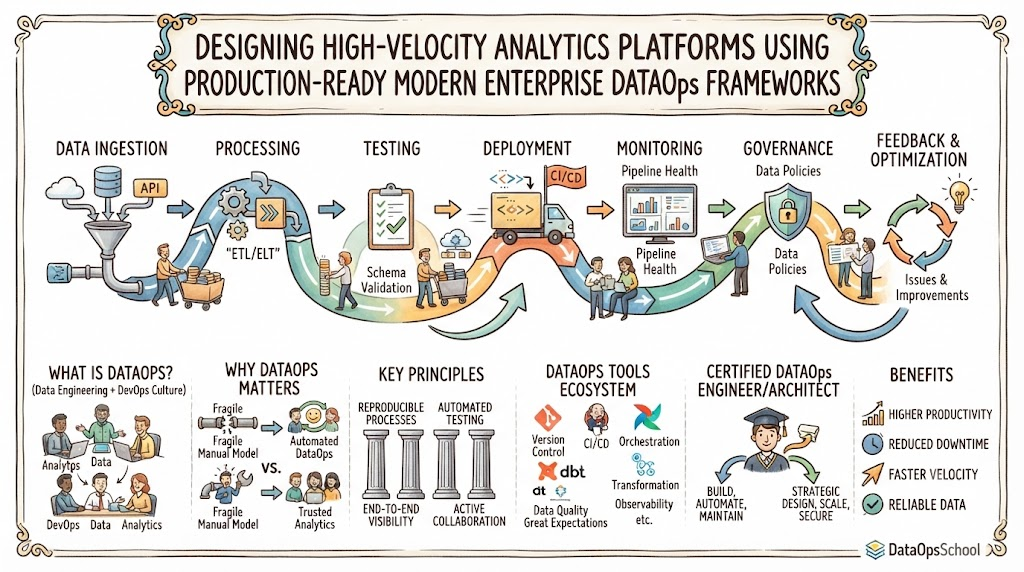
An operational data lifecycle progresses systematically across data extraction, raw ingestion, declarative transformation, automated unit and integration testing, data freshness validation, release deployment, observability, and iterative feedback. Changes to data pipelines begin in version-controlled repositories, where developers make declarative updates to ingestion definitions, container manifests, or transformation queries. Submitting a code change triggers automated CI/CD runners to build transient containers, lint code, run schema tests on mock data, and test business logic against production snapshots. Once deployed, distributed orchestrators trigger pipeline runs, validate row counts and distribution thresholds via automated assertions, emit telemetry to monitoring stacks, and immediately route operational alerts through incident channels whenever an anomalous run occurs.
DataOps Lifecycle
The DataOps lifecycle balances continuous software development practices with automated statistical pipeline management, ensuring changes migrate reliably from local sandboxes into distributed production platforms. Operating this cycle demands strict integration between code versioning, schema registries, automated orchestrators, and governance layers rather than treating individual pipelines as detached scheduled tasks.
| Stage | What Happens | Example |
| Data Ingestion | Raw data enters the platform securely | Streaming message ingestion via Apache Kafka |
| Processing | Data is cleaned, enriched, and modeled | SQL-based transformations using dbt |
| Testing | Pipeline logic and schemas undergo validation | Automated null-value and uniqueness checks |
| Deployment | Tested configurations release to production | Automated GitHub Actions deployment to cloud |
| Monitoring | Pipeline runtime and freshness are tracked | Datadog latency and failure alerts |
| Governance | Policies, lineage, and access controls apply | Column-level role masking via Apache Ranger |
| Feedback | Performance metrics guide operational tuning | Query execution plan and resource optimization |
Key Principles of DataOps
Operational discipline relies on treating pipeline configurations as code, automating verification at every stage, and guaranteeing reproducible environments across the delivery ecosystem. Version control systems manage all transformation logic, infrastructure templates, and pipeline DAGs, enabling complete traceability and atomic rollbacks when production anomalies arise. Continuous automated testing verifies both pipeline application code and dynamic data payloads, ensuring that schema drift and distribution shifts are caught before reaching reporting warehouses. Embedding automated governance, comprehensive monitoring, and blameless post-mortem feedback loops ensures data platforms continuously scale without accumulating hidden technical debt.
DataOps Tools
Enterprise data teams avoid single monolithic platforms, preferring to assemble modular, best-of-breed technology ecosystems tailored to specific infrastructure and orchestration demands. Selecting appropriate frameworks requires evaluating team skillsets, cloud hosting constraints, data compliance mandates, and analytical query latency targets.
| DataOps Function | Example Tools / Technologies | Purpose |
| Version Control | Git, GitLab, GitHub | Track changes to pipelines and analytical models |
| CI/CD | Jenkins, GitHub Actions, GitLab CI | Automate testing, image packaging, and deployment |
| Orchestration | Apache Airflow, Dagster, Prefect | Schedule workflows and manage dependencies |
| Transformation | dbt, Apache Spark, Trino | Transform, aggregate, and enrich distributed datasets |
| Containers | Docker, Kubernetes, Helm | Standardize portable environments across clusters |
| Data Quality | Great Expectations, Soda, pytest | Validate dataset schemas and statistical assertions |
| Observability | Monte Carlo, Datafold, Acceldata | Trace data lineage and monitor pipeline metrics |
| Cloud Data | AWS, Microsoft Azure, Google Cloud | Host enterprise storage engines and compute nodes |
| Monitoring | Prometheus, Grafana, OpenTelemetry | Track infrastructure health and ingestion latencies |
| Databases | Snowflake, BigQuery, PostgreSQL | Store analytical, relational, and dimensional datasets |
DataOps vs DevOps vs Data Engineering
Understanding modern operational practices requires recognizing that DataOps, DevOps, and Data Engineering are complementary practices sharing core reliability values rather than competing methodologies. DevOps standardizes code testing, deployment automation, and infrastructure availability for predictable software environments, while Data Engineering constructs the physical storage layers, streaming connectors, and query architectures needed to move bits efficiently. DataOps brings these disciplines together by treating unpredictable, continuously changing data as a first-class operational variable alongside code, using statistical process controls to maintain platform stability.
| Area | DataOps | DevOps | Data Engineering |
| Main Focus | Reliable data delivery and pipeline health | Predictable application releases | Building scalable data infrastructure |
| Automation | Data quality checks and transformation runs | Infrastructure provisioning and app builds | Batch and real-time processing pipelines |
| Testing | Payload assertions, schema drift, SQL logic | Unit, integration, and system regression | Transformation query logic and DAG runs |
| Monitoring | Freshness, volume drift, lineage breaks | System uptime, CPU load, error response | Job run durations and warehouse credit use |
| CI/CD | Pipeline code, dbt docs, and schema testing | Microservices and cloud infrastructure | Pipeline migrations and connector scripts |
Benefits of Implementing DataOps
Adopting automated data practices significantly reduces pipeline failures by catching schema anomalies, unhandled null values, and broken foreign keys before production transformation runs finish. Developers ship changes faster through standardized CI/CD pipelines, eliminating error-prone manual schema updates and reducing friction between operational teams and analytical consumers. Mean time to detection (MTTD) and mean time to resolution (MTTR) improve because comprehensive monitoring and data lineage engines trace broken dashboard numbers directly back to offending upstream microservices. These technical improvements lower warehouse computing overhead, establish predictable governance standards, and provide leadership teams with reliable analytics.
Real-Life DataOps Scenarios and Industry Experience
A multi-tenant healthcare enterprise faced weekly pipeline failures when third-party hospital APIs changed JSON schema keys without warning, breaking production ingestion jobs and corrupting executive analytics. The engineering team deployed an automated DataOps workflow using Great Expectations within a GitHub Actions pre-merge check, immediately quarantining payload discrepancies to an isolated dead-letter queue before warehouse ingestion. In another enterprise scenario, a global retail platform reduced dashboard downtime by implementing blue-green deployments with dbt and cloud storage snapshots, allowing instant rollbacks when Black Friday reporting volumes caused unexpected memory thrashing.
How to Implement DataOps in an Organization
Establishing sustainable data practices requires executing a structured, step-by-step roadmap that incrementally hardens production systems without halting active development initiatives.
- Step 1: Assess the Current Data EnvironmentConduct a discovery audit across every data source, transformation step, and manual pipeline operation to identify single points of failure, unmonitored scripts, and pipeline bottlenecks.
- Step 2: Define Data Quality StandardsEstablish measurable SLAs, SLIs, and SLOs for schema completeness, data accuracy, distributional freshness, and column-level format consistency across all production tables.
- Step 3: Introduce Version ControlMigrate all orchestration DAGs, dbt models, database migration scripts, and infrastructure configurations into Git, enforcing peer reviews and standardized branching strategies.
- Step 4: Automate TestingImplement automated pre-merge testing suites containing unit tests for business logic, schema assertions, and integration checks evaluated against isolated test environments.
- Step 5: Introduce CI/CDConstruct automated deployment pipelines using continuous integration platforms to eliminate manual server logins, automatically rolling out tested artifacts to production engines.
- Step 6: Add Monitoring and ObservabilityDeploy runtime monitoring and distributed tracing to track pipeline run durations, schema drift, upstream latency, row volume variations, and platform memory utilization.
- Step 7: Improve GovernanceImplement automated column-level masking, role-based access controls, and dynamic cataloging to ensure continuous regulatory compliance, full lineage visibility, and auditable data ownership.
- Step 8: Continuously ImproveReview platform incidents through blameless post-mortems, optimize slow-running transformation queries, and continuously update validation checks as source data models naturally evolve.
DataOps Training and DataOps Course
Mastering modern data reliability requires structured skill development, as engineers must combine distributed computing architectures, software testing standards, and DevOps automation workflows. A thorough DataOps course must balance theoretical engineering designs with hands-on labs covering distributed orchestration, containerization, schema assertion frameworks, and automated CI/CD runners. Practitioners with software engineering or cloud engineering backgrounds benefit from learning how changing data schemas disrupt downstream analytical systems. DataOpsSchool provides structured training pathways, hands-on tutorials, and foundational courses built specifically around modern data operations.
DataOps Certification
Pursuing a recognized DataOps certification helps engineers validate their technical competency across distributed pipeline automation, continuous integration, and operational platform management. Preparing for an industry exam requires mastering automated testing architectures, container orchestration, programmatic governance, real-time observability, and declarative pipeline transformations. Achieving verified certification confirms your ability to run dependable data operations, distinguishing you in competitive enterprise engineering markets. While paper credentials cannot replace practical troubleshooting experience, certification programs provide structured curricula that eliminate knowledge gaps across the modern data stack.
Certified DataOps Engineer
A Certified DataOps Engineer focuses on the hands-on implementation of automated data delivery pipelines, CI/CD integrations, schema testing engines, and runtime monitoring stacks. These professionals manage containerized workloads, write automated transformation logic using dbt and SQL, configure orchestrators like Apache Airflow, and implement data quality frameworks across production platforms. Engineers moving from traditional ETL development, software engineering, or platform reliability roles find this specialization provides practical, production-focused skills. DataOpsSchool delivers curated learning paths, practical exercises, and preparation resources designed specifically for engineers targeting certified technical credentials.
Certified DataOps Architect
A Certified DataOps Architect designs scalable, highly available enterprise data platform architectures while establishing comprehensive security, governance, and operational standards. Architects evaluate cloud infrastructure designs, choose orchestration frameworks, build disaster recovery blueprints, and design automated deployment patterns for engineering organizations. Unlike individual pipeline engineers focused on day-to-day bugs, architects align platform automation with broader corporate governance, multi-region compliance, and cost-efficiency targets. Mastering enterprise data architecture enables senior engineers and technical leaders to lead cross-functional infrastructure initiatives without accumulating tech debt.
DataOps Tutorial: Where Should Beginners Start?
Beginning practitioners should focus on fundamental operational methodologies, learning how infrastructure, pipelines, and automated validation frameworks interact before memorizing specific vendor tool interfaces.
- Learn Git and Version ControlMaster branching, pull requests, merge conflict resolution, and collaborative code review practices for pipeline definitions.
- Understand Linux and ScriptingGain comfort with bash scripting, shell automation, permissions, environment variables, and core operating system concepts.
- Master Relational and Dimensional ModelingLearn SQL fundamentals, normalization rules, dimensional warehousing schemas, and analytical query optimization techniques.
- Explore Containerization FundamentalsPackage data ingestion tools, dependencies, and transformation scripts into portable Docker containers.
- Study Workflow OrchestrationBuild dependent, multi-step pipeline DAGs using modern Python-based orchestration engines like Apache Airflow or Dagster.
- Implement Automated CI/CD PipelinesWrite declarative continuous integration jobs using GitHub Actions or GitLab CI to lint code and run automated pre-commit tests.
- Integrate Data Quality AssertionsWrite automated schema and data validation assertions using Great Expectations or dbt tests within the ingestion workflow.
- Deploy Monitoring and ObservabilityTrack pipeline run durations, schema drift, and data freshness metrics using OpenTelemetry, Prometheus, and Grafana.
- Construct an End-to-End Capstone ProjectBuild and deploy a complete production pipeline that ingests public APIs, runs automated tests, transforms data, and exposes alerts.
DataOps Consulting and DataOps Services
Enterprise organizations often bring in DataOps consulting teams when frequent pipeline disruptions, unmonitored failures, and manual deployment processes start stalling critical business roadmaps. Professional service teams evaluate existing architectures, identify operational failure points, set up modern CI/CD delivery pipelines, and establish enterprise-grade observability stacks across multi-cloud environments. These external services help teams implement reliable data quality standards, automated role-based access governance, and containerized transformation workflows while upskilling internal platform staff. DataOpsSchool complements its educational programs by providing specialized consulting and advisory services that help businesses build resilient, automated data operations.
Common Mistakes to Avoid in DataOps
Organizations regularly make predictable mistakes when introducing automation into legacy platforms, which undermines team buy-in and slows down production delivery.
- Treating DataOps as a Single Purchasable ToolAssuming a third-party software platform will fix broken operational workflows without changing underlying team processes.
- Neglecting Pipeline Version ControlAllowing developers to edit production SQL transformations, Airflow DAGs, or cloud settings directly through web consoles.
- Testing Only Infrastructure While Ignoring Data PayloadsVerifying that jobs finish with exit code zero without validating whether ingested data contains null values or corrupt numbers.
- Building Monolithic, Tightly Coupled PipelinesDesigning massive, brittle transformation scripts where a minor upstream schema change crashes the entire processing workflow.
- Deploying Alerts Without Actionable OwnershipFlooding internal communication channels with thousands of unprioritized pipeline alerts, causing alert fatigue and missed incidents.
- Overlooking Data Governance and Access ControlsFailing to embed role-based masking, sensitive column encryption, and compliance audits directly into automated pipelines.
- Delaying Testing Until Production Run TimeSkipping pre-merge CI integration tests and synthetic data assertions, catching schema bugs only after analytical tables update.
- Operating Without Comprehensive Data LineageFailing to track data dependencies across stages, forcing engineers to manually trace upstream failure causes during critical outages.
How to Choose the Right DataOps Approach
Selecting the best operational approach requires evaluating your organization’s specific technical constraints, engineering headcount, cloud infrastructure footprint, and analytical reporting latency demands. Early-stage startups managing modest data volumes may only need lightweight Git workflows, dbt Cloud transformations, and native data assertions, whereas regulated global enterprises require automated multi-cloud CI/CD runners, distributed Spark orchestrators, and real-time lineage engines. Avoid over-engineering systems by adopting complex container clusters before your data volumes demand them; focus first on solving pipeline fragility, visibility gaps, and deployment friction. Ultimately, the best operational strategy standardizes reliable, repeatable data delivery without placing excessive maintenance burdens on the engineering team.
Who Should Learn DataOps?
Engineers and technical leaders across diverse technical backgrounds can leverage their existing skill sets to transition into specialized operational and platform engineering roles.
- Data EngineersTransition from writing brittle, manual pipeline scripts to constructing automated, version-controlled delivery platforms.
- DevOps EngineersApply established infrastructure-as-code, CI/CD, and site reliability principles to analytical data pipelines and data warehouses.
- Site Reliability Engineers (SREs)Expand infrastructure availability metrics into data-specific reliability goals, pipeline error budgets, and freshness SLAs.
- Data Scientists and Analytics EngineersLearn how to build self-service transformations, write automated model tests, and deploy production-ready analytics code safely.
- Cloud and Platform EngineersDesign resilient cloud data platforms, scalable container clusters, and secure access boundaries for data engineering teams.
- Data Architects and Technical LeadersDesign scalable, cost-effective enterprise platforms and operational models that reduce team friction and pipeline downtime.
Why DataOpsSchool Can Be a Useful Resource
DataOpsSchool focuses specifically on modern data operations, engineering reliability, pipeline automation, and enterprise infrastructure management. The platform provides structured technical training, detailed courses, hands-on tutorials, and certification preparation pathways designed for engineers seeking Certified DataOps Engineer or Certified DataOps Architect credentials. Beyond individual learning, the platform offers enterprise consulting and professional services, helping organizations design resilient data platform architectures, integrate automated CI/CD pipelines, establish data observability, and implement robust governance controls. Whether you are an engineer looking to upskill or a technical leader building dependable data platforms, DataOpsSchool provides the practical guidance needed to master operational excellence.
Frequently Asked Questions
1. What is the fundamental goal of DataOps?
The primary goal of DataOps is to shorten pipeline development cycles while dramatically increasing data reliability, quality, and platform operational uptime. It achieves this by integrating agile methodologies, DevOps automation principles, and statistical process controls directly into continuous analytical workflows.
2. Is DataOps a dedicated software product?
No, DataOps is an operational methodology, culture, and engineering framework supported by various testing, orchestration, and continuous deployment tools. No single software tool can establish a complete DataOps practice without supporting organizational processes, version control habits, and quality standards.
3. How does DataOps differ from traditional DevOps?
DevOps focuses on the continuous integration, testing, and deployment of software application code and static infrastructure components. DataOps encompasses these software development workflows while addressing the added challenges of dynamic data payloads, schema drift, data freshness, and non-deterministic analytical pipelines.
4. Do small data teams really need DataOps?
Yes, small data teams benefit substantially by adopting foundational practices like Git version control, automated transformation testing, and standardized CI/CD pipelines. Implementing lightweight automated guardrails early prevents pipeline fragility and technical debt as enterprise data volumes grow.
5. What are the most common tools used in DataOps?
Modern technology stacks frequently integrate Git for version control, GitHub Actions or GitLab for CI/CD, and Apache Airflow or Dagster for workflow orchestration. Transformations are handled with dbt, while tools like Great Expectations, Docker, Prometheus, and Grafana provide testing, containerization, and monitoring.
6. How does automated testing work in data pipelines?
Automated testing operates on two distinct layers: checking pipeline code logic and asserting data payload quality. Pre-merge unit tests evaluate business logic against synthetic datasets, while runtime assertions continuously validate live production payloads for schema drift, null counts, uniqueness, and distributional shifts.
7. What role does data observability play in DataOps?
Data observability provides continuous visibility into platform health by monitoring data freshness, volume anomalies, schema migrations, pipeline lineage, and job run durations. When anomalies occur, observability engines trace dependencies to find the upstream cause, shortening operational troubleshooting cycles.
8. What is the role of a Certified DataOps Engineer?
A Certified DataOps Engineer designs, automates, and maintains operational data delivery pipelines, testing frameworks, and continuous delivery workflows across cloud platforms. They implement automated validation rules, configure orchestrators, package pipeline containers, and monitor distributed transformations to maintain platform reliability.
9. Can DataOps help with compliance and governance?
Yes, DataOps integrates automated access governance, data cataloging, column-level masking, and end-to-end lineage tracking directly into deployment pipelines. This automated traceability gives compliance teams clear audit trails for regulatory standards like GDPR, HIPAA, and SOC 2 without slowing down engineering velocity.
10. How should an enterprise start implementing DataOps?
Begin by running an operational assessment to identify unmonitored scripts, manual handoffs, and recurring pipeline failure points across your existing architecture. Move all transformation queries into Git version control, establish automated schema assertion tests, and set up basic continuous integration runners before buying complex tools.
11. What qualifications are needed to learn DataOps?
Learners should understand fundamental SQL, basic Python scripting, relational database architectures, and fundamental Linux command-line operations. Prior experience in data engineering, software development, cloud infrastructure administration, or DevOps deployment pipelines helps practitioners pick up concepts quickly.
12. How does DataOps reduce cloud infrastructure costs?
DataOps reduces platform expenses by detecting failed runs and infinite query loops before runaway cloud warehouse workloads consume unnecessary credits. Automated orchestration, workload-based autoscaling, and efficient query design prevent expensive compute resource waste across modern platforms like Snowflake, BigQuery, and Databricks.
Conclusion
DataOps delivers a reliable, automated approach to modern data engineering by combining agile delivery practices, continuous integration, and statistical data quality controls. Adopting these operational methods transforms fragile batch scripts into resilient production systems, helping engineering teams reduce pipeline downtime and deliver trustworthy analytics to business stakeholders. Organizations can transition by incrementally adopting Git version control, building automated CI/CD testing suites, and implementing comprehensive observability platforms. Engineers and technical architects can expand their operational skillsets through hands-on tutorials, continuous lab practice, and professional credential programs. Platforms such as DataOpsSchool support this professional growth through targeted courses, certification paths, and enterprise advisory services designed to scale data platform operations. Long-term platform success comes from prioritizing testing rigor, automation, and operational discipline over accumulating unintegrated tools.
