Introduction
While modern vacationers routinely pack their bags for the commercialized, gridlocked tourist hubs of neighboring states, true connoisseurs of time seek out destinations that breathe silently. If you are exhausted by superficial travel itineraries, Vaishali in Bihar offers a profound, unhurried alternative. This isn’t a place of artificial, neon-lit photo opportunities; it is a sprawling open-air archive of human evolution. Standing amidst its quiet orchards and ancient brick mounds, you realize you are walking through the soil that witnessed the birth of global democracy and the radical spiritual awakenings of Jainism and Buddhism. The air carries an unmistakable weight of authenticity, inviting you to connect with structural roots that are over 2,500 years old.
Why Vaishali is a must visit city
Vaishali is not merely a destination; it is an irreplaceable chapter in the story of civilization. Geographically positioned just north of the Ganges, this ancient soil served as the capital of the Lichchhavi Republic, universally recognized by historians as one of the world’s very first successful democracies. It is the sacred land where Lord Mahavira was born, shaping the foundational tenets of Jain philosophy. For Buddhists, it holds an emotionally charged significance: it is where Gautama Buddha delivered his final sermon, permitted the formal ordination of women into the Sangha, and famously announced his impending Mahaparinirvana (death).
The entire historical circuit of Vaishali is remarkably compact, allowing travelers to explore the foundational layers of Mauryan, Sunga, and Kushan history within a few square kilometers. For modern travelers, accessing this sacred geography is highly seamless. The region is well-connected by the newly upgraded National Highway 22 (NH-22) and the JP Setu from Patna, making it a comfortable two-hour drive from the state capital. The nearby Hajipur Junction provides excellent rail connectivity, while a growing ecosystem of heritage stays and comfortable government-run tourist bungalows ensures smooth hospitality for history buffs, spiritual seekers, and solo backpackers alike.
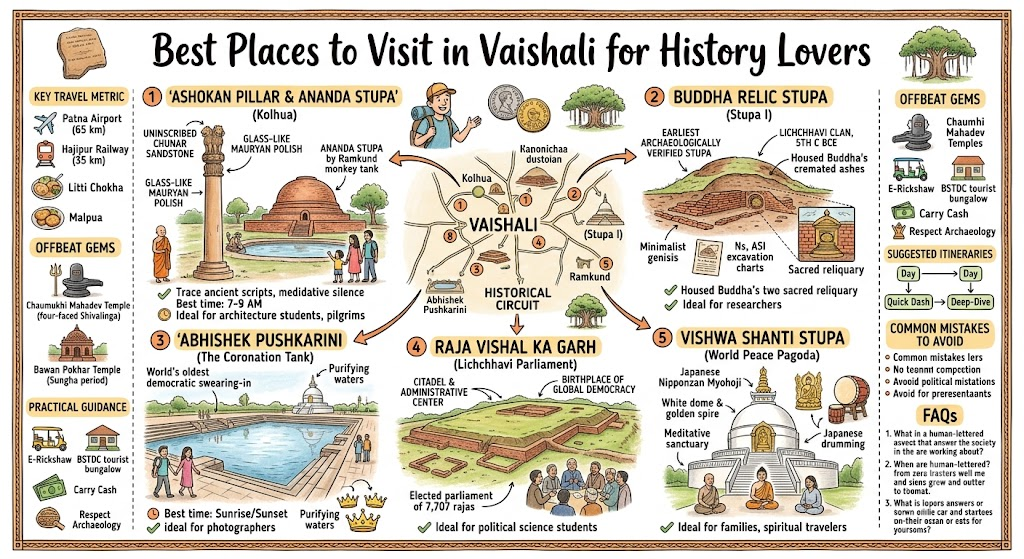
| Key Travel Metric | Practical Information for Vaishali |
| Primary Historical Themes | First Republic, Rise of Buddhism, Birthplace of Jainism, Mauryan Architecture |
| Nearest Transit Hubs | Patna Airport (approx. 65 km), Hajipur Railway Junction (approx. 35 km) |
| Ideal Exploration Duration | 1 to 2 Full Days |
| Core Local Culinary Specialties | Authentic Litti Chokha, Malpua, Muzaffarpur Shahi Lychee (seasonal) |
Best Places or Experiences
1. The Ashokan Pillar & Ananda Stupa at Kolhua
The archaeological complex at Kolhua stands as the visual and spiritual crown jewel of Vaishali. It features a magnificent, flawlessly preserved monolithic column erected by Emperor Ashoka the Great in the 3rd century BCE to mark the exact spot where Buddha preached his last sermon. Nearby sits the brick-built Ananda Stupa, raised to honor the Buddha’s most loyal companion and memory-keeper.
The engineering of the column is staggering; carved out of a single massive block of highly polished Chunar red sandstone, it retains its glass-like Mauryan polish even after 2,300 years of exposure to elements. Unlike other Ashokan columns that bear royal edicts, this pillar is completely uninscribed and is uniquely crowned by a singular, life-sized Asiatic Lion capital facing north—the exact directional route Buddha took on his final journey toward Kushinagar.
- Location: Kolhua Village, approximately 5 km from the main Vaishali Basarh bus stand and 63 km from Patna.
- Why it is worth visiting: It is one of the very few Ashokan pillars across the Indian subcontinent that remains completely intact with its original lion capital still sitting securely at the top.
- Best things to do: Trace the ancient Brahmi and Gupta-era Shell script markings near the pillar’s base, admire the perfectly symmetric reflection of the Ananda Stupa in the adjoining ancient monkey tank (Ramkund), and sit quietly on the lawns to feel the deep, meditative silence of the complex.
- Best time to visit: Between 7:00 AM and 9:00 AM, when the early morning golden sunlight perfectly illuminates the polished texture of the red sandstone.
- Ideal for whom: Serious history buffs, architecture students, and spiritual pilgrims.
- Travel tip: Hire an official Archaeological Survey of India (ASI) certified guide at the entrance gate; the complex layers of Sunga, Kushan, and Mauryan brick reconstructions are impossible to decipher without an expert eye.
2. The Buddha Relic Stupa (Stupa I)
The Buddha Relic Stupa is arguably one of the most historically significant spots on Earth for practitioners of Buddhism. Raised originally in the 5th century BCE by the democratic Lichchhavi clan, this modest mound of earth and clay was constructed to house their precise one-eighth share of the holy cremated remains (ashes) of Gautama Buddha following his Mahaparinirvana.
Though visually minimalist compared to later, grander monuments, this site represents the absolute genesis of Buddhist monumental architecture. In 1958, archaeological excavations uncovered its core and unearthed a highly sacred soapstone reliquary casket containing the holy ashes mixed with a small piece of gold leaf, a conch shell fragment, and ancient punch-marked copper coins.
- Location: Located near the Abhishek Pushkarini tank, central Vaishali zone.
- Why it is worth visiting: It is recognized globally as the earliest archaeologically verified stupa structure in human history.
- Best things to do: Observe the distinct layers of subsequent brick reinforcements added by the Mauryan and Sunga dynasties, read the detailed ASI excavation charts on-site, and walk the ancient parikrama (circumambulation) path.
- Best time to visit: Late afternoons (4:00 PM to 6:00 PM) when the temperature cools and local monks often gather to chant.
- Ideal for whom: Spiritual seekers, archaeological purists, and researchers.
- Travel tip: Do note that the original soapstone reliquary casket itself was shifted for high-security preservation and is currently displayed in a dedicated gallery at the Patna Museum.
3. Abhishek Pushkarini (The Coronation Tank)
Abhishek Pushkarini is a vast, historic water body that functioned as the spiritual civic center of the ancient Lichchhavi Republic. In an era when most surrounding kingdoms were ruled by absolute monarchs, Vaishali operated via an elected parliament of 7,707 rajas (representatives).
Before any newly elected representative or ruler could ascend the sacred governing council or take their official seat in the parliament house, they were mandatorily bathed in the waters of this tank. The water was considered highly sacred, filled with purifying properties, and protected with absolute martial security by the state guards of ancient Vaishali.
- Location: Situated directly across from the entry path of the Vishwa Shanti Stupa.
- Why it is worth visiting: It stands as a living, physical monument to the world’s oldest democratic swearing-in ceremonies.
- Best things to do: Take a slow walk along the old stone steps (ghats), photograph the sweeping reflection of the adjacent Peace Pagoda across the water, and observe local life unfolding along the periphery.
- Best time to visit: Sunrise or sunset, when the vast water surface catches stunning crimson reflections.
- Ideal for whom: Photographers, political history enthusiasts, and families looking for a peaceful stroll.
- Travel tip: Avoid visiting late at night as the lighting around the open embankments can be sparse.
4. Raja Vishal Ka Garh
Raja Vishal Ka Garh is a massive, fortified archaeological mound that covers an impressive perimeter of roughly one kilometer. Excavations indicate that this heavily diked site was the actual parliament house and administrative citadel where the 7,707 elected representatives of the Lichchhavi Republic gathered to debate state laws and vote on democratic policies.
Today, the site presents itself as an enormous, elevated plateau flanked by a massive mud rampart and an ancient defensive moat system that once kept rival empires like Magadha at bay. Walking across this grassy field feels surreal when you realize that modern representative democracy was modeled on debates that happened right under your feet.
- Location: Roughly 3 km from the Vaishali museum hub.
- Why it is worth visiting: It is the literal architectural birthplace of global republican governance.
- Best things to do: Walk up the elevated rampart mounds to visualize the grand layout of the ancient fortress, explore the exposed brick foundations of the meeting halls, and look out for ancient pottery shards that occasionally surface after rain.
- Best time to visit: October to February, when the weather allows for extensive walking across the open field.
- Ideal for whom: Political science students, adventurous solo travelers, and military history enthusiasts.
- Travel tip: Wear heavy walking shoes or boots; the area is vast, completely unpaved, and requires navigating thick brush and uneven terrain.
5. Vishwa Shanti Stupa (World Peace Pagoda)
Rising majestically on the banks of the Abhishek Pushkarini, the Vishwa Shanti Stupa is a brilliant white, modern structural marvel that pays homage to Vaishali’s ancient pacifist legacy. Built by the Japanese Buddhist order Nipponzan Myohoji under the guidance of Fujii Guruji, it stands as one of the several Peace Pagodas constructed globally to promote non-violence.
The stupa features a soaring white dome topped with a golden spire. Nestled within its structured niches are large, beautifully crafted golden statues depicting various milestones of Gautama Buddha’s life, including his birth, enlightenment, sermons, and ultimate departure from the physical world.
- Location: Directly adjacent to the Coronation Tank, Vaishali.
- Why it is worth visiting: It seamlessly bridges Vaishali’s ancient spiritual roots with modern global architecture and offers an incredibly peaceful sanctuary.
- Best things to do: Sit inside the dedicated meditation hall, listen to the rhythmic, hypnotic Japanese drumming prayers if you time it right, and view the beautifully detailed golden relief plaques on the stupa walls.
- Best time to visit: 5:00 PM to 6:00 PM to catch the serene evening arati and prayers as the sun dips below the horizon.
- Ideal for whom: Couples seeking quietude, spiritual travelers, and families.
- Travel tip: You must remove your footwear at the base of the main stupa platform; the stone tiles can get extremely hot by afternoon, so wearing socks is highly recommended.
Offbeat Exploration: Hidden Gems Tourists Miss
Chaumukhi Mahadev Temple
Tucked away from the primary Buddhist tourist trail lies this remarkable, ancient Hindu shrine dedicated to Lord Shiva. The temple houses a striking, black stone Chaumukhi (four-faced) Shivalinga that dates back to the late Gupta and early Pala periods. Each face carved into the stone displays intricately detailed expressions representing different aspects of Shiva’s cosmic persona. It is a brilliant example of how Vaishali remained a vital, multi-faith artistic workshop long after its political glory waned.
Bawan Pokhar Temple
Located next to a massive, rectangular water body from which it derives its name (Bawan Pokhar means 52 ponds), this ancient temple structure dates back to the Sunga period. The temple houses a rare, eclectic collection of Hindu deities whose statues were unearthed during local agrarian activities. The surrounding village paths are quiet and offer an authentic, raw look into rural north Bihar life that generic tour buses completely skip.
Detailed Practical Guidance for Travelers
The major historical sites in Vaishali operate under structured ticketing and timing schedules managed by the Archaeological Survey of India. The logistics are summarized below:
| Destination | Standard Entry Fee | General Timings | Best Local Food Options Nearby | Recommended Nearby Attractions |
| Kolhua Complex (Ashokan Pillar) | INR 25 (Indians), INR 300 (Foreigners) | 6:00 AM – 6:00 PM | Local stalls serving hot Samosas, Jalebi, and seasonal Lychee juice | Vaishali Archaeological Museum |
| Buddha Relic Stupa | INR 20 (Indians), INR 250 (Foreigners) | 6:30 AM – 5:30 PM | Small eateries offering traditional thalis near the main junction | Abhishek Pushkarini tank |
| Raja Vishal Ka Garh | Free Entry | Sunrise to Sunset | Simple village tea shops; carry your own water | Bawan Pokhar Temple |
| Vishwa Shanti Stupa | Free Entry | 6:00 AM – 6:00 PM | Cafe setups and sweet shops near the park entrance | Coronation Tank views |
Logistics & On-Ground Navigation
Local Transport Options
- Railways: The nearest major railhead is Hajipur Junction (35 km away). From Hajipur, you can easily hail local buses or shared autos directly to Vaishali.
- Auto-Rickshaws & E-Rickshaws: These form the backbone of intra-city travel in Vaishali. E-rickshaws are incredibly cheap and environmentally friendly, perfect for hopping between the Relic Stupa and the Peace Pagoda.
- Car Rentals: For absolute comfort, hiring a private taxi for a full day from Patna is the best option. It allows you to cover all sites seamlessly without waiting for local connections on rural roads.
Budget Planning
- Budget/Backpacker Tier (INR 800 – INR 1,500 per day): Utilizes shared auto-rickshaws for transit, opts for meals at local dhabas (expecting delicious Litti Chokha and basic rice plates), and stays in basic budget lodges or pilgrim guest houses.
- Mid-Range/Comfort Tier (INR 3,000 – INR 5,500 per day): Involves renting a private AC sedan from Patna, dining at established heritage resort restaurants, and staying at comfortable hotels like the Bihar Tourism Development Corporation (BSTDC) tourist bungalows.
Safety and Inclusivity Tips
- For Families: The archaeological parks are wonderfully manicured and safe for children to run around. Ensure you carry mosquito repellents if you stay near water bodies past sunset.
- For Couples: The lawns around the Vishwa Shanti Stupa and Kolhua are highly scenic and peaceful. Stick to the main historical complexes and avoid wandering deep into isolated fields or unmapped rural trails after dark.
- General Safety: The local residents are incredibly warm, polite, and eager to help travelers. However, public infrastructure can be rural; ensure you finish your sightseeing by 6:00 PM and head back to your hotel base safely.
Strategic Travel Planning Guardrails
Travel Planning Tips for Vaishali
- Cash is King: While UPI and digital payments are widely accepted at major ticket counters, local e-rickshaw drivers and street food vendors almost exclusively prefer hard cash.
- Dress Modestly: Vaishali is a highly revered sacred ground for both Buddhists and Jains; ensure your shoulders and knees are properly covered when visiting active shrines.
- Hydration is Critical: The open archaeological plains offer very little canopy or shade. Always carry an insulated bottle of water with you.
- Seasonal Booking: If visiting between November and January (peak pilgrim season), ensure your accommodation is booked at least two weeks in advance.
- Respect the Archaeology: Do not touch or lean on the ancient Mauryan brick walls; the salt on human hands can accelerate the decay of terracotta and old masonry.
Common Mistakes to Avoid
- Treating it as a half-day rush: Many tourists try to squeeze Vaishali into a tight morning trip before heading somewhere else, missing out on the magical late-afternoon spiritual energy.
- Assuming English fluency everywhere: While guides speak fluent English, local auto drivers speak Hindi or Bajjika; keep a translation app handy or stick to basic phrases.
- Skipping the local Museum: The Vaishali Archaeological Museum houses priceless terracotta figurines, ancient coins, and statues that give essential context to the ruins outside.
- Expecting high-end fine dining: Vaishali offers rustic, deeply flavorful local food; do not look for continental multi-cuisine fine dining restaurants here.
- Forgetting to check seasonal closures: The local museums are traditionally closed on Fridays; plan your itinerary accordingly to avoid missing out.
Suggested Itinerary Blueprints
1. Day Quick Dash (The Republic Route)
Designed for time-crunched travelers coming in directly from Patna. Arrive by 8:30 AM at the Kolhua Complex to see the Ashokan Pillar before the heat peaks. Head to the Vaishali Archaeological Museum at 11:30 AM for historical context. Grab a rustic lunch of Litti Chokha near the main crossroads, explore the Buddha Relic Stupa and Abhishek Pushkarini by 3:00 PM, and conclude your day with the evening peace rituals at the Vishwa Shanti Stupa before driving back to Patna by 6:30 PM.
2. Day Deep-Dive (The Spiritual Heritage Circuit)
- Day 1: Dedicate your entire morning to the extensive ruins of Kolhua, spending time tracing the old monastic cells and the monkey tank. After a traditional afternoon thali, explore the massive earthen ramparts of Raja Vishal Ka Garh and watch the sunset from the quiet banks of the Bawan Pokhar Temple.
- Day 2: Start early with a serene morning walk around the Abhishek Pushkarini. Spend your midday exploring the Buddha Relic Stupa and uncovering the multi-faced stone masterpiece inside the Chaumukhi Mahadev Temple. Devote your afternoon to souvenir shopping for local Sikki grass handicrafts before your departure.
3. Complete Weekend Travel Plan (The Ancient Foundations Loop)
- Friday Evening: Arrive in Vaishali, check into your heritage room or tourist bungalow, and spend a quiet evening watching the illumination at the Vishwa Shanti Stupa.
- Saturday: Undertake the complete historic loop. Morning at Kolhua (Ashokan Pillar), midday at the Vaishali Museum, late afternoon walking the historic plains of Raja Vishal Ka Garh, followed by a rustic street food tour.
- Sunday: Visit the Buddha Relic Stupa for morning meditation. Spend your pre-lunch hours exploring the offbeat Chaumukhi Mahadev shrine and interacting with local terracotta artisans before checking out and heading to Hajipur Junction for your return transit.
Common Tourist Mistakes to Avoid
- Geographic Blunders: Do not attempt to pair an exhaustive trip of Vaishali with a visit to Nalanda or Rajgir on the exact same day. They sit on geographically opposite sides of the Ganges, and you will spend your entire day stuck in highway transit rather than exploring.
- Commercial Traps: Avoid spending your limited travel hours looking for modernized shopping plazas or westernized cafes in nearby suburban pockets. Vaishali’s true charm lies in its old, rustic village markets, open orchards, and atmospheric historical complexes.
- Neglecting Modern/Alternative Zones: Do not ignore the beautifully quiet, modern monasteries built nearby by various Buddhist nations like Vietnam, Japan, and Cambodia. These spaces offer beautiful, manicured architecture and quiet meditation spaces that tourists routinely overlook.
- Transport Overpayment: Local rickshaw drivers may try to charge premium rates if they realize you are unfamiliar with the geography. Always cross-reference distances on digital maps, ask your hotel front desk for standard local rates, or settle on a fixed round-trip price before stepping into an auto.
- Luxury Dining Bias: Sticking exclusively to enclosed hotel dining halls means you completely miss out on Bihar’s incredible street food heritage. Missing out on roadside stalls serving fresh, charcoal-roasted Litti Chokha, flaky Khaja, or hot Malpuas deprives you of tasting the real soul of the region.
Frequently Asked Questions
1. Is Vaishali safe for solo female travelers exploring historical sites?
Yes, Vaishali is generally a very warm and welcoming destination for solo female travelers. The main archaeological complexes like Kolhua and the Peace Pagoda are heavily guarded by security personnel and see regular footfall of international pilgrims. However, because the region is largely rural and public lighting on village roads can be minimal, it is highly recommended to finish your outdoor exploration by 5:30 PM and avoid walking alone through isolated fields or unmapped paths after dark.
2. What is the exact historical connection between Lord Buddha and Vaishali?
Lord Buddha shared a deep, emotional bond with Vaishali and visited it multiple times throughout his life. It was here that he accepted a bowl of honey from a group of local monkeys, a famous event celebrated in Buddhist art. More importantly, Vaishali is where Buddha broke ancient tradition by ordaining his foster mother, Mahaprajapati Gautami, thereby establishing the world’s very first order of Buddhist bhikhunis (nuns). He also chose Vaishali to deliver his final sermon and announce his approaching death.
3. Why does the Ashokan Pillar at Vaishali not have any written inscriptions?
Unlike most other monolithic columns erected by Emperor Ashoka, which are etched with royal edicts detailing laws and moral codes, the pillar at Vaishali is completely plain and uninscribed. Historians believe this indicates that it was one of the earliest experimental pillars commissioned by Ashoka. Instead of functioning as a royal billboard, it was created purely as a silent, monumental marker of absolute devotion to point pilgrims toward the sacred path of Buddha’s final journey.
4. Can we see the actual relics of Buddha at the Relic Stupa site today?
No, you cannot see the physical relics at the open archaeological site today. While the brick foundations of the original 5th-century BCE stupa are fully visible, the sacred soapstone reliquary casket and the holy ashes excavated from its core in 1958 were shifted to prevent damage and ensure high security. The original artifact is beautifully preserved and displayed under strict climate control in a dedicated high-security wing at the Patna Museum in Patna.
5. How far is Vaishali from Patna, and what is the most reliable way to travel?
Vaishali is located roughly 63 kilometers north of Patna. The most reliable, comfortable, and efficient way to travel is by hiring a private, air-conditioned taxi for a full day from Patna. Thanks to the newly expanded NH-22 and the JP Setu over the Ganges, the drive takes around 1.5 to 2 hours each way, allowing you to travel comfortably and access all the scattered historical sites without waiting for local village transport.
6. What are the unique local handicrafts one can buy as souvenirs in Vaishali?
Vaishali is famous for its gorgeous, eco-friendly Sikki work handicrafts, which are beautiful items hand-woven out of a special golden-hued wild grass unique to this region. You can purchase exquisite Sikki baskets, toys, and wall hangings directly from local village artisans. Additionally, the region is known for authentic stone sculptures carved in the old Mauryan style, handmade terracotta toys, and beautiful Madhubani paintings created by local women.
7. Is the entire archaeological circuit wheel-chair accessible for elderly travelers?
The major attractions like the Kolhua Complex (Ashokan Pillar) and the Vishwa Shanti Stupa feature beautifully paved, flat stone walkways and manicured lawns that are reasonably friendly for elderly travelers and strollers. However, older sites like Raja Vishal Ka Garh and the Buddha Relic Stupa are largely unpaved mud plateaus with uneven terrain, steps, and no dedicated ramp infrastructure, making wheelchair navigation quite challenging there.
8. What exactly was the ‘Coronation Tank’ used for in ancient times?
The Coronation Tank, locally known as Abhishek Pushkarini, functioned as the political and spiritual cleansing center of the ancient Lichchhavi Republic. Before any elected representative (raja) could formally take their oath of office or enter the central parliament house to vote on state policies, they were required by constitutional law to bathe in these sacred waters to purify themselves, symbolizing their dedication to transparency and public service.
9. What is the best season to plan a history-focused trip to Vaishali?
The absolute best time to visit Vaishali is during the winter season, specifically from October to February. During these months, the weather in north Bihar is wonderfully pleasant, with daytime temperatures hovering between 15°C and 25°C, making it perfect for spending long hours walking across open, unshaded archaeological fields. Summers (April to June) should be strictly avoided, as temperatures can soar past 40°C with intense humidity.
10. Are there comfortable accommodation options available within Vaishali itself?
Yes, while many tourists visit as a day trip from Patna, Vaishali has highly comfortable choices for overnight travelers. The Bihar State Tourism Development Corporation (BSTDC) operates well-maintained tourist bungalows (such as the Lichchhavi Vihar) that offer clean, air-conditioned rooms, local dining halls, and secure parking at very reasonable prices. There are also a few peaceful, meditative guest houses run by international Buddhist monasteries.
11. Why is Vaishali considered a vital pilgrimage site for followers of Jainism?
Vaishali holds a position of supreme spiritual reverence in Jainism because its outer suburb, known historically as Kundalpur or Vasokund, is the absolute birthplace of Lord Mahavira, the 24th and final Tirthankara of Jainism. Born into the ruling Kshatriya family of the republic in the 6th century BCE, Mahavira spent his early years in this region before renouncing his worldly kingdom to preach the core philosophies of Ahimsa (absolute non-violence) and Anekantavada.
12. What are the photography rules and regulations at the ASI sites in Vaishali?
Standard photography using regular digital cameras or smartphones is completely permitted and free of charge across all the major Archaeological Survey of India (ASI) sites in Vaishali, including Kolhua and the Relic Stupa. However, using professional tripods, complex lighting gear, or commercial video recording requires prior written permission and a separate paid permit from the ASI office. Using commercial drones is strictly prohibited across the entire heritage zone without high-level security clearance.
Conclusion
Choosing a journey to Vaishali over a standard, commercialized vacation spot is an investment in your intellectual and spiritual well-being. As you stand before the towering Ashokan Pillar or look across the historic waters of the Coronation Tank, the frantic noise of modern life naturally fades away, replaced by a profound, grounding connection to history. You leave Vaishali not just with digital photographs, but with a renewed sense of wonder at how human beings, thousands of years ago, sat under these same trees to draft the laws of democracy and map the paths of inner peace. It is a destination that does not merely entertain you; it quietly transforms the way you view the world.
