Introduction
Mainstream itineraries rush travelers through sterile resort corridors and packaged sightseeing loops that strip away the raw heartbeat of India. Bihar flips that commercial script completely. Here, cultural immersion is not bought in boutique lounges; it is poured piping hot from unpretentious brass kettles into terracotta kulhads along bustling street corners.
The aroma of hand-roasted sattu, bubbling pans of mustard oil, and simmering ginger-cardamom decoctions define everyday life across the state. In Bihar, tea and evening snacks form a social anchor where university students, political thinkers, and neighborhood elders convene to dissect the universe.
Why Bihar is a must-visit city
Bihar is a defining cradle of world history, where the fertile Gangetic plain has nourished ancient empires, groundbreaking philosophies, and legendary culinary traditions for millenia. Beyond the spiritual sanctity of Bodh Gaya and Nalanda, the region’s urban hubs are vibrant centers of grassroots gastronomy. Excellent highway expansions, electrified railway corridors, and daily flights into Patna (PAT) and Gaya (GAY) make traversing Bihar remarkably seamless for culinary explorers, heritage backpackers, and multi-generational families alike.
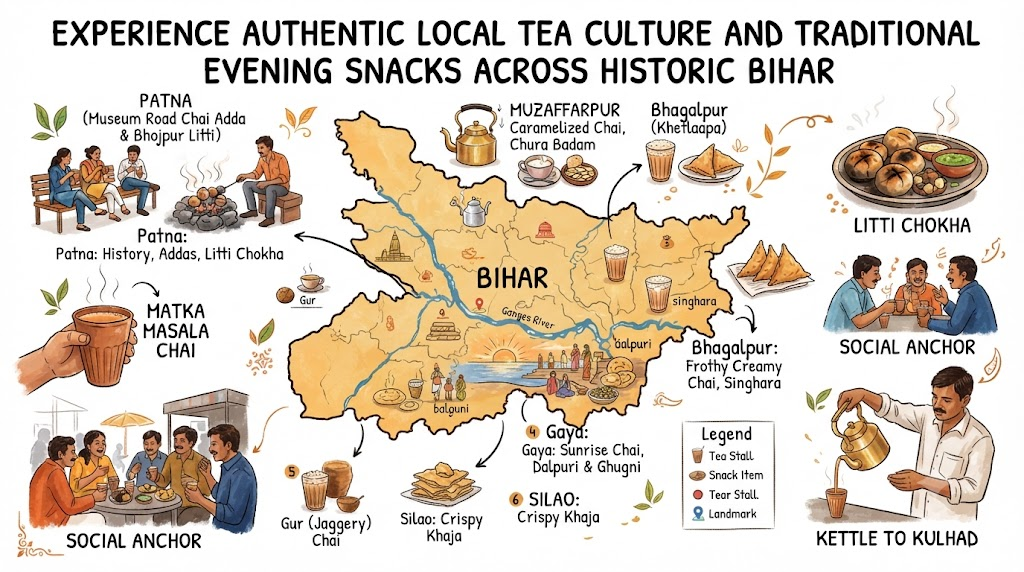
The primary culinary circuit flows along the sacred banks of the Ganges, linking the vibrant street food hubs of Patna to the pilgrimage alleys of Gaya, the intellectual lanes of Muzaffarpur, and the silk quarters of Bhagalpur. Along this belt, snacks like litti chokha, crisp dalpuris, singhara, and chura badam pair with malai-layered tea to create an unforgettable tapestry of regional flavors.
| Metric / Fact | Details |
|---|---|
| Geographic Hub | Gangetic Plains, Eastern India |
| Primary Transit Nodes | Patna Airport, Jay Prakash Narayan Terminal, NH 31 / Purvanchal Connectors |
| Signature Beverages | Matka Masala Chai, Gur (Jaggery) Chai, Sattu Sharbat |
| Staple Street Snacks | Litti Chokha, Dalpuri-Ghugni, Bihar-style Singhara, Khaja |
| Peak Culinary Season | October to March (Crisp mornings and cool evenings) |
| Average Snack Cost | ₹20 – ₹80 per serving |
Best Places or Experiences
Smoky charcoal-roasted litti with chokha.
Bhojpur Litti Chokha & Chai Corner
Tucked right beside Kargil Chowk on the northern fringe of Gandhi Maidan, this spot stands as an undeniable benchmark for charcoal-roasted litti. The stall crackles from morning to night, filling the air with the unmistakable fragrance of roasted gram flour, crushed ajwain, and pure desi ghee.
Every order is prepared with culinary theatrics: the dough balls are baked over open cow-dung and wood embers, cracked open by hand, and dunked directly into a brass vat of warm clarified butter. Pair them with a tumbler of intense, double-boiled ginger tea brewed in heavy milk for the quintessential Bihari evening ritual.
- Location: Near Gate No. 6, Gandhi Maidan, Patna (3.5 km from Patna Junction).
- Why it is worth visiting: Unmatched authenticity in wood-smoked sattu balls submerged in aromatic farm ghee.
- Best things to do: Watch the pit-masters turn coals bare-handed, pair your plate with fire-roasted brinjal chokha, and finish with sweet malai chai.
- Best time to visit: 5:00 PM to 8:30 PM for fresh batches and vibrant local energy.
- Ideal for whom: Solo backpackers, food history enthusiasts, and curious budget foodies.
- Travel tip: Ask for sukha litti if you prefer your ghee served on the side rather than fully drenched.
Patna Museum Road Chai Adda
Clustered under massive colonial-era banyan trees along Museum Road, this gathering spot represents the beating heart of Patna’s tea culture. It is not a single café, but an enduring row of wood-and-tin tea stalls operating brass samovars that whistle all day long.
Generations of scholars, journalists, and artists have gathered on these wooden benches to debate regional politics over clay cups of adrak-elaichi tea. The tea is brewed exceptionally strong, reduced slowly with buffalo milk until it attains a velvety texture, and served alongside crunchy salted biscuits or piping-hot aloo chops.
- Location: Budh Marg, Near Patna Museum, Central Patna (1.2 km from Patna Junction).
- Why it is worth visiting: The intellectual epicenter of Patna’s open-air tea conversations and rich street banter.
- Best things to do: Sip slow-boiled kadak chai, sample the paper-wrapped salted savory namkeen, and browse the open-air bookstalls nearby.
- Best time to visit: 7:00 AM to 9:30 AM for quiet morning breezes, or 4:00 PM for peak lively crowds.
- Ideal for whom: Writers, culture seekers, solo explorers, and history lovers.
- Travel tip: Bring exact change in coins or small paper notes, as digital network signals occasionally dip under the dense canopy.
DK Litti and Tea Stall, Bailey Road
Positioned right along the buzzing Bailey Road corridor near Khajpura, DK Litti Corner is an iconic evening landmark that draws queues stretching onto the sidewalk. Unlike rustic roadside pop-ups, this stall has perfected high-volume consistency without sacrificing the fiery authenticity of its fillings.
The sattu filling here carries a distinctive kick of pickled mango masala, raw mustard oil, and crushed green chillies. After tackling a plate of their fiery litti and tangy tomato relish, the neighboring counter serves boiling kulhad tea infused with crushed black pepper and clove to settle the palate.
- Location: Bailey Road, Khajpura Pillar No. 18, Patna (6 km from Patna Airport).
- Why it is worth visiting: Legendary spiced sattu blend featuring house-cured mustard oils and bold green chilli chutneys.
- Best things to do: Try the roasted garlic cloves mixed into the aloo chokha, sip the clove-infused chai, and observe the high-speed packing line.
- Best time to visit: 1:00 PM for lunch rush or 6:30 PM for post-work snack hour.
- Ideal for whom: Working professionals, families, road-trippers, and spice lovers.
- Travel tip: Parking on the main artery is heavily regulated; park your vehicle inside the designated commercial service lane.
Pappu Chaiwala & Snacks Hub, Muzaffarpur
Muzaffarpur is world-renowned for its shahi litchi, but its winter tea culture centered around Saraiyaganj is equally captivating. Pappu Chaiwala is an institution where tea is brewed over slow-burning charcoal braziers in broad aluminium pans, giving the milk a deeply caramelized, nutty note.
Accompanying the tea is the city’s favorite street snack: freshly fried chura badam (beaten rice tossed with peanuts, dried chillies, and rock salt) alongside crisp kachoris filled with spiced lentils. The ambient aroma of hot oil and simmering tea makes this a legendary halt for travelers heading north toward Janakpur or Sitamarhi.
- Location: Motijheel Market Lane, Saraiyaganj, Muzaffarpur (75 km north of Patna).
- Why it is worth visiting: Signature slow-reduced coal-brewed milk chai paired with freshly tempered chura badam.
- Best things to do: Taste freshly made hot lentil kachoris, order the double-malai kulhad tea, and pick up roasted savory beaten rice packets to go.
- Best time to visit: 6:30 AM to 9:00 AM to catch the hot kachori batches right out of the kadhai.
- Ideal for whom: Heritage road-trippers, culinary photographers, and early-morning wanderers.
- Travel tip: The market lanes are extremely narrow; disembark from your car on the main road and walk 200 meters inside.
Fresh savory singharas and chaat snacks.
Khetlaapa Tea & Nasta Centre, Bhagalpur
In the historic silk city of Bhagalpur, tea takes a dramatic turn toward rich, creamy perfection. Located near Khalifabagh Chowk, Khetlaapa draws people from every walk of life with its signature spices and frothy pour techniques.
Justdial
The accompanying culinary attraction here is the East Bihar special singhara—distinct from North Indian samosas with its paper-thin crust, whole coriander seeds, and tender cauliflower-potato filling. Sitting on a wooden bench, cracking the crispy pastry shell, and washing it down with sweet cardamom tea captures the true ease of small-town Bihar.
- Location: Khalifabagh Market Road, Adampur, Bhagalpur (220 km east of Patna). Justdial
- Why it is worth visiting: Thin-crust seasonal vegetable singharas served with frothy, thick-cream masala tea.
- Best things to do: Sample the winter special cauliflower singhara, request your tea unsweetened (bina cheeni), and buy local tilkut nearby.
- Best time to visit: 4:30 PM to 7:00 PM for fresh evening frying cycles.
- Ideal for whom: Couples, slow travelers, and sweet-and-savory pastry enthusiasts.
- Travel tip: Wear slip-on shoes since tea seating here often utilizes raised wooden platforms.
Falgu Riverfront Chai & Dalpuri Point, Gaya
Near the sacred ghats of Gaya, tea stalls awaken long before dawn to fuel morning pilgrims and holy visitors. This modest riverside open-air setup combines divine river breezes with a hearty breakfast plate of hot dalpuri (soft wheat flatbread stuffed with spiced chana dal) and black-chickpea ghugni.
After savoring the savory, cumin-rich gravy of the ghugni, the vendor pours dark, spiced black tea brewed with crushed black salt, lemon, and tulsi leaves—or full-cream milk chai according to your taste. The morning sun rising over the calm water creates an ethereal culinary setting.
- Location: Near Vishnupad Temple Corridor, Gaya (105 km south of Patna).
- Why it is worth visiting: Sacred riverfront ambiance combined with traditional breakfast dalpuri and restorative herbal chai.
- Best things to do: Eat steaming dalpuris topped with raw onion slices, sip hot tulsi tea on stone steps, and watch the sunrise rituals.
- Best time to visit: 5:30 AM to 8:00 AM for fresh river air and morning serenity.
- Ideal for whom: Pilgrims, photography buffs, budget backpackers, and spiritual travelers.
- Travel tip: Keep an eye on riverside monkeys who have a knack for snatching unattended snack plates.
Offbeat Exploration: Hidden Gems Tourists Miss
Silao Khaja Stalls on the Nalanda-Rajgir Highway
While passing through Nalanda district, commercial tourists often zoom past the sleepy hamlet of Silao. Pulling over reveals artisan shops layering paper-thin sheets of wheat flour and ghee into crispy, multi-layered khaja. Enjoying warm, unstewed salted khaja paired with a fresh glass of earthen-cup tea right beside the ancient ruins offers an unforgettable sensory throwback.
The Gur Chai Stalls of Bihta Bypass
Along the rural bypass roads of Bihta, rustic vendors have shunned refined white sugar entirely in favor of dark, unrefined sugarcane jaggery infused with crushed ginger and long pepper. Because sugarcane curdles boiling milk easily, these master brewers employ a rhythmic two-pot pouring technique that aerates the jaggery decoction into creamy milk right before serving.
Maner Dargah Ghat Tea Shacks
Behind the magnificent sandstone architecture of the 17th-century Chhoti Dargah in Maner, narrow earthen trails wind down toward the seasonal riverbeds. Here, rustic wooden shanties prepare piping hot tea brewed in copper pots, paired with the region’s world-famous gram-flour Maner Laddus. It remains one of the quietest, most scenic tea spots anywhere in central Bihar.
Detailed Practical Guidance for Travelers
| Destination | Standard Entry Fee | General Timings | Best Local Food Options Nearby | Recommended Nearby Attractions |
|---|---|---|---|---|
| Bhojpur Litti Corner (Patna) | Free (Snacks: ₹40-80) | 10:30 AM – 10:00 PM | Mutton Gravy Litti, Roasted Chokha | Golghar, Gandhi Sangrahalaya |
| Museum Road Chai Adda (Patna) | Free (Tea: ₹10-20) | 6:00 AM – 9:30 PM | Aloo Chop, Salted Bakery Biscuits | Patna Museum, Bihar Museum |
| DK Litti Corner (Patna) | Free (Snacks: ₹50-90) | 11:00 AM – 10:30 PM | Special Ghee Litti, Green Chutney | Patna Planetarium, Eco Park |
| Pappu Chaiwala (Muzaffarpur) | Free (Snacks: ₹15-40) | 6:00 AM – 9:00 PM | Spiced Chura Badam, Samosa Chaat | Jubba Sahni Park, Baba Garibnath |
| Khetlaapa Tea Point (Bhagalpur) | Free (Tea: ₹15-30) | 7:00 AM – 10:00 PM | Cauliflower Singhara, Khasta Puri | Vikramshila Ruins, Burhanath Temple |
| Falgu Dalpuri Stall (Gaya) | Free (Snacks: ₹30-60) | 5:30 AM – 1:00 PM | Chana Dalpuri, Spiced Black Ghugni | Vishnupad Temple, Mangla Gauri |
Logistics & On-Ground Navigation
Local Transport Options
- Shared & Reserved Auto-Rickshaws: The lifeline of Bihar’s major towns. Shared autos cost just ₹10 to ₹25 per short hop, while reserving the entire vehicle for customized stops requires negotiating upfront.
- App-Based Cabs & Autos: Ride-hailing platforms like Ola and Uber operate smoothly throughout Patna and Gaya, making it easy to hop between morning chai stalls and afternoon heritage sites without haggling.
- E-Rickshaws (“Totos”): Perfect for traversing congested market areas like Patna City, Motijheel in Muzaffarpur, and Khalifabagh in Bhagalpur at a leisurely ₹10 per rider.
- Intercity Express Trains: High-frequency, comfortable superfast trains (such as the Vande Bharat and Jan Shatabdi expresses) connect Patna to Gaya, Bhagalpur, and Muzaffarpur in under two to three hours.
Budget Planning
- Budget / Backpacker Tier: Expect to spend around ₹800 – ₹1,400 per day. This covers clean guest houses or pilgrim dharmashalas, public transportation via e-rickshaws, and generous indulgence in authentic street stalls, samosas, and chai.
- Mid-Range / Comfort Tier: Expect to spend around ₹3,000 – ₹5,500 per day. This includes private air-conditioned car rentals with drivers, stays in quality business hotels, and a mix of historic street eats alongside sit-down regional thali restaurants.
Safety and Inclusivity Tips
- For Families: The culinary trail is exceptionally welcoming to family groups. Vendors take great pride in accommodating kids by preparing milder variations of snacks and serving boiled, warm milk upon request.
- For Couples: Stick to bustling, daylight-to-early-evening food promenades such as Patna’s Marine Drive (Ganga Path) or the illuminated plazas outside Bihar Museum, which feature safe pedestrian walks and open-air seating.
- General Health & Safety: Always drink hot beverages brewed fresh in your sight, and verify that snacks are fried or roasted straight from boiling woks and burning embers. Keep a hand sanitizer handy for street dining.
Strategic Travel Planning Guardrails
Travel Planning Tips for Bihar
- Target the Winter Window: Plan your foodie trip between November and February, when cool Gangetic winds make steaming tea and charcoal-roasted snacks absolute bliss.
- Carry Cash for Local Stalls: While UPI and mobile QR payments are widespread even at small tea shacks, carrying ₹10, ₹20, and ₹50 cash notes ensures seamless transactions when telecom connectivity lags.
- Embrace the Early Morning Rhythm: The crispest dalpuris, kachoris, and freshly skimmed tea milk sell out by 9:30 AM; start your day with the sun.
- Dress for Foot Travel: Navigating the most historic tea alleys involves uneven cobblestones and bustling bazars; wear comfortable, slip-resistant walking shoes.
- Learn Regional Snack Lingo: Asking for sukha means no gravy/ghee, chhan-ke means piping hot out of the fryer, and kadak yields a darker, stronger brew.
Common Mistakes to Avoid
- Do not assume all tea stalls are identical: A stall boiling milk with charcoal will yield a much creamier, smokier cup than one utilizing high-pressure gas burners.
- Never skip the local accompaniments: Turning down roasted green chillies, pickled onions, or roasted coriander dip robs litti and samosas of their balanced flavors.
- Avoid traveling between distant cities during peak evening traffic: Always board intercity trains rather than getting stuck on state highway bottlenecks after dark.
- Do not discard clay kulhads in plastic bins: Clay cups are biodegradable; discard them into designated mud heaps or compost bins where they dissolve back into natural soil.
- Never accept pre-packed cold street savories: Always wait an extra five minutes for a fresh, bubbling batch to be lifted from the tawa or karahi.
Suggested Itinerary Blueprints
1. Day Quick Dash (Patna Urban Food Loop)
Designed for business travelers or short-transit explorers looking to experience the state capital’s culinary hallmarks in twelve hours.
- Morning (7:30 AM – 10:00 AM): Settle in at Patna Museum Road Chai Adda for double-boiled milk tea and crispy aloo chops, followed by a cultural walk through the historic galleries.
- Afternoon (1:00 PM – 3:00 PM): Head to Bailey Road for a fiery lunch plate at DK Litti Corner, cooling down with a glass of roasted cumin sattu drink.
- Evening (5:30 PM – 8:30 PM): Stroll along the Ganga Path (Marine Drive) to catch river breezes, then finish at Bhojpur Litti Corner near Gandhi Maidan for pure ghee-drenched litti and sweet kulhad chai.
2. Day Deep-Dive (Patna to the Spiritual South Circuit)
An experiential two-day route exploring modern urban food joints on day one, followed by heritage flavors along sacred ghats.
- Day 1 (Patna Gastronomy): Begin with classic kachori-jalebi breakfast near Fraser Road, explore the architectural wonders of Bihar Museum, stop for afternoon chai along Boring Canal Road, and wrap up with smoky tandoori tea at Maurya Lok complex.
- Day 2 (Nalanda & Gaya Delights): Take an early morning train to Gaya. Feast on warm dalpuri and ghugni at Falgu Riverfront, visit the sacred Vishnupad Temple, drive through the hills of Rajgir, and halt at Silao for crispy afternoon khaja and spiced jaggery tea before returning.
3. Complete Weekend Travel Plan (Grand Gangetic Food Trail)
A comprehensive 72-hour weekend voyage covering three culturally distinct culinary destinations.
- Friday (Arrival in Patna): Check into your hotel, embark on a progressive tea-tasting crawl starting from Budh Marg to Gandhi Maidan, and spend the night sampling regional street fare.
- Saturday (Muzaffarpur Excursion): Cross the iconic Digha-Sonpur rail-road bridge early morning to Muzaffarpur. Spend your morning sipping coal-brazier tea at Pappu Chaiwala, snack on roasted chura badam, explore local artisan markets, and head back by nightfall.
- Sunday (Silk & Riverfronts in Bhagalpur): Take a rapid morning train east to Bhagalpur. Discover the unique thin-crust cauliflower singharas at Khetlaapa Tea Point, taste fresh seasonal fruit preparations, and wrap up your culinary expedition with riverside evening chai along the Gangetic bends.
Common Tourist Mistakes to Avoid
Geographic Blunders
Attempting to sandwich Muzaffarpur (north of the Ganges) and Gaya (south in the Magadh hills) into the exact same day is a recipe for exhaustion. Focus on one side of the river per day to account for bridge crossings and intercity rail transfers.
Commercial Traps
Spending your evenings seated inside sterile glass shopping malls along Fraser Road will rob you of real local flavor. Skip generic café chains completely; the genuine social warmth, political wit, and best brewing traditions reside on rustic wooden benches at local street stalls.
Neglecting Modern/Alternative Zones
Many visitors stick only to historic market corners and overlook Patna’s modern, beautifully planned waterfront expansions. Strolling along the pedestrian boulevards of the Ganga Riverfront at dusk provides world-class river views, modern artisanal tea pop-ups, and a safe, family-friendly evening atmosphere.
Transport Overpayment
Hailing unmetered auto-rickshaws directly outside the exit doors of major railway stations often results in inflated quotes. Walk fifty meters out to the designated prepaid counter, hop on an e-rickshaw, or cross-reference pricing on ride-hailing mobile apps before confirming your fare.
Luxury Dining Bias
Confining your meals to air-conditioned five-star hotel dining rooms shields you from the culinary soul of the state. Bihar’s most complex, authentic culinary recipes—from the spicy mustard pungency of eggplant chokha to the precise layering of afternoon khaja—have been guarded and perfected by street vendors for generations.
Frequently Asked Questions
1. Is it safe to drink tea and eat street snacks in Bihar?
Yes, it is very safe if you follow common-sense street food rules. Because tea is boiled vigorously in boiling water and milk right before your eyes, it is one of the safest hot beverages you can consume. For snacks, always patronize busy stalls with high turnover where litti is roasted fresh over hot coals and fried items are lifted straight from bubbling oil.
2. What is the usual price range for tea and snacks across Bihar?
Street-side culinary exploration in Bihar remains remarkably affordable. A classic terracotta cup of masala or ginger chai ranges between ₹10 and ₹20, a complete plate of two desi-ghee littis with chokha costs between ₹40 and ₹80, and single breakfast savory items like dalpuri or singhara sell for ₹15 to ₹30.
3. What is the difference between Bihari Singhara and standard North Indian Samosa?
While a typical samosa has a thick, doughy crust packed primarily with mashed cumin potatoes, the Bihari singhara features a much thinner, flakier, puff-pastry-like crust. The filling is chunky rather than mashed, combining diced potatoes, roasted peanuts, whole coriander seeds, and tender cauliflower florets spiced with wild celery seeds (radhuni).
4. Are these traditional snack places suitable for vegetarians?
Virtually all traditional tea and savory snack joints across Bihar are strictly vegetarian. Traditional snacks like litti chokha, dalpuri, ghugni, kachori, and singhara rely entirely on roasted grains, lentils, fresh vegetables, and dairy ghee, making the state an absolute paradise for vegetarian travelers.
5. How do I order tea that is less sweet at local tea stalls?
Street chai vendors in Bihar traditionally brew their tea sweet and rich. If you prefer low sugar or no sugar, clearly ask the vendor for “kam cheeni” (less sugar) or “bina cheeni ki chai” (tea without sugar) before they begin brewing your individual kulhad.
6. What makes the tea in Bihar taste unique compared to other states?
The distinct taste comes from the slow reduction of rich buffalo milk in heavy iron pans, which slightly caramelizes the lactose. Furthermore, serving the beverage in unglazed, hand-turned terracotta kulhads infuses every sip with a refreshing, earthy mineral aroma known locally as sondha pan.
7. Can I find vegan-friendly snacks on this culinary trail?
Yes, you can easily find vegan choices by requesting your litti served sukha (dry, without being submerged in dairy ghee). Roasted chura badam, oil-fried singharas, boiled sattu sherbet made with chilled water and lemon, and plain black lemon tea are naturally plant-based and dairy-free.
8. Which festival season offers the best traditional snacks in Bihar?
The autumn-winter festive period during Chhath Puja and Makar Sankranti (October through January) is unmatched. During these months, the streets overflow with winter specials like freshly beaten flattened rice, curd preparations, date-palm jaggery sweets, spiced tilkut, and steaming cauldrons of hot winter tea.
9. Are digital payments accepted at smaller roadside stalls?
Yes, digital payments via QR codes and UPI applications (such as PhonePe, Google Pay, and Paytm) are ubiquitous even at tiny tea shacks across Bihar. However, carrying some small paper currency is always wise in case of unexpected battery depletion or temporary cellular network drops.
10. What is the ideal beverage pairing for Litti Chokha?
While most locals pair litti with chilled, spiced sattu sharbat during the blazing heat of summer, a dark ginger-clove spiced chai in an earthen kulhad is the undisputed gold standard pairing during breezy mornings and cool winter evenings.
11. Is language a barrier for travelers looking to explore local food hubs?
Not at all. While locals converse comfortably in regional languages like Bhojpuri, Maithili, Magahi, and Angika, almost every vendor and city resident speaks and understands standard Hindi fluently. Basic conversational English is also widely understood in urban transit hubs and university zones.
12. How do I distinguish an authentic coal-roasted litti stall from a commercial imitation?
Authentic litti vendors will always have an open, glowing brazier of dried cow-dung cakes and hardwood embers burning beside their counter. Avoid modern fast-food shops that deep-fry their litti dough balls in oil, as true litti must have that characteristic smoky, blistered outer crust achieved only through woodfire roasting.
Conclusion
Choosing to explore Bihar through its humble tea stalls and neighborhood food benches is an antidote to the sanitized, predictable nature of modern travel. It is a journey that trades velvet dining chairs for warm wooden benches, and processed flavors for the ancient, honest marriage of woodsmoke, roasted grain, and sweet cardamom cream. Standing on a misty riverbank with a warm earthen cup cradled in your palms, watching life unfold along the eternal Ganges, you realize that the truest soul of travel was never hidden in a five-star brochure—it was simmering in a rustic kettle right here all along.
