Introduction
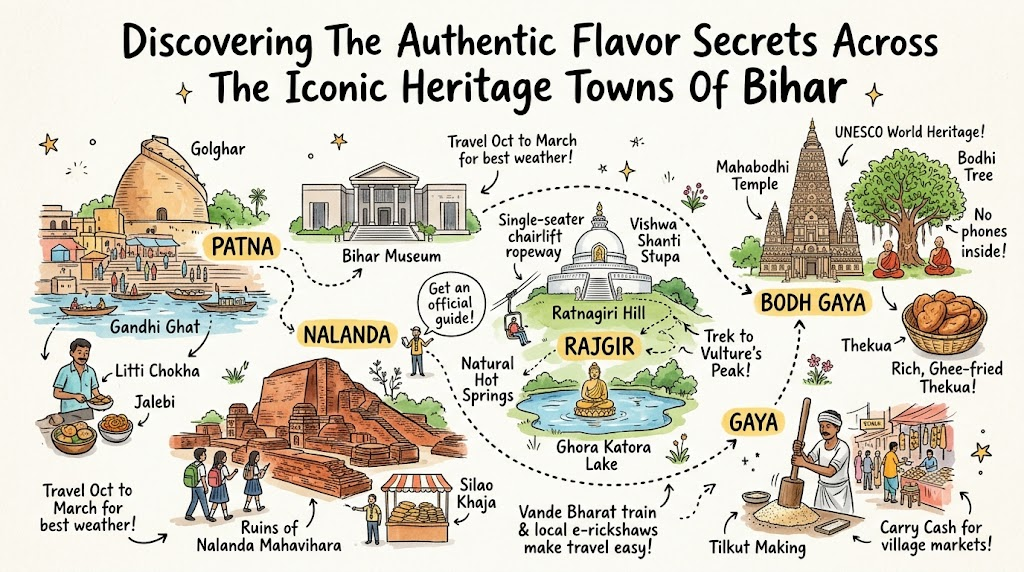
Mainstream tourism often traps travelers in crowded corridors, artificial resorts, and curated souvenir strips. Bihar offers the opposite: a raw, grounded journey into living antiquity where sacred rivers meet spiritual philosophies born millennia ago.
Here, ancient monastic ruins share narrow lanes with bustling confectioneries where copper cauldrons bubble with bubbling clarified butter. A journey through this heartland rewards curious travelers seeking profound cultural connections and culinary treasures perfected over generations.
Authentic Bihari Thekua fried in pure ghee
Why Bihar is a must-visit city
Bihar stands as the spiritual cradle and intellectual bedrock of the Indian subcontinent. It was here that Siddhartha Gautama found enlightenment under the Bodhi tree, Mahavira preached Jain philosophy, and scholars congregated at the world’s first global residential universities.
Traversing this historic region is remarkably smooth today due to four-lane expressways, modern Vande Bharat rail links, and direct flights connecting Patna, Gaya, and Darbhanga. The core tourist circuit seamlessly connects Patna, Nalanda, Rajgir, and Bodh Gaya, making it accessible for solo backpackers, multigenerational families, and heritage enthusiasts alike.
| Metric / Fact | Details |
|---|---|
| Primary Circuit | Patna – Nalanda – Rajgir – Bodh Gaya |
| Best Travel Season | October to March (pleasant days, cool evenings) |
| Nearest International Gateways | Jay Prakash Narayan Airport (Patna), Gaya Airport |
| Core Heritage Highlights | UNESCO World Heritage Sites, Ancient Monasteries, Hot Springs |
| Signature Local Delicacy | Thekua (traditional jaggery & whole wheat delicacy) |
Best Places or Experiences
Mahabodhi Temple Complex & Bodhi Tree
Rising dramatically above the verdant plains of the Falgu river basin, the Mahabodhi Temple Complex represents one of the earliest brick structures surviving in eastern India. The 50-meter-high grand spire, flanked by intricate votive stupas, marks the sacred spot where Prince Siddhartha attained supreme enlightenment in the 6th century BCE.
Walking into this sanctum immerses you in a serene aura of chanting Tibetan monks, fluttering prayer flags, and the rustling leaves of the sacred Bodhi Tree. The surrounding stone railings date back to the Sunga and Mauryan eras, retaining original carved medallions depicting mythological motifs and lotus rosettes.
The majestic Mahabodhi Temple spire in Bodh Gaya.
- Location: Bodh Gaya, Gaya District (approx. 115 km south of Patna).
- Why it is worth visiting: It is a UNESCO World Heritage Site marking the geographic origin of Buddhism.
- Best things to do: Sit for early morning meditation beneath the Bodhi tree; observe the 1st-century BCE sandstone Vajrasana (Diamond Throne); walk through the beautifully landscaped meditation garden.
- Best time to visit: 5:30 AM to 8:30 AM for serene meditation before crowds arrive; visit between November and February.
- Ideal for whom: Spiritual seekers, architecture admirers, history enthusiasts, and solo explorers.
- Travel tip: > Mobile phones and electronic gadgets are strictly banned inside the main temple premises; deposit them at the secure counter near the primary security checkpoint.
Ruins of Nalanda Mahavihara
The sprawling brick monastic complex of Nalanda Mahavihara was an intellectual powerhouse that attracted over 10,000 scholars and 2,000 teachers from across Asia during its peak. Excavations reveal a masterfully planned university campus featuring dormitories, lecture halls, meditation chambers, and intricate drainage canals engineered between the 5th and 12th centuries CE.
Stupa No. 3 stands prominently with its tiered terraces, sculpted stucco panels, and staircase overlooking centuries of academic heritage. Strolling through the brick pathways allows you to see how ancient scholars lived, studied astronomy and logic, and engaged in philosophical debate.
Archaeological ruins of Nalanda Mahavihara.
- Location: Nalanda District, near Bargaon (approx. 85 km southeast of Patna).
- Why it is worth visiting: The world’s first residential international university and a UNESCO World Heritage Monument.
- Best things to do: Examine the stucco Buddha figurines adorning Stupa No. 3; tour the on-site Archaeological Museum; decipher the thermal cooling architecture visible inside ancient student hostel cells.
- Best time to visit: 9:00 AM to 11:30 AM during winter months before the afternoon sun intensifies.
- Ideal for whom: History buffs, architecture students, photographers, and academic researchers.
- Travel tip: Hire an ASI-licensed guide at the official ticket counter; unverified local guides outside often share unverified folklore instead of archaeological facts.
Vishwa Shanti Stupa & Griddhakuta Peak
Perched atop the craggy Ratnagiri Hill in Rajgir, the gleaming white Vishwa Shanti Stupa (World Peace Pagoda) radiates tranquility over the surrounding forested valleys. Built under the guidance of Japanese Buddhist monk Nichidatsu Fujii, the massive marble dome houses four gilded bronze statues of Buddha depicting his birth, enlightenment, teaching, and passing.
Adjacent to the stupa lies Griddhakuta (Vulture’s Peak), where Lord Buddha delivered his foundational Prajnaparamita sutras to assemblies of monks. The panoramic view of the ancient ring of hills that once defended the Magadha capital of Rajagriha is breathtaking.
Vishwa Shanti Stupa overlooking Rajgir valley.
- Location: Rajgir, Nalanda District (approx. 100 km from Patna).
- Why it is worth visiting: Houses the world’s most accessible hilltop peace pagoda reached via a scenic single-seater ropeway.
- Best things to do: Ride the historic Japanese ropeway chairlift; trek the ancient biped stone path to Griddhakuta Peak; listen to the rhythmic taiko drumming during afternoon prayers inside the Japanese temple.
- Best time to visit: 3:30 PM to 5:30 PM for golden hour photography and sunset across the Rajgir ridges.
- Ideal for whom: Couples, spiritual travelers, trekking enthusiasts, and families.
- Travel tip: If you have knee issues, take the single-seater ropeway up and down rather than climbing the steep 1,000-step stairway.
Patna Museum & Bihar Museum Cultural Corridor
The state capital presents a striking juxtaposition between classical antiquity and avant-garde modern architecture along Bailey Road. The Bihar Museum, designed by renowned Japanese architect Fumihiko Maki, houses priceless antiquities within its weathered Corten steel walls, including the celebrated 3rd-century BCE polished sandstone Didarganj Yakshi.
A short drive eastward brings you to the historic Patna Museum, built in 1917 in Mughal-Rajput style, hosting an ancient fossilized pine tree spanning over 200 million years. Together, these institutions provide a foundational narrative for the entire Gangetic civilization.
- Location: Jawaharlal Nehru Marg (Bailey Road), Patna city center.
- Why it is worth visiting: Houses the world’s most comprehensive collection of Mauryan, Gupta, and Pala stone sculptures.
- Best things to do: View the lustrous finish on the Didarganj Yakshi sculpture; explore the interactive children’s gallery and botanical courtyards; visit the rare collection of Tibetan Thangka paintings.
- Best time to visit: 11:00 AM to 3:00 PM (air-conditioned indoor galleries make it ideal for mid-day heat).
- Ideal for whom: Art lovers, historians, museum curators, and traveling families.
- Travel tip: > Both museums remain closed on Mondays; plan your visit between Tuesday and Sunday to avoid missing the galleries.
Golghar & The Historic Riverfront Ghats
Built by Captain John Garstin in 1786 as a colossal famine granary following the devastating famine of 1770, Golghar remains one of Patna’s most distinctive architectural landmarks. The massive dome-shaped stupa-like structure features no pillars inside, relying entirely on 3.6-meter-thick brick foundation walls.
Winding twin spiral staircases wrap around the exterior, designed so laborers carrying heavy grain sacks could ascend one side and descend the other uninterrupted. The summit delivers a wide-angle vista over Patna’s urban sprawl and the silver ribbon of the holy River Ganga.
- Location: Near Gandhi Maidan, Patna (heart of the capital city).
- Why it is worth visiting: An unusual pillarless beehive architectural wonder offering the highest historic observation point in central Patna.
- Best things to do: Climb the exterior staircase during cool morning breezes; stroll down to nearby Gandhi Ghat for the vibrant evening Ganga Aarti; take a sunset boat ride on a country dinghy along the riverbank.
- Best time to visit: 4:30 PM to 6:30 PM to enjoy the river sunset after your climb.
- Ideal for whom: Urban explorers, families, landscape photographers, and heritage walkers.
- Travel tip: Wear shoes with solid traction; the spiral steps can feel slick underfoot due to fine river sand carried by the winds.
Offbeat Exploration: Hidden Gems Tourists Miss
Barabar Caves: Echo Chambers of Ashokan Antiquity
Tucked away in the granite hills of Jehanabad district, the Barabar Caves represent the earliest surviving rock-cut architectural monuments in India, dating back to Emperor Ashoka’s reign in the 3rd century BCE. Carved specifically for ascetic monks of the ancient Ajivika sect, chambers like the Lomas Rishi Cave feature an intricately sculpted chaitya arch facade. Inside, the granite walls are polished to a glassy, mirror-like smoothness, producing reverberating acoustics where a whisper echoes for several seconds.
Ghora Katora Lake: A Hidden Sanctuary in Rajgir
Surrounded by steep hills on three sides, Ghora Katora (Horse Bowl Lake) is a clean, tranquil natural reservoir where motorized vehicles are strictly banned. Travelers reach this serene water body using colorful electric rickshaws or horse-drawn tongas traversing dense reserve forest tracts. In the center of the lake sits a monolithic pink marble statue of Lord Buddha, reflecting peacefully against the azure water.
Traditional Thekua Making in Rural Mithila Courtyards
While modern sweetshops across Patna sell boxed dry snacks, the authentic soul of Thekua resides inside household courtyards during community festivals like Chhath Puja. Hand-pressed on hand-carved wooden blocks called Saancha, this revered sweet balances whole wheat flour, crushed green cardamom, desiccated coconut, and pure local sugarcane jaggery fried slowly in iron woks over wood fires. Tasting a batch hot off the fire reveals a depth of flavor commercial bakeries cannot replicate.
Detailed Practical Guidance for Travelers
| Destination | Standard Entry Fee | General Timings | Best Local Food Options Nearby | Recommended Nearby Attractions |
|---|---|---|---|---|
| Mahabodhi Temple | Free (INR 100 for camera) | 5:00 AM – 9:00 PM | Tibet Kitchen (Butter Tea, Thukpa), Mohammad’s Restaurant | Great Buddha Statue, Royal Bhutan Monastery |
| Nalanda Mahavihara | INR 50 (Indian), INR 600 (Foreign) | 9:00 AM – 5:00 PM | Silao Khaja stalls on Rajgir highway (crisp sweet pastry) | Nalanda Archaeological Museum, Xuanzang Memorial |
| Vishwa Shanti Stupa | Free (Ropeway: INR 120 return) | 9:00 AM – 5:00 PM | Green Hotel (Traditional Bihari Litti Chokha & Sattu drinks) | Ghora Katora Lake, Venu Vana, Saptaparni Cave |
| Bihar Museum | INR 100 (Adults), INR 50 (Children) | 10:30 AM – 5:00 PM | Potbelly Rooftop Cafe (Bhojpuri & Maithili Thalis) | Patna Planetarium, Patna Museum, High Court Heritage |
| Golghar | INR 20 per person | 10:00 AM – 5:00 PM | Maurya Lok Food Complex (local Chaat, hot Jalebis) | Gandhi Maidan, Patna Sahib Gurudwara, Gandhi Ghat |
Logistics & On-Ground Navigation
Local Transport Options
- Railways: The lifelines connecting Patna, Gaya, and Rajgir run frequently; opt for Jan Shatabdi or Vande Bharat services for clean, punctual intercity hops.
- Pre-Booked Cabs: For navigating the golden triangle (Patna–Nalanda–Bodh Gaya), booking a full-day cab through trusted operators costs roughly INR 2,800 to 3,500 per day for an air-conditioned sedan.
- Auto-Rickshaws & E-Rickshaws: E-rickshaws dominate city centers like Gaya and Rajgir. They are quiet, cheap (INR 15–30 for short hops), and slip easily through crowded bazaar corridors.
- Rideshare Apps: Ola and Uber operate reliably across urban Patna, offering predictable pricing between airports, stations, and museums.
Budget Planning
- Backpacker / Budget Tier: INR 1,200 – 1,800 per day. Covers clean heritage dharamsalas or budget guesthouses, local state transport buses, shared auto-rickshaws, and hearty meals at local bhojanalayas serving piping-hot Litti Chokha.
- Mid-Range / Comfort Tier: INR 4,500 – 7,500 per day. Includes comfortable 3-star to 4-star boutique hotels, private day cabs with drivers, sit-down family restaurants, and monument guide bookings.
Safety and Inclusivity Tips
- For Families: Keep water purification tablets or stick strictly to sealed mineral water bottles. Distances between historic stops involve 2–3 hours on rural highways; keep healthy dry snacks like baked Thekua and roasted Makhana (fox nuts) handy for young children.
- For Couples: Public monuments and temple grounds are welcoming and safe. Dress respectfully (covering shoulders and knees) to align with conservative local customs, particularly inside Buddhist monasteries and Hindu pilgrimage sites.
- General Safety: Avoid traversing deserted rural bypasses late at night past 10:00 PM. Keep emergency numbers recorded offline and verify that your app-based rides have active child locks disabled.
Strategic Travel Planning Guardrails
Travel Planning Tips for Bihar
- Book Autumn/Winter Months: Plan visits between October and March when ambient temperatures range between 12°C and 26°C, avoiding extreme northern Indian summer heatwaves.
- Cash is Essential in Suburbs: While UPI payment QR codes are widespread even at small fruit stalls, carry INR 2,000–3,000 in crisp cash for rural auto rides and inner-village market purchases.
- Observe Monastic Modesty: When entering Bodh Gaya monasteries, remove leather accessories where requested and step over wooden door thresholds rather than stamping on them.
- Reserve Rail Berths in Advance: Major express trains running through Patna Junction and Gaya Junction fill weeks ahead due to high festive commuter movement.
- Pack Walking Shoes: Heritage complexes like Nalanda and Rajgir require between 8,000 and 14,000 walking steps per day over uneven brick and stone pavements.
Common Mistakes to Avoid
- Overpacking the Daily Schedule: Attempting to visit Patna, Nalanda, and Bodh Gaya all within a single calendar day leads to exhaustion and empty road-weariness.
- Relying Exclusively on Fast Food: Skipping modest corner sweetshops means missing out on freshly made regional delicacies like Silao ka Khaja, Gaya Tilkut, and fresh Chhena Murki.
- Ignoring Government Museums: Skipping the on-site archaeological museums near excavated sites deprives you of viewing the delicate original bronze idols preserved under climate control.
- Blindly Trusting Highway Touts: Never accept unmetered, unsolicited cab offers right inside railway arrival platforms; use official prepaid counters or app bookings.
- Assuming Lack of Connectivity: Assuming rural regions lack digital banking or cellular networks; modern 5G signals cover all prime tourist nodes across Bihar.
Suggested Itinerary Blueprints
Day Quick Dash (Patna Urban Heritage Run)
- Target Audience: Business travelers, short layover visitors, or solo weekend tourists.
- 08:30 AM: Start with traditional Puri-Sabzi and Jalebi breakfast near Fraser Road.
- 10:00 AM: Tour the modern galleries and sculpture courtyards at the Bihar Museum.
- 01:30 PM: Enjoy a traditional Champaran mutton or regional vegetarian Thali at Maurya Lok.
- 03:00 PM: Climb the iconic spiral ramps of Golghar and view the Ganga riverfront.
- 05:30 PM: Conclude the evening witnessing the Ganga Aarti rituals at Gandhi Ghat.
Day Deep-Dive (Spiritual & Scholarly Triangle)
- Target Audience: Heritage enthusiasts, culture lovers, and multi-day travelers.
- Day 1 (Nalanda & Rajgir): Depart Patna early via NH31; spend the morning inspecting the excavated monasteries of Nalanda. Head to Rajgir for an afternoon ropeway ride up Ratnagiri Hill to the Vishwa Shanti Stupa. Enjoy hot Silao Khaja snacks before an overnight stay in Rajgir.
- Day 2 (Bodh Gaya Sanctuary): Drive early morning to Bodh Gaya (approx. 2 hours). Spend your morning absorbing the peace of the Mahabodhi Temple and meditating under the sacred Bodhi Tree. Dedicate the afternoon to touring international Buddhist monasteries (Thai, Japanese, Tibetan) and the 80-foot Great Buddha statue before evening departure.
Complete Weekend Travel Plan (Grand Magadha Historical Circuit)
- Friday: Arrive in Patna. Explore the Didarganj Yakshi at the Bihar Museum, enjoy local street food at Maurya Lok, and walk through the historic lanes of old Patna.
- Saturday: Depart at dawn for Nalanda Mahavihara ruins. Midday transit to Rajgir to visit the hot sulfur springs and take the chairlift to the World Peace Pagoda. Drive to Bodh Gaya for dinner at a Tibetan cafe and restful night stay.
- Sunday: Wake before sunrise for quiet contemplation under the Bodhi Tree. Tour the international monastic quarter and the archaeological museum. Complete your circuit with a quick shopping stop in Gaya bazaar for authentic sesame Tilkut before taking an evening train or flight home.
Common Tourist Mistakes to Avoid
- Geographic Blunders: Many travelers mistakenly book hotels in Patna while planning multiple day-trips back and forth to Bodh Gaya. Gaya is over 110 km south; base yourself directly in Bodh Gaya or Rajgir to avoid spending six hours inside transit daily.
- Commercial Traps: Spending afternoon hours browsing generic indoor shopping malls along Patna’s Boring Road wastes precious daylight. Instead, explore traditional bazaars like Hathwa Market or the handicraft emporium Upendra Maharathi Shilp Anusandhan Sansthan for Madhubani art.
- Neglecting Modern/Alternative Zones: Visitors often rush exclusively between ancient monuments without visiting modern cultural spaces like Patna’s Sabhyata Dwar, the serene Buddha Smriti Park, or open-air cafes near the eco-parks.
- Transport Overpayment: Unregulated rickshaw operators stationed outside Gaya Junction often demand inflated rates from newcomers. Check rates on ride-hailing apps or confirm the standard union rate with station police kiosks before boarding.
- Luxury Dining Bias: Eating only inside hotel dining halls shields you from true regional flavor. The real culinary soul of Bihar thrives in small family-run establishments where authentic Litti Chokha, slow-cooked Champaran handi meat, and ghee-fried Thekua are cooked fresh daily.
Frequently Asked Questions
1. Where can I find the most authentic Thekua in Bihar?
While Thekua is traditionally prepared in family homes during the sacred festival of Chhath, travelers can buy high-quality, authentic Thekua year-round from long-standing heritage sweet vendors like Harilal’s in Patna, local confectioneries around Gandhi Maidan, and rural bazaars across Gaya and Nalanda.
2. What ingredients make authentic traditional Bihari Thekua unique?
Authentic Thekua uses stone-ground coarse whole wheat flour (atta), desi ghee, pure unrefined jaggery (gur), cracked green cardamom, and dry coconut flakes, carefully pressed on wooden carved dies called Saancha and deep-fried over slow heat to achieve a crumbly, biscuit-like texture.
3. Is it safe for solo female travelers to tour the Bihar Buddhist circuit?
Yes, the core Buddhist circuit connecting Bodh Gaya, Rajgir, and Nalanda receives thousands of international pilgrims every year and is welcoming; solo travelers should arrange daytime transit between hubs and choose verified guesthouses.
4. How many days are ideal for exploring the complete heritage circuit?
A well-paced itinerary requires 4 to 5 days, which allows comfortable travel between Patna’s museums, the educational ruins of Nalanda, the historic hills of Rajgir, and the sacred temples of Bodh Gaya without rushing.
5. What is the dress code for visiting the Mahabodhi Temple?
Visitors must wear modest attire covering shoulders and knees; hats, caps, and footwear must be deposited at the outer entrance shoe stalls before stepping onto the temple complex stones.
6. Are mobile phones permitted inside the Mahabodhi Temple in Bodh Gaya?
No, mobile phones, smartwatches, and large electronics are prohibited inside the inner complex for security purposes; you must leave them in the secure locker facility near the primary screening gate.
7. How do I travel between Rajgir and Nalanda easily?
The two historical towns sit roughly 15 km apart, and the journey takes only 25 minutes using inexpensive shared auto-rickshaws, private taxis, or local electric shuttles running frequently along the main highway.
8. What other local sweets should I taste besides Thekua?
Do not leave the state without tasting Silao ka Khaja (a multi-layered crisp pastry), Gaya ka Tilkut (pounded sesame brittle made with jaggery), Maner ka Laddu, and Chhena Jhili.
9. Can I visit the Nalanda ruins without hiring an on-site guide?
While you can freely walk through the excavated campus, hiring an official ASI-licensed guide from the ticket office brings the complex alive by decoding the monastery numbers, ancient drainage channels, and student dorm layout.
10. What is the single best time of year to visit this region?
The ideal window spans from late October through early March, when the weather remains pleasant, cool, and dry, making outdoor monument exploration enjoyable compared to blistering summer months.
11. Is digital payment widely accepted across smaller local stalls?
Yes, QR-code-based UPI transactions are accepted across the majority of tea stalls, snack corners, and auto-rickshaws, though carrying some cash remains advisable for remote monument tickets and deep village bazaars.
12. How accessible are the hilltop shrines in Rajgir for elderly visitors?
The Vishwa Shanti Stupa at Rajgir is accessible for elderly travelers thanks to an aerial chairlift ropeway that ascends the steep hill in under eight minutes, bypassing the stone stairs entirely.
Conclusion
Stepping into Bihar breaks through ordinary travel cliches, offering an enriching encounter with the origins of great world philosophies and living heritage. Whether standing silently under the Bodhi tree where Gautama meditated, tracing the stone pathways of scholars at Nalanda, or breaking into a crisp, freshly made piece of golden Thekua at a rustic roadside stall, you connect with an enduring civilizational story. It is a journey that changes your view of eastern India, leaving you grounded, inspired, and deeply connected to the roots of the subcontinent.
