Introduction
Mainstream vacation spots across India have become overcrowded, marked by inflated resort tariffs, packed souvenir streets, and staged experiences. In contrast, Bihar offers genuine cultural authenticity where history lives in active stupas, ancient stone corridors, and bustling riverside ghats.
Traveling here is an unfiltered encounter with deep civilizational roots that do not break the bank. You do not need luxury tour packages to wander through millenia-old university grounds or savor regional delicacies served hot from brass woks. Budget travel in Bihar unlocks remarkable hospitality, pocket-friendly public transit, and world-class heritage at unmatched value.
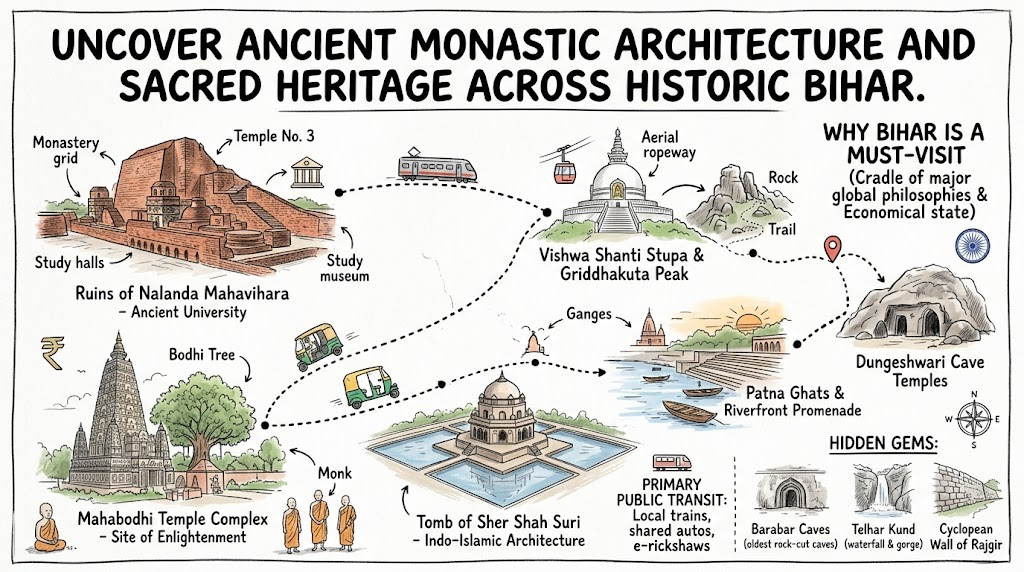
Why Bihar is a must-visit city
Bihar is the cradle of major global philosophies, having nurtured the founding paths of Buddhism and Jainism while anchoring the ancient Mauryan and Gupta empires. From the intellectual legacies of Nalanda to the sacred enlightenment grounds of Bodh Gaya, its soil holds immense intellectual, spiritual, and artistic weight. Despite this immense historical significance, Bihar remains one of India’s most economical states to explore, offering affordable access to UNESCO World Heritage monuments, lush hill valleys, and storied riverfronts.
The state’s travel connectivity has grown substantially, featuring smooth expressways, well-connected rail links across Patna, Gaya, and Rajgir, and frequent public state-run electric buses. Budget travelers, backpackers, solo explorers, and families can easily traverse its classic circuits without sacrificing comfort or safety.
| Travel Circuit Parameter | Practical Details |
|---|---|
| Primary Transit Gateways | Jay Prakash Narayan Airport (Patna), Gaya International Airport, Patna Junction |
| Best Travel Season | October to March (Comfortable daytime weather, cool mornings) |
| Average Daily Budget | ₹1,000 – ₹1,800 per day (Backpacking / Budget explorer tier) |
| Primary Public Transit | Local passenger trains, shared autos, and e-rickshaws |
| Circuit Routing Scope | Patna – Nalanda – Rajgir – Bodh Gaya – Sasaram |
The sacred Mahabodhi Temple in Bodh Gaya.
Best Places or Experiences
Ruins of Nalanda Mahavihara
The archaeological complex of Nalanda Mahavihara stands as a testament to the world’s first great residential university, where over ten thousand scholars once gathered to study philosophy, astronomy, mathematics, and medicine. Walking along the red-brick terraces reveals a massive monastic grid of study halls, living cells, meditation rooms, and water-harvesting wells, all engineered with sophisticated drainage channels.
The towering silhouette of Temple No. 3, flanked by votive stupas and stucco Buddha figures, commands the skyline with quiet grandeur. Even on a tight backpacker budget, spending a morning walking among these crimson ruins delivers a deeply enriching historical experience at a tiny fraction of typical tourist admission costs.
- Location: Nalanda District; roughly 85 km southeast of Patna and 15 km north of Rajgir.
- Why it is worth visiting: A UNESCO World Heritage masterpiece showcasing the intellectual zenith of ancient Indian education.
- Best things to do: Study the intricate stucco sculptures of Temple No. 3, walk the long brick dormitory walkways of Monastery 1, and explore the nearby Archaeological Museum’s bronze collection.
- Best time to visit: 9:00 AM to 11:30 AM during winter months to avoid midday heat.
- Ideal for whom: History buffs, architecture lovers, solo backpackers, and student groups.
- Travel tip: Skip costly private day-tours; take a local MEMU passenger train from Patna to Nalanda or Rajgir for less than ₹50.
Ancient brick structures of Nalanda Mahavihara.
Mahabodhi Temple Complex, Bodh Gaya
The Mahabodhi Temple marks the sacred spot where Siddhartha Gautama attained enlightenment beneath the sacred Bodhi Tree over 2,500 years ago. The majestic 50-meter-high pyramidal stone spire is adorned with detailed niches, while the surrounding gardens feature serene votive stupas and ancient stone railings constructed during the Sunga and Mauryan eras.
Dawn and dusk fill the air with deep resonant chants from maroon-robed monks circumambulating the sanctum. The peaceful meditation park, quiet reflection ponds, and sacred stone platforms offer a world-class spiritual experience that remains free of charge for every visitor.
- Location: Bodh Gaya, Gaya District; approximately 115 km south of Patna and 16 km from Gaya Junction railway station.
- Why it is worth visiting: The supreme spiritual center of Buddhism and a living architectural treasure.
- Best things to do: Sit beneath the descendants of the Bodhi Tree, admire the gilded Buddha inside the inner sanctum, and walk around the Lotus Pond during morning chants.
- Best time to visit: 5:30 AM to 8:00 AM or 5:30 PM to 8:00 PM for atmospheric prayer ceremonies.
- Ideal for whom: Spiritual seekers, culture lovers, photographers, and budget travelers.
- Travel tip: Mobile phones must be kept in the free security cloakroom outside; only standalone cameras are allowed inside with a paid permit.
Vishwa Shanti Stupa & Griddhakuta Peak, Rajgir
Perched high atop the Ratnagiri Hills, the gleaming white Vishwa Shanti Stupa, or World Peace Pagoda, rises gracefully above dense green forested valleys. Built by the Japanese Buddhist community, the stupa houses four shining golden statues depicting the birth, enlightenment, teaching, and passing of Lord Buddha.
Nearby, Griddhakuta Peak, or the Vulture’s Peak, features natural rock outcroppings where the Buddha delivered some of his most celebrated discourses. The gentle mountain winds and sweeping panoramic views across the Rajgir hills reward visitors with calm and scenic beauty without expensive hill-station prices.
- Location: Rajgir, Nalanda District; about 102 km southeast of Patna.
- Why it is worth visiting: Panoramic hilltop vistas paired with historic rock-cut meditation platforms.
- Best things to do: Take the single-chair aerial ropeway to the summit, hike down the stone trail to Griddhakuta Peak, and inspect ancient Mauryan stone steps.
- Best time to visit: 7:30 AM to 10:30 AM when the valley breeze is cool and mountain mist clears.
- Ideal for whom: Nature lovers, panoramic landscape photographers, and budget hikers.
- Travel tip: The paved hiking stairs are free and take only 30 minutes to climb, offering an energetic, zero-cost alternative to the chairlift.
Vishwa Shanti Stupa on Ratnagiri Hill, Rajgir.
Tomb of Sher Shah Suri, Sasaram
Rising dramatically from the center of a vast square artificial lake, the mausoleum of Sher Shah Suri is a magnificent triumph of Indo-Islamic stone architecture. Built from fine Chunar sandstone, the octagonal tomb rests upon an elevated stepped plinth accessible across an elegant stone causeway.
Reaching a grand height of over 120 feet, its massive central dome was once the second widest in all of India. The tranquil, mirror-like lake reflects the carved kiosks, arched verandahs, and decorative parapets, creating a cinematic visual setup that rivals more famous northern monuments.
- Location: Sasaram, Rohtas District; about 155 km southwest of Patna along the Grand Trunk Road corridor.
- Why it is worth visiting: An architectural bridge between the Sultanate and Mughal styles standing surrounded by water.
- Best things to do: Walk the perimeter stone promenade for reflection photography, view the ancient sarcophagus within the airy chamber, and observe water birds resting on the kiosks.
- Best time to visit: 6:30 AM to 8:30 AM or 4:00 PM to 5:30 PM for soft golden illumination on the sandstone.
- Ideal for whom: Architectural purists, solo photographers, and heritage explorers.
- Travel tip: Hop on frequent passenger trains between Gaya and Sasaram; tickets cost less than ₹60 for a scenic two-hour ride.
Tomb of Sher Shah Suri reflecting on its moat.
Patna Ghats & Riverfront Promenade
The historic riverfront along the holy Ganges in Patna spans numerous ancient ghats, each bearing stories of trade, philosophy, and river worship. The recently developed JP Ganga Path promenade provides a continuous, pedestrian-friendly walkway where visitors can enjoy sweeping river breezes away from busy traffic.
Early mornings and evenings at Gandhi Ghat and Kali Ghat feature vibrant community life, boatmen preparing traditional wooden skiffs, and priests conducting the atmospheric evening Ganga Aarti. It is an authentic glimpse into the daily rhythm of the city that costs nothing to enjoy.
- Location: Northern edge of Patna city, easily accessible from Ashok Rajpath and Patna Junction.
- Why it is worth visiting: Expansive panoramic river views, boat reflections, and traditional devotional aarti ceremonies.
- Best things to do: Attend the weekend evening Ganga Aarti at Gandhi Ghat, hire a shared wooden boat for a morning cruise, and sample hot roasted corn along the promenade.
- Best time to visit: 5:30 AM to 7:00 AM for sunrise or 5:30 PM to 7:00 PM for twilight ceremonies.
- Ideal for whom: Street photographers, evening stroll enthusiasts, budget travelers, and local culture buffs.
- Travel tip: Shared wooden country boats charge between ₹30 and ₹50 per person for short river rides, offering an affordable alternative to private charters.
Dungeshwari Cave Temples (Mahakala Caves)
Set into the rocky ridges north of Bodh Gaya, the Dungeshwari Caves are where Gautama Buddha practiced severe austerities and asceticism for six years prior to reaching Bodh Gaya. A small Buddhist shrine inside the dark natural rock chamber holds an emaciated, ascetic Buddha idol, while a neighboring cave enshrines a golden meditating statue.
The scenic hilltop walk up to the caves winds through dry deciduous hills dotted with prayer flags that flutter against jagged stone boulders. The site receives only a fraction of Bodh Gaya’s foot traffic, providing an introspective atmosphere without commercialized tourist traps.
- Location: Pragbodhi Hills, Gaya District; approximately 12 km northeast of Bodh Gaya town.
- Why it is worth visiting: An austere, authentic cave sanctuary illustrating a crucial transitional chapter in Buddhist history.
- Best things to do: Meditate inside the ascetic cave chamber, capture valley panoramas from the ridge trail, and study colorful Tibetan prayer banners strung across rocky cliffs.
- Best time to visit: 7:00 AM to 9:30 AM to complete the hill walk before the sun gets strong.
- Ideal for whom: Offbeat hikers, meditation practitioners, and spiritual historians.
- Travel tip: Share a three-wheeled auto from Bodh Gaya market with other travelers to split the round-trip waiting fare.
Offbeat Exploration: Hidden Gems Tourists Miss
Barabar Caves, Jehanabad
Dating back to the 3rd century BCE under Emperor Ashoka, the Barabar Caves are the oldest surviving rock-cut cave chambers in India. Carved straight out of massive, solitary granite boulders, the caves feature the legendary “Mauryan polish”—glass-smooth interior granite walls that produce incredible acoustic resonance. A simple hum or whisper echoes for several seconds inside the chamber of the Lomas Rishi cave. The surrounding rocky plain offers stark, windswept terrain that feels completely untouched by modern commercial tourism.
Telhar Kund & Tutla Bhawani, Rohtas
Tucked along the northern escarpment of the Kaimur Plateau, Rohtas district hides some of the most spectacular waterfalls and river gorges in eastern India. Telhar Kund plunges from a sheer forested cliff into a deep emerald-green pool, while Tutla Bhawani features a suspended footbridge spanning a lush gorge framed by rushing streams. These natural paradises offer clean outdoor swimming, canyon viewpoints, and shady picnic clearings with minimal entry fees.
Cyclopean Wall of Rajgir
Stretching over 40 kilometers across the rugged ridges of the Rajgir hills, this massive ancient fortification was erected using raw, unmortared stone boulders prior to the 6th century BCE. Built by the rulers of the Brihadratha and Haryanka dynasties to protect ancient Rajagriha, it predates the Great Wall of China. Visitors can easily hike up from the valley to stand on these massive stone foundations, looking across ancient battlefield gaps without paying any commercial gate fees.
Detailed Practical Guidance for Travelers
| Destination | Standard Entry Fee | General Timings | Best Local Food Options Nearby | Recommended Nearby Attractions |
|---|---|---|---|---|
| Nalanda Ruins | ₹30 (Indian), ₹300 (Foreigner) | 9:00 AM – 5:00 PM | Silao Khaja, Sattu Paratha at roadside dhabas | Nalanda Archaeological Museum, Hieun Tsang Memorial Hall |
| Mahabodhi Temple | Free (Camera pass: ₹100) | 5:00 AM – 9:00 PM | Tibetan Momos, Thukpa, Bihar Litti Chokha | Great Buddha Statue, Royal Thai Monastery |
| Vishwa Shanti Stupa | Free (Ropeway: ₹100 return) | 8:00 AM – 5:00 PM | Fresh roasted corn, Poha, sugarcane juice | Griddhakuta Peak, Venuvana Monastery |
| Sher Shah Suri Tomb | ₹20 (Indian), ₹250 (Foreigner) | 6:00 AM – 5:30 PM | Sattu Drink, Chana Ghugni, Jalebi | Rohtasgarh Fort, Chaurasan Mandir |
| Patna Riverfront | Free | Open 24 Hours | Litti Chokha at Gandhi Ghat stalls, Kulhad Chai | Bihar Museum, Golghar, Patna Sahib |
| Dungeshwari Caves | Free | 6:00 AM – 6:00 PM | Coconut water, roasted gram, Maggi stalls | Sujata Kuti, Falgu River Ghats |
Logistics & On-Ground Navigation
Local Transport Options
- Indian Railways (Passenger & Express): The state boasts an extensive rail network. Unreserved second-class tickets between major hubs like Patna, Gaya, Sasaram, and Rajgir cost between ₹30 and ₹80, making trains the ultimate choice for budget explorers.
- Shared Auto-Rickshaws & E-Rickshaws: Shared tempos connect city centers, railway stations, and surrounding rural sights. Trips between nearby towns (such as Rajgir to Nalanda) cost merely ₹20 to ₹40 per seat.
- State Road Transport Corporation (BSRTC) Buses: Air-conditioned electric and non-AC buses run regularly between Patna, Gaya, and Rajgir along smooth national highways for around ₹120 to ₹250.
- Walking and Bicycle Rentals: Towns like Bodh Gaya and the temple precincts of Rajgir are compact and pedestrian-friendly. Several guest houses in Bodh Gaya rent bicycles for as little as ₹80 to ₹100 per day.
Budget Planning
- Backpacker / Solo Traveler Tier: ₹900 – ₹1,600 per day. This covers clean dorms or budget monastery guesthouses (₹400–₹800), regional street meals and thalis (₹300–₹400), shared public transport (₹150–₹250), and basic monument entries.
- Mid-Range / Comfort Tier: ₹2,800 – ₹4,500 per day. This includes comfortable AC hotel rooms (₹1,800–₹2,800), sit-down dining at heritage restaurants (₹700–₹1,000), private auto or shared cab hires, and guided site visits.
Local Budget Secret: Many international Buddhist monasteries in Bodh Gaya (including Burmese, Vietnamese, and Bhutanese complexes) offer peaceful pilgrim guest rooms for modest donation amounts (₹400–₹700 per night), provided you respect monastic silence and curfews.
Safety and Inclusivity Tips
- For Families: Stick to well-maintained tourist hubs such as Bodh Gaya, central Rajgir, and Patna’s museum district. Monument precincts have smooth walkways, but carry packaged drinking water and wet wipes for children.
- For Couples: Public displays of affection are culturally discouraged in small regional towns and sacred spaces. Dress modestly when visiting active temples, mosques, and stupas to avoid unwanted attention.
- General Safety: Avoid traveling alone on unpaved rural roads late at night. Complete intercity highway journeys by 8:30 PM and always use authorized pre-paid taxi booths or app-based rides when arriving at railway stations past midnight.
Strategic Travel Planning Guardrails
Travel Planning Tips for Bihar
- Target the Winter Window: Plan your itinerary strictly between October and March to enjoy pleasant morning sunshine, cool evenings, and manageable afternoon temperatures.
- Carry Backup Cash: While UPI QR payments work well in city shops, small shared-auto operators, village tea stalls, and ticket counters in rural areas frequently require small cash notes (₹10, ₹20, and ₹100).
- Pack Modest, Layered Clothing: Winter mornings drop to 9°C to 12°C, needing light fleece jackets that you can peel off by noon. Ensure shoulders and knees are covered for temple entry.
- Download Offline Maps: Cellular signals can drop unexpectedly around rural canyon sites and hills near Rohtas and Barabar. Save your regional maps offline in advance.
- Rise with the Sun: Temples and historical ruins open early. Arriving between 6:00 AM and 8:00 AM lets you beat school tour groups, dodge harsh afternoon light, and capture atmospheric photos.
Common Mistakes to Avoid
- Overpacking Your Daily Itinerary: Trying to squeeze Patna, Nalanda, Rajgir, and Bodh Gaya into two days results in exhausting travel without enough time to actually enjoy the sites.
- Relying Exclusively on Private Cabs: Booking private taxis for every segment burns cash quickly. Take comfortable express trains between major junctions to save up to 80% on transit.
- Skipping Iconic Street Stalls: Dining exclusively in hotel restaurants misses the soul of the state’s cuisine. Freshly roasted litti chokha, chana ghugni, and silao khaja from busy roadside makers are both sanitary and delicious.
- Forgetting Monument Closing Days: Note that government-run museums and certain archaeological libraries close on Mondays or Fridays. Verify operational schedules before making long trips.
- Neglecting Camera Regulations: Walking into the Mahabodhi complex with a concealed smartphone leads to security hassles. Deposit your phones at the free locker counter before joining the security line.
Suggested Itinerary Blueprints
1. Day Quick Dash (Patna Heritage Express)
Target Audience: Weekend business travelers or transit passengers with 24 hours to spare.
- 07:00 AM – 09:30 AM: Sunrise stroll along the JP Ganga Path promenade, followed by sweet jalebis and litti chokha near Gandhi Ghat.
- 10:00 AM – 01:30 PM: Deep dive into the world-class architecture and historical artifacts of the Bihar Museum on Bailey Road.
- 02:00 PM – 04:30 PM: Visit the ancient granary dome of Golghar and browse traditional Madhubani paintings at local state emporiums.
- 05:30 PM – 07:30 PM: Evening blessing at Takht Sri Patna Sahib, one of the five sacred Takhts of Sikhism, enjoying the langar meal.
2. Day Deep-Dive (Ancient Monastic Heartlands)
Target Audience: Culture enthusiasts and backpackers seeking history over 48 hours.
- Day 1 (Rajgir): Morning passenger train from Patna to Rajgir. Take the foot trail to Vishwa Shanti Stupa and Griddhakuta Peak. Spend the afternoon exploring Venuvana bamboo park and the hot sulfur springs of Brahmakund. Overnight in Rajgir.
- Day 2 (Nalanda & Pawapuri): Morning shared auto (₹30) to the red-brick ruins of Nalanda Mahavihara and the Archaeological Museum. Afternoon shared tempo to the serene marble Jal Mandir in Pawapuri, returning to Patna by evening express train.
3. Complete Weekend Travel Plan (Bodh Gaya & Sasaram Heritage Loop)
Target Audience: Explorers and photographers taking a 3-day deep cultural loop.
- Friday (Patna to Bodh Gaya): Morning Vande Bharat or express train to Gaya Junction. Check in to a monastery guesthouse in Bodh Gaya. Spend the afternoon visiting the Giant Buddha statue and Thai Monastery, followed by sunset meditation at the Mahabodhi Temple.
- Saturday (Bodh Gaya to Dungeshwari & Gaya): Early morning auto to Dungeshwari Cave temples for quiet hill hiking. Return for lunch in Bodh Gaya, then take an evening stroll along the Falgu riverbanks and explore Tibetan refugee handicrafts.
- Sunday (Sasaram & Return): Early morning train from Gaya to Sasaram (1.5 hours). Photograph the water-bound Tomb of Sher Shah Suri and the Tomb of Hasan Khan Suri. Catch an evening return train back to Patna or onward to Varanasi.
Common Tourist Mistakes to Avoid
Geographic Blunders
Many visitors try to combine Sasaram in the far southwest with Vikramshila near Bhagalpur in the far east in a single weekend. These points sit over 350 km apart on opposing travel corridors. Focus strictly on one geographic cluster—either the Central Magadh circuit (Patna, Nalanda, Rajgir, Gaya) or the Southwestern Heritage trail (Sasaram, Rohtas, Kaimur).
Commercial Traps
Wasting travel hours in modernized shopping malls on Fraser Road or Bailey Road in Patna deprives you of authentic historical neighborhoods. Instead, wander the historic lanes of Patna City, where traditional spice merchants, brass metalworkers, and century-old sweet shops preserve centuries of traditional urban life.
Neglecting Modern/Alternative Zones
While ancient monuments are captivating, overlooking contemporary cultural spaces is a mistake. Patna’s Bihar Museum is widely recognized as one of the finest modern museum complexes in Asia, offering striking contemporary architecture and interactive galleries that provide essential context for the ruins you visit later.
Transport Overpayment
Auto-rickshaw drivers outside Patna Junction and Gaya Railway Station frequently quote inflated fares (₹400–₹600) to newly arrived tourists. Walk past the primary station exit to find shared tempos charging standard fares (₹20–₹40), or cross-reference fares on ride-hailing apps like Ola or Uber before accepting any private ride.
Luxury Dining Bias
Avoiding street-level food vendors out of an abundance of caution means missing out on the culinary highlights of the region. Busy street stalls where you watch mustard oil sizzling, sattu dough being packed with spices, and balls of litti being roasted over charcoal are typically safe, highly authentic, and cost under ₹60 a plate.
Frequently Asked Questions
1. How much does a typical 3-day budget trip to Bihar cost for a solo traveler?
A 3-day budget trip across the Nalanda, Rajgir, and Bodh Gaya circuit typically costs between ₹3,000 and ₹4,800. This includes affordable guesthouse accommodations, meals at local eateries, state-run passenger train travel, shared auto-rickshaws, and standard entry tickets at all archaeological monuments.
2. What is the most economical way to travel between Patna, Nalanda, and Bodh Gaya?
The most economical transit method is using the Indian Railways network combined with shared three-wheeled autos. Local MEMU and passenger trains connect Patna, Rajgir, and Gaya for less than ₹60 per leg, while local e-rickshaws cover short distances between railway stations and heritage complexes for ₹20 to ₹40.
3. Are monastery guesthouses in Bodh Gaya open to regular budget tourists?
Yes, numerous international Buddhist monasteries—including Japanese, Burmese, Bhutanese, and Sri Lankan temples—welcome independent travelers for modest nightly donations ranging from ₹400 to ₹800. However, guests are expected to adhere to house rules, including quiet hours, early evening curfews, and modest dress codes.
4. Is street food in Bihar safe for travelers with sensitive stomachs?
Street food in Bihar is generally safe if you stick to freshly prepared, piping-hot dishes made in plain sight. Roasted litti chokha, freshly fried kachoris, and boiled chana ghugni from busy market stalls with rapid customer turnover are reliable, clean, and nutritious choices that avoid stagnant water ingredients.
5. How much are the monument entry fees for Indian and foreign tourists in Bihar?
Standard entry fees at major Archaeological Survey of India (ASI) sites, such as the Nalanda Ruins and Sher Shah Suri Tomb, are typically ₹20 to ₹30 for Indian citizens and ₹250 to ₹300 for foreign passport holders. The Mahabodhi Temple in Bodh Gaya provides free general admission for all visitors.
6. Is it safe to take early morning trains and buses in Bihar as a solo traveler?
Yes, early morning trains and state-run electric buses are safe, active, and frequently used by daily commuters, students, and pilgrims. Major railway junctions like Patna, Gaya, and Rajgir maintain round-the-clock railway police presence. Keep your belongings zipped, maintain regular vigilance, and avoid boarding deserted coaches.
7. Can I rent two-wheelers or bicycles in towns like Rajgir or Bodh Gaya?
Bodh Gaya features several budget guesthouses and travel shops along the main temple road that rent bicycles for ₹80 to ₹100 per day, making exploring the outlying temples very cheap. Motorized scooter rentals are rarer, but local auto drivers can be hired for half-day excursions through upfront negotiation.
8. Which regional souvenirs offer the best value for budget shoppers?
Authentic Madhubani paintings purchased directly from artisan stalls around Patna’s cultural centers or village collectives in Mithila offer incredible artistry for ₹200 to ₹800. Additionally, boxes of crispy Silao Khaja, handmade brass trinkets, and woven stone pottery from Gaya make wonderful, inexpensive cultural souvenirs.
9. Do I need an advance permit to visit the historical Barabar Caves?
No advance permits are required for general domestic or international tourists visiting the Barabar Caves in Jehanabad district. You simply need to register your name and details at the basic police checkpoint located at the foot of the hill before walking up the stone trail to the chambers.
10. What clothes should I pack for a budget trip to Bihar in winter?
Pack versatile, light layers including long cotton pants, breathable shirts, a warm fleece jacket, and a wool scarf. Early mornings and late evenings from December through February can drop below 10°C, while afternoons remain sunny and mild. Slip-on shoes make visiting multiple temple sanctums easier.
11. Does UPI digital payment work reliably in smaller towns like Sasaram and Rajgir?
Yes, UPI via platforms like PhonePe, Google Pay, and Paytm is widely accepted across Bihar, even by roadside tea stalls and fruit sellers. However, you should still keep around ₹1,000 in small physical currency notes for remote monuments, shared village autos, and rural emergencies.
12. How can budget backpackers avoid paying inflated auto-rickshaw fares outside stations?
Avoid accepting offers from drivers waiting directly at train carriage doors or platform exits. Instead, walk out to the main public road beyond the station gates, where shared passenger autos run continuous point-to-point routes for standard fixed rates, or use app-based aggregators to check base prices.
Conclusion
Choosing an immersive, budget-conscious journey through Bihar reveals a side of India that flashy luxury brochures can never replicate. When you stand quietly before the brick stupas of Nalanda, share a bench over kulhad chai with friendly locals, or watch the morning mist rise above the sacred Ganges, you experience a timeless civilizational landscape. Traveling light and spending mindfully brings you closer to the heartbeat of this legendary region, rewarding curious travelers with memories, stories, and connections that far outweigh the cost.
