Introduction
While conventional tourist circuits herd crowds toward commercialized hill stations and identical urban malls, Bihar offers a deeply grounded journey into the foundational origins of Eastern civilization. Here, antiquity is not tucked away in glass cases; it lives in the chanting of maroon-robed monks, the weathered bricks of millennium-old monasteries, and the aromatic smoke rising from roadside wood fires.
Traveling across this historic landscape strips away tourist pretense to reveal a raw, magnetic authenticity. Embarking on a 48-hour journey through Bihar connects your path directly with sacred philosophies, ancient global academic triumphs, and genuine, unhurried hospitality.
Why Bihar is a must-visit city
Bihar holds monumental weight as the cradle where two major world religions—Buddhism and Jainism—took root, while also serving as the heartland of the Maurya and Gupta Empires that defined classical India. Its geographic positioning along the fertile Gangetic plain nurtured world-renowned universities and artistic lineages thousands of years before the modern era. Today, smooth multi-lane highways, dedicated express trains like the Vande Bharat, and expanded regional airports bridge this historic heartland with seamless accessibility for backpackers, family pilgrims, and heritage scholars alike.
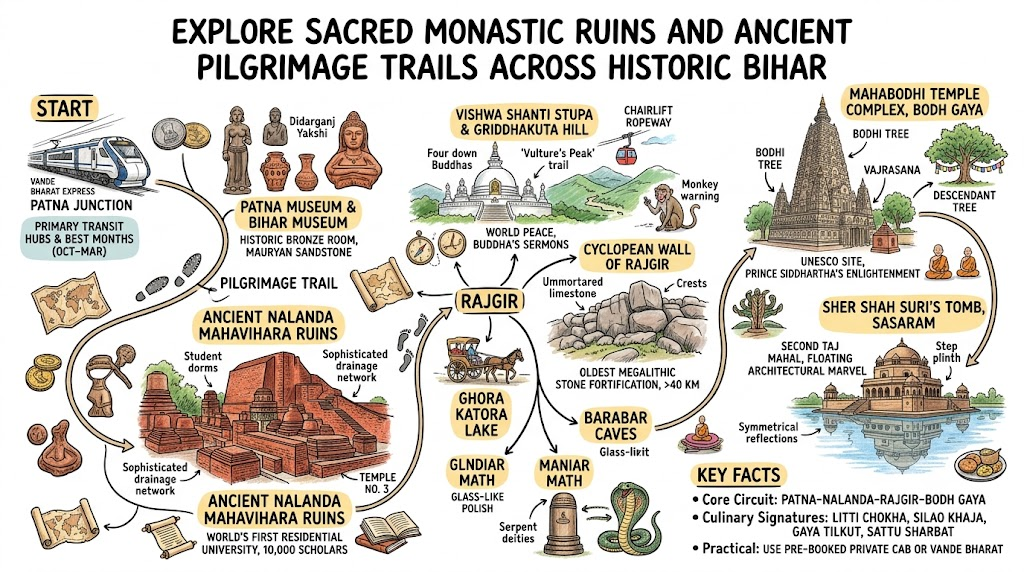
The primary 48-hour circuit strategically links Patna, Nalanda, Rajgir, and Bodh Gaya into an unforgettable transit loop. This high-density cultural corridor allows travelers to experience architectural marvels, therapeutic natural hot springs, and tranquil meditative sanctums without spending exhaustive hours behind the wheel.
| Key Fact | Practical Information |
|---|---|
| Primary Transit Hubs | Jay Prakash Narayan Airport (Patna), Gaya International Airport |
| Best Travel Months | October to March (Crisp mornings, pleasant daytime temperatures) |
| Core Circuit Route | Patna – Nalanda – Rajgir – Bodh Gaya |
| Ideal Transport Mode | Pre-booked private cab or Vande Bharat Express to Gaya |
| Culinary Signatures | Litti Chokha, Silao Khaja, Gaya Tilkut, Sattu Sharbat |
Mahabodhi Temple spires reaching upward.
Best Places or Experiences
1. Mahabodhi Temple Complex, Bodh Gaya
The Mahabodhi Temple stands as an awe-inspiring 50-meter-high grand stone pyramid, marking the exact spot where Prince Siddhartha attained supreme enlightenment under the sacred Bodhi Tree. Dating back structurally to the Gupta and Pala periods, its intricate carvings, niche-enshrined Buddha figures, and ashlar masonry showcase an architectural sophistication that influenced Buddhist design throughout Asia.
Walking through the complex at daybreak envelops visitors in hypnotic stillness, punctuated only by Tibetan horn calls, fluttering prayer flags, and the low hum of monastic chants. The energy surrounding the Vajrasana (Diamond Throne) and the lotus-filled pond creates an unforgettable atmosphere of spiritual clarity and peace.
- Location: Bodh Gaya, Gaya District; approximately 115 km south of Patna and 15 km from Gaya Junction.
- Why it is worth visiting: A UNESCO World Heritage Site marking the pivotal ground of Buddhism with supreme historical and spiritual resonance.
- Best things to do: Sit in quiet meditation under the descendant of the original Bodhi Tree, admire the delicate ancient Asokan stone railings, and circumambulate the main sanctum at dawn.
- Best time to visit: November through February; early morning (5:30 AM – 7:00 AM) or sunset during evening lamp offerings.
- Ideal for whom: Spiritual travelers, architecture enthusiasts, and global history buffs.
- Travel tip: Mobile phones are completely prohibited inside the inner complex; leave them securely in your vehicle or utilize the authorized cloakroom counters outside.
2. Ancient Nalanda Mahavihara Ruins
Spanning sprawling manicured grounds, the excavated red-brick remains of Nalanda University stand as the world’s first major residential university, hosting over 10,000 scholars from China, Korea, and Persia between the 5th and 12th centuries CE. Its architectural genius includes sophisticated drainage networks, lecture amphitheaters, meditation halls, and double-storied student dormitories built with remarkably durable hand-molded bricks.
The iconic Temple No. 3 towers dramatically above the excavated monastic cells, wrapped in multiple layers of stupas adorned with stucco sculptures of the Buddha. Walking down its ancient central avenues evokes the spirit of master scholars like Aryabhata and Xuanzang lecturing on astronomy, logic, and philosophy.
- Location: Nalanda District; roughly 85 km southeast of Patna and 15 km from Rajgir.
- Why it is worth visiting: The world’s most storied ancient university ruins, recognized as an irreplaceable UNESCO World Heritage marvel.
- Best things to do: Photograph the striking multi-layered staircases of Temple No. 3, explore Monastery Site 1 to see individual student rooms with built-in bed platforms, and visit the adjacent Archaeological Museum.
- Best time to visit: 9:00 AM to 11:30 AM during winter months when soft sunlight highlights the warm brick tones.
- Ideal for whom: Archaeology lovers, academic researchers, and families with curious children.
- Travel tip: Hire an authorized ASI-licensed guide at the ticket window, as the ruins lack comprehensive explanatory plaques and require scholarly context to appreciate fully.
Monastic brick ruins at Nalanda.
3. Vishwa Shanti Stupa & Griddhakuta Hill, Rajgir
Perched atop the craggy Ratnagiri Hill in Rajgir, the gleaming white Vishwa Shanti Stupa (World Peace Pagoda) was envisioned by Japanese Buddhist monk Nichidatsu Fujii to radiate harmony across the world. The massive marble dome houses four gold-leafed Buddha statues depicting his birth, enlightenment, first sermon, and parinirvana, contrasting against the emerald green ridgeline of Rajgir’s five hills.
Directly below on Griddhakuta (Vulture’s Peak), Buddha delivered seminal discourses, including the Lotus Sutra. Visitors can reach the peak via a single-person chairlift ropeway that glides silently above dense valleys, or by walking along the ancient stone pathway paved by King Bimbisara.
- Location: Rajgir, Nalanda District; 100 km south of Patna.
- Why it is worth visiting: Dramatic hilltop vistas coupled with an inspiring monument of universal peace.
- Best things to do: Ride the historic single-seater aerial ropeway, listen to Japanese monks chanting peace mantras to traditional drumbeats, and walk the paved ridge trail down to Vulture’s Peak.
- Best time to visit: 8:00 AM – 10:30 AM or late afternoon (3:30 PM – 5:00 PM) to catch cooling breezes and valley sunsets.
- Ideal for whom: Nature lovers, couples, and seekers of tranquil panoramic landscapes.
- Travel tip: Keep food items tucked securely inside backpacks to avoid attracting the overly mischievous local macaque monkeys along the stairs.
Vishwa Shanti Stupa in Rajgir
4. Cyclopean Wall of Rajgir
Stretching across more than 40 kilometers along the crest of the Rajgir hills, the Cyclopean Wall is one of the world’s most enigmatic ancient fortifications, built before the 6th century BCE to protect the capital of Magadha. Assembled without mortar, the defensive barrier relies on massive raw limestone boulders fitted together with stone-age engineering precision.
Tracing the remains along the roadside reveals walls standing over four meters high, displaying weathered patina earned across millennia of dynastic warfare. The engineering scale rivals the ancient megaliths of Mycenaean Greece, making it an extraordinary testament to India’s pre-Mauryan military might.
- Location: Flanking the ancient perimeter gates of Rajgir; easily viewed along the Rajgir-Gaya highway.
- Why it is worth visiting: One of the oldest surviving megalithic stone fortifications on the Indian subcontinent.
- Best things to do: Inspect the unmortared interlocking stone masonry up close, frame panoramic landscape shots of the wall climbing distant ridges, and explore the nearby ancient rock-cut chariot tracks.
- Best time to visit: Early morning (7:00 AM – 9:00 AM) when gentle lateral sunlight highlights the rugged stone textures.
- Ideal for whom: Military history enthusiasts, geological trekkers, and offbeat explorers.
- Travel tip: Wear thick-soled hiking boots, as the surrounding ground is composed of uneven scrubland and loose volcanic rubble.
5. Patna Museum & Bihar Museum
The contemporary Bihar Museum in Patna sets a global standard for storytelling, with its expansive weathered-steel and glass pavilions designed by Maki and Associates. Inside, the world-famous Didarganj Yakshi polished stone sculpture from the 3rd century BCE anchors a collection chronicling thousands of years of regional civilization.
Contrasting this sleek modern space is the heritage Patna Museum, built in 1928 in the Mughal-Rajput style, which holds ancient terracotta relics, Tibetan thangkas, and a preserved fossilized tree trunk dating back millions of years. Together, these institutions establish an unparalleled baseline for understanding the deep cultural currents of the Gangetic valley.
- Location: Bailey Road, Central Patna; 4 km from Patna Junction.
- Why it is worth visiting: Houses the world-renowned Mauryan polished sandstone masterpieces within world-class, immersive curatorial spaces.
- Best things to do: Stand face-to-face with the mesmerizing, mirror-smooth Didarganj Yakshi, explore the experiential children’s discovery galleries, and walk through the historic bronze room.
- Best time to visit: 10:30 AM to 1:30 PM (Bihar Museum is closed on Mondays).
- Ideal for whom: Art connoisseurs, cultural historians, and urban travelers.
- Travel tip: Purchase tickets online or arrive right at opening time to avoid school group crowds in the popular history pavilions.
6. Sher Shah Suri’s Tomb, Sasaram
Rising dramatically from the center of a wide square artificial lake, the 122-foot-tall sandstone mausoleum of Sher Shah Suri is a triumph of Indo-Islamic architecture. Built in 1545, this octagonal structure sits on a stepped stone plinth connected to the mainland via a wide bridge, earning it the enduring title of the “Second Taj Mahal of India.”
The sandstone shifts colors throughout the day, transforming from dusty amber to fiery crimson in the glow of the setting sun. The surrounding waters provide mirror-like reflections of the domed kiosks, offering a tranquil space far removed from mainstream tourist circuits.
- Location: Sasaram, Rohtas District; approximately 150 km southwest of Patna via NH19.
- Why it is worth visiting: A floating octagonal architectural marvel that directly influenced subsequent Mughal palace design.
- Best things to do: Walk the perimeter stone promenade to capture symmetrical water reflections, examine the geometric interior dome carvings, and explore the nearby smaller tomb of Hasan Khan Suri.
- Best time to visit: 3:30 PM to 5:45 PM for golden hour lighting across the lake.
- Ideal for whom: Architecture purists, fine-art photographers, and road-trippers.
- Travel tip: Walk to the eastern bank just before sunset for the best angle to capture the monument reflected in the water without backlighting glare.
Floating sandstone mausoleum in Sasaram.
Offbeat Exploration: Hidden Gems Tourists Miss
Ghora Katora Lake, Rajgir
Tucked inside a natural mountain amphitheater, Ghora Katora (Horse Bowl) is an eco-reserve that bans gasoline-powered vehicles entirely. Accessible only via horse-drawn tonga, electric carts, or a peaceful 6-kilometer walk, this pristine lake features a large pink-stone Buddha seated directly in the water, framed by mist-shrouded green ridges.
Barabar Caves, Jehanabad
Carved directly into monolithic granite boulders during the reign of Emperor Ashoka around the 3rd century BCE, the Barabar Caves are the oldest surviving rock-cut chambers in India. Their interior walls are polished to a glass-like finish, producing dramatic acoustics where even a whisper echoes for several seconds.
Maniar Math, Rajgir
Located in the center of the ancient walled city, this mysterious cylindrical brick structure is dedicated to local serpent deities dating back to the Mahabharata era. Its unusual circular shrine design offers a stark contrast to typical linear temple architecture, surrounded by lush rural fields that few mainstream travelers ever explore.
Detailed Practical Guidance for Travelers
| Destination | Standard Entry Fee | General Timings | Best Local Food Options Nearby | Recommended Nearby Attractions |
|---|---|---|---|---|
| Mahabodhi Temple | Free (Camera: ₹100) | 5:00 AM – 9:00 PM | Tibetan Cafe, Hari Om Cafe | Great Buddha Statue, Thai Monastery |
| Nalanda Ruins | ₹40 (Indian), ₹600 (Foreigner) | 9:00 AM – 5:00 PM | Local roadside dhabas serving sattu paratha | Nalanda Multimedia Museum, Kundalpur |
| Vishwa Shanti Stupa | Free (Ropeway: ₹100) | 8:00 AM – 5:30 PM | Green Garden Restaurant, Khaja stalls | Griddhakuta Peak, Venu Vana |
| Cyclopean Wall | Free | Open 24 Hours | Local fruit vendors along the highway | Bimbisara Jail, Son Bhandar Caves |
| Bihar Museum | ₹100 (Adults), ₹50 (Children) | 10:30 AM – 5:00 PM | The Potbelly (Bihari fine dining on-site) | Patna Museum, Golghar, Ganga Path |
| Sher Shah Suri Tomb | ₹25 (Indian), ₹300 (Foreigner) | 6:00 AM – 6:00 PM | Maurya Dhaba, local sweetshops | Rohtasgarh Fort, Manjhar Kund |
Logistics & On-Ground Navigation
Local Transport Options
- Railways: Excellent high-frequency trains connect Patna Junction to Gaya, Rajgir, and Sasaram, offering a rapid, budget-friendly transit backbone.
- Private Chauffeur Rentals: The most practical option for a tight 48-hour itinerary; hiring an AC sedan allows you to link Nalanda, Rajgir, and Bodh Gaya without timetable delays.
- E-Rickshaws: Plentiful, eco-friendly, and quiet, e-rickshaws provide the best way to navigate within heritage towns like Bodh Gaya and Rajgir.
- Auto-Rickshaws: Reliable for point-to-point urban transfers in Patna; negotiate rates or insist on metered fares before boarding.
Budget Planning
- Backpacker / Budget Tier: ₹1,200 – ₹1,800 per day (Covers clean ashram guesthouses, state transport buses, shared autos, and roadside dining).
- Mid-Range / Comfort Tier: ₹3,500 – ₹6,500 per day (Includes heritage boutique hotels, private dedicated sedan rentals, and sit-down dining).
Safety and Inclusivity Tips
- Families: Major heritage sites feature broad paved paths, though sturdy footwear is essential for uneven brick surfaces at Nalanda and Sasaram.
- Couples: Bodh Gaya and Rajgir offer exceptionally calm, respectful environments; public displays of affection should be avoided near monastic spaces.
- General Safety: Road safety is standard, but avoid rural highway drives late at night due to heavy commercial truck traffic and seasonal winter fog.
Strategic Travel Planning Guardrails
Travel Planning Tips for Bihar
- Target the Winter Window: Plan your trip between November and mid-March to enjoy comfortable walking weather and avoid intense summer heat.
- Embrace Digital Payments with Cash Backup: UPI via Google Pay and Paytm works universally at markets, but carry small cash denominations for remote ticket booths.
- Observe Monastic Modesty: Wear lightweight clothing that covers shoulders and knees when visiting active pilgrimage shrines.
- Hydration is Key: Drink only sealed bottled water or carry a filtered flask during long walking tours through open archaeological complexes.
- Reserve Morning Ropeway Slots: Arrive at the Rajgir chairlift by 8:30 AM to skip lengthy weekend lines.
Common Mistakes to Avoid
- Overpacking Day One: Trying to explore Patna, Nalanda, and Sasaram on the same day is logistically impossible due to highway distances.
- Rushing Bodh Gaya: Treating the Mahabodhi Temple as a quick photo-op misses the quiet meditative depth that requires slow, unhurried time.
- Skipping Regional Gastronomy: Relying exclusively on hotel breakfast buffets prevents you from tasting real local signatures like roasted Litti Chokha.
- Neglecting Pre-arranged Cabs: Expecting on-demand app rides in smaller towns like Rajgir or Nalanda will leave you stranded; book day cabs in advance.
- Overlooking Museum Closing Days: Forgetting that the Bihar Museum is closed on Mondays can disrupt an otherwise tight urban schedule.
Suggested Itinerary Blueprints
1. Day Quick Dash (Patna Urban Heritage)
Tailored for business travelers or short-transit visitors seeking an intense, high-yield cultural immersion within the capital.
- 07:00 AM – 09:00 AM: Morning walk along JP Ganga Path (Patna Marine Drive), taking in fresh river breezes and local chai.
- 09:30 AM – 01:30 PM: Deep exploration of the world-class archaeological galleries inside the Bihar Museum.
- 02:00 PM – 03:30 PM: Authentic Maithili and Bhojpuri lunch at The Potbelly, sampling Sarso Machhli or Litti Platter.
- 04:00 PM – 06:30 PM: Sunset visit to the historic Sikh pilgrimage center of Takht Sri Patna Sahib in the old city.
2. Day Deep-Dive (The Classic Sacred Circuit)
The ultimate 48-hour route balancing historic academic ruins with serene spiritual sanctuaries.
- Day 1 (Nalanda & Rajgir): Depart Patna early (6:00 AM) by road toward Nalanda. Spend the morning walking through the red-brick ruins of Nalanda University and exploring the multimedia museum. Transition by noon to Rajgir, stop for lunch, take the scenic aerial ropeway to Vishwa Shanti Stupa, and conclude the day exploring the Cyclopean Wall before driving to Bodh Gaya for an overnight stay.
- Day 2 (Bodh Gaya Sacred Enlightenment): Rise early (5:30 AM) to experience the serene dawn chants inside the Mahabodhi Temple. Spend the midday visiting the international monasteries—including the Japanese, Thai, and Bhutanese pagodas—as well as the 80-foot Great Buddha statue. Conclude the evening soaking in the tranquil sunset vibes around the sacred Bodhi Tree before heading to Gaya Junction or airport for departure.
3. Complete Weekend Travel Plan (Grand Heritage Loop)
A relaxed 3-day weekend loop connecting capital history with ancient architecture and southern pilgrimage grounds.
- Friday: Arrive in Patna; spend the afternoon admiring ancient sculptures in the Bihar Museum and take an evening boat ride on the Ganges.
- Saturday: Early drive to Sasaram to photograph the floating sandstone tomb of Sher Shah Suri; proceed eastward through rural scenery to Bodh Gaya for dinner.
- Sunday: Morning meditation and monastery tours in Bodh Gaya; afternoon drive to Rajgir for the ropeway ride and hot springs before heading to Gaya or Patna for departure.
Common Tourist Mistakes to Avoid
Geographic Blunders
Attempting to combine Sasaram and Nalanda on the same single morning leads to hours of unnecessary driving. Keep your routing focused along the well-connected Patna-Nalanda-Rajgir-Gaya linear corridor.
Commercial Traps
Spending precious leisure hours browsing generic Western brands in Patna’s shopping malls wastes an opportunity to explore vibrant local handicraft hubs like Upendra Maharathi Sansthan.
Neglecting Modern/Alternative Zones
Overlooking the newly revitalized green promenades along the Ganges in Patna misses out on how the modern city enjoys its riverfront culture.
Transport Overpayment
Avoid accepting arbitrary flat quotes from auto drivers outside railway stations; cross-reference app rates or ask locals for prevailing standard pricing.
Luxury Dining Bias
Dining exclusively inside five-star hotels deprives you of tasting genuine street culinary artistry, from wood-fired Litti Chokha to freshly pressed sugarcane juice.
Frequently Asked Questions
1. Is two days truly enough to experience the highlights of Bihar?
Yes, a focused 48-hour itinerary lets you comfortably explore the premier heritage corridor connecting Nalanda, Rajgir, and Bodh Gaya. By hiring a dedicated private vehicle, you can travel between these closely clustered sites without logistical delays, experiencing the region’s top archaeological and spiritual treasures.
2. Which airport serves as the best arrival hub for this two-day itinerary?
Patna’s Jay Prakash Narayan Airport works best if you plan to start your journey with museums before traveling south. Alternatively, Gaya International Airport is ideal if your primary focus is spending maximum time around Bodh Gaya and Rajgir.
3. Is it safe to travel across Bihar by road during early morning or late hours?
Major expressways and national highways connecting Patna, Rajgir, and Bodh Gaya are well-paved, heavily patrolled, and safe for travel. However, avoid driving through rural roads late at night during peak winter, as dense Gangetic fog can reduce visibility.
4. What unique local foods must I try on a two-day trip to Bihar?
Beyond iconic charcoal-roasted Litti Chokha served with spicy brinjal bharta, you should sample crispy multi-layered Silao Khaja sweet pastry, melt-in-the-mouth Gaya Tilkut made of pounded sesame, and protein-packed Sattu Parathas served with tangy mint chutney.
5. How strict is the dress code inside the Mahabodhi Temple?
The Mahabodhi Temple maintains a respectful monastic environment. Visitors should dress modestly, ensuring shoulders and knees are covered. Hats and footwear must be removed at the outer boundary security gates before entering the central courtyard.
6. Can I complete the Rajgir ropeway and Nalanda ruins on the same day?
Yes, they are situated only 15 kilometers apart. You can explore the Nalanda ruins for two to three hours in the morning, stop for a traditional lunch, and reach Rajgir by early afternoon for the ropeway up to Vishwa Shanti Stupa.
7. Are electronic devices allowed inside the Nalanda University ruins?
Yes, smartphones and regular handheld cameras are permitted inside the excavated grounds of Nalanda upon paying a standard nominal entry fee. Commercial recording equipment, tripods, and flying drones require formal written authorization from the Archaeological Survey of India.
8. Where should I purchase authentic Madhubani paintings and local souvenirs?
Look for genuine hand-painted Madhubani art, Sikki grass crafts, and stone carvings at government-run emporiums like Upendra Maharathi Shilp Anusandhan Sansthan in Patna, or through registered artisan cooperatives operating directly outside Bodh Gaya’s main monasteries.
9. What should I pack for a 48-hour winter trip across Bihar?
Pack versatile layers, including a light fleece jacket or woolen shawl for chilly mornings and evenings when temperatures drop to around 8°C. During sunny winter afternoons, lightweight breathable cottons, comfortable walking sneakers, and UV-filtering sunglasses are ideal.
10. How does the chairlift ropeway in Rajgir operate for visitors?
The classic single-person chairlift ropeway operates continuously throughout the day, transporting visitors smoothly up the steep incline of Ratnagiri Hill in under ten minutes. A newer enclosed cabin cable car system also operates alongside it, offering family-friendly access.
11. Is English or Hindi widely understood along this tourist route?
Hindi is spoken and understood universally across all transit hubs, hotels, and restaurants in Bihar. In international pilgrimage centers like Bodh Gaya, hospitality staff, licensed guides, and shopkeepers also converse fluently in English, Japanese, and Thai.
12. How much cash should I carry for incidental expenses over two days?
Carrying approximately ₹2,000 to ₹3,000 in small denominations per person is recommended. While major hotels, cafes, and museum ticket counters accept cards and UPI payments, small cash comes in handy for buying roasted snacks and hiring rickshaws.
Conclusion
Choosing a 48-hour journey through Bihar rewards you with an experience that typical tourist getaways simply cannot match. From standing beneath the tranquil branches of the sacred Bodhi Tree to walking along the quiet brick corridors of ancient Nalanda, this historic region connects you with milestones that shaped the world. Step beyond the usual travel circuits, open your mind to timeless heritage, and let the enduring soul of Bihar leave a lasting mark on your travels.
