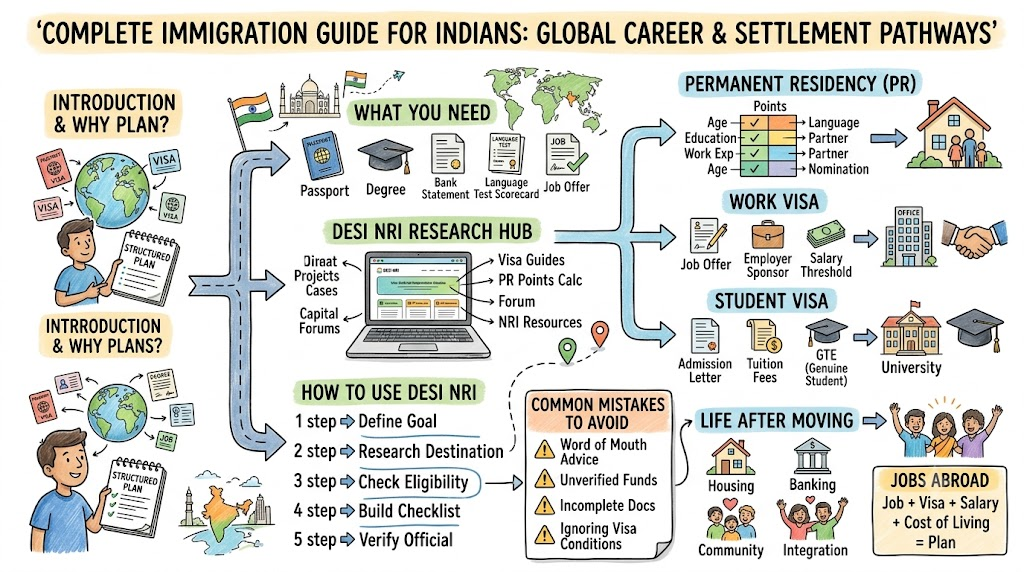
Introduction
Indian professionals and students are increasingly looking beyond borders to pursue advanced education, global career milestones, and higher living standards. Navigating international immigration, however, remains remarkably challenging because every country enforces distinct legal standards, quota ceilings, and procedural rules. Distinguishing between a temporary work visa, an academic study permit, and direct permanent residency is vital to making sound decisions. Eligibility criteria hinge on meticulous documentation, language scores, credentials, and strict financial compliance, which leaves little margin for procedural oversight. Establishing a reliable information baseline early saves months of confusion, which is where DesiNRI serves as an informational research platform helping applicants explore pathways, evaluate options, and structure relocation goals responsibly.
What Are Visa Requirements for Indians?
Visa criteria vary considerably depending on the destination country, chosen visa category, your educational background, and your primary purpose of travel. Common baseline requirements typically demand a valid passport, accurate government application forms, standard biometric photographs, authenticated academic credentials, work experience records, and comprehensive proof of financial solvency. You will also need language proficiency test results, official admission letters or validated employment offers, formal sponsorship filings, police clearances, medical fitness screenings, and civil status certificates. Because each route imposes unique prerequisites, you must confirm your precise visa subclass before compiling documents to avoid unnecessary processing delays or administrative refusals.
Why Indian Applicants Need a Structured Immigration Plan
Strategic immigration planning requires evaluating your legal rights, long-term options, and family security rather than simply securing an initial visa stamp. Key parameters include local employment rights, legal duration of stay, dependants’ work authorization, employer-tied visa restrictions, realistic permanent residency pathways, living costs, and comprehensive settlement milestones. Aspiring immigrants must address critical questions: Does this visa allow career mobility across employers? Can a spouse work legally without additional sponsorship? Does the route provide clear legal transition to permanent residence? Establishing these long-term parameters safeguards your financial investments and career stability before moving abroad.
What Is DesiNRI and How Can It Help?
DesiNRI operates as an informational research platform designed for Indian professionals, skilled workers, and international students planning overseas relocation. The platform compiles country-specific visa frameworks, eligibility requirements, and relocation guidelines into clear, accessible research materials. It supports prospective applicants during the critical exploratory stage by helping them evaluate multiple visa categories, compare residency criteria, and understand immigration documentation rules before making life-changing financial commitments. While DesiNRI provides foundational educational guidance to help applicants formulate informed plans, it acts as a structured research resource rather than a replacement for official immigration department portals or licensed legal advisors.
What Can You Find on DesiNRI?
The platform organizes immigration knowledge into practical sections so users can easily evaluate relocation options across major destinations.
| Resource Area | What It Can Help You Research |
| Visa Guides | Visa subclasses, eligibility criteria, mandatory documents, and sequential application steps |
| PR Points Calculators | Preliminary points benchmarks and skilled eligibility planning assessments |
| Immigration Articles | Detailed updates on visa pathways, immigration policy overhauls, and legal requirements |
| Forum | Peer-to-peer discussions, shared experiences, relocation questions, and settlement tips |
| NRI Resources | Practical guidance on banking, diaspora networks, housing, and social adaptation abroad |
| Country Guides | Destination-specific overviews covering living costs, job markets, and local regulations |
How to Use DesiNRI for Immigration Research
Navigating international immigration successfully demands a systematic research methodology that converts basic curiosity into a structured, verifiable relocation strategy.
Define Your Immigration Goal
Begin by identifying your core international objective, whether it involves completing higher education, securing an overseas corporate role, or seeking permanent settlement. Clarifying your timeline, career aspirations, and family goals ensures you concentrate exclusively on relevant visa subclasses without getting overwhelmed by unrelated pathways.
Research the Destination
Examine the socio-economic realities, labor shortages, minimum wage thresholds, and cost-of-living metrics in your target destination before committing resources. Comparing national policies allows you to determine whether a country actively welcomes foreign skill profiles in your particular industry and provides a sustainable standard of living.
Check Your Preliminary Eligibility
Assess your profile against national points benchmarks, language testing thresholds, academic equivalency criteria, and occupation shortage lists. Evaluating your age, education, and relevant work history highlights your genuine competitive standing and reveals areas needing improvement before you incur substantial application fees.
Build Your Visa Document Checklist
Assemble a preliminary inventory of primary documents, including identity proofs, certified academic degrees, employment verification letters, and financial reserves. Compiling this portfolio early helps identify missing records, name discrepancies, or certification hurdles well before your formal submission deadline.
Verify Requirements With Official Authorities
Cross-reference your platform research with the official gazettes and immigration portals of your destination government. Official regulations, processing fees, and documentation criteria change periodically, making final verification with government guidelines essential before lodging your application.
PR Points Calculator: What Does It Actually Tell You?
A PR points system evaluates economic immigration candidates using quantifiable profile characteristics to rank skilled talent objectively. Points matter because governments use selection thresholds to invite candidates from competitive application pools. However, calculated points reflect only indicative eligibility based on self-reported variables rather than an official guarantee of invitation or visa grant. Selection pools fluctuate with labor priorities, regional targets, and quota caps, which means achieving the minimum score is an entry baseline rather than an assurance of selection.
| Factor | Why It Matters | What Applicants Should Do |
| Age | Most systems assign higher points to early-to-mid career profiles | Monitor age threshold deductions and apply within peak scoring years |
| Education | Higher academic credentials yield greater points allocations | Secure formal educational credential assessments early |
| Work Experience | Verifiable skilled work demonstrates international employability | Maintain detailed reference letters, tax filings, and employment contracts |
| Language | Higher language proficiency scores significantly increase points | Sit for approved tests (IELTS/PTE) and target top-tier bands |
| Partner Profile | A skilled partner can add points to the primary profile | Evaluate both applicants to select the strongest primary candidate |
| Nomination | State or regional nominations add substantial bonus points | Research regional demand lists and state-specific sponsorship options |
Utilizing a structured PR points calculator helps you map out realistic scores and assess whether pursuing language upgrades or regional sponsorship is necessary to remain competitive.
Permanent Residency for Indians
Permanent Residency (PR) grants foreign nationals the legal right to live, work, and study indefinitely in a host country without being bound to a single employer. Common pathways include skilled migration streams, employer-sponsored programs, regional initiatives, family reunification, and investment avenues. Additionally, many applicants utilize temporary-to-permanent routes, transitioning from student or temporary work permits into permanent status. Because immigration rules and annual quotas vary across countries, applicants must evaluate vital questions: Does my occupation match local shortage lists? What are the physical residency requirements to maintain PR status? What is the complete pathway toward citizenship?
Work Visa for Indians
Securing an overseas work visa requires an eligible occupation, an authorized employer, and strict compliance with local immigration labor laws. In most jurisdictions, employers must demonstrate that domestic candidates were unavailable before issuing a sponsorship certificate or qualifying job offer. Applicants must present matching academic credentials, verifiable work history, and approved language scores while meeting mandatory minimum salary thresholds. Crucially, obtaining a corporate job offer does not guarantee visa approval, as immigration authorities independently review employer sponsorship compliance, occupation codes, and dependants’ legal status before granting temporary work authorization.
Student Visa for Indians
A student visa enables Indian nationals to pursue accredited education overseas while gaining international academic credentials. Mandatory requirements encompass formal university admission, enrollment at a designated learning institution, verified financial reserves covering tuition and living expenses, valid health insurance, and demonstrated compliance with genuine student criteria. While many student visas offer limited on-campus or off-campus work permissions during academic terms, work rights vary substantially across jurisdictions. International students should also evaluate post-study work regulations, as graduate stay schemes represent a critical bridge between foreign education and subsequent professional work authorization.
Visa Document Checklist for Indians
Thorough document preparation is vital to preventing administrative rejections, formal inquiries, or processing delays during visa adjudications.
| Document Category | Common Examples |
| Identity | Current passport, previous passports, national ID cards, biometric photographs |
| Education | Degree certificates, consolidated mark sheets, credential assessment reports |
| Employment | Detailed work experience letters, formal appointment letters, monthly pay slips |
| Financial | Bank account statements, tax returns, sponsor declarations, loan sanctions |
| Language | Valid scorecards from authorized testing authorities (such as IELTS or PTE) |
| Family | Registered marriage certificates, spouse identity proofs, dependent birth certificates |
| Character | Police clearance certificates from home and previous host nations |
| Health | Medical exam reports and chest x-rays from empanelled clinics |
| Immigration | Historical visa approval letters, travel records, previous refusal notices |
| Application | Fully completed government visa forms, statutory declarations, fee payment receipts |
Note: Document requirements, translations, and apostille procedures differ depending on destination country guidelines and chosen visa subclasses.
Real-Life Scenarios / Experiences
- Transitioning from Student Visa to Skilled Work: A graduate in computer science completes their master’s degree overseas, utilizes a post-study graduate work visa to gain two years of local tech experience, meets domestic employer sponsorship criteria, and subsequently qualifies for skilled permanent residency points without having to return home.
- Direct Skilled Migration via Regional Streams: A senior civil engineer living in India assesses their credentials, achieves superior English language bands, secures a state nomination through a regional development program, and obtains permanent residency directly without relying on an upfront corporate job offer.
- Employer-Sponsored Relocation with Dependants: A finance professional receives an internal corporate transfer to an overseas branch, secures a sponsored skilled worker visa covering their spouse with full open-market work rights, and enrolls their children in the host country’s school system with dependent status.
Jobs Abroad for Indians
Pursuing employment opportunities overseas requires a realistic strategy that harmonizes professional aspirations with practical immigration realities. Job seekers must target recognized shortage occupations, verify license recognition protocols, ensure salary offerings meet official immigration thresholds, and evaluate regional living expenses before accepting offers. Simply securing an interview is insufficient; you must confirm that the hiring firm holds legal sponsorship authorization and that the role paves the way for long-term career progression. An effective global career strategy aligns the equation: Job opportunity + visa eligibility + salary + cost of living + long-term pathway = realistic relocation plan.
NRI Community and Life After Moving Abroad
Settling into a foreign country involves managing practical post-arrival challenges that extend well beyond the initial visa approval stamp. New immigrants must secure rental housing, establish local banking profiles, navigate unfamiliar workplace expectations, manage domestic family obligations, and build personal social circles. Joining local cultural associations and diaspora groups provides valuable emotional grounding and practical neighborhood advice, easing cultural transition while keeping you connected with India. Peer discussions provide practical insights on daily life abroad, though community advice should never be treated as official immigration or legal counsel.
Common Mistakes to Avoid When Planning Your Relocation
- Submitting Inconsistent Documentation: Submitting application materials with conflicting employment dates, spelling variations, or mismatched salary figures triggers lengthy background checks and potential visa refusals.
- Relying Solely on Informal Community Advice: Adopting visa strategies based on the personal experiences of friends rather than current official immigration statutes leads to non-compliance and missed filing deadlines.
- Overlooking Strict Financial Maintenance Rules: Failing to maintain required funds in accessible, unencumbered bank accounts for the specified holding period often results in direct financial refusal.
- Underestimating Credential Verification Timelines: Delaying mandatory educational credential assessments or professional licensing validations can postpone visa submissions by several critical months.
- Assuming Job Offers Equal Automatic Visas: Failing to confirm that an employer holds authorized government sponsorship credentials before signing an overseas employment agreement leads to unexpected legal roadblocks.
- Ignoring Dependants’ Legal Work Restrictions: Assuming family members automatically receive open work rights on any temporary visa can create unanticipated financial strain if they are restricted from working.
- Disregarding Health and Character Disclosures: Omitting prior visa rejections, minor legal matters, or past medical conditions on official forms creates severe grounds for misrepresentation and future entry bans.
- Failing to Plan for Post-Arrival Living Costs: Underbudgeting for initial rental bonds, temporary accommodation, and family living expenses before receiving your first paycheck can cause severe cash-flow disruptions.
How DesiNRI Fits Into Your Immigration Research
What DesiNRI Provides
DesiNRI provides an accessible central repository of immigration knowledge, country-specific visa breakdowns, preliminary points evaluation systems, and community discussions. It consolidates scattered visa guidelines, documentation frameworks, and post-arrival settlement considerations into organized educational resources for Indian applicants worldwide.
Why Use DesiNRI?
The platform simplifies complex immigration terminology, allowing prospective migrants to understand core legal requirements before spending heavily on formal applications. By functioning as a comprehensive research starting point, it helps you benchmark your profile, organize documentation, and compare international relocation pathways independently.
Practical Research Workflow
An effective research workflow follows a disciplined path: Goal → Country → Visa → Eligibility → PR Calculator → Documents → Official Verification → Application. Initiating your journey with clear educational resources ensures you enter the formal immigration process with realistic expectations, verified records, and a dependable relocation roadmap.
Frequently Asked Questions
1. How do visa requirements for Indians vary across different countries?
Visa requirements depend entirely on the host country’s domestic immigration statutes, economic priorities, and bilateral diplomatic agreements with India. While baseline standards such as valid passports, clean character records, and medical checks are universal, specific criteria regarding employer sponsorship, language benchmarks, financial reserves, and skill evaluations vary significantly from one country to another.
2. Can Indian passport holders apply for permanent residency directly from India?
Yes, several nations operate direct skilled migration programs that allow qualified Indian professionals to apply for permanent residency without prior domestic residency or a localized job offer. Eligibility typically depends on meeting rigorous points criteria covering age, educational credentials, verified work experience, and high language proficiency test results before receiving an invitation to apply.
3. What is the fundamental difference between a work visa and permanent residency?
A work visa is a temporary status tied to employment, requiring valid sponsorship and carrying strict expiration dates and employer conditions. Permanent residency grants an indefinite right to live, work, and study anywhere in the destination country, offering social benefits, freedom to change employers, and a direct path to citizenship.
4. What documents are most critical for proving financial capability for student visas?
Authorities require verifiable, liquid funds demonstrating you can comfortably pay international tuition and living expenses without unauthorized work. Primary documents include official bank statements, educational loan sanction letters, fixed deposit certificates, government sponsor affidavits, and income tax returns of your financial sponsors, all adhering to strict holding-period and source-of-fund rules.
5. Why does an employer job offer not guarantee a work visa approval?
Securing an employment offer satisfies only the recruitment phase; immigration authorities must independently evaluate the employer’s sponsorship credentials, verify that local labor market testing rules were followed, confirm the job code meets statutory wage thresholds, and review the applicant’s background before granting legal work authorization.
6. How accurate are online PR points calculators compared to official assessments?
Online PR points calculators provide preliminary estimations based on your self-reported data to help you gauge competitiveness. They cannot replicate the rigorous verification conducted by immigration officers, who thoroughly examine official skill assessments, test score validity, background checks, and fluctuating invitation round cutoffs before determining official eligibility.
7. Can my spouse work legally while accompanying me on an overseas student visa?
Spousal work rights depend strictly on the host nation’s student visa regulations and the academic level of the primary applicant’s program. While some countries permit full-time work for partners of master’s or doctoral students, others limit work hours or restrict spousal employment entirely on undergraduate student visas.
8. What should Indian professionals do if their educational degree requires overseas licensing?
Professionals in regulated fields like healthcare, engineering, law, and accounting must undergo formal credential evaluations with designated professional boards in the destination country. This process often entails submitting detailed syllabi, completing bridging programs, sitting for local licensing examinations, and fulfilling supervised training hours before gaining full practice rights.
9. Why is police clearance certification mandatory for long-term visa processing?
Immigration authorities require police clearance certificates to ensure incoming residents pose no threat to national security or public safety. Indian applicants must obtain these certificates through the Passport Seva Kendra or local police authorities, covering every jurisdiction where they have resided for more than six to twelve months.
10. How do post-study work visas assist students seeking long-term settlement?
Post-study work visas grant international graduates open-market work rights for a designated duration, allowing them to gain relevant local work experience without immediate employer sponsorship. This valuable domestic work experience often yields bonus points in skilled migration systems, smoothing the transition to long-term temporary or permanent residence.
11. What are the common reasons for skilled work visa application refusals?
Frequent causes for visa refusals include discrepancies between declared duties and official occupation classifications, failure to satisfy minimum prevailing wage thresholds, inadequate employer sponsorship accreditation, unverified gaps in employment history, and submitting unofficial or uncertified translations of supporting civil documents.
12. How does participating in an NRI community forum assist recent migrants?
Engaging with overseas community forums connects recent migrants with experienced diaspora members who provide practical advice on neighborhood selection, rental procedures, utility connections, healthcare registration, and banking setups. While valuable for day-to-day settlement tips, community discussions should always be paired with official government resources for legal matters.
Conclusion
Relocating overseas involves careful planning across international immigration policies, documentation, and long-term career aspirations. Understanding the differences between temporary student visas, employer-sponsored work permits, and points-tested permanent residency allows you to choose pathways that align with your background and goals. Clear research into destination requirements, credential recognition, living costs, and post-arrival settlement factors prevents costly delays and builds a solid foundation for your move. Using structured informational platforms like DesiNRI helps you explore options, verify documentation standards, and understand immigration requirements before applying. Approaching the relocation process methodically and confirming details through official immigration channels ensures your journey abroad is informed, practical, and successful.
