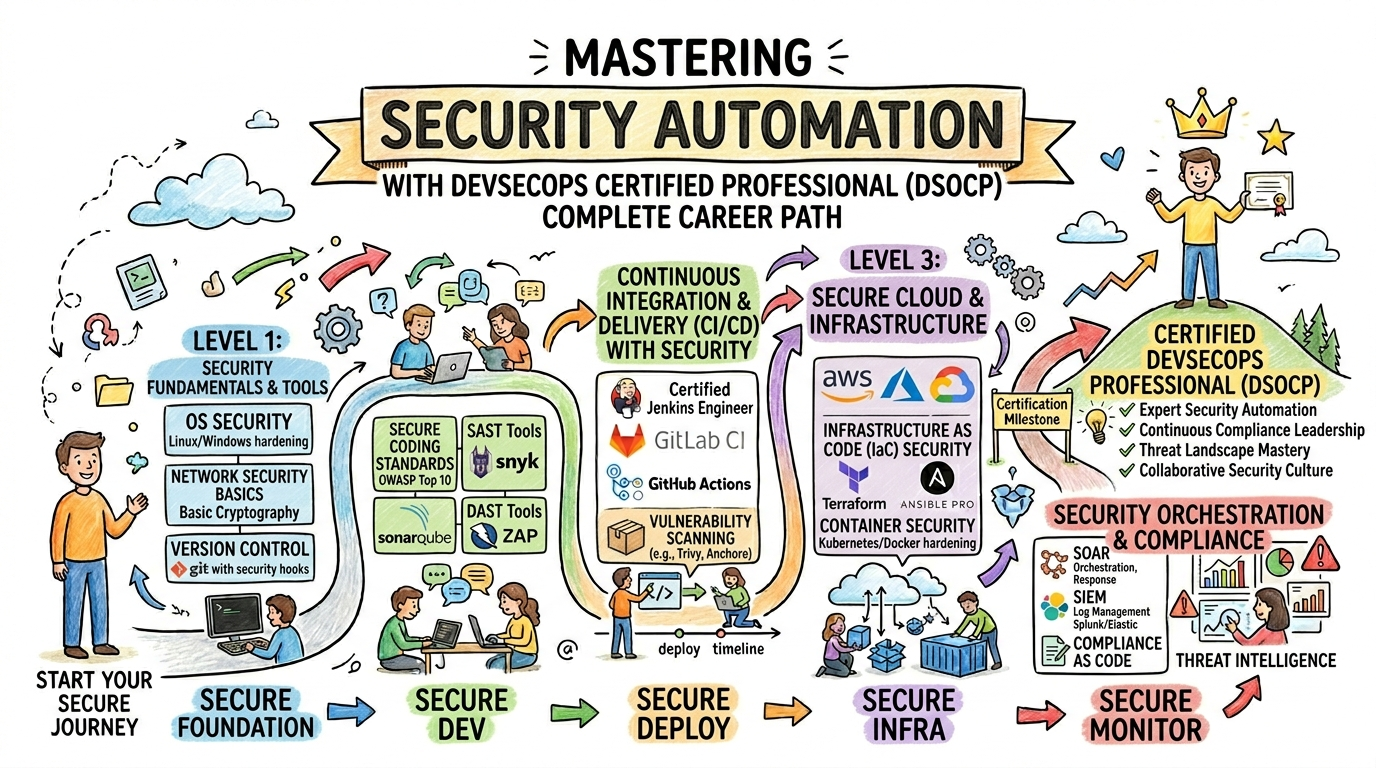
Introduction
The DevSecOps Certified Professional (DSOCP) is a comprehensive validation designed for engineers who recognize that security is no longer a separate phase of the software life cycle. This guide is written for software developers, system administrators, and security practitioners who want to bridge the gap between rapid delivery and robust protection. In today’s landscape of automated deployments and cloud-native architectures, security must be “shifted left” and integrated into the very fabric of the platform. This guide serves as a roadmap to help you understand how this certification can pivot your career toward high-demand roles in platform engineering and secure cloud operations.
What is the DevSecOps Certified Professional (DSOCP)?
The DSOCP represents a shift from theoretical security checklists to practical, production-focused automation. It exists to certify that an engineer can navigate the complexities of modern CI/CD pipelines while ensuring every stage—from code commit to production monitoring—is audited and secure. Unlike traditional security certifications that focus on policy, the DSOCP emphasizes the “Ops” and “Dev” aspects, teaching you how to use tools to automate vulnerability scanning and compliance. It aligns perfectly with enterprise practices where speed and security are treated as equal priorities in the engineering workflow.
Who Should Pursue DevSecOps Certified Professional (DSOCP)?
This certification is ideal for DevOps engineers, Site Reliability Engineers (SREs), and Cloud Architects who are already managing infrastructure but need to deepen their security expertise. It is also highly beneficial for security analysts who want to learn the automation side of the house to become more effective in a fast-paced development environment. Beginners with a strong foundation in Linux and networking will find it a perfect entry point into the world of secure automation, while managers in the Indian and global tech sectors can use it to better lead cross-functional technical teams.
Why DevSecOps Certified Professional (DSOCP)
As we move through 2026, the demand for “Security-as-Code” has reached an all-time high due to the increasing sophistication of supply chain attacks. The DSOCP is valuable because it focuses on core principles that outlast specific tool versions, ensuring your skills remain relevant even as the landscape evolves. Organizations are moving away from siloed security teams and toward integrated DevSecOps models, making professionals with this certification high-value assets. Your return on investment is measured not just in salary increases, but in the longevity of your career as an indispensable protector of the enterprise’s digital assets.
DevSecOps Certified Professional (DSOCP) Certification Overview
The program is delivered via the official DevSecOps Certified Professional (DSOCP) course and is hosted on devopsschool. The certification is structured to take a hands-on approach, moving candidates through various modules that cover the entire SDLC. It is not just about passing a multiple-choice exam; it’s about demonstrating an understanding of how to implement security gates in real-world pipelines. The ownership and structure are maintained by industry veterans, ensuring the assessment reflects the current challenges faced by top-tier tech companies.
DevSecOps Certified Professional (DSOCP) Certification Tracks & Levels
The DSOCP program is organized into levels that match your career stage, moving from Foundation to Professional and finally Advanced tiers. The Foundation level introduces the mindset of shifting left, while the Professional level dives deep into the technical implementation of security tools. Advanced tracks allow for specializations in areas like Cloud Security, Container Security, or Secure SRE practices. This tiered approach allows professionals to build their expertise incrementally, ensuring that each level of certification aligns with a corresponding jump in their professional responsibilities.
Complete DevSecOps Certified Professional (DSOCP) Certification Table
| Track | Level | Who it’s for | Prerequisites | Skills Covered | Recommended Order |
| Core Security | Foundation | Newbie Engineers | Basic Linux | CI/CD, Security Basics | 1st |
| Engineering | Professional | DevOps/SREs | DSOCP Foundation | SAST, DAST, IAST | 2nd |
| Architecture | Advanced | Senior Leads | 3+ Years Experience | Governance, Risk, Compliance | 3rd |
| Cloud Sec | Specialized | Cloud Engineers | AWS/Azure Basics | Cloud-native Security | 4th |
Detailed Guide for Each DevSecOps Certified Professional (DSOCP) Certification
DevSecOps Certified Professional (DSOCP) – Professional Level
What it is
This certification validates an engineer’s ability to integrate security tools directly into the DevOps pipeline. It proves you can automate security checks without slowing down the deployment frequency.
Who should take it
It is designed for mid-level DevOps engineers and SREs who are responsible for maintaining the health and security of production environments.
Skills you’ll gain
- Mastery of SAST (Static Application Security Testing) tools.
- Implementation of DAST (Dynamic Application Security Testing) in CI/CD.
- Container and Image scanning techniques.
- Infrastructure as Code (IaC) security auditing.
- Automated compliance monitoring.
Real-world projects you should be able to do
- Build a Jenkins or GitLab pipeline that automatically fails on high-severity vulnerabilities.
- Set up a centralized dashboard for security alerts using ELK or Prometheus.
- Implement automated patching schedules for Kubernetes clusters.
Preparation plan
- 7–14 Days: Focus on the “Shift Left” philosophy and understanding the theoretical differences between SAST, DAST, and SCA.
- 30 Days: Set up a local lab environment. Practice integrating security plugins into a sample pipeline and fixing the resulting errors.
- 60 Days: Deep dive into compliance-as-code. Learn how to write policies using OPA (Open Policy Agent) and prepare for the final assessment.
Common mistakes
- Focusing too much on a single tool rather than the underlying process.
- Neglecting the “Dev” part of DevSecOps—you must understand how developers work.
- Overlooking the importance of culture and communication between teams.
Best next certification after this
- Same-track option: DSOCP Advanced Architect.
- Cross-track option: Certified Kubernetes Security Specialist (CKS).
- Leadership option: DevSecOps Managerial Certification.
Choose Your Learning Path
DevOps Path
For those in the DevOps track, the DSOCP provides the necessary security layer to round out your deployment expertise. You will focus heavily on CI/CD integration and ensuring that “speed to market” doesn’t compromise “safety of product.” This path is ideal for those who want to be the “engine room” of the software delivery process.
DevSecOps Path
This is the dedicated path for security specialists moving into the modern era. You will learn to stop being a “gatekeeper” and start being an “enabler.” By automating the security checks you used to do manually, you become a core part of the engineering team rather than an outside auditor.
SRE Path
Site Reliability Engineers use the DSOCP to ensure that systems are not only available and performant but also resilient against attacks. In this path, security is treated as a specialized branch of reliability. You will focus on monitoring, incident response, and secure system design to keep the platform stable.
AIOps / MLOps Path
As AI becomes more prevalent, securing ML pipelines is critical. This path uses DSOCP principles to protect data sets, model training environments, and inference endpoints. It ensures that the “black box” of AI doesn’t become a backdoor for malicious actors.
DataOps Path
Data security and privacy are paramount for data engineers. This path focuses on securing the flow of data through pipelines, ensuring that sensitive information is masked, encrypted, and accessible only to authorized users, all while maintaining high processing speeds.
FinOps Path
Security and cost often go hand-in-hand. This path explores how insecure configurations can lead to unexpected cloud costs (like crypto-jacking). You will learn to use DSOCP principles to ensure that your infrastructure is both secure and cost-efficient.
Role → Recommended DevSecOps Certified Professional (DSOCP) Certifications
| Role | Recommended Certifications |
| DevOps Engineer | DSOCP Foundation + Professional |
| SRE | DSOCP Professional + SRE Advanced |
| Platform Engineer | DSOCP Professional + Cloud Security |
| Cloud Engineer | DSOCP Cloud-native Specialist |
| Security Engineer | DSOCP Professional + Advanced |
| Data Engineer | DSOCP DataOps Specialist |
| FinOps Practitioner | DSOCP Foundation + FinOps Core |
| Engineering Manager | DSOCP Foundation + Leadership Track |
Next Certifications to Take After DevSecOps Certified Professional (DSOCP)
Same Track Progression
Once you have mastered the professional level, the next logical step is the Advanced Architect track. This allows you to move from “doing” to “designing,” where you create the security blueprints for the entire organization. You will focus on enterprise-wide governance and high-level strategy.
Cross-Track Expansion
If you want to broaden your horizons, consider moving into Cloud-specific security certifications like those offered by AWS or Azure. Alternatively, diving into Kubernetes-specific security (CKS) is a powerful way to specialize in the container orchestration layer that most modern enterprises use.
Leadership & Management Track
For those looking to move into management, the next step is focusing on technical leadership and DevSecOps strategy. This involves learning how to manage team dynamics, budgets, and high-level risk assessments, transitioning from a hands-on engineer to a decision-making leader.
Training & Certification Support Providers for DevSecOps Certified Professional (DSOCP)
DevOpsSchool
As the primary provider, DevOpsSchool offers a highly structured and lab-heavy environment. Their instructors are industry veterans who bring real-world scenarios into the classroom, ensuring that students aren’t just memorizing facts but are learning how to solve actual production problems with the latest DevSecOps tools.
Cotocus
Cotocus is known for its boutique approach to technical training, focusing on personalized mentorship. They provide excellent support for those who need a more hands-on, guided experience during their DSOCP journey, particularly for professionals looking to transition from traditional IT roles into modern secure engineering.
Scmgalaxy
Scmgalaxy is a massive community-driven platform that offers extensive resources, blogs, and tutorials. For the DSOCP, they provide a wealth of supplementary material that helps bridge the gap between classroom learning and the day-to-day challenges of configuration management and automated security.
BestDevOps
BestDevOps focuses on the practical application of tools. Their training programs for DSOCP are designed to get you up to speed quickly with the tech stack, making them a great choice for engineers who need to implement security tools in their current jobs immediately.
devsecopsschool
This dedicated portal focuses exclusively on the security aspect of the DevOps world. Their support for the DSOCP is unparalleled in terms of depth, offering specialized workshops on niche security topics that are often overlooked in more generalist programs.
sreschool
For those coming at DSOCP from an SRE background, SRESchool provides the perfect context. They emphasize the reliability and monitoring aspects of security, ensuring that your certification preparation aligns with the goals of maintaining high-availability systems.
aiopsschool
AIOpsSchool integrates the DSOCP curriculum with artificial intelligence and machine learning. This is the place to go if you want to understand how security fits into the future of automated, AI-driven operations and intelligent monitoring systems.
dataopsschool
DataOpsSchool provides specialized support for data professionals taking the DSOCP. They focus heavily on data governance, encryption, and securing the data pipeline, which is essential for any engineer working in data-heavy or highly regulated industries.
finopsschool
FinOpsSchool helps bridge the gap between security and cloud financial management. Their support for DSOCP candidates includes insights into how secure configurations prevent cost overruns, making your security expertise a clear financial benefit to your company.
Frequently Asked Questions (General)
- How difficult is the DSOCP exam? The exam is challenging because it focuses on practical application rather than just theory. If you have hands-on experience, you will find it manageable.
- Do I need to be a coder to pass? While you don’t need to be a software developer, you should be comfortable with scripting languages like Python or Bash and understanding YAML files.
- How long does the certification stay valid? Typically, the certification is valid for two to three years, after which you may need to renew to show you are current with new tech.
- What are the prerequisites? A basic understanding of the Linux command line and general DevOps principles is highly recommended before starting the professional track.
- Can I take the exam online? Yes, the program is designed to be accessible globally through online proctored assessments and digital learning modules.
- Does this certification help with salary? Yes, DevSecOps professionals are among the highest-paid in the engineering field due to the specialized nature of their skills.
- How much time should I dedicate to study? For working professionals, 5 to 10 hours a week over two months is usually sufficient to master the material.
- Is there a community for DSOCP students? Yes, there are vibrant communities on platforms like Scmgalaxy and various Slack channels where students share tips and job leads.
- What tools are covered? You will gain exposure to Jenkins, GitLab, SonarQube, Snyk, Aqua Security, and various cloud-native security tools.
- Is DSOCP recognized in India? Absolutely. It is highly regarded by major Indian tech hubs and MNCs looking for skilled secure-automation engineers.
- Can a manager take this course? Yes, there is a foundation level specifically designed to help managers understand the “why” and “how” of DevSecOps without needing to be deep in the code.
- What is the ROI of this certification? The ROI is significant, often resulting in access to more senior roles, better job security, and the ability to lead high-impact projects.
FAQs on DevSecOps Certified Professional (DSOCP)
- Is DSOCP better than general security certs? Yes, if you work in modern engineering. It’s practical, not just theoretical.
- Can I jump straight to the professional level? Only if you have significant prior experience in DevOps and security; otherwise, foundation is best.
- Does it cover Kubernetes? Yes, container security and K8s hardening are core parts of the professional curriculum.
- What is the passing score? The passing criteria involve both the final assessment and the completion of lab-based projects.
- Are there retakes available? Yes, most providers offer a retake policy if you don’t pass on your first attempt.
- Is the course content updated regularly? Yes, the curriculum is updated annually to reflect changes in the threat landscape and tool ecosystem.
- Does it cover AWS/Azure? While tool-agnostic, the principles are applied to major cloud providers throughout the training.
- How do I verify my certificate? Digital badges and verification links are provided upon successful completion of the program.
Final Thoughts: Is DevSecOps Certified Professional (DSOCP) Worth It?
From a mentor’s perspective, the DSOCP is one of the most practical investments you can make in your technical career today. We are past the era where security was a “nice-to-have” or someone else’s problem. By earning this certification, you are signaling to the industry that you are a modern, responsible engineer who understands the full lifecycle of software. It’s not a magic pill that will make you an expert overnight, but it provides the rigorous framework and hands-on skills necessary to handle production-grade security challenges. If you want to move into high-level platform or cloud roles, this is a clear and effective path forward.
