Introduction
When mainstream travelers map out their next escape, they predictably echo the same crowded hill stations or commercialized coastal strips. But for those seeking genuine soul-stirring discovery, the geographical core of ancient empires offers an unrivaled epic. Nestled directly around the world-class architecture of the Bihar Museum in Patna lies a treasure trove of heritage that defies ordinary tourist itineraries. This isn’t a passive concrete jungle; it is a living, breathing epicenter where millennia-old histories converge seamlessly with modern urban revivals. By anchoring your journey here, you trade generic sightseeing for an intimate walk through the foundational chapters of Indian art, spirituality, and politics.
Why Patna is a must visit city
Patna, historically celebrated as Pataliputra, serves as the ultimate macro-level gateway into India’s civilizational consciousness. It was from this very ground that the Mauryan and Gupta empires governed the subcontinent, and where monumental spiritual shifts in Buddhism, Jainism, and Sikhism took root. Geographically perched along the sweeping banks of the holy Ganges, the city features incredible connectivity, split evenly between an expanded network of multi-lane national highways, a massive railway junction, and regular flights. The architectural anchoring provided by the world-class Bihar Museum serves as the perfect jumping-off point for modern explorers. Whether you are an academic looking to decipher Brahmi scripts or a family seeking green breaks amid historic backdrops, this central circuit offers immediate access to luxury hospitality, metro projects, and safe, walkable paths.
| Key Metric | Regional Travel Baseline Details |
| Primary Hub Focus | Central Patna Heritage Corridor |
| Optimal Travel Months | October to March (Pleasant Winters) |
| Top Regional Specialty | Litti Chokha, Khaja, Tikuli Art Souvenirs |
| Transit Connectivity | Patna Junction (Rail), Patna Airport (Air), Auto/E-rickshaws |
Best Places or Experiences
Patna Museum
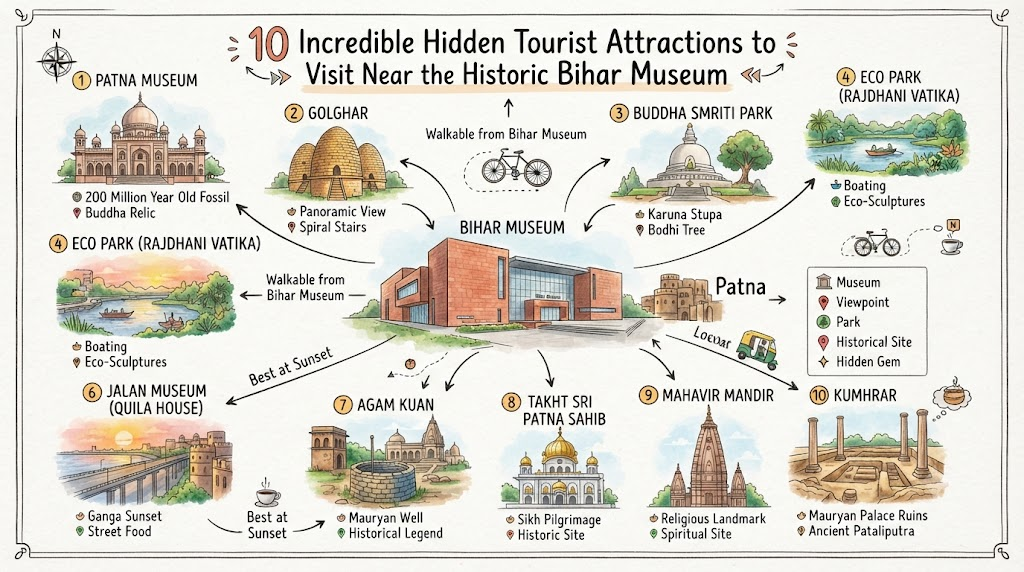
Stepping into the Patna Museum, located less than two kilometers from its newer sister institution, is akin to walking straight into a time capsule curated over a century ago. Constructed in 1917 during the British Raj using an elegant blend of Mughal and Rajput architectural design, this Indo-Saracenic marvel houses an invaluable array of archaeological findings. Its grand galleries are globally famous for safeguarding ancient terracotta figures, weapons from different dynasties, and the legendary fossilized tree trunk estimated to be over 200 million years old.
The true crowning glory of this space is the sacred Buddha Relic Casket, excavated from the ancient ruins of Vaishali, which fills the quiet galleries with a profound sense of historical gravity. Visitors will also find themselves spellbound by the pristine Gandhara sculptures and the intricate medieval scroll paintings that reflect the artistic dialogue between ancient Bihar and the rest of Asia.
- Location: Patna Central, approximately 1.5 km east of the Bihar Museum.
- Why it is worth visiting: It holds the invaluable, genuine sacred relics of Lord Buddha and unparalleled Mauryan-era archaeological discoveries.
- Best things to do: View the 200-million-year-old fossilized tree, explore the specialized Dr. Rajendra Prasad gallery, and admire the Lohanipur Jain torso.
- Best time to visit: Morning hours between 10:30 AM and 1:00 PM for optimal soft indoor gallery lighting.
- Ideal for whom: Deep history enthusiasts, academic researchers, and cultural documentary photographers.
- Travel tip: Remember that the museum remains strictly closed to the public on Mondays; plan your itinerary accordingly.
Golghar
Rising like a massive, windowless dome against the Patna skyline, Golghar is an architectural marvel that tells a fascinating story of British engineering responding to local crises. Built in 1786 by Captain John Garstin following the devastating famine of 1770, this beehive-shaped granary was designed to store over 130,000 tons of grain for the army. The structure is entirely unique because its thick brick walls curve inward without a single internal pillar supporting the massive ceiling.
Two spiral stone staircases wrap around the exterior, meeting at the very top where a small opening was designed to pour grain down into the dark belly of the monument. Climbing these steps rewards travelers with a panoramic vista of the city below and the shimmering waters of the Ganges River flowing silently in the distance.
- Location: Near Gandhi Maidan, roughly 2.5 km from the Bihar Museum.
- Why it is worth visiting: A masterclass in pillarless brick architecture offering the most iconic panoramic viewpoint over old Patna.
- Best things to do: Climb the twin spiral staircases, enjoy the manicured green lawns at the base, and attend the evening light show.
- Best time to visit: Late afternoon around 4:30 PM to catch the sunset over the Ganges from the summit.
- Ideal for whom: Architecture lovers, landscape photographers, and families with older children.
- Travel tip: Watch your step on the narrow spiral stairs as there are no continuous safety handrails along the exterior wall.
Buddha Smriti Park
In absolute contrast to the chaotic energy of the surrounding commercial hubs, Buddha Smriti Park stands as a expansive 22-acre oasis of absolute spiritual peace. Conceptually designed to commemorate the 2500th anniversary of Lord Buddha’s enlightenment, the park’s visual centerpiece is the stunning Patliputra Karuna Stupa. This massive dome houses authentic relics of the Buddha contributed by multiple nations, creating an active destination for international meditation and reflection.
The park is exquisitely landscaped, featuring a lush Bodhi tree planted from a sapling brought directly from Anuradhapura in Sri Lanka, linking it back to Emperor Ashoka’s era. As twilight falls, the entire complex transforms with subterranean lighting and musical fountains that mirror the internal quietude sought by the monks who visit.
- Location: Opposite Patna Junction Railway Station, about 3 km from the Bihar Museum.
- Why it is worth visiting: Home to the magnificent Karuna Stupa and a dedicated international meditation center blessed by the Dalai Lama.
- Best things to do: Meditate inside the quiet glass chambers, visit the interactive underground museum, and view the sacred Bodhi trees.
- Best time to visit: Evening between 5:30 PM and 7:00 PM to view the spectacular architectural lighting display.
- Ideal for whom: Spiritual seekers, solo travelers looking for quiet, and couples looking for a peaceful walk.
- Travel tip: Shoes must be removed before entering the central stupa area; carry a pair of clean socks for hot afternoon floors.
Eco Park (Rajdhani Vatika)
For travelers seeking to escape the midday heat and reconnect with nature, Eco Park (locally known as Rajdhani Vatika) offers the ultimate urban green sanctuary. Spread across dozens of acres of meticulously maintained woodlands, this park functions as the green lungs of the capital city. It features two large, shimmering artificial lakes connected by a picturesque wooden bridge, where visitors can enjoy peaceful boating excursions away from traffic noise.
The park is highly celebrated for its dedicated ecological zones, including a vibrant rose garden, a massive greenhouse filled with rare tropical plants, and creative open-air sculptures made entirely from recycled industrial waste. Winding jogging tracks weave through dense bamboo thickets, making it a favorite spot for locals and travelers alike.
- Location: Strand Road, just 0.8 km west of the Bihar Museum.
- Why it is worth visiting: It is the closest major nature getaway to the museum, offering excellent boating facilities and modern eco-sculptures.
- Best things to do: Rent a paddleboat on the central lake, walk through the waste-to-art display, and explore the children’s adventure zone.
- Best time to visit: Early morning at 6:00 AM for birdwatching or late afternoon for boating.
- Ideal for whom: Families with young children, fitness enthusiasts, and nature walkers.
- Travel tip: The park can become exceptionally crowded on Sunday afternoons; choose a weekday for a peaceful experience.
Ganga Path (Patna Marine Drive)
Representing the modern, progressive face of the city, the Ganga Path—popularly dubbed the Marine Drive of Patna—has completely revolutionized how evening leisure is experienced in the capital. This stunning elevated expressway stretches smoothly along the banks of the majestic Ganges River, offering a flawless, breezy driving experience. As the sun sets, the entire waterfront comes alive with a festive atmosphere, illuminated by glowing streetlights and the headlights of thousands of evening visitors.
The promenade has rapidly evolved into the ultimate street food culinary hotspot of the city. Dozens of brightly lit stalls set up along the path, serving everything from traditional charcoal-grilled snacks to modern fusion street food, all while cool river breezes drift over the crowds.
- Location: Running along the northern edge of the city, roughly 3.5 km from the Bihar Museum.
- Why it is worth visiting: Experience Patna’s spectacular modern infrastructure development combined with panoramic sunset views over the river.
- Best things to do: Take an evening drive, sample street food from local vendors, and enjoy the cool river breeze.
- Best time to visit: Late evening from 6:00 PM onwards when the temperature drops and the lights turn on.
- Ideal for whom: Groups of friends, foodies, and young couples looking for a lively atmosphere.
- Travel tip: Traffic can slow down significantly near major exit ramps between 7:00 PM and 8:30 PM on weekends.
Offbeat Exploration: Hidden Gems Tourists Miss
Jalan Museum (Quila House)
Tucked away inside the historic narrow lanes of old Patna City, the Jalan Museum is a private museum built directly upon the foundations of the ancient Sher Shah Suri fort. This hidden gem houses an astonishing private collection of European and Asian antiques, including exquisite jade carvings, Marie Antoinette’s mechanical clock, and delicate porcelain dinnerware custom-made for Napoleon Bonaparte. Because it remains a private residence, it offers an exclusive look into the lifestyle of Patna’s historic elite.
Agam Kuan (The Unfathomable Well)
Steeped in dark historical legends, Agam Kuan is an ancient archaeological site dating directly back to the Mauryan Emperor Ashoka’s reign. Folklore insists this incredibly deep brick well was built by Ashoka to torture his enemies and brothers before his dramatic conversion to Buddhism. Today, the site holds deep religious significance, situated right next to the historic Shitala Devi temple, where locals come to offer prayers for healing.
Detailed Practical Guidance for Travelers
| Destination | Standard Entry Fee | General Timings | Best Local Food Options Nearby | Recommended Nearby Attractions |
| Patna Museum | ₹50 (Indians) / ₹500 (Foreigners) | 10:30 AM – 5:00 PM (Closed Mon) | Sattu Paratha at local stalls | Indira Gandhi Planetarium |
| Golghar | ₹20 per person | 10:00 AM – 6:00 PM Daily | Litti Chokha at Gandhi Maidan | Maurya Lok Shopping Complex |
| Buddha Smriti Park | ₹40 entry fee | 9:00 AM – 7:00 PM Daily | South Indian meals at Station Road | Mahavir Mandir Temple |
| Eco Park | ₹30 entry fee | 6:00 AM – 8:00 PM Daily | Street food and snacks at entry gate | Patna Zoo (Jaivik Udyan) |
| Jalan Museum | Prior Permission Required | By appointment only | Traditional sweets in Patna City | Takht Sri Patna Sahib |
Logistics & On-Ground Navigation
Local Transport Options
- Railways: Patna Junction serves as the central hub, providing seamless connections to all major attractions via the main arterial roads.
- Auto-Rickshaws: Shared autos run constantly along fixed routes like Frazer Road and Bailey Road, offering a highly economical transit option.
- E-Rickshaws: Perfect for short-distance hops between the Bihar Museum and nearby locations like Eco Park or Maurya Lok.
- Car Rentals: App-based cabs (Ola and Uber) operate extensively across the city, providing reliable, air-conditioned comfort for day-long bookings.
Budget Planning
- Budget/Backpacking Tier: Expect to spend roughly ₹800 to ₹1,200 per day. This covers budget guest houses, relying entirely on shared e-rickshaws, and enjoying authentic street food stalls for meals.
- Mid-Range/Comfort Tier: Plan for approximately ₹2,500 to ₹4,500 per day. This budget accommodates comfortable 3-star hotels, private app-based cab rentals, entry fees for premium museum galleries, and dining at air-conditioned family restaurants.
Safety and Inclusivity Tips
- Families: All central parks and museums are highly secure with visible security guards, making them exceptionally welcoming for multi-generational families.
- Couples: Stick to mainstream, well-lit spaces like Eco Park and the Bihar Museum campus; avoid poorly lit, isolated corners of public grounds after dark.
- General Safety: Patna is generally a welcoming city; however, it is smart practice to avoid traveling through unlit industrial or old city zones past 10:00 PM.
Strategic Travel Planning Guardrails
Travel Planning Tips for Patna
- Always download and use reliable UPI digital payment apps, but keep at least ₹1,000 in crisp cash bills for small e-rickshaw fares.
- Schedule your major indoor museum gallery explorations for the middle of the day to stay cool during peak summer heat.
- Dress respectfully when visiting active religious landmarks like the Mahavir Mandir or Patna Sahib Gurudwara by keeping shoulders and knees covered.
- Book your accommodation as close to Bailey Road or Frazer Road as possible to drastically reduce daily commuting times.
- Carry a lightweight power bank with you, as extensive photography inside the gorgeous museum galleries will drain your phone battery quickly.
Common Mistakes to Avoid
- Never try to plan a visit to both the Bihar Museum and the older Patna Museum on a Monday, as doors will be locked.
- Do not assume you can easily walk between old Patna City attractions and western hubs in a single afternoon; the traffic can be intense.
- Avoid skipping the local street side sweet vendors; missing out on fresh, hot Khaja or Kesaria Peda means missing the culinary heart of the region.
- Do not engage with unregistered tour guides standing outside major monuments; stick to official audio guides or museum-appointed curators.
- Avoid over-packing your daily itinerary; limit your targets to three major locations per day to avoid travel fatigue.
Suggested Itinerary Blueprints
1. One-Day Quick Dash (The Museum Core Route)
Designed for time-pressed travelers. Start at 10:00 AM with a detailed three-hour tour of the Bihar Museum. Grab a traditional lunch at the in-house restaurant, then take a quick 5-minute e-rickshaw ride to the historic Patna Museum. Conclude your evening with a relaxing sunset stroll through the lush lawns of Eco Park.
2. Two-Day Deep-Dive (Heritage & Culture Circuit)
- Day 1: Dedicate your entire morning to the grand galleries of the Bihar Museum. In the afternoon, explore the architectural marvel of Golghar, and end your evening enjoying street food along the breezy Ganga Path.
- Day 2: Start early with spiritual reflection at Buddha Smriti Park, followed by a history walk through the older Patna Museum. Spend your afternoon tracking down the hidden treasures of the private Jalan Museum in the old city.
3. Complete Weekend Travel Plan (The Ultimate Patna Loop)
- Friday: Arrive and settle into your hotel. Head out for a late afternoon stroll around Gandhi Maidan and watch the sunset from the top of Golghar.
- Saturday: Immerse yourself in the world-class displays at the Bihar Museum before lunch. Spend the evening hours relaxing by the lakes inside Eco Park, followed by a dynamic dinner cruise or walk along the Ganga Path.
- Sunday: Dedicate your morning to the peaceful meditation zones of Buddha Smriti Park. Spend your final afternoon shopping for authentic Madhubani paintings and Tikuli art at Maurya Lok before checking out.
Common Tourist Mistakes to Avoid
- Geographic Blunders: A very common mistake is attempting to explore the ancient ruins of Kumhrar and the old Patna Sahib Gurudwara in the exact same morning block as the western modern expansions; the cross-city traffic will consume your entire day.
- Commercial Traps: Do not waste your precious travel evenings wandering through modernized, generic glass shopping malls that look identical to those in any other metropolitan city; instead, seek out the atmospheric local markets filled with history.
- Neglecting Modern/Alternative Zones: Many travelers focus so heavily on ancient history that they completely forget to experience the creative, artistic cafe culture expanding rapidly behind Patliputra Colony and Boring Road.
- Transport Overpayment: Never accept blind flat-rate quotes from auto drivers waiting directly outside railway stations; always cross-reference the distance on your ride-sharing apps to check the fair market price.
- Luxury Dining Bias: Limiting your meals entirely to expensive hotel buffets will deprive you of the region’s true soul. The most authentic, delicious flavor profiles are found at humble, multi-generational street vendors turning out hot Littis over charcoal.
Frequently Asked Questions
1. What is the exact physical distance between the new Bihar Museum and the old Patna Museum?
The physical distance between the two primary museums is approximately 1.5 to 2 kilometers, easily covered via a brief 5-minute e-rickshaw or auto ride straight down Bailey Road.
2. Can travelers safely photograph the exhibits inside both of these major institutions?
Photography is permitted inside the general galleries of the Bihar Museum upon purchasing a digital camera ticket at the main counter, but strict restrictions apply to specific high-security zones like the Buddha Relic Casket chamber in the Patna Museum.
3. Are there clean, reliable dining facilities available within walking distance of the Bihar Museum?
Yes, the Bihar Museum features an exceptional in-house restaurant serving authentic regional delicacies, while the nearby Maurya Lok Complex offers dozens of modern cafes and multi-cuisine family restaurants.
4. Is there an integrated entry ticket available that covers all these heritage monuments together?
No, there is currently no combined single-ticket system; entry tokens must be purchased individually at the respective gates of each park, museum, or monument.
5. How much time should a traveler ideally dedicate to properly exploring the Bihar Museum?
To truly appreciate the extensive historical collections, world-class interactive media, and art galleries, you should allocate at least 3 full hours.
6. What is the most reliable and safe local transport option for a solo female traveler moving around Patna?
App-based cabs like Ola and Uber offer tracked, safe point-to-point transport, while daytime travel via local e-rickshaws along major roads is highly reliable and communal.
7. Are the historic staircases of the Golghar granary currently open for climbing to the top?
The staircases are occasionally closed for structural maintenance and preservation work; it is best to check with the local tourism desk at the base gate upon arrival.
8. Where can international travelers buy authentic, certified Madhubani and Tikuli art paintings nearby?
The official museum souvenir shop inside the Bihar Museum campus and the government-run Upendra Maharathi Shilp Anusandhan Sansthan offer verified, authentic local handicrafts.
9. Does Buddha Smriti Park provide secure cloakroom facilities for storing heavy travel luggage?
Yes, there is a secure cloakroom located right next to the main ticket counter where travelers can safely deposit bags before entering the meditation zones.
10. Is the newly developed Ganga Path Marine Drive safe for family strolls late at night?
The main promenade is heavily patrolled by local police and very well-lit, making it highly safe for families up until 9:30 PM, after which traffic starts to thin out.
11. Do these major tourist landmarks provide wheelchair access and ramps for elderly visitors?
The modern Bihar Museum and Buddha Smriti Park are fully built with international accessibility standards, featuring smooth ramps and elevators, whereas older structures like Golghar present steep stairs.
12. Which specific local street food item must a traveler try first when exploring Patna?
Without a doubt, you must try hot Litti Chokha prepared fresh over open charcoal fire, served with a generous dollop of pure desi ghee and spicy eggplant mash.
Conclusion
Choosing to explore the historic circuit around the Bihar Museum is far more than an ordinary holiday escape; it is a profound journey into the very cradle of Indian heritage. As you walk past ancient Mauryan stone sculptures, watch the golden sunset mirror off the timeless Ganges, and lose yourself in the quiet meditation gardens, you will feel a deep civilizational connection that modern commercial resorts can never replicate. This journey rewards the conscious traveler with an enduring intellectual and spiritual awakening, leaving you with a profound appreciation for a region that shaped the history of Asia.
