Introduction
Mainstream tourist corridors frequently trap travelers in overcrowded souvenir markets filled with mass-manufactured replicas and synthetic dyes. True cultural journeying demands peeling back commercial facades to uncover places where heritage breathes through living tradition.
Madhubani painting, also celebrated globally as Mithila art, represents a sacred indigenous design philosophy that took root thousands of years ago in northern Bihar. Journeying directly into the rustic villages and state-run guild emporiums across Bihar offers you a rare, unmediated encounter with master artisans whose lineages have safeguarded this art form across centuries.
Why Bihar is a must-visit city
Bihar forms the ancient beating heart of South Asian civilization, philosophy, and creative expression. The Mithila region in particular—cradled north of the Ganges toward the Himalayan foothills—carries immense mythological and cultural weight as the celebrated birthplace of Goddess Sita. The intricate geometric patterns, celestial motifs, and vivid natural iconography that define Madhubani paintings originated as devotional wall art decorating village wedding chambers.
The travel circuit connecting the capital city of Patna to Darbhanga and rural Madhubani district has matured into an accessible artistic trail. High-speed express trains like the Vande Bharat and Jan Sadharan networks link Patna and Darbhanga seamlessly. Meanwhile, civil flight operations at Darbhanga Airport drastically cut down transit time for modern art seekers, backed by well-maintained four-lane national highways and traditional rural hospitality.
| Region Characteristic | Strategic Insight |
|---|---|
| Primary Cultural Epicenter | Madhubani District (Jitwarpur, Ranti, Rajnagar) |
| Urban Procurement Hub | Patna (Dak Bungalow, Maurya Lok Complex) |
| Artistic Classification | GI-Tagged Folk Heritage (Styles: Bharni, Katchni, Godna, Tantric) |
| Nearest Airport Hubs | Patna Airport (PAT) & Darbhanga Airport (DBR) |
| Ideal Transit Season | October through March |
Best Places or Experiences

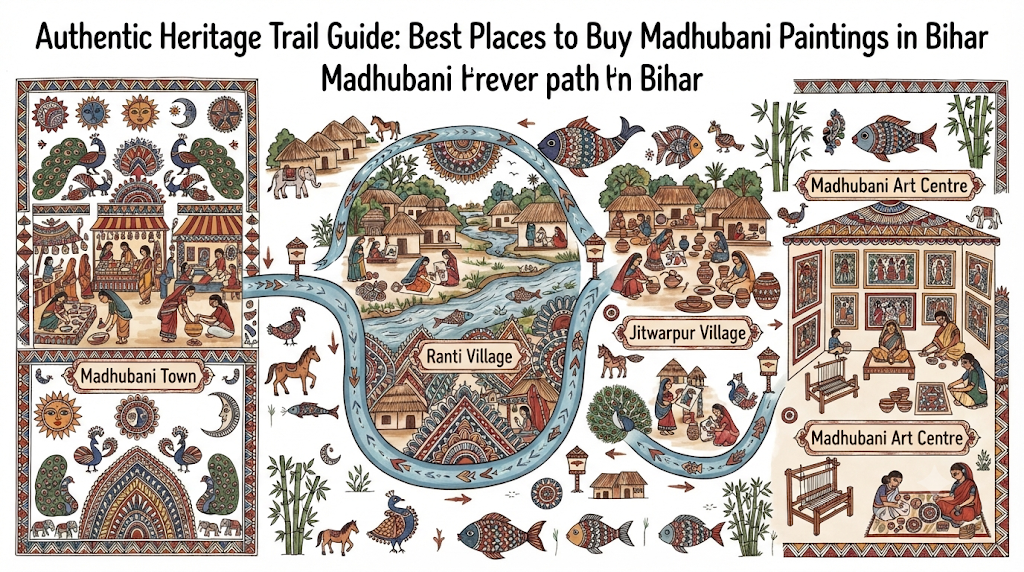
Jitwarpur Artisan Village, Madhubani
Jitwarpur stands as the spiritual homeland and birthplace of modern canvas-based Mithila art. Walking down the narrow mud-brick lanes of this village reveals courtyard walls covered in vibrant mythological epics. The hamlet has produced legendary National Awardees and Padma Shri recipients, notably the pioneering artist Sita Devi.
Visiting this living craft settlement allows you to step directly into artist homesteads where families sit together on woven mats, utilizing fine bamboo twigs and natural pigment concoctions to draft intricate narratives on handmade paper.
- Location: Madhubani District, approximately 4 km east of Madhubani town and 175 km northeast of Patna.
- Why it is worth visiting: It offers an unmediated opportunity to purchase certified GI-grade artworks straight from multi-generational award-winning families without middlemen markups.
- Best things to do: Observe the intricate hand-pigment mixing process using crushed lampblack and plant saps; commission custom ancestral motifs; photograph the painted village exterior walls.
- Best time to visit: November to February, preferably during morning daylight between 9:00 AM and 1:00 PM.
- Ideal for whom: Art collectors, cultural ethnographers, documentary photographers, and heritage enthusiasts.
- Travel tip: Carry clean crisp cash denominations, as intermittent cellular data can disrupt digital QR transactions in inner village hamlets.
Ranti Village Art Settlement, Madhubani
Ranti is widely celebrated as the torchbearer of the delicate Katchni (line drawing) tradition pioneered by legendary masters like Ganga Devi and Godavari Dutt. In contrast to the heavy chromatic fills of neighboring hamlets, Ranti art focuses on monochrome line precision and sophisticated geometric hatching using natural black ink.
The settlement serves as a powerful women-led collective where craft serves as both domestic ritual and financial empowerment. The courtyards are quiet, filled with the soft rustle of mulberry paper and the steady rhythm of handmade nibs mapping out spiritual cosmos patterns.
- Location: Madhubani District, roughly 5 km from Madhubani Railway Station.
- Why it is worth visiting: Unmatched collection of fine-line Katchni monochrome canvases and contemporary social commentary pieces rendered by celebrated women artisans.
- Best things to do: Sit down for private demonstration sessions with resident master artists; study the contrast between classic mythology and contemporary themes; acquire signed collectible scrolls.
- Best time to visit: Winter months (October to March), ideally in the late afternoon from 2:00 PM to 5:00 PM.
- Ideal for whom: Modern minimalist decorators, monochrome art lovers, solo women travelers, and folklorists.
- Travel tip: Remove your shoes before entering village verandahs and residential studio spaces as an essential sign of respect.
Upendra Maharathi Shilp Anusandhan Sansthan, Patna
Situated in the heart of Patliputra, this state-run apex craft and research institute serves as the supreme guardian of Bihar’s traditional arts. Established under the Department of Industries, the campus houses specialized training centers, conservation archives, and an expansive public gallery showcasing museum-grade Mithila masterpieces.
The on-site sales showroom features vetted artwork created by master instructors and senior apprentices, guaranteeing absolute authenticity in technique, paper preparation, and vegetable dye extraction.
- Location: Patliputra Industrial Area, Patna, roughly 7 km from Patna Junction Railway Station.
- Why it is worth visiting: Fixed, standardized government pricing on genuine hand-painted canvases with documented artist attribution and GI certification.
- Best things to do: Tour the permanent craft museum gallery; observe formal workshop classes in session; buy verified silk and handmade paper works with certificates of authenticity.
- Best time to visit: Year-round on weekdays between 11:00 AM and 4:00 PM.
- Ideal for whom: Corporate buyers, institutional collectors, first-time tourists seeking zero-hassle authentic shopping.
- Travel tip: The research library holds rare archival monographs on Mithila symbolism that are accessible on request to curious travelers.
Bihar State Handloom & Handicrafts Emporium (Amrapali), Patna
Located within the sprawling, bustling commercial center of Maurya Lok Complex, Amrapali is Bihar’s iconic flagship retail window. It curates authenticated folk crafts sourced directly from cooperative craft societies throughout North Bihar.
For travelers who cannot journey deep into rural Mithila villages, this emporium provides an authentic urban alternative. You will discover an extensive catalog ranging from affordable framed desk motifs to grand wall hangings, Bhagalpuri silk sarees decorated with Madhubani borders, and hand-painted home linen.
- Location: Maurya Lok Shopping Complex, Dak Bungalow Road, Patna.
- Why it is worth visiting: Guaranteed authenticity with transparent government-regulated pricing tags, clear return receipts, and card/UPI payment facilities.
- Best things to do: Browse hand-painted Tussar silk sarees; pick up Madhubani stationery sets and canvas wall hangings; explore Maurya Lok’s classic local food scene right outside.
- Best time to visit: Open year-round from 10:30 AM to 7:30 PM (except Sundays).
- Ideal for whom: Souvenir hunters, family vacationers, and business travelers operating on tight schedules.
- Travel tip: Check the border stitching on hand-painted sarees carefully to confirm the design is entirely hand-rendered rather than screen-printed.
Rajnagar Palace Complex Artisan Guilds, Rajnagar
The grand ruined palace complex built by Maharaja Rameshwar Singh of Darbhanga provides one of Bihar’s most evocative historical backdrops. Surrounded by semi-ruined marble pavilions, towering arches, and historic Durga shrines, local craft collectives nearby produce high-end folk art inspired by the royal court’s original patronage.
The painters around Rajnagar often reflect antique color schemes, using rich ochres, terracotta wash, and vermilion shades derived from classical temple motifs. Purchasing artwork here ties your souvenir directly to the historic royal preservation of the Mithila region.
- Location: Rajnagar, Madhubani District, approximately 14 km north of Madhubani town.
- Why it is worth visiting: The magical juxtaposition of royal architectural ruins and traditional Mithila artisan stalls operating in adjoining bazaars.
- Best things to do: Explore the massive 1934-earthquake-surviving red-brick Durga temple; shop for classic Kohbar wedding drawings; photograph the vintage palace archways.
- Best time to visit: Early morning hours (8:00 AM to 11:00 AM) between November and February to catch the mist clearing over the palace ponds.
- Ideal for whom: Architectural explorers, history buffs, and vintage craft hunters.
- Travel tip: Hire a local cycle-rickshaw guide from Rajnagar railway station to easily navigate the palace compound and nearby artisan workshops.
Offbeat Exploration: Hidden Gems Tourists Miss
The Painted Platforms of Madhubani Railway Station
Unlike standard concrete transit hubs, the Madhubani railway terminal serves as an open-air public art installation. In 2017, over 180 local Mithila artists painted more than 7,000 square feet of bare station walls without taking wages, turning railway platforms, waiting rooms, and stairwells into an open folk gallery. It represents one of the largest public community art restorations in India.
Saurath Sabha Grounds
Located just off the Madhubani–Darbhanga highway, Saurath is historically famous for the annual gathering of Maithil Brahmins holding ancestral genealogies on ancient palm-leaf scrolls (Panji). During quiet non-festival seasons, the village’s resident artists create specialized astrological and genealogical scroll paintings that are rarely found in urban art shops.
Simri Village Border Workshops
Situated along the rural outskirts near Darbhanga, Simri is renowned for Godna (tattoo-inspired) art forms. Emerging from marginalized communities who transformed ritual body tattoos into stunning linear and concentric mandala art, Simri’s workshops offer travelers a unique look at Bihar’s subaltern folk expressions.
Detailed Practical Guidance for Travelers
| Destination | Standard Entry Fee | General Timings | Best Local Food Options Nearby | Recommended Nearby Attractions |
|---|---|---|---|---|
| Jitwarpur Artisan Village | Free entry (Artist donations welcome) | Sunrise to Sunset (Daily) | Traditional Maithil Thali, Sattu Drink | Uchaitha Bhagwati Temple, Benipatti |
| Ranti Village Settlement | Free entry | 9:00 AM – 6:00 PM (Daily) | Local Makhanas, Kachori-Jalebi stalls | Madhubani Town Bazaar, Ekhatra Temple |
| Upendra Maharathi Sansthan | Free entry | 10:00 AM – 5:00 PM (Mon–Fri) | Litti Chokha at Boring Road stalls | Patna Museum, Bihar Museum |
| Amrapali Emporium (Patna) | Free entry | 10:30 AM – 7:30 PM (Mon–Sat) | Maurya Lok street chaat, South Indian cafes | Golghar, Buddha Smriti Park |
| Rajnagar Palace Complex | Free entry (Nominal ₹10 temple care) | 6:00 AM – 6:30 PM (Daily) | Village peda, fresh sugarcane juice | Darbhanga Raj Fort, Shyama Mai Temple |
Logistics & On-Ground Navigation
Local Transport Options
- Inter-City Railways: Fast superfast express trains run regularly from Patna Junction to Darbhanga and Madhubani stations.
- Auto-Rickshaws & E-Rickshaws: Green electric rickshaws dominate town centers like Madhubani and Darbhanga; they are inexpensive, zero-emission, and perfect for village hops under 8 km.
- Private Taxi Hire: Renting an air-conditioned cab from Patna or Darbhanga with a dedicated driver ensures maximum flexibility when hopping across rural villages like Jitwarpur and Ranti.
- Bicycle Rentals: Many village homestays and local lodges arrange vintage cruiser bikes, offering an unhurried, scenic way to glide along quiet rural farming paths.
Budget Planning
- Backpacker Tier (₹1,000 – ₹1,800 per day): Stays at budget railway guesthouses or dharamsalas; journeys made via passenger trains and shared e-rickshaws; meals of street-side Litti Chokha, sattu parathas, and tea.
- Mid-Range / Comfort Tier (₹3,500 – ₹7,000 per day): Comfortable heritage stays or air-conditioned business hotels in Patna or Darbhanga; private day cabs for village excursions; dining at established family restaurants and heritage thali venues.
Safety and Inclusivity Tips
- For Families: Rural village communities are exceedingly welcoming; locals often invite visiting families onto verandahs for tea, jaggery, and water. Stick to bottled water during village travels.
- For Couples: Modest, respectful dressing that covers shoulders and knees helps travelers blend naturally into conservative village settings. Public displays of intimacy are uncommon.
- General Safety: Keep daytime village excursions aligned with sunlight hours. Rural roads connecting remote hamlets frequently lack street lighting after dark.
Strategic Travel Planning Guardrails
Travel Planning Tips for Bihar
- Schedule Around Chhath Puja: Autumn brings vibrant celebrations, but transit systems and accommodations book out months in advance.
- Carry Cash Reserves: Rural master painters rarely own credit card terminals; have banknotes ready for small and medium purchases.
- Authenticate the Pigments: Ask artists to demonstrate their plant-derived binders—turmeric yellow, indigo blue, peepal bark orange, and kohl black.
- Request Custom Signatures: Authentic painters will gladly sign and date the reverse of the canvas with their village name and style classification.
- Bring a Rigid Cardboard Tube: Sturdy art mailing cylinders prevent handmade paper pieces from creasing during transit.
Common Mistakes to Avoid
- Rushing the Artists: True hand-painted works demand days of painstaking linework; do not expect immediate custom turnover for detailed orders.
- Assuming Cheap Souvenirs Are Real: Screen-printed polyester cloths sold at railway stalls are cheap commercial reproductions, not handmade originals.
- Ignoring the District Rural Outskirts: Sticking solely to city emporiums in Patna deprives you of meeting the actual master artists in their home studios.
- Traveling Without Insect Protection: Rural evenings near irrigation canals can see active mosquito presence; pack personal insect repellent.
- Treating Studios Like Mere Shops: Village artist homes are sacred living spaces; approach conversations with cultural curiosity rather than sharp, confrontational bargaining.
Suggested Itinerary Blueprints
1. Day Quick Dash (The Patna Urban Collector Loop)
- Target Audience: Business travelers, day-trippers, and transit passengers with limited time.
- Morning: Arrive in Patna and head directly to Upendra Maharathi Shilp Anusandhan Sansthan in Patliputra for museum inspiration and certified archival purchases.
- Afternoon: Head over to Maurya Lok Complex to browse Amrapali Emporium for silk dupattas and wall pieces, followed by an authentic lunch of Champaran meat or Litti Chokha.
- Late Afternoon: Tour the newly curated folk art galleries at Bihar Museum before boarding your evening connection.
2. Day Deep-Dive (The Mithila Heartland Circuit)
- Target Audience: Discerning collectors and design enthusiasts.
- Day 1 (Darbhanga Base): Land at Darbhanga Airport, check into your hotel, and explore the historic Darbhanga Raj Fort and Chandradhari Museum. Afternoon drive to Rajnagar to view the palace ruins and shop from local artist clusters.
- Day 2 (Madhubani Artisan Odyssey): Early morning drive into Madhubani district. Dedicate your morning to Jitwarpur Click to open side panel for more information ‘s Bharni workshops and your afternoon to Ranti’s delicate Katchni studios. Return to Darbhanga for dinner.
3. Complete Weekend Travel Plan (The Grand Folk Art Odyssey)
- Friday: Arrive in Patna, explore local galleries, and take an evening executive train across the Ganges to Darbhanga.
- Saturday: Full-day immersive art residency in Jitwarpur Click to open side panel for more information . Share home-cooked meals with artist families, observe dye extractions, and commission custom works.
- Sunday: Morning exploration of Ranti village and the painted platforms of Madhubani Railway Station. Afternoon stop at Saurath heritage village before taking an evening return flight out of Darbhanga Airport.
Common Tourist Mistakes to Avoid
- Geographic Blunders: Attempting to combine the southern Buddhist pilgrimage circuit (Bodh Gaya, Nalanda, Rajgir) and the northern Mithila art circuit (Madhubani, Darbhanga) in a single weekend. The two regions lie on opposite sides of the Ganges and deserve separate travel itineraries.
- Commercial Traps: Spending your entire shopping budget inside air-conditioned multi-brand shopping malls where art prints are mass-produced on synthetic surfaces without royalty returns to rural communities.
- Neglecting Modern Alternative Zones: Overlooking university art departments and experimental studios in modern Patna, where young painters merge ancient folk iconography with contemporary urban graphic design.
- Transport Overpayment: Agreeing to unmetered airport taxis without comparing rates on digital aggregator apps or asking station prepaid booths for standard government rate cards.
- Luxury Dining Bias: Eating exclusively in closed hotel buffets. Skipping neighborhood street-side Sattu sherbet, hot steaming Litti Chokha, and authentic fresh Makhana kheer deprives you of the culinary essence of Mithila culture.
Frequently Asked Questions
1. How do I distinguish an authentic Madhubani painting from a machine print?
Authentic Madhubani paintings are completed on handmade or handmade mulberry paper with visible fiber textures. Because they are painted entirely by hand using fine nibs, bamboo twigs, or brushes, you will notice subtle line-thickness variations, natural color gradations, and intentional geometric asymmetries that commercial printing machines cannot duplicate.
2. What are the key styles of Madhubani painting available in Bihar?
There are five recognized styles: Bharni (bold, vibrant mythological color fills), Katchni (delicate monochrome or duo-tone linework), Tantric (esoteric, sacred geometry), Godna (concentric tattoo-inspired rings), and Gobar/Kobar (earthy washes on cow-dung treated surfaces).
3. Are natural vegetable dyes still used by artists today?
Yes, traditional master artists still formulate natural pigments using turmeric (yellow), crushed indigo (blue), soot or lampblack (black), palash blossom (orange), and bilva leaves (green). However, high-grade non-toxic acrylics are also commonly used on commercial canvas and textiles to ensure long-term UV durability.
4. What is the standard price range for an authentic Madhubani painting?
Small, postcard-sized handmade paper works typically start between ₹300 and ₹800. Medium framed canvas works range from ₹2,500 to ₹8,000, while intricate, large-scale heirloom tapestries crafted by senior award-winning masters can command anywhere from ₹25,000 to well over ₹1,00,000 depending on the detail.
5. Can I visit artist homes directly in Jitwarpur and Ranti without a tour guide?
Yes, both Jitwarpur Click to open side panel for more information and Ranti are hospitable, open rural communities. You can easily hire an auto-rickshaw from Madhubani town to take you into the villages, where you can politely greet local families and request to view their workshop verandahs.
6. Which airport is closest to the rural Madhubani painting villages?
Darbhanga Airport (DBR) is the closest operational airport, located approximately 35 km southwest of Madhubani town. It connects directly with major Indian metro hubs like Delhi, Mumbai, and Bengaluru.
7. Can I commission custom Madhubani paintings directly from village artisans?
Yes, most resident master painters readily accept commissioned orders for custom sizes, specific mythological scenes, wedding Kohbars, or family portraits adapted into traditional Mithila iconography. They can securely roll and ship the finished works to your home address upon completion.
8. Do government emporiums in Patna accept credit cards and UPI payments?
State-run showrooms like Amrapali Emporium (Maurya Lok) and the showroom at Upendra Maharathi Shilp Anusandhan Sansthan accept all major credit cards, debit cards, and standard UPI payments.
9. What special packaging is recommended when buying paintings in Bihar?
Ask the artist or shop to roll the unframed painting with a protective sheet of butter paper over the paint surface, then seal it inside an airtight cylindrical plastic or heavy cardboard tube to protect against accidental moisture and bending.
10. What local dishes should I try while exploring the Mithila art circuit?
Indulge in authentic Maithil Thali containing Machher Jhol (mustard fish curry) or fresh pointed gourd preparations, accompanied by Ol (yam) chutney, Sattu parathas, and crunchy roasted Makhana (fox nuts).
11. Is it customary to bargain when purchasing art directly from village painters?
While minor rounding down is normal, aggressive bargaining is discouraged. These handmade creations require weeks of delicate manual labor; compensating artists fairly protects and preserves this indigenous craft tradition.
12. What is the best season to take this cultural road trip through Bihar?
The winter window between October and March offers cool, pleasant weather, clear daytime skies, and comfortable rural walking conditions across northern Bihar.
Conclusion
Choosing an intentional cultural journey through the artistic heartlands of Bihar transforms a routine vacation into an unforgettable encounter with living history. Walking the unpaved courtyards of Mithila, watching master artists extract brilliant pigments from flowers and soot, and bringing home an original canvas straight from an artisan’s verandah creates a lasting personal bond with one of humanity’s oldest unbroken visual traditions.
