Introduction
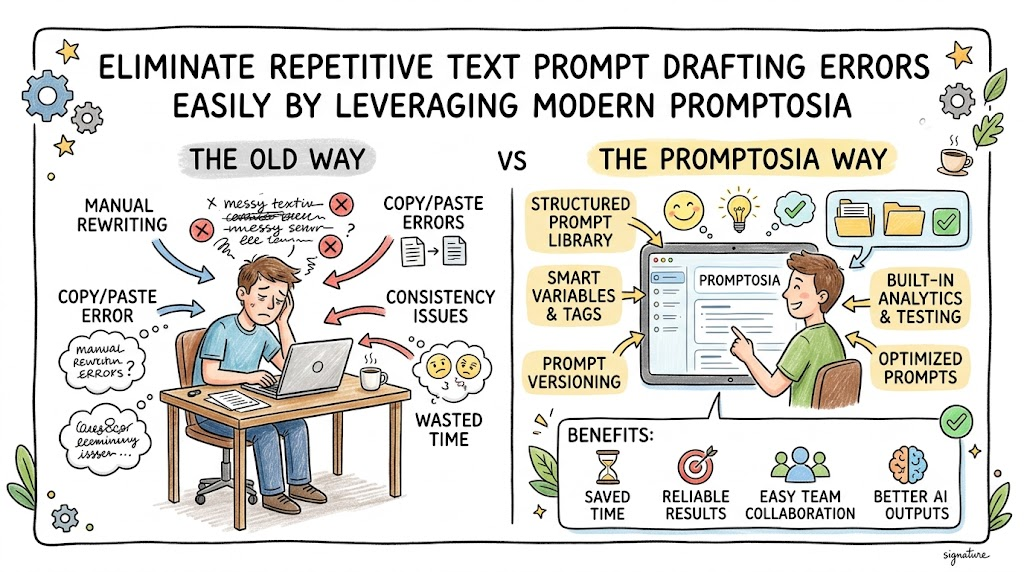
Scatter effective AI instructions across endless conversation logs, note apps, and draft folders, and you immediately waste valuable energy recovering them later. Every professional who interacts with modern language models hits this wall eventually: you craft a brilliant prompt, secure an ideal output, and watch that exact phrasing vanish into digital clutter. Attempting to rebuild successful queries from memory creates uneven responses and slows your output to a crawl. Integrating an organized workflow through Promptosia transforms those transient wins into structured, permanent resources that yield high-quality outputs on demand.
Why AI Prompt Management Matters
Structuring your interactions with modern algorithms unlocks massive productivity gains across every project. Relying on guesswork or unorganized text files introduces subtle phrasing shifts that skew tone, depth, and factual accuracy. Establishing a centralized workspace ensures that your best instructions produce reliable, predictable outcomes every single run. You eliminate trial-and-error sessions, reclaim hours of lost time every week, and shift your primary focus toward high-level strategy and execution.
What is Promptosia?
Innovators, engineers, and digital creators built this dedicated workspace to solve the daily headache of lost prompts and fragmented notes. The platform serves as a unified command center where you can store, refine, score, and distribute top-tier instructions effortlessly. Instead of treating your queries like disposable text snippets, you cultivate them as long-term intellectual capital. Real-time feedback tools, systematic organization, and collaborative features empower individuals and teams to turn quick ideas into reusable digital assets.
Understanding an AI Prompt Library
A well-structured library acts as an active repository for your entire suite of specialized instructions. You arrange prompts using intuitive tags, distinct folders, and customizable variable slots rather than hunting through endless chat histories. Variable placeholders let you inject new data instantly without compromising the core framework of the query. Fast search capabilities help you pinpoint the exact template you need in seconds, keeping your creative and analytical workflows running smoothly.
AI Prompt Organizer
Digital clutter drains efficiency, but a smart organization system restores absolute control over your growing asset collection. Grouping items by domain, objective, or client keeps text files from piling up on your desktop. You maintain dedicated workspaces for programming tasks, content strategy, data analysis, and corporate communications. Knowing precisely where every high-value instruction lives ensures you never waste time hunting down past work again.
AI Prompt Optimizer
Converting a basic idea into an impactful, bulletproof instruction demands strategic language and proper formatting. Optimization features evaluate your rough text and automatically insert necessary context, output constraints, and clear task parameters. Providing explicit directives regarding tone, structure, and depth prevents vague or off-target AI responses right from the start. Transforming rough concepts into polished templates reduces back-and-forth editing and yields vastly superior results.
AI Prompt Analyzer
Deconstructing the internal architecture of a query allows you to predict performance before executing a task. Structural analysis breaks down your draft into core elements, inspecting goals, variable slots, audience parameters, tone rules, and safety boundaries. Evaluating these factors uncovers hidden gaps or missing context that could derail your output. Spotting flaws beforehand guarantees your instructions execute reliably and deliver precise, actionable information every time.
Prompt Quality Checker
Evaluating prompt quality before running a complex task prevents frustrating errors and wasted generation tokens. An automated quality checker rates your query on clarity, contextual depth, format rules, and reusability. It delivers an instant score alongside targeted suggestions to fix ambiguous phrasing or weak constraints. Acting on this direct feedback elevates basic text into sharp, reliable prompts that fulfill your exact standards every time.
Prompt Version Control
Polishing an instruction takes time, and losing a successful variation to an accidental overwrite sets your work back significantly. Integrated version control tracks every subtle edit, letting you compare new revisions against your original baseline. You can instantly revert to a previous draft if a new variation produces disappointing answers. Tracking your revision history grants total freedom to experiment with bold ideas while protecting your proven formulas.
AI Prompt Testing
Testing your instructions against varied test cases before deployment protects your projects from unexpected formatting glitches. Running comparative tests demonstrates how distinct phrasing, structural tweaks, and variable options change the final output. You witness how minor syntax adjustments influence tone, accuracy, and formatting across identical inputs. Rigorous testing replaces guesswork with data, ensuring your finalized templates perform flawlessly across real-world situations.
Reusable AI Prompt Templates
Relying on tested, reusable templates stops you from reinventing the wheel whenever a routine task arises. Flexible frameworks equipped with dynamic variables set a high performance standard for repetitive assignments like code reviews, research summaries, and client updates. Standardizing your approach guarantees uniform output quality, no matter who on your team runs the query. Building a personal template repository reduces mental fatigue, accelerates daily output, and drives long-term operational efficiency.
Step-by-Step Guide to Managing AI Prompts
Identify Repetitive Tasks
Audit your weekly operations to pinpoint tasks where you repeatedly prompt AI models for assistance, such as writing emails or parsing data sets.
Draft the Initial Prompt
Write out a complete baseline instruction that specifies your primary goal, required background context, output formatting rules, and target tone.
Optimize the Phrasing
Polish your rough draft by cutting vague terms, defining clear boundaries, and embedding variable fields for flexible data inputs.
Categorize and Tag
File your refined query into a specific workspace folder and attach descriptive tags so you can locate it instantly in the future.
Store Reusable Versions
Save your finalized template in your central repository, making sure team members can identify and fill variable fields without disrupting the underlying prompt structure.
Conduct Controlled Tests
Run your stored template against diverse scenarios to verify that generated outputs align with your original project expectations.
Compare Generated Outputs
Evaluate the variations in tone, depth, and layout produced by different prompt iterations to select the absolute best performer.
Refine and Version
Update your prompt using insights from your test runs and log the new iteration in version control to preserve historical progress while boosting overall performance.
Who Can Benefit?
Writers
- Eliminate creative block by keeping structured brainstorming frameworks ready for immediate execution.
- Maintain consistent narrative pacing and character tone across long chapters and articles.
- Cut setup time significantly when planning new creative projects.
Bloggers
- Build reliable research frameworks and article outline templates for rapid drafting.
- Generate optimized meta descriptions and catchy headlines using stored queries.
- Simplify content repurposing across social channels, newsletters, and video scripts.
Developers
- Store complex code documentation and bug-fixing queries in a unified workspace.
- Standardize technical architecture sheets across engineering teams effortlessly.
- Preserve precise syntax instructions for automated code refactoring assignments.
Students
- Organize study guide generators and complex concept simplification prompts.
- Create standardized templates for proofreading essays and academic papers.
- Maintain structured research notes for diverse academic subjects across semesters.
Researchers
- Standardize data extraction and source synthesis frameworks to streamline analysis.
- Apply strict analytical standards across broad literature reviews.
- Organize domain-specific queries to gather objective, repeatable findings consistently.
Educators
- Build reusable lesson planning guides and grading rubric generators.
- Standardize assignment feedback formats to grade student work faster.
- Store interactive discussion starters for quick daily access during lectures.
Digital Marketers
- Enforce brand voice standards across all promotional copy templates.
- Organize campaign generators for email sequences and social media channels.
- Test ad copy variations quickly using structured testing setups.
Businesses
- Standardize customer support messages and weekly operations reports across departments.
- Align team communications with clear, unified brand standards.
- Onboard new employees quickly using pre-built company prompt libraries.
Content Creators
- Keep video script outlines and social media post templates organized logically.
- Brainstorm trending topic ideas using structured content strategy queries.
- Maintain consistent branding across different online publishing platforms.
Teams
- Stop duplicate work by sharing a central, approved prompt hub across the company.
- Refine complex workflows together using clear, transparent version histories.
- Keep output quality consistently high across cross-functional department projects.
Real-Life Scenarios
Technical Documentation Refinement
- Problem: Software developers spent hours writing manual API documentation, resulting in messy formatting and missing endpoint details.
- Practical Approach: The engineering lead crafted a structured documentation prompt with variable fields for endpoint data and saved it in a shared folder.
- Outcome: Developers produced clean, uniform API documentation in minutes, saving dozens of hours while keeping engineering standards high.
Customer Support Response Standardization
- Problem: Support agents sent varied, inconsistent responses to customers, causing confusion and slow resolution times.
- Practical Approach: The support manager built a library of approved response templates with variable slots for order numbers and customer names.
- Outcome: Response times dropped fast, while customer satisfaction scores soared due to clear, helpful, and accurate answers.
Academic Literature Summarization
- Problem: A researcher felt bogged down reading dozens of studies, struggling to extract data consistently.
- Practical Approach: The researcher developed a specialized summary query that pulled methods, findings, and limits into a clean table format.
- Outcome: Literature reviews took half the time, giving the researcher clear, structured notes for their final paper.
Marketing Email Campaign Generation
- Problem: A marketing agency struggled to keep client brand voices distinct, producing generic email copy with low click rates.
- Practical Approach: Marketers built custom campaign templates for each client brand and stored them with version tracking.
- Outcome: Setup time dropped by half, and click-through rates climbed thanks to sharp, on-brand messaging.
Weekly Executive Status Reporting
- Problem: A manager spent every Friday afternoon manually sifting through raw team notes to write executive updates.
- Practical Approach: The manager created a reporting prompt that automatically turned raw notes into a polished executive summary.
- Outcome: Weekly reporting dropped from two hours to ten minutes, giving leadership crisp, actionable updates.
Common Mistakes to Avoid
Saving Prompts Randomly
Scattering instructions across sticky notes, random text documents, and browser tabs creates a chaotic mess. Storing everything in a dedicated hub ensures your best tools stay organized and searchable.
Rewriting Prompts Repeatedly
Recreating queries from memory wastes time and introduces subtle errors that lower output quality. Saving winning instructions as permanent templates stops rework and guarantees solid results.
Ignoring Version History
Overwriting a working prompt with unverified edits risks destroying a winning formula. Using version control lets you test fresh ideas safely while protecting earlier, proven drafts.
Using Vague Instructions
Leaving out critical context, formatting rules, or audience limits leads to bland, unhelpful AI outputs. Taking time to optimize your phrasing with clear boundaries dramatically improves accuracy.
Not Testing Prompts
Launching prompts without checking them across varied inputs often leads to surprise formatting glitches. Systematic testing verifies that your templates perform reliably before you use them on real tasks.
Mixing Unrelated Prompts Together
Packing too many conflicting goals into a single prompt confuses AI models and degrades answer quality. Keeping your queries focused on single, clear objectives yields much better control.
Ignoring Prompt Quality
Assuming any quick sentence will yield ideal results leads to frustrating, low-quality outputs. Evaluating your prompts with quality tools uncovers missing variables and structural gaps fast.
Forgetting Context
Omitting key background details forces the AI to guess, resulting in off-target outputs. Providing complete background context ensures generated answers fit your exact project goals.
Keeping Prompts Disorganized
Collecting dozens of unnamed templates without folders or tags makes finding the right resource painfully slow. Keeping your collection categorized guarantees quick, effortless navigation.
AI Prompt Management Features and Their Purpose
| Feature | Why It Matters | Practical Benefit |
| Centralized Library | Eliminates scattered notes by housing all queries in a single secure environment. | Reduces search time and prevents accidental loss of proven instructions. |
| Categorization & Tagging | Allows quick filtering by topic, project, or function. | Keeps large template collections neatly organized and instantly accessible. |
| Variable Placeholders | Enables static templates to adapt to new inputs without altering core structure. | Standardizes recurring tasks while accommodating unique project details. |
| Optimization Tools | Enhances rough drafts into clear, structured instructions automatically. | Improves output accuracy and saves time spent manual editing. |
| Version Tracking | Preserves historical iterations to safeguard past successful phrasing. | Allows safe experimentation without risking the loss of baseline templates. |
| Comparative Testing | Enables side-by-side evaluation of different query iterations. | Identifies the most effective phrasing prior to official deployment. |
Characteristics of a High-Quality AI Prompt
| Factor | Why It Is Important | Practical Tip |
| Clear Objective | Prevents off-topic responses by defining the exact goal. | State the precise action required using strong, active verbs. |
| Rich Context | Gives necessary background so the output fits the situation. | Include relevant constraints, user personas, and background facts. |
| Defined Output Format | Ensures generated content matches technical or layout needs. | Explicitly request bullet points, JSON, tables, or word count limits. |
| Tone Specification | Align communication style with target audience expectations. | State whether tone should be formal, conversational, technical, or persuasive. |
| Dynamic Variables | Keeps templates versatile across multiple similar assignments. | Use clear bracketed placeholders like [Insert Topic] for flexible editing. |
| Safety & Constraints | Prevents harmful, irrelevant, or hallucinatory content generation. | Define explicit boundaries on what topics or terms to avoid. |
Benefits of Managing AI Prompts
- Saves Time: Pull pre-tested templates instantly instead of drafting new queries from scratch.
- Improves Consistency: Secure reliable formatting, tone, and depth across all generated work.
- Reduces Repeated Work: Stop spending time re-learning phrasing for routine daily tasks.
- Makes Collaboration Easier: Share approved team libraries so everyone follows top standards.
- Encourages Prompt Reuse: Convert one-off winning queries into long-term productivity tools.
- Improves Organization: Maintain tagged collections that simplify complex project tracking.
- Supports Continuous Improvement: Polish your prompts over time using structured testing and version control.
FAQ Section
1. How do you define an AI prompt management system?
Dedicated software environments give users a structured space to save, organize, polish, test, and distribute artificial intelligence instructions instead of abandoning them in unorganized chat histories.
2. How does an AI prompt library improve daily productivity?
Pre-tested, high-grade templates stored in a central repository load in seconds, eliminating time wasted rewriting instructions, fixing layout errors, or digging through old notes.
3. Why are variable placeholders important in prompt templates?
Dynamic fields allow a single core template to adapt to diverse projects through custom data inputs, preserving structural standards while accommodating specific task requirements.
4. What is the difference between an organizer and an optimizer?
Organizational systems sort, group, and tag saved templates for quick retrieval, whereas optimization tools enhance phrasing, context, and structural formatting to trigger superior AI responses.
5. How does version control help when refining prompt instructions?
Automatic revision history logs past iterations, granting full creative freedom to test new wording without risking the permanent loss of a proven baseline query.
6. Can teams collaborate using a centralized prompt library?
Shared workspaces empower team members to distribute high-performing templates, align on brand voice standards, eliminate duplicate effort, and accelerate cross-functional projects.
7. Why should I test my prompts before using them for work?
Systematic testing across varied scenarios exposes formatting bugs, vague answers, or off-topic outputs early, ensuring your final template performs reliably under pressure.
8. Is prompt management useful for non-technical users?
Writers, marketers, educators, and executives gain massive efficiency advantages by transforming routine research, writing, and administrative queries into reusable templates.
9. How do tags and categories help in managing prompt collections?
Logical grouping via tags and folders lets you filter, search, and retrieve specific templates instantly, keeping large collections easy to navigate as your repository expands.
10. What makes a prompt instruction high quality?
Superior queries combine a unambiguous primary objective with rich context, explicit output constraints, dynamic variable slots, and strict tone guidelines to guarantee repeatable results.
Conclusion
Managing your artificial intelligence prompts systematically forms the cornerstone of a modern, efficient workflow. Leaving your best instructions buried in cluttered chat histories wastes valuable hours, generates erratic outputs, and forces you to solve recurring problems repeatedly. Establishing a central repository with dynamic variables, automated scoring, and version tracking elevates temporary notes into high-performing work assets. Solutions like Promptosia deliver the precise infrastructure required to build, store, evaluate, and scale your prompt collection. Taking command of your prompt assets today streamlines your operational output, eliminates wasted effort, and unlocks the true potential of advanced AI technology.
