Introduction
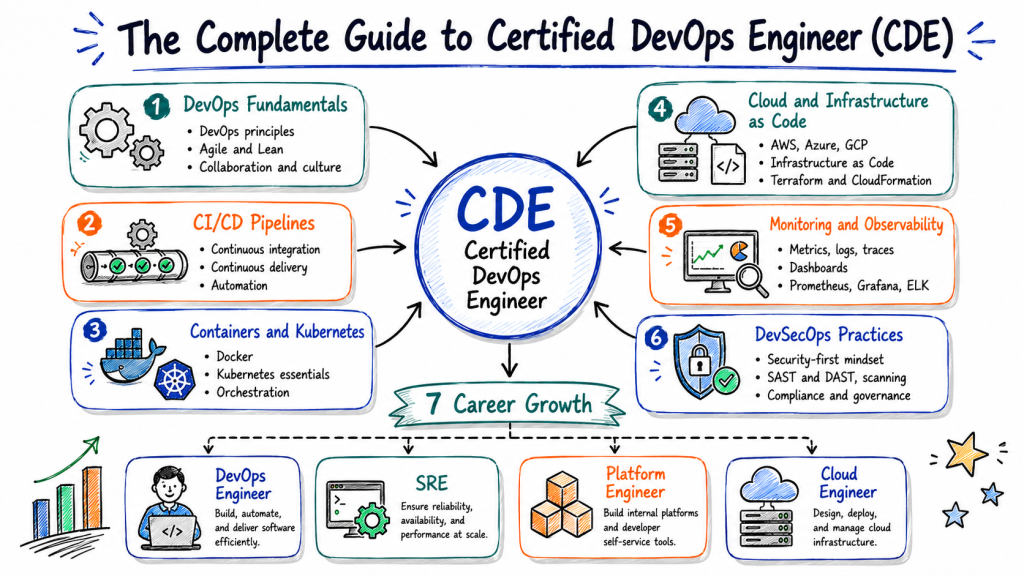
The Certified DevOps Engineer (CDE) program is a specialized track designed to bridge the gap between traditional operations and modern software delivery. This guide is built for working engineers and technical leaders who need to navigate the complexities of cloud-native environments and automated pipelines. In today’s market, understanding the “how” and “why” of DevOps is more critical than simply knowing how to use a single tool. This article provides a clear roadmap to help you evaluate if this certification aligns with your specific career goals in SRE or platform engineering.
What is the Certified DevOps Engineer (CDE)?
The Certified DevOps Engineer (CDE) is a professional validation that focuses on the practical application of culture, automation, and measurement. Unlike theoretical courses, it represents a commitment to mastering production-grade workflows that drive business value. It exists to standardize the skills required for modern engineering, ensuring that practitioners can handle high-velocity releases without compromising stability. By aligning with enterprise practices, it prepares you to manage the entire lifecycle of an application within a collaborative ecosystem.
Who Should Pursue Certified DevOps Engineer (CDE)?
This path is ideal for software engineers looking to transition into operations and systems administrators moving toward automation. Site Reliability Engineers (SREs) and cloud architects will find the structured approach to scaling infrastructure particularly beneficial for their daily tasks. Even security and data professionals can leverage these principles to better integrate their workflows into the broader development cycle. Whether you are an experienced lead in India or a budding engineer in a global firm, this certification provides the common language needed for modern IT.
Why Certified DevOps Engineer (CDE) is Valuable in 2026 and Beyond
As we move further into an era of automated intelligence and distributed systems, the demand for engineers who can orchestrate these environments is at an all-time high. The Certified DevOps Engineer (CDE) offers longevity because it teaches core principles that remain relevant even as specific tools like Jenkins or Terraform evolve. Enterprises are rapidly adopting these frameworks to stay competitive, making this an essential investment for long-term career stability. By earning this, you demonstrate a high return on investment for any organization looking to reduce technical debt and increase deployment frequency.
Certified DevOps Engineer (CDE) Certification Overview
The program is officially delivered through Certified DevOps Engineer (CDE) and is hosted on the devopsschool platform. It uses a rigorous assessment approach that values hands-on capability over simple rote memorization of facts. The structure is designed to be modular, allowing professionals to progress from core fundamentals to specialized master-level competencies. By owning this certification, you gain access to a verified curriculum that is recognized by industry leaders for its depth and technical accuracy.
Certified DevOps Engineer (CDE) Certification Tracks & Levels
The certification is divided into three distinct stages: Foundation, Professional, and Advanced, ensuring a clear path for every stage of your career. Specialization tracks allow you to pivot into niche areas like DevSecOps, SRE, or FinOps, depending on your current role and future aspirations. Each level is carefully mapped to specific professional responsibilities, helping you move from individual contributor to a strategic lead. This tiered approach ensures that you are always learning skills that are immediately applicable to your level of seniority and project complexity.
Complete Certified DevOps Engineer (CDE) Certification Table
| Track | Level | Who it’s for | Prerequisites | Skills Covered | Recommended Order |
| Core DevOps | Foundation | Beginners/Associates | Basic Linux/Git | CI/CD, Containerization | 1st |
| Engineering | Professional | Mid-level Engineers | 2+ Years Exp | IaC, Orchestration | 2nd |
| Architecture | Advanced | Senior/Leads | 5+ Years Exp | Scalability, Governance | 3rd |
| Reliability | SRE Track | SREs/Ops | Basic DevOps | Monitoring, SLIs/SLOs | 2nd (Optional) |
Detailed Guide for Each Certified DevOps Engineer (CDE) Certification
Certified DevOps Engineer (CDE) – Foundation
What it is
This certification validates your understanding of the core pillars of DevOps, including culture, automation, and continuous integration. It serves as the baseline for all subsequent specialized tracks in the ecosystem.
Who should take it
It is designed for junior developers, system admins, and managers who need to understand the fundamental mechanics of a modern software delivery pipeline.
Skills you’ll gain
- Proficiency in Git-based version control systems.
- Understanding of Continuous Integration (CI) concepts.
- Basic containerization using Docker.
- Knowledge of DevOps culture and team collaboration.
Real-world projects you should be able to do
- Automate a basic build-and-test pipeline for a web app.
- Containerize a legacy application for local development.
Preparation plan
- 7–14 days: Focus on core terminology and the DevOps handbook; understand the cultural shift required for success.
- 30 days: Set up a local lab with Git and Docker to practice the commands and workflow scenarios manually.
- 60 days: Deep dive into the official curriculum on devopsschool and complete all provided practice assessments to ensure readiness.
Common mistakes
- Ignoring the cultural aspects of DevOps and focusing only on tools.
- Skipping the fundamentals of Linux and command-line interfaces.
Best next certification after this
- Same-track: CDE Professional Level.
- Cross-track: Certified DevSecOps Professional.
- Leadership: DevOps Foundation for Managers.
Certified DevOps Engineer (CDE) – Professional
What it is
This level focuses on the orchestration of complex environments and the implementation of Infrastructure as Code (IaC) to ensure consistency. It proves you can manage production-grade infrastructure at scale.
Who should take it
Experienced engineers who are responsible for maintaining uptime and managing automated deployments in cloud environments.
Skills you’ll gain
- Advanced Infrastructure as Code using tools like Terraform.
- Kubernetes orchestration and cluster management.
- Advanced CI/CD pipeline optimization and security.
- Implementation of centralized logging and monitoring.
Real-world projects you should be able to do
- Provision a multi-tier cloud environment using code.
- Deploy a microservices-based application on a Kubernetes cluster.
Preparation plan
- 7–14 days: Review documentation for Terraform and Kubernetes; focus on architecture and networking components.
- 30 days: Build a complete end-to-end pipeline that provisions cloud resources and deploys an application automatically.
- 60 days: Study real-world troubleshooting scenarios and performance tuning techniques covered in the advanced devopsschool modules.
Common mistakes
- Failing to understand how to manage state files in Infrastructure as Code.
- Neglecting security patches and secret management in the pipeline.
Best next certification after this
- Same-track: CDE Advanced Architect.
- Cross-track: Certified SRE Professional.
- Leadership: Technical Product Manager in DevOps.
Choose Your Learning Path
DevOps Path
The DevOps path focuses on the seamless integration of development and operations to speed up delivery. It emphasizes automation at every stage, from code commit to production monitoring and feedback loops. Engineers on this path spend significant time optimizing pipelines and ensuring that code moves safely through environments. It is the primary route for those who want to be “generalist” experts in the field.
DevSecOps Path
The DevSecOps path integrates security checks directly into the automated delivery process rather than treating it as an afterthought. You will learn how to implement static and dynamic analysis, container scanning, and compliance as code. This ensures that every release is not just fast, but also secure and compliant with industry standards. It is a critical path for engineers working in highly regulated industries like finance or healthcare.
SRE Path
The Site Reliability Engineering (SRE) path applies software engineering mindsets to solve operational challenges. You will focus on maintaining system availability, defining Service Level Objectives (SLOs), and managing “error budgets” to balance speed and stability. This path is perfect for those who enjoy deep-diving into system performance and high-availability architecture. It bridges the gap between manual operations and fully autonomous systems.
AIOps / MLOps Path
This path focuses on applying DevOps principles to the lifecycle of machine learning models and using AI to manage IT operations. You will learn how to automate model training, deployment, and monitoring while handling large-scale data pipelines. It is an emerging field that is essential for companies moving toward data-driven decision-making. Engineers here work closely with data scientists to ensure models are production-ready.
DataOps Path
DataOps is centered on improving the quality and reducing the cycle time of data analytics. It involves automating the data pipeline from ingestion to reporting, ensuring that data is reliable and accessible to stakeholders. This path is ideal for data engineers who want to apply DevOps-style automation to their data architecture. It helps in managing complex data warehouses and real-time streaming services.
FinOps Path
The FinOps path introduces financial accountability to the variable spend model of the cloud. It combines finance, engineering, and business teams to optimize cloud costs and maximize the value of every dollar spent. You will learn how to track cloud usage, identify waste, and implement cost-saving measures without sacrificing performance. This path is increasingly vital as enterprise cloud bills continue to grow.
Role → Recommended Certified DevOps Engineer (CDE) Certifications
| Role | Recommended Certifications |
| DevOps Engineer | CDE Foundation, CDE Professional |
| SRE | CDE Professional, Certified SRE |
| Platform Engineer | CDE Professional, CDE Advanced |
| Cloud Engineer | CDE Foundation, Cloud-Specific CDE |
| Security Engineer | CDE Foundation, DevSecOps Professional |
| Data Engineer | CDE Foundation, DataOps Specialist |
| FinOps Practitioner | CDE Foundation, FinOps Professional |
| Engineering Manager | CDE Foundation, DevOps Leadership |
Next Certifications to Take After Certified DevOps Engineer (CDE)
Same Track Progression
Once you have mastered the professional level, the logical next step is to pursue the Advanced or Expert tiers. These certifications move away from specific tool implementation and focus more on architectural patterns and organizational strategy. You will learn how to design systems that handle massive global traffic and how to lead large-scale digital transformations. Deep specialization ensures you remain at the top of the technical hierarchy.
Cross-Track Expansion
If you want to become a “T-shaped” professional, expanding into DevSecOps or AIOps is a smart move. By broadening your skills into these adjacent domains, you become more versatile and valuable to cross-functional teams. This allows you to speak the language of security experts or data scientists, making you an ideal candidate for lead roles. Diversifying your knowledge protects your career against shifts in industry focus.
Leadership & Management Track
For those looking to move into management, certifications in DevOps Leadership or Value Stream Management are excellent choices. These paths focus on the “people” and “process” sides of the equation, teaching you how to build high-performing teams. You will learn how to measure the business impact of technical changes and how to align engineering efforts with corporate goals. This is the path for those who want to influence the direction of an entire organization.
Training & Certification Support Providers for Certified DevOps Engineer (CDE)
DevOpsSchool
DevOpsSchool is a leading provider of technical training, offering a comprehensive suite of courses tailored for the Certified DevOps Engineer (CDE) program. They provide hands-on labs and real-world project scenarios that help engineers gain practical experience. Their instructors are industry veterans who bring deep technical knowledge to the classroom. The platform is known for its structured curriculum and extensive library of study materials.
Cotocus
Cotocus specializes in high-end consulting and training for cloud-native technologies and DevOps practices. They offer customized learning paths that help organizations upskill their teams effectively for modern engineering challenges. Their focus on practical, result-oriented training makes them a preferred partner for enterprises looking to implement DevOps at scale. They provide excellent support for those pursuing CDE certifications through intensive workshops.
Scmgalaxy
Scmgalaxy is a robust community-driven platform that offers a wealth of resources for software configuration management and DevOps professionals. They provide detailed tutorials, documentation, and training sessions specifically designed for the CDE track. Their focus is on empowering the community with the latest tools and best practices in the industry. It is an excellent resource for self-paced learners who need reliable technical information.
BestDevOps
BestDevOps offers a curated approach to DevOps education, focusing on the most relevant tools and methodologies used in the industry today. They provide targeted training for CDE candidates, ensuring that they are well-prepared for both the exams and their daily jobs. Their curriculum is updated frequently to reflect the fast-paced changes in the cloud-native ecosystem. They emphasize hands-on learning through interactive lab environments.
devsecopsschool
DevSecOpsSchool is dedicated to the integration of security into the DevOps lifecycle, providing specialized training for modern security engineers. They offer deep-dive courses on automated security testing, compliance as code, and cloud security architecture. For CDE candidates, this provider offers the essential bridge into the world of secure software delivery. Their training is highly respected for its focus on practical vulnerability management.
sreschool
SREschool focuses on the principles and practices of Site Reliability Engineering, helping ops professionals transition to more automated roles. They provide training on monitoring, observability, and incident response frameworks that are vital for modern production environments. Their courses are a perfect complement to the CDE program for those looking to specialize in system reliability. They emphasize the use of engineering to solve operational problems.
aiopsschool
AIOpsSchool is at the forefront of the intersection between artificial intelligence and IT operations. They offer training on how to use machine learning to automate root cause analysis and improve system performance. For CDE professionals, this provider offers a glimpse into the future of autonomous infrastructure management. Their curriculum covers both the data science and the operational aspects of AIOps.
dataopsschool
DataOpsSchool provides the training needed to manage the complex lifecycles of data in modern enterprises. They focus on the automation of data pipelines and the implementation of DevOps principles in data engineering teams. Their courses help CDE candidates understand how to provide high-quality data to stakeholders with speed and reliability. This is an essential resource for anyone working in data-heavy environments.
finopsschool
FinOpsSchool is the go-to resource for learning how to manage and optimize cloud spending in a professional environment. They offer training on cloud cost management, budget forecasting, and unit economics for engineers and finance professionals. For CDE practitioners, this training provides the financial literacy needed to justify cloud investments and reduce waste. Their courses are practical and aligned with global FinOps standards.
Frequently Asked Questions (General)
- How difficult is the Certified DevOps Engineer (CDE) exam?The difficulty depends on your hands-on experience; it is designed to be challenging but fair for those who have worked with CI/CD and cloud tools.
- How much time does it take to prepare for the certification?Most professionals find that 30 to 60 days of consistent study and lab work is sufficient to pass the exam.
- Are there any prerequisites for the foundation level?There are no formal prerequisites, but a basic understanding of Linux and at least one programming language is highly recommended.
- What is the return on investment (ROI) for this certification?Professionals often see significant salary increases and access to more senior roles in high-growth companies after earning their CDE.
- Is this certification recognized globally?Yes, it is recognized by enterprises across India, North America, and Europe as a standard for DevOps competence.
- Do I need to know how to code to be a Certified DevOps Engineer?While you don’t need to be a full-stack developer, you should be comfortable with scripting (like Bash or Python) and YAML for configuration.
- How often do I need to renew my certification?The certification typically requires renewal every two to three years to ensure your skills remain current with industry changes.
- Can I skip the foundation level if I have experience?While possible, it is recommended to review foundation materials to ensure there are no gaps in your understanding of the core principles.
- Does the program cover specific cloud providers like AWS or Azure?The program is designed to be cloud-agnostic, focusing on principles that apply across all major cloud service providers.
- Is the exam focused on multiple-choice or hands-on tasks?The assessment includes a mix of both, with a strong emphasis on hands-on tasks that simulate real-world production issues.
- Are there community groups for CDE candidates?Yes, platforms like Scmgalaxy and DevOpsSchool offer vibrant communities where you can ask questions and share knowledge.
- Can my company sponsor this certification?Many enterprises have professional development budgets specifically for technical certifications like the CDE.
FAQs on Certified DevOps Engineer (CDE)
- Does CDE focus more on tools or culture?It provides a balanced approach, teaching you the technical skills for tools while emphasizing the cultural shifts needed for success.
- Is Kubernetes a major part of the CDE curriculum?Yes, container orchestration is a core pillar of the professional and advanced tracks in the CDE program.
- How does CDE compare to vendor-specific certifications?CDE is vendor-neutral, providing broader skills that apply to any environment, unlike certifications tied to a single cloud provider.
- Will this help me move into a Lead DevOps role?Absolutely, the advanced tracks are specifically designed to prepare you for senior technical leadership and architectural responsibilities.
- Is there a focus on Infrastructure as Code?Yes, mastering IaC is a primary requirement for passing the professional level of the CDE certification.
- Are labs included in the training fee?Most providers like DevOpsSchool include access to cloud labs as part of their training package for CDE candidates.
- What happens if I fail the exam on the first try?Most programs offer a retake policy; you should review your weak areas and practice more in the labs before retrying.
- Can a manager benefit from the CDE Foundation?Yes, it provides the technical context managers need to support their teams and make informed decisions about toolchains.
Final Thoughts: Is Certified DevOps Engineer (CDE) Worth It?
In the current landscape of rapid technological shifts, the Certified DevOps Engineer (CDE) serves as a stable foundation for any technical career. It isn’t just about adding a badge to your profile; it’s about gaining the confidence to handle production environments that are increasingly complex and automated. From my experience, the engineers who thrive are those who understand the underlying patterns of delivery and reliability rather than just the latest buzzwords. If you are serious about moving into a senior or lead role within the DevOps or SRE space, this investment in your skills is practically essential. Focus on the labs, understand the “why” behind the automation, and you will find that the career opportunities follow naturally.
