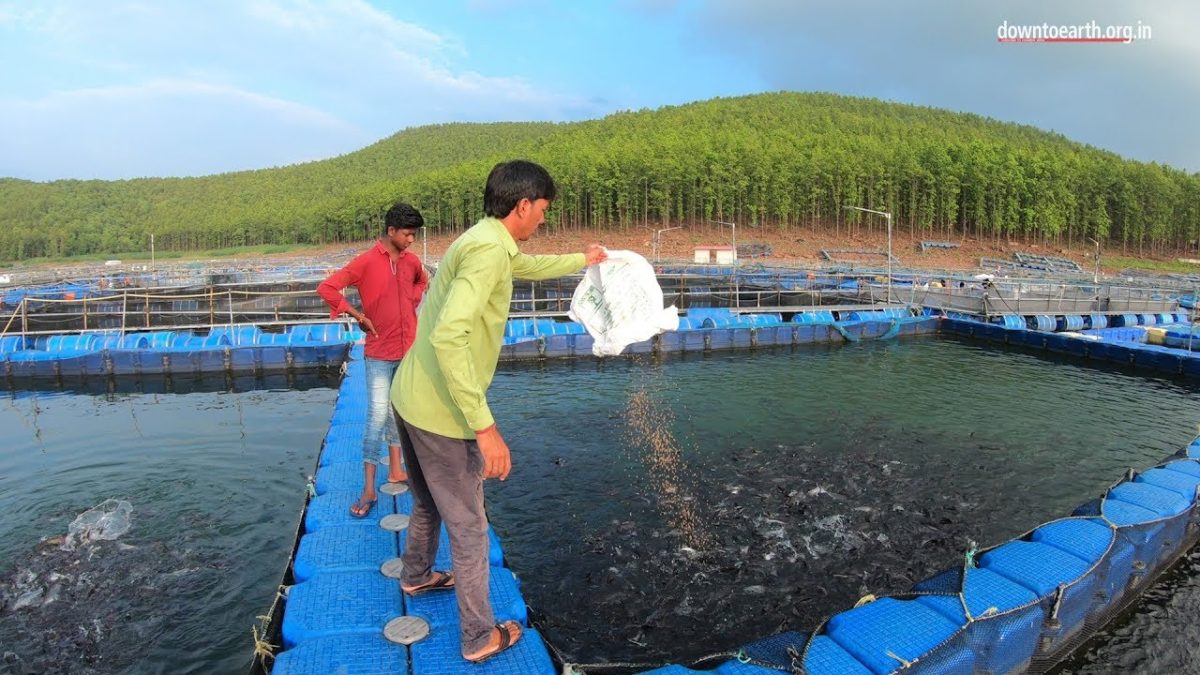
Source – downtoearth.org.in
Around 12,000 families lost their livelihood due when the Chandil dam came up in Jharkhand’s Saraikela Kharsawan district in the 1980s. Its reservoir on the Subarnarekha river submerged more than 100 villages.
The people affected struggled for decades with the Jharkhand government for better rehabilitation and employment.
Now they have found an alternative source of income — pisciculture.
Some of those displaced because of the dam formed a cooperative society in ’05 to rear fish in the reservoir. The right to fish in the waterbody that came up on their land was one of the demands of those affected by the project.
In the late 2000s, the Jharkhand government focused on developing fisheries as an alternative income source for the state’s farmers. The cooperative took the opportunity to benefit from the government’s push for commercial fishing in water bodies.
After testing some success the Jharkhand government introduced the cage culture in the state’s dam reservoirs to scale up commercial fish production in 2012-13.
Cage culture is an intensive fish farming technique in which fish are kept in cubicle-shaped net enclosures. It is ideal for controlled fishing in large waterbodies in which it is otherwise difficult to restrict fish movement.
Jharkhand’s catch of fish doubled to 208,450 tonnes in 2018-19 from 104,820 tonnes in 2013-14 because of cage culture. There is an annual demand for 200,000 tonnes in the state itself.
The state government trains farmers from across the state on various aspects of fish-rearing. To maximise profits, farmers prefer commercial fish such as Pangasius (Basa) for cage culture.
The fish take around nine months to reach a weight of around a kilogramme. At times the cultivators sell them even at six months.
The Jharkhand government has presented fish farming as a success story, calling it the ‘Blue Revolution’.
Some 128,000 fish farmers now rear fish in the state’s tanks, reservoirs, check dams, and coal pits across two lakh hectares.

I am a travel writer and regional storyteller dedicated to documenting the culture, heritage, daily life, and travel experiences of Bihar. Through Mera Apna Bihar, I share local insights, real travel stories, and on-ground experiences that highlight the true spirit of Bihar for readers, travelers, and culture enthusiasts.
In addition to regional storytelling, I curate travel narratives and destination experiences through HolidayLandmark Stories, where journeys, city moments, and authentic travel experiences are documented in a story-driven format:
I also manage a growing network of city-focused travel platforms where I regularly publish daily travel logs capturing real-time journeys, local discoveries, and everyday experiences across India:
- Bangalore Orbit – Daily Logs
- Bhopal Orbit – Daily Logs
- Chennai Orbit – Daily Logs
- Gujarat Orbit – Daily Logs
- Kerala Orbit – Daily Logs
- Mera Apna Bihar – Daily Logs
- Mumbai Orbit – Daily Logs
For readers seeking deeper insights, curated content, and structured travel information, I also publish city blogs and destination guides across multiple platforms:
- Bangalore Orbit – Blog
- Bhopal Orbit – Blog
- Chennai Orbit – Blog
- Gujarat Orbit – Blog
- Kerala Orbit – Blog
- Mera Apna Bihar
- Mumbai Orbit – Blog
Through this interconnected network, my goal is to preserve regional stories, promote local culture, and provide authentic travel information that reflects the real experiences of people and places across Bihar and India.